11.1 Functions and Quadratics
Revision slides, flash cards, quizzes, revision notes and a text version of the slides for this unit. Open to everyone, no password needed.
11.1.1 Functions
11.1.1 Functions Flash cards
Click a card to flip it. Say the answer first, then check.
Print the cards (PDF): word on the front, answer on the back, double-sided, flip on the long edge
11.1.1 Functions Quizzes
Pick an answer to see if you are right. Your score shows at the end of each quiz.
11.1.1 Functions Revision notes
Download and print the revision notes (PDF, A4)
The big idea. A function gives exactly one output for every input. Learn the language (set notation, domain, range, function notation), then, if you are in the extended class, inverse and composite functions.
Key vocabulary
| Word | Meaning |
|---|---|
| Set | a collection of items, called elements |
| Element | an item in a set; ∈ means “is an element of” |
| Relation | any set of ordered pairs (input, output) |
| Function | a relation where every input has exactly one output |
| Domain | the set of all allowed inputs (x values) |
| Range | the set of all outputs (y values) |
| Function notation | f(x) is read “f of x”: the output when the input is x |
| Vertical line test | a graph is a function if every vertical line crosses it at most once |
| Inverse function | f⁻¹ undoes f: if f(a) = b then f⁻¹(b) = a |
| Composite function | (f∘g)(x) = f(g(x)): do g first, then f |
Prerequisite: solving linear equations
Set notation
Relations and functions
Domain and range
Graphs and the vertical line test
Function notation
Extended: inverse functions
Extended: composite functions
Using functions to model
Common mistakes
✓ f(x) is notation, read “f of x”. It is the output for input x: f(3) = 7.
✓ The inverse undoes the function. The reciprocal is 1f(x). They are different.
✓ Square the bracket: (−3)² = 9, so f(−3) = 10.
✓ Do g first: (f∘g)(x) = f(g(x)).
✓ Domain is the inputs (x). Range is the outputs (y).
✓ Divide both sides by −2: x = −3.
✓ Squares are never negative: the range is {y ∈ ℝ : y ≥ 0}.
✓ A strict inequality leaves the end value out. Use ≥ to include 2.
Answers to the checks
Cover this page until you have tried the check yourself.
| Check | Answer |
|---|---|
| Check 1 | Solve 4x − 7 = 21 Answer: 4x = 28, so x = 7. |
| Check 2 | Solve 3(x + 2) = 21 Answer: x + 2 = 7, so x = 5. |
| Check 3 | Solve 7x + 1 = 3x + 13 Answer: 4x = 12, so x = 3. |
| Check 4 | Solve x3 − 2 = 4 Answer: x3 = 6, so x = 18. |
| Check 5 | Is 4 in {x ∈ ℝ : x ≥ 4}? Answer: Yes, because ≥ includes 4. |
| Check 6 | Is {(2, 3), (4, 3), (5, 1)} a function? Answer: Yes. Each input has one output. |
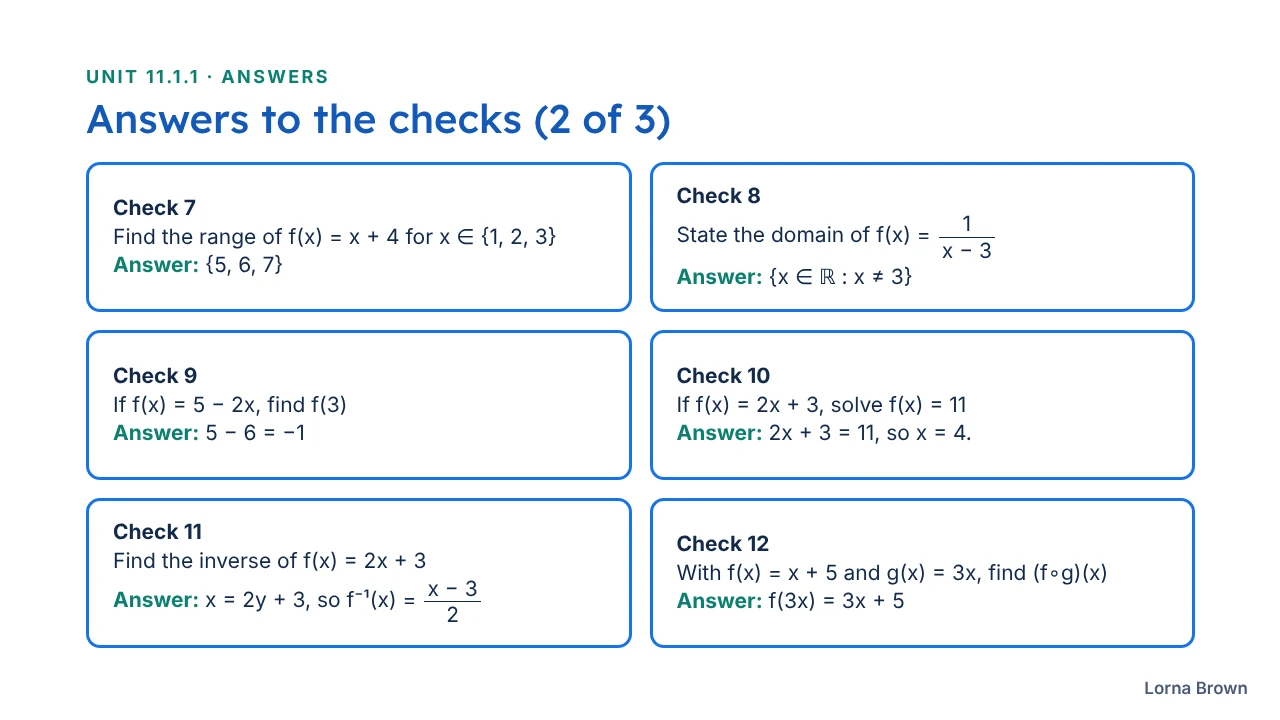
| Check 7 | Find the range of f(x) = x + 4 for x ∈ {1, 2, 3} Answer: {5, 6, 7} |
| Check 8 | State the domain of f(x) = 1x − 3 Answer: {x ∈ ℝ : x ≠ 3} |
| Check 9 | If f(x) = 5 − 2x, find f(3) Answer: 5 − 6 = −1 |
| Check 10 | If f(x) = 2x + 3, solve f(x) = 11 Answer: 2x + 3 = 11, so x = 4. |
| Check 11 | Find the inverse of f(x) = 2x + 3 Answer: x = 2y + 3, so f⁻¹(x) = x − 32 |
| Check 12 | With f(x) = x + 5 and g(x) = 3x, find (f∘g)(x) Answer: f(3x) = 3x + 5 |
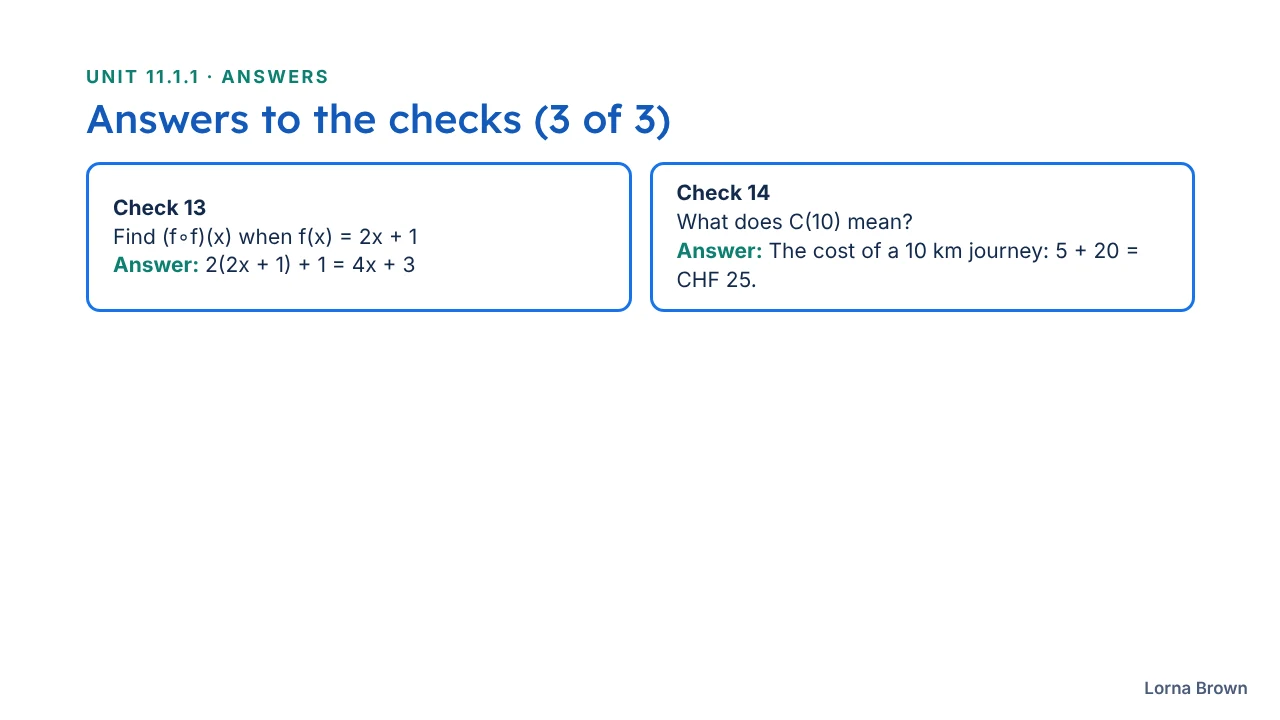
| Check 13 | Find (f∘f)(x) when f(x) = 2x + 1 Answer: 2(2x + 1) + 1 = 4x + 3 |
| Check 14 | What does C(10) mean? Answer: The cost of a 10 km journey: 5 + 20 = CHF 25. |
11.1.1 Functions Revision slides as text (easy to translate)
This is a plain-text version of the revision slides. Your browser can translate it into any language.
Slide 1: Functions
Revision slides: everything you need for the test, one idea per slide.
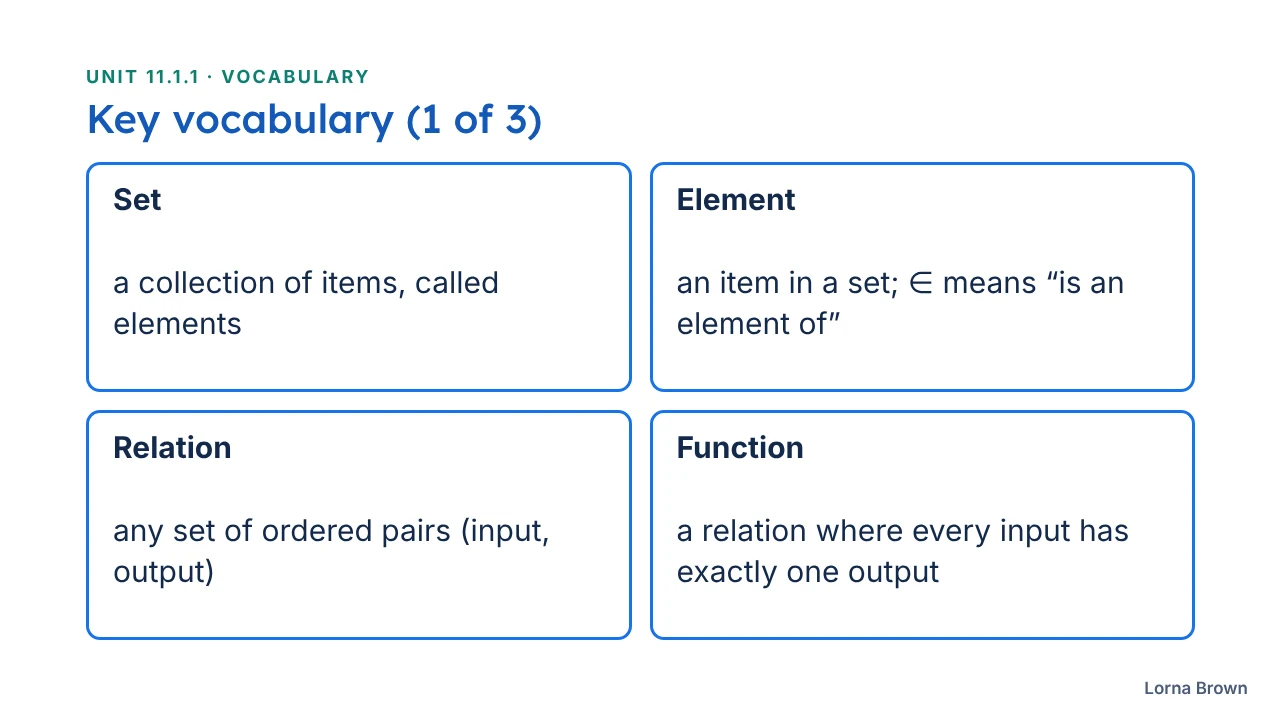
Slide 2: Key vocabulary (1 of 3)
Set: a collection of items, called elements
Element: an item in a set; ∈ means “is an element of”
Relation: any set of ordered pairs (input, output)
Function: a relation where every input has exactly one output
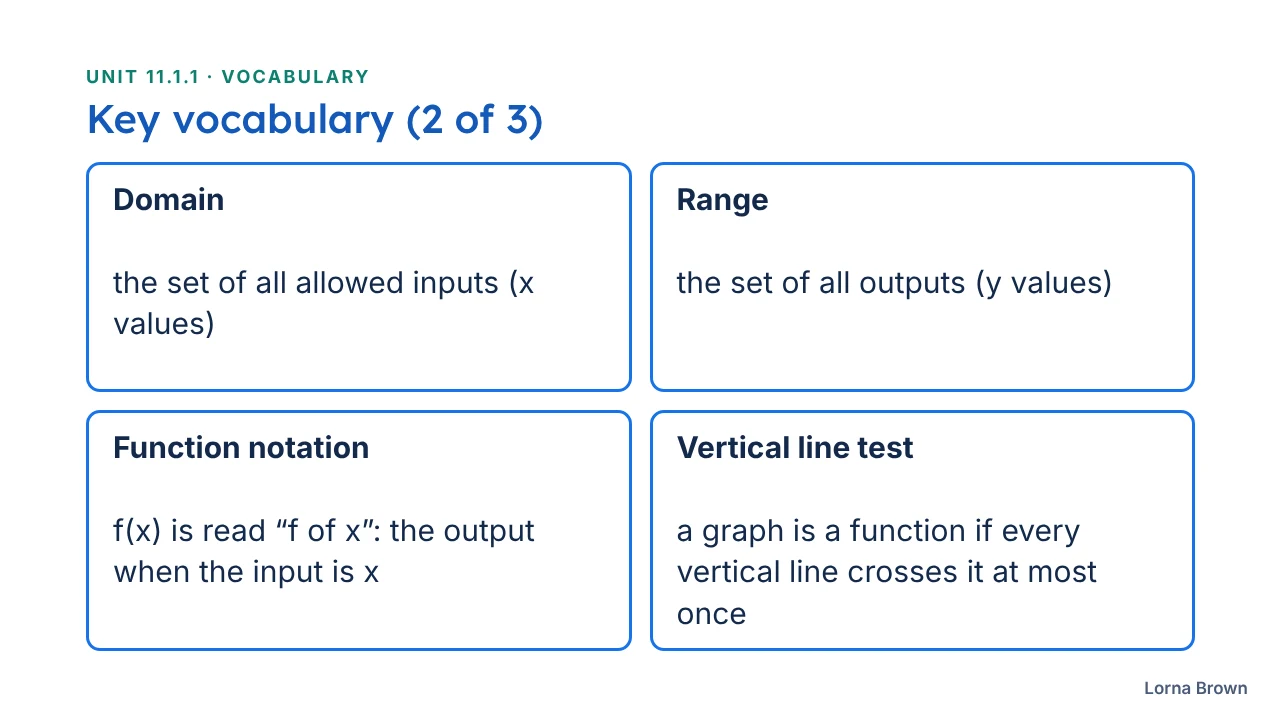
Slide 3: Key vocabulary (2 of 3)
Domain: the set of all allowed inputs (x values)
Range: the set of all outputs (y values)
Function notation: f(x) is read “f of x”: the output when the input is x
Vertical line test: a graph is a function if every vertical line crosses it at most once
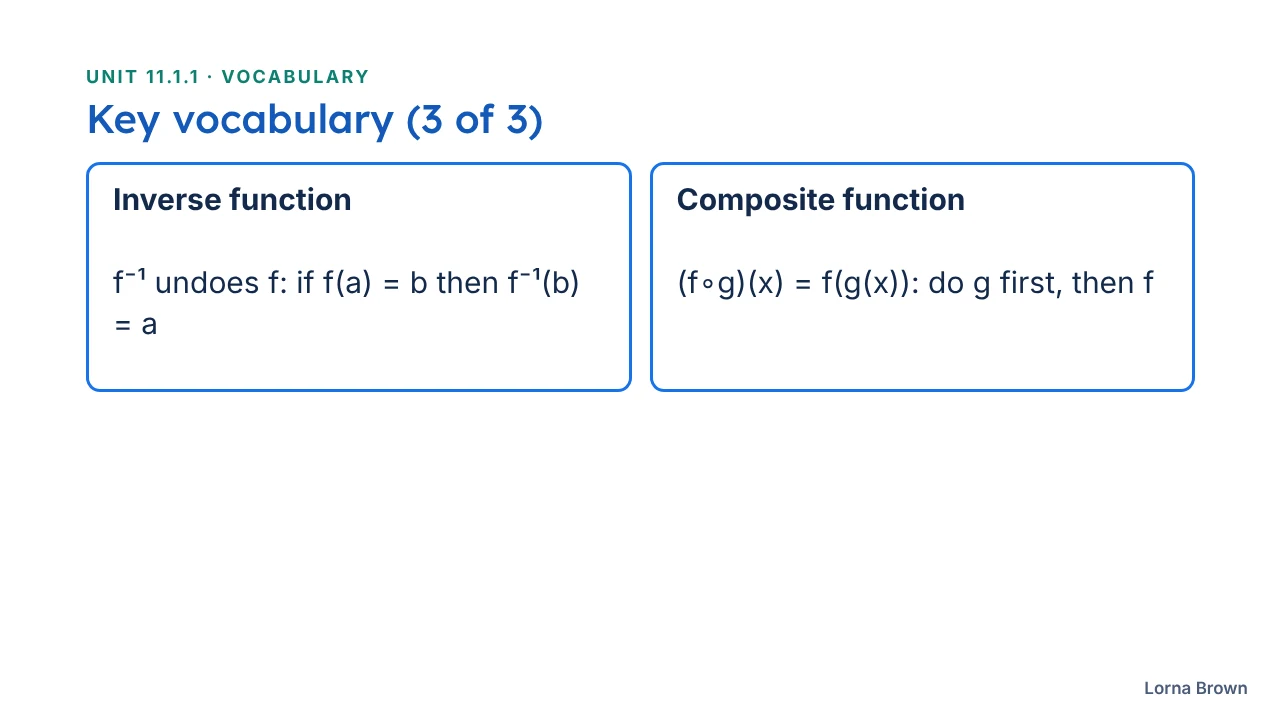
Slide 4: Key vocabulary (3 of 3)
Inverse function: f⁻¹ undoes f: if f(a) = b then f⁻¹(b) = a
Composite function: (f∘g)(x) = f(g(x)): do g first, then f
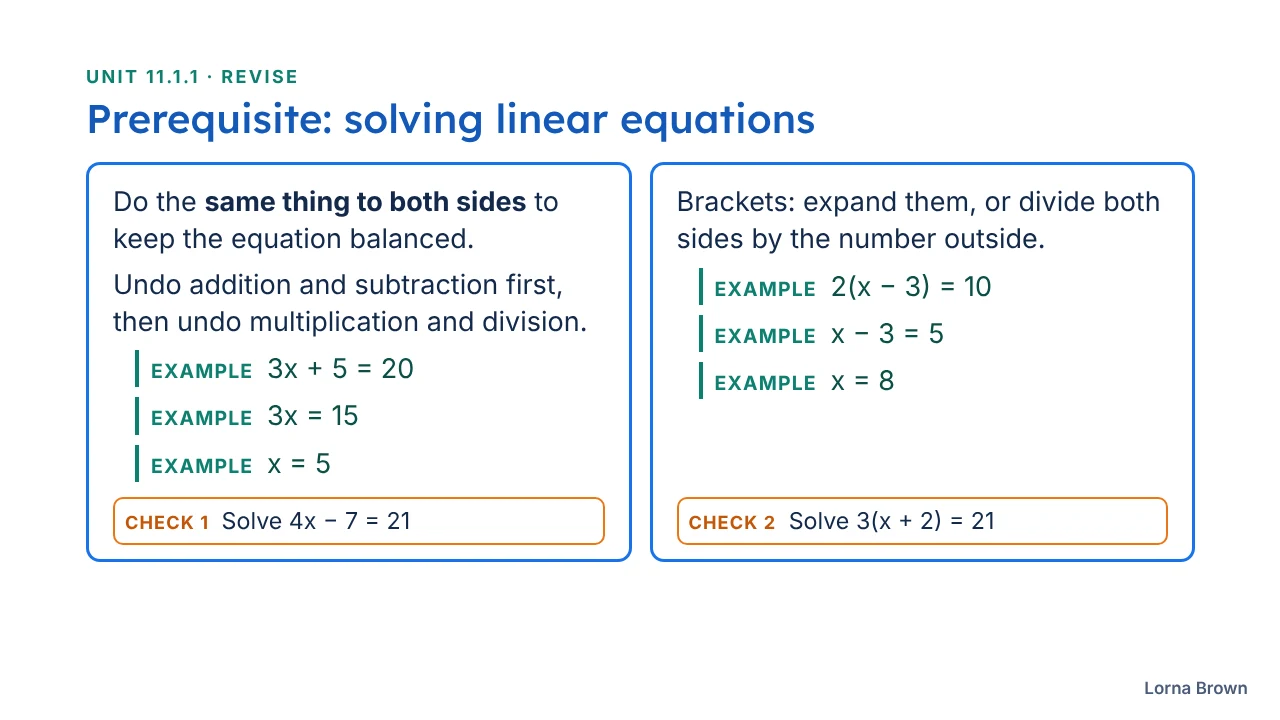
Slide 5: Prerequisite: solving linear equations
Do the same thing to both sides to keep the equation balanced.
Undo addition and subtraction first, then undo multiplication and division.
3x + 5 = 20
3x = 15
x = 5
Check 1 Solve 4x − 7 = 21
Brackets: expand them, or divide both sides by the number outside.
2(x − 3) = 10
x − 3 = 5
x = 8
Check 2 Solve 3(x + 2) = 21
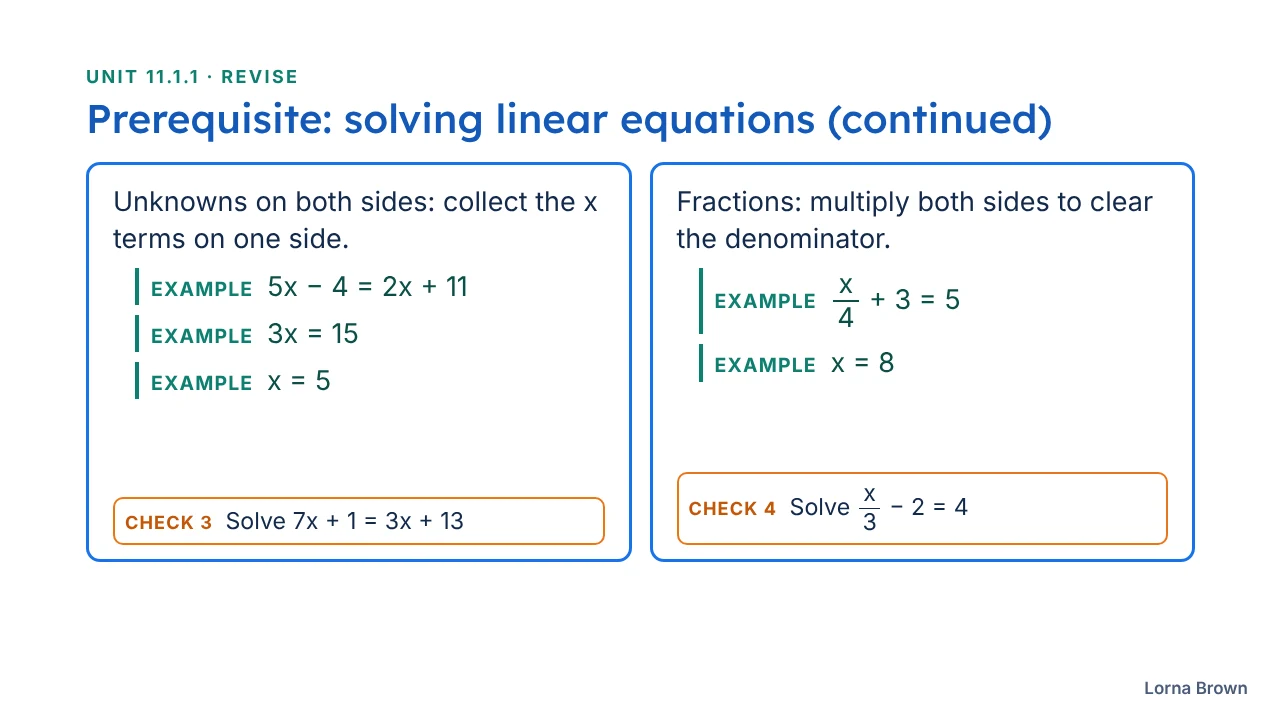
Slide 6: Prerequisite: solving linear equations (continued)
Unknowns on both sides: collect the x terms on one side.
5x − 4 = 2x + 11
3x = 15
x = 5
Check 3 Solve 7x + 1 = 3x + 13
Fractions: multiply both sides to clear the denominator.
x4 + 3 = 5
x = 8
Check 4 Solve x3 − 2 = 4
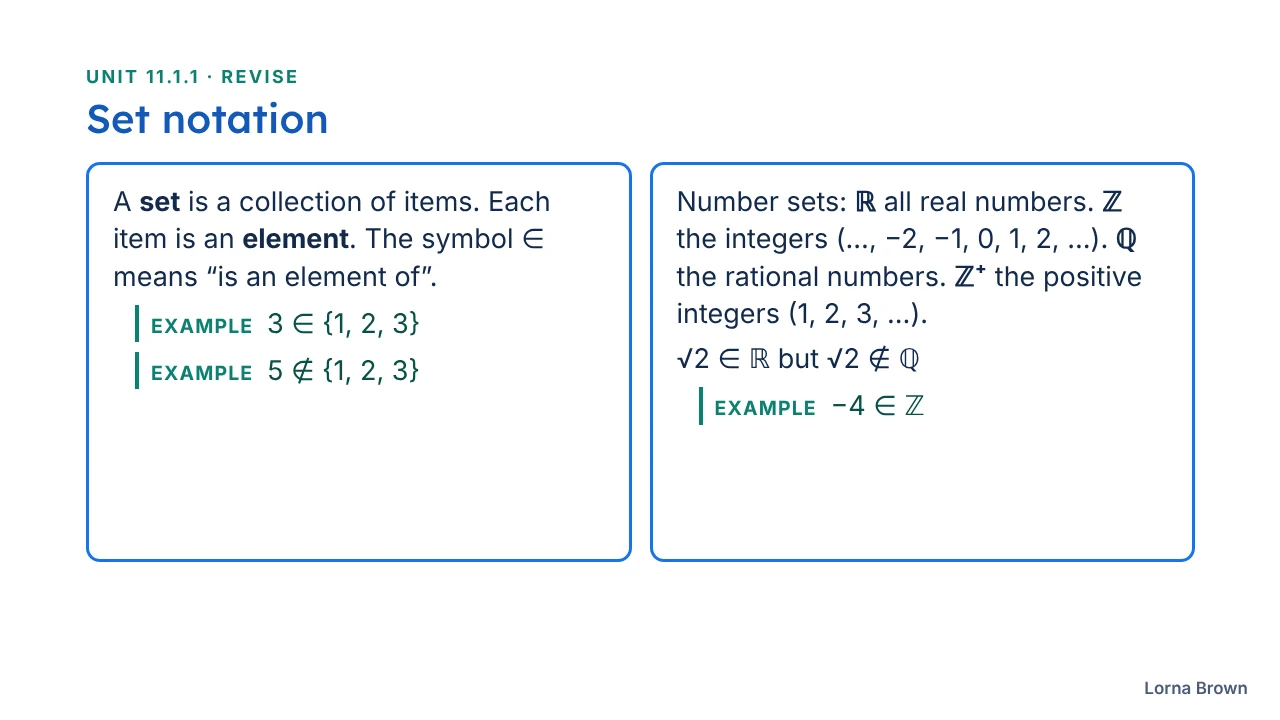
Slide 7: Set notation
A set is a collection of items. Each item is an element. The symbol ∈ means “is an element of”.
3 ∈ {1, 2, 3}
5 ∉ {1, 2, 3}
Number sets: ℝ all real numbers. ℤ the integers (…, −2, −1, 0, 1, 2, …). ℚ the rational numbers. ℤ⁺ the positive integers (1, 2, 3, …).
√2 ∈ ℝ but √2 ∉ ℚ
−4 ∈ ℤ
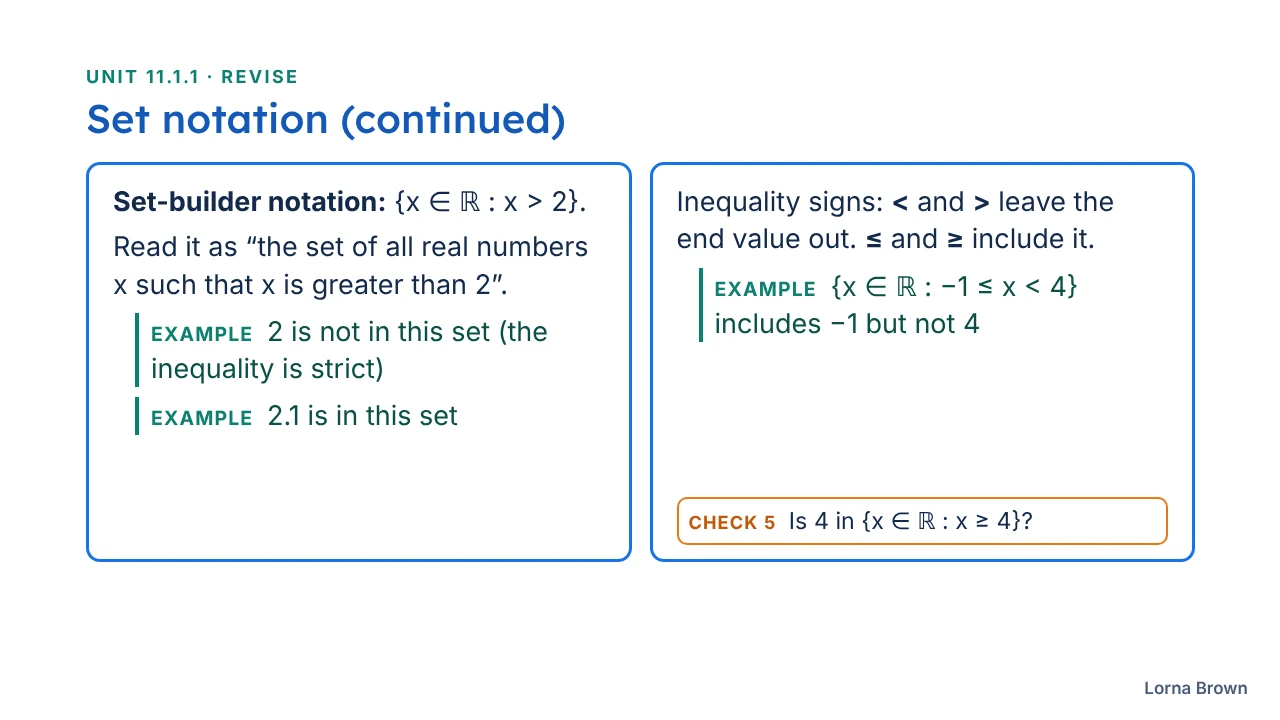
Slide 8: Set notation (continued)
Set-builder notation: {x ∈ ℝ : x > 2}.
Read it as “the set of all real numbers x such that x is greater than 2”.
2 is not in this set (the inequality is strict)
2.1 is in this set
Inequality signs: < and > leave the end value out. ≤ and ≥ include it.
{x ∈ ℝ : −1 ≤ x < 4} includes −1 but not 4
Check 5 Is 4 in {x ∈ ℝ : x ≥ 4}?
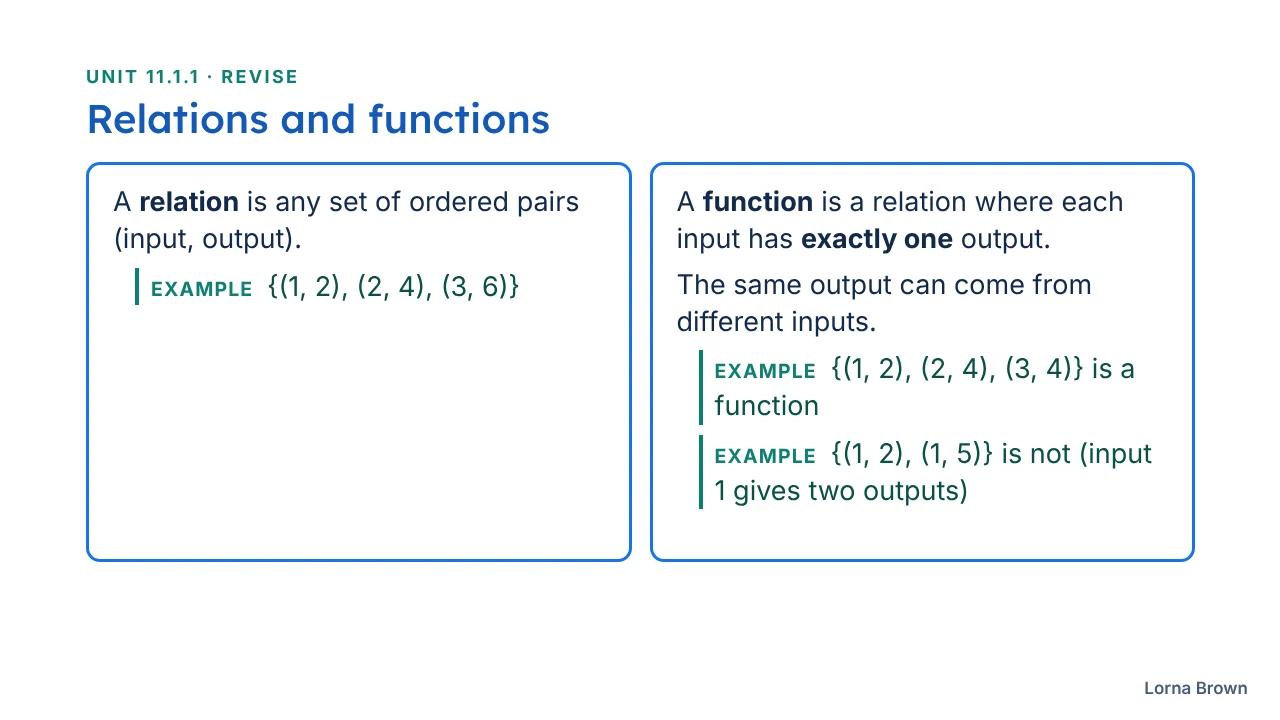
Slide 9: Relations and functions
A relation is any set of ordered pairs (input, output).
{(1, 2), (2, 4), (3, 6)}
A function is a relation where each input has exactly one output.
The same output can come from different inputs.
{(1, 2), (2, 4), (3, 4)} is a function
{(1, 2), (1, 5)} is not (input 1 gives two outputs)
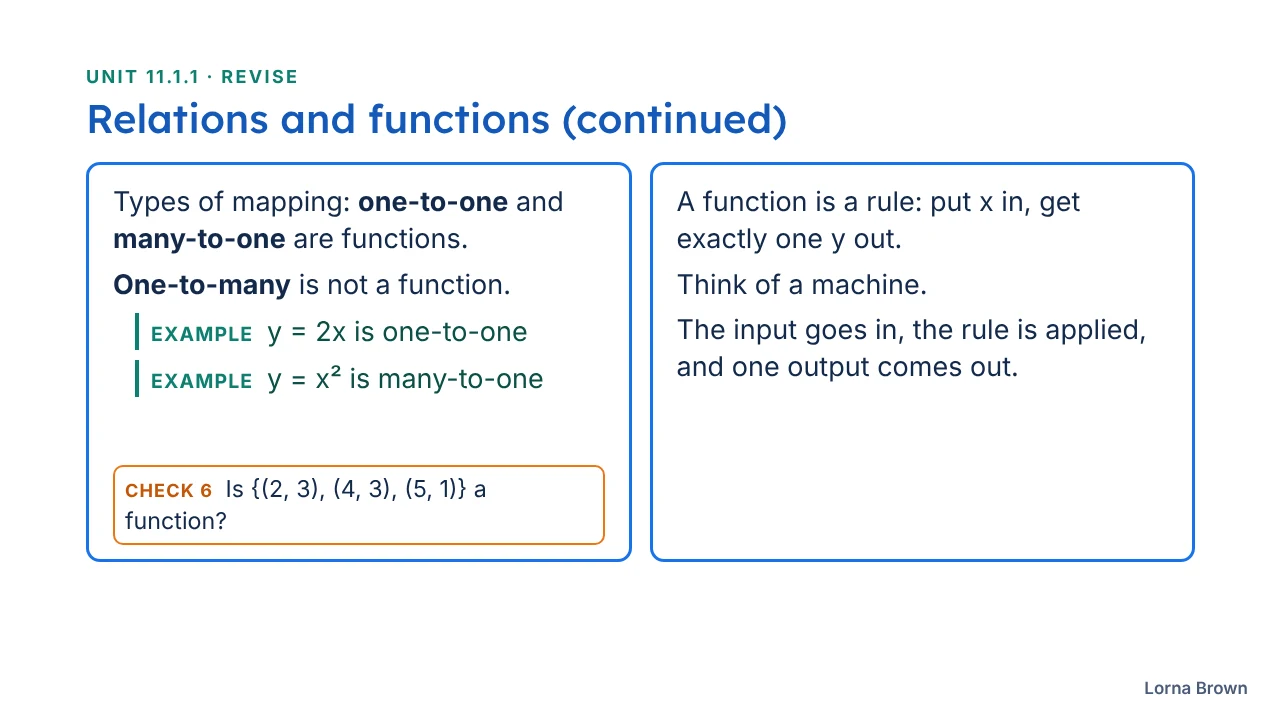
Slide 10: Relations and functions (continued)
Types of mapping: one-to-one and many-to-one are functions.
One-to-many is not a function.
y = 2x is one-to-one
y = x² is many-to-one
Check 6 Is {(2, 3), (4, 3), (5, 1)} a function?
A function is a rule: put x in, get exactly one y out.
Think of a machine.
The input goes in, the rule is applied, and one output comes out.
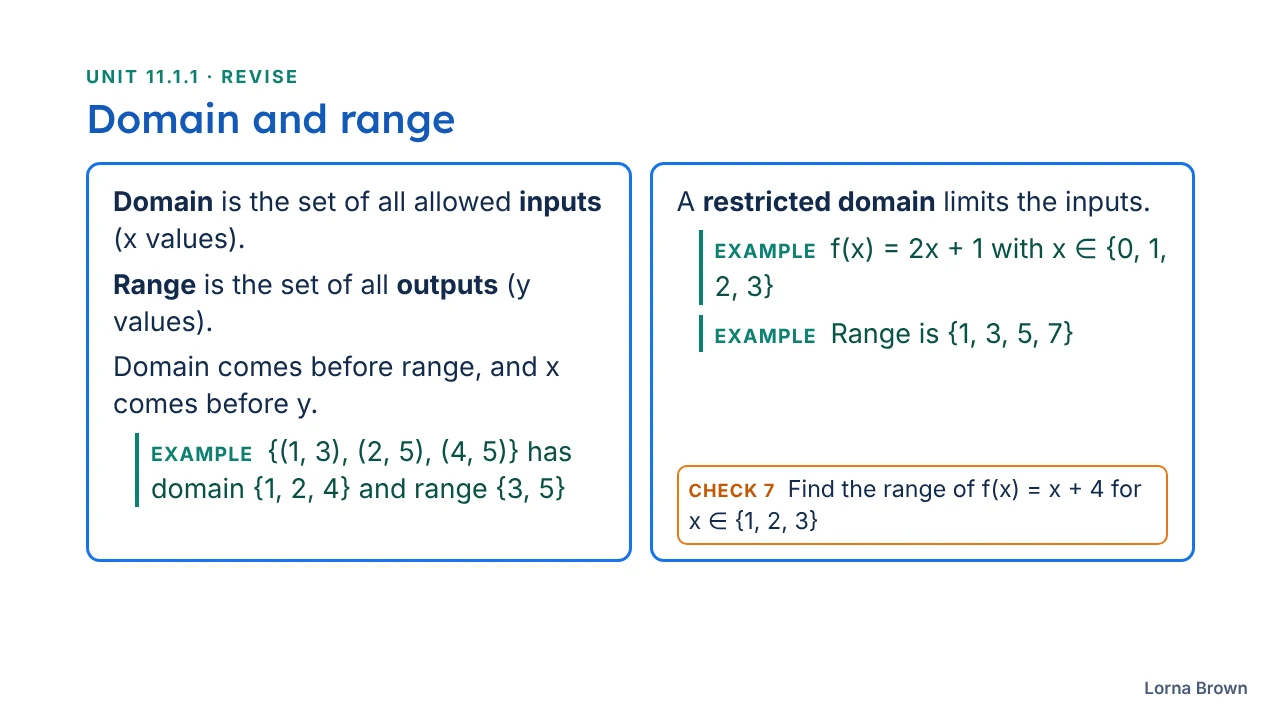
Slide 11: Domain and range
Domain is the set of all allowed inputs (x values).
Range is the set of all outputs (y values).
Domain comes before range, and x comes before y.
{(1, 3), (2, 5), (4, 5)} has domain {1, 2, 4} and range {3, 5}
A restricted domain limits the inputs.
f(x) = 2x + 1 with x ∈ {0, 1, 2, 3}
Range is {1, 3, 5, 7}
Check 7 Find the range of f(x) = x + 4 for x ∈ {1, 2, 3}
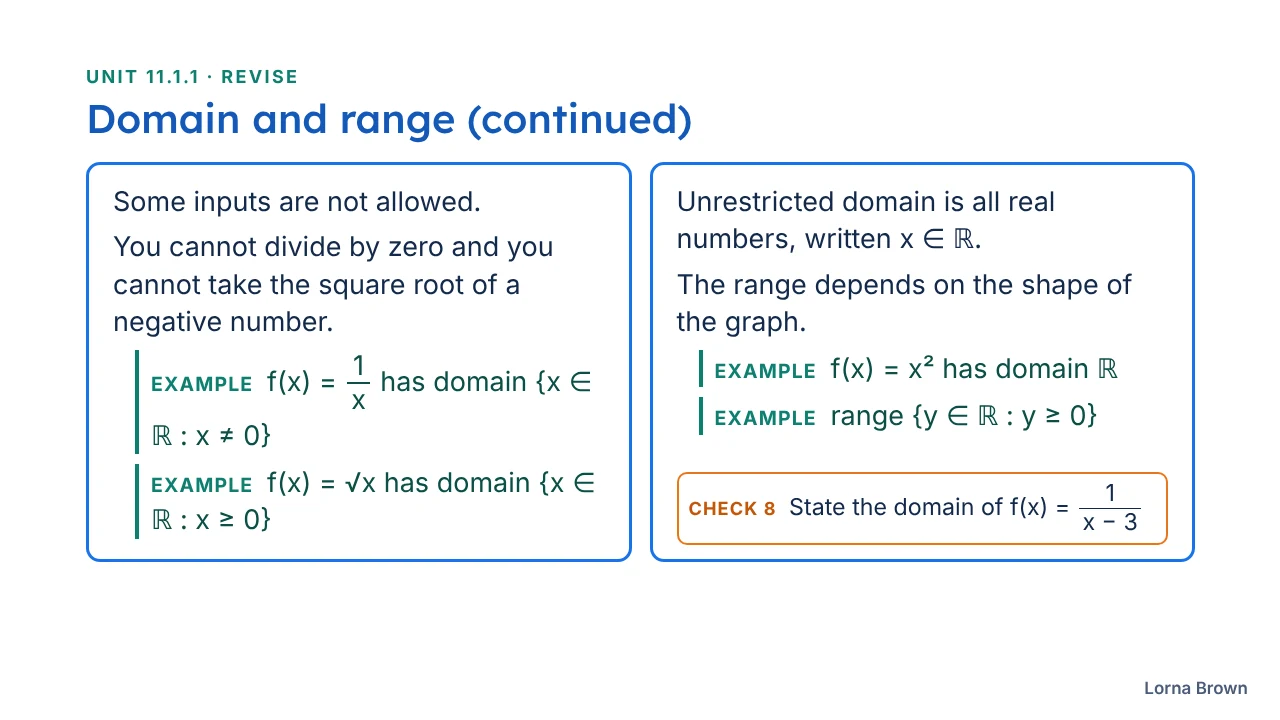
Slide 12: Domain and range (continued)
Some inputs are not allowed.
You cannot divide by zero and you cannot take the square root of a negative number.
f(x) = 1x has domain {x ∈ ℝ : x ≠ 0}
f(x) = √x has domain {x ∈ ℝ : x ≥ 0}
Unrestricted domain is all real numbers, written x ∈ ℝ.
The range depends on the shape of the graph.
f(x) = x² has domain ℝ
range {y ∈ ℝ : y ≥ 0}
Check 8 State the domain of f(x) = 1x − 3
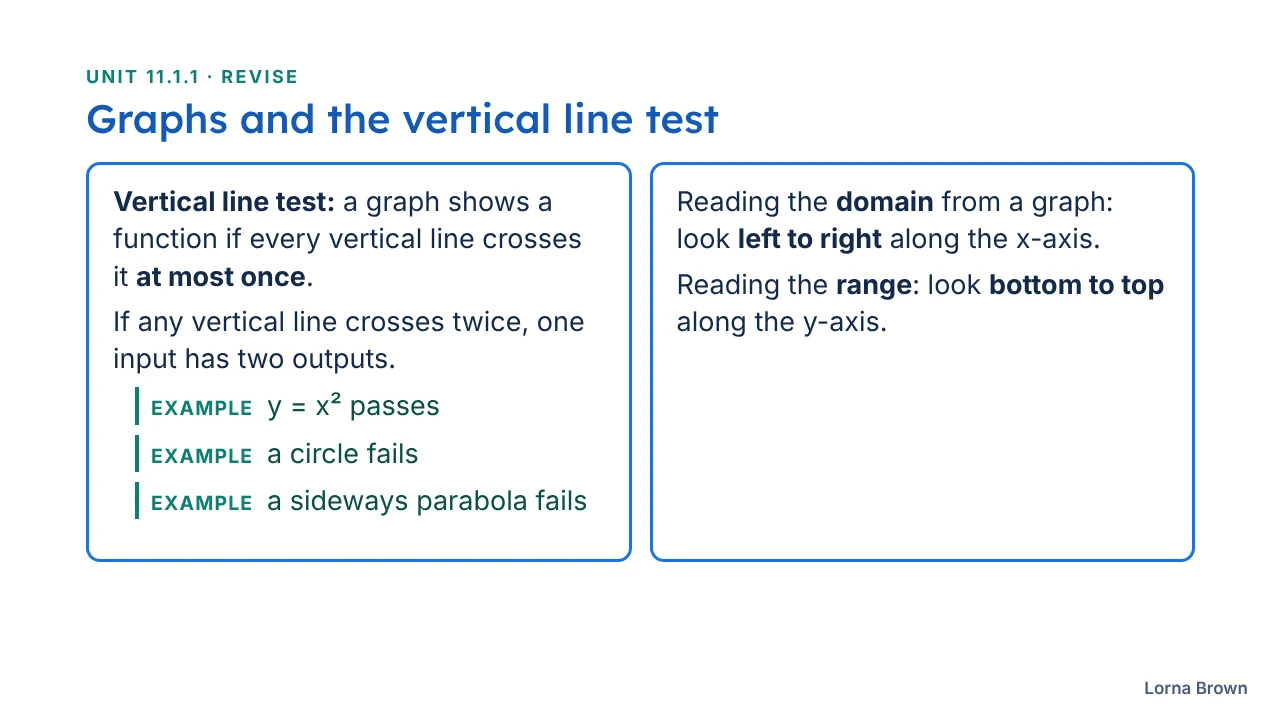
Slide 13: Graphs and the vertical line test
Vertical line test: a graph shows a function if every vertical line crosses it at most once.
If any vertical line crosses twice, one input has two outputs.
y = x² passes
a circle fails
a sideways parabola fails
Reading the domain from a graph: look left to right along the x-axis.
Reading the range: look bottom to top along the y-axis.
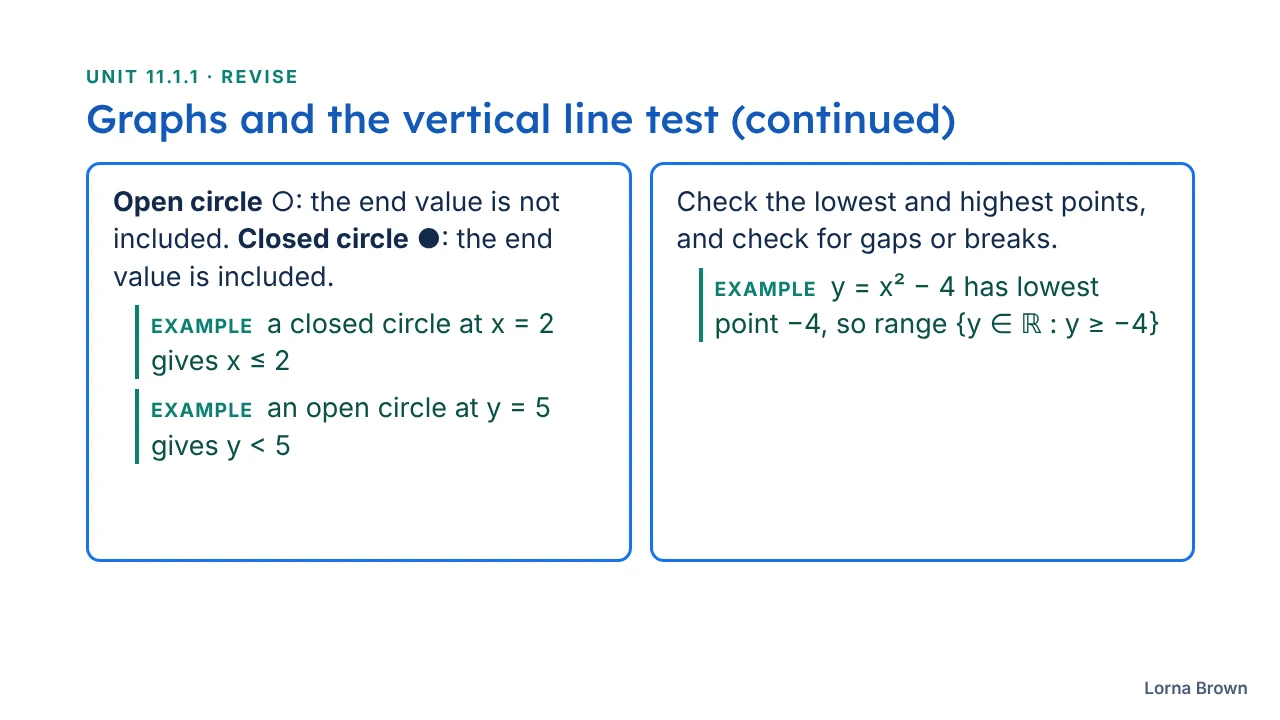
Slide 14: Graphs and the vertical line test (continued)
Open circle ○: the end value is not included. Closed circle ●: the end value is included.
a closed circle at x = 2 gives x ≤ 2
an open circle at y = 5 gives y < 5
Check the lowest and highest points, and check for gaps or breaks.
y = x² − 4 has lowest point −4, so range {y ∈ ℝ : y ≥ −4}
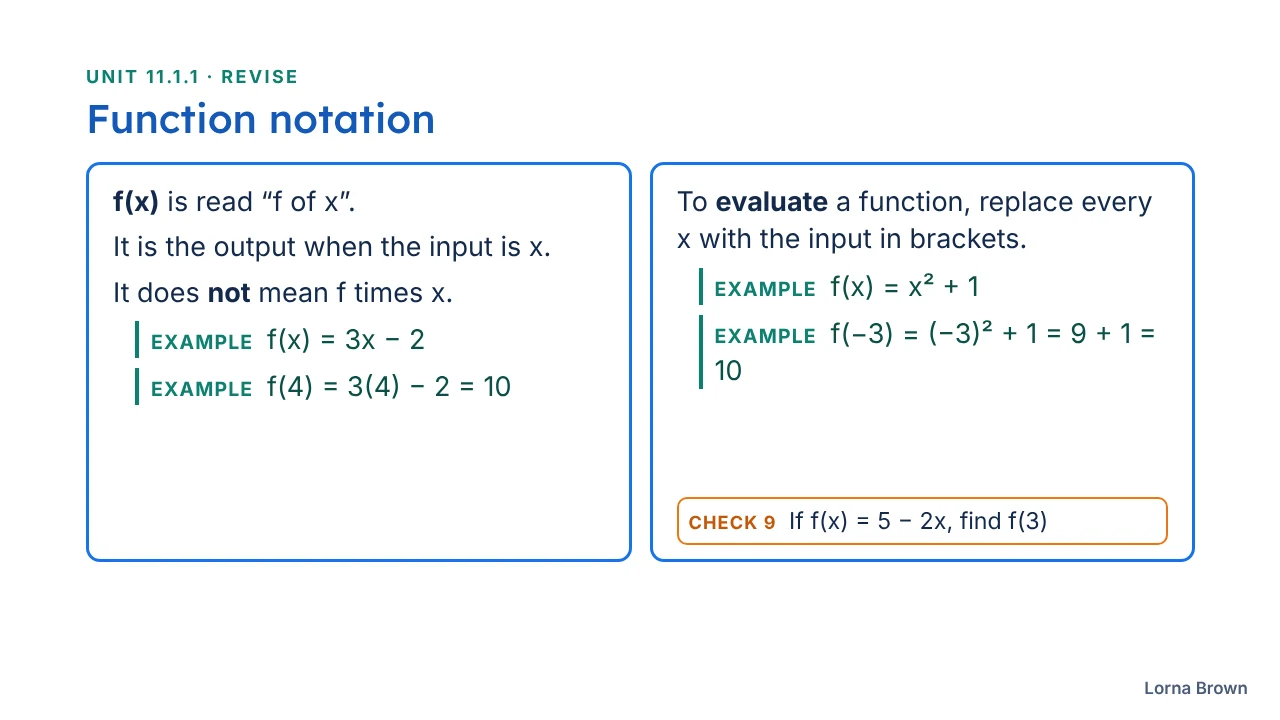
Slide 15: Function notation
f(x) is read “f of x”.
It is the output when the input is x.
It does not mean f times x.
f(x) = 3x − 2
f(4) = 3(4) − 2 = 10
To evaluate a function, replace every x with the input in brackets.
f(x) = x² + 1
f(−3) = (−3)² + 1 = 9 + 1 = 10
Check 9 If f(x) = 5 − 2x, find f(3)
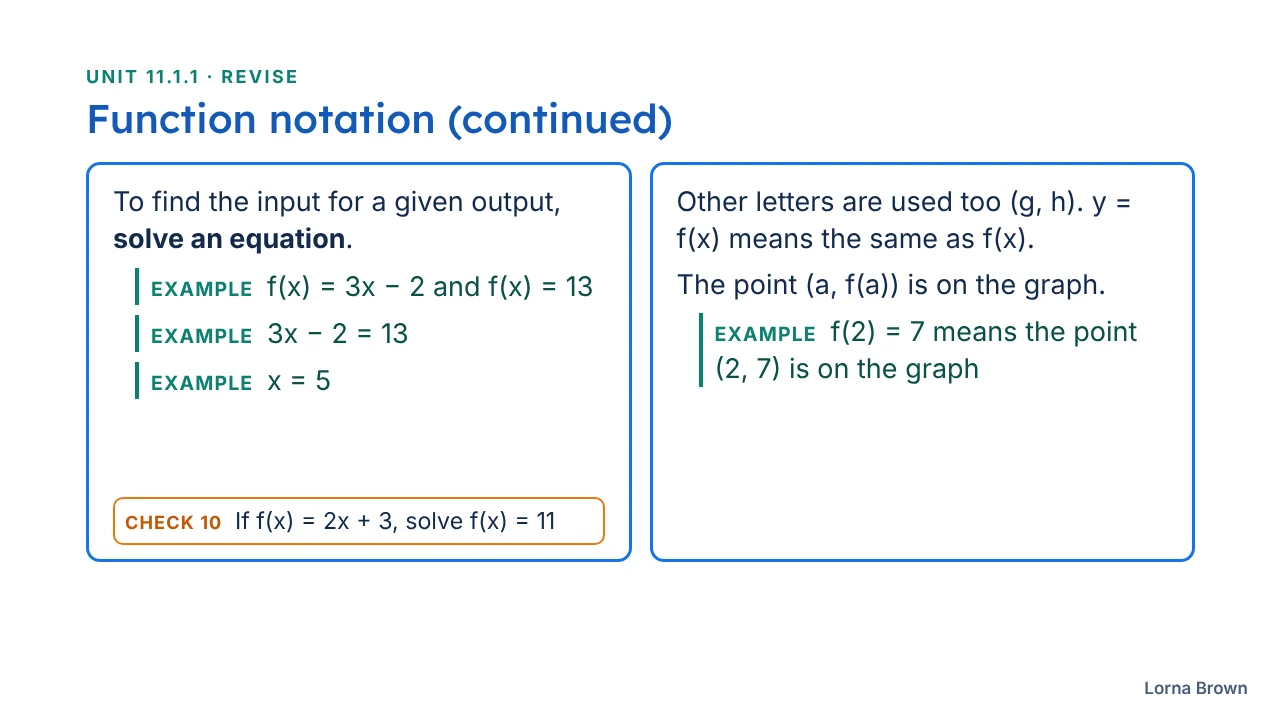
Slide 16: Function notation (continued)
To find the input for a given output, solve an equation.
f(x) = 3x − 2 and f(x) = 13
3x − 2 = 13
x = 5
Check 10 If f(x) = 2x + 3, solve f(x) = 11
Other letters are used too (g, h). y = f(x) means the same as f(x).
The point (a, f(a)) is on the graph.
f(2) = 7 means the point (2, 7) is on the graph
Slide 17: Extended: inverse functions
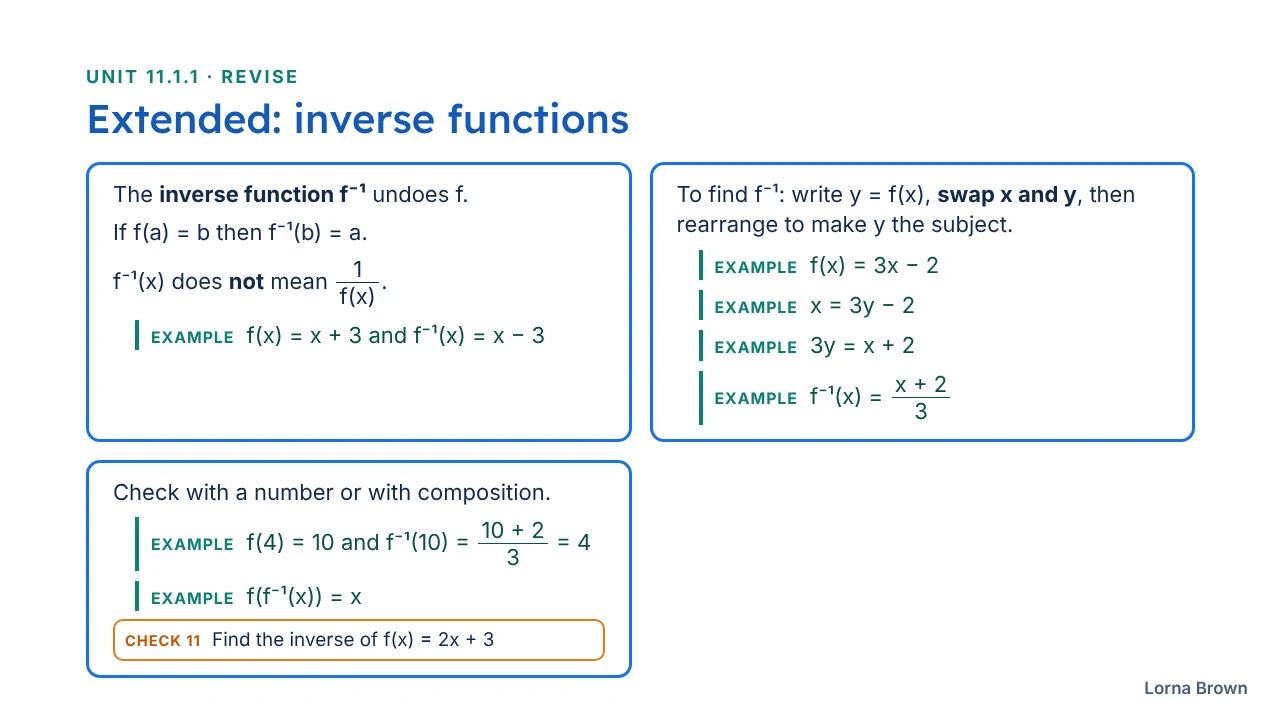
The inverse function f⁻¹ undoes f.
If f(a) = b then f⁻¹(b) = a.
f⁻¹(x) does not mean 1f(x).
f(x) = x + 3 and f⁻¹(x) = x − 3
To find f⁻¹: write y = f(x), swap x and y, then rearrange to make y the subject.
f(x) = 3x − 2
x = 3y − 2
3y = x + 2
f⁻¹(x) = x + 23
Check with a number or with composition.
f(4) = 10 and f⁻¹(10) = 10 + 23 = 4
f(f⁻¹(x)) = x
Check 11 Find the inverse of f(x) = 2x + 3
Slide 18: Extended: inverse functions (continued)
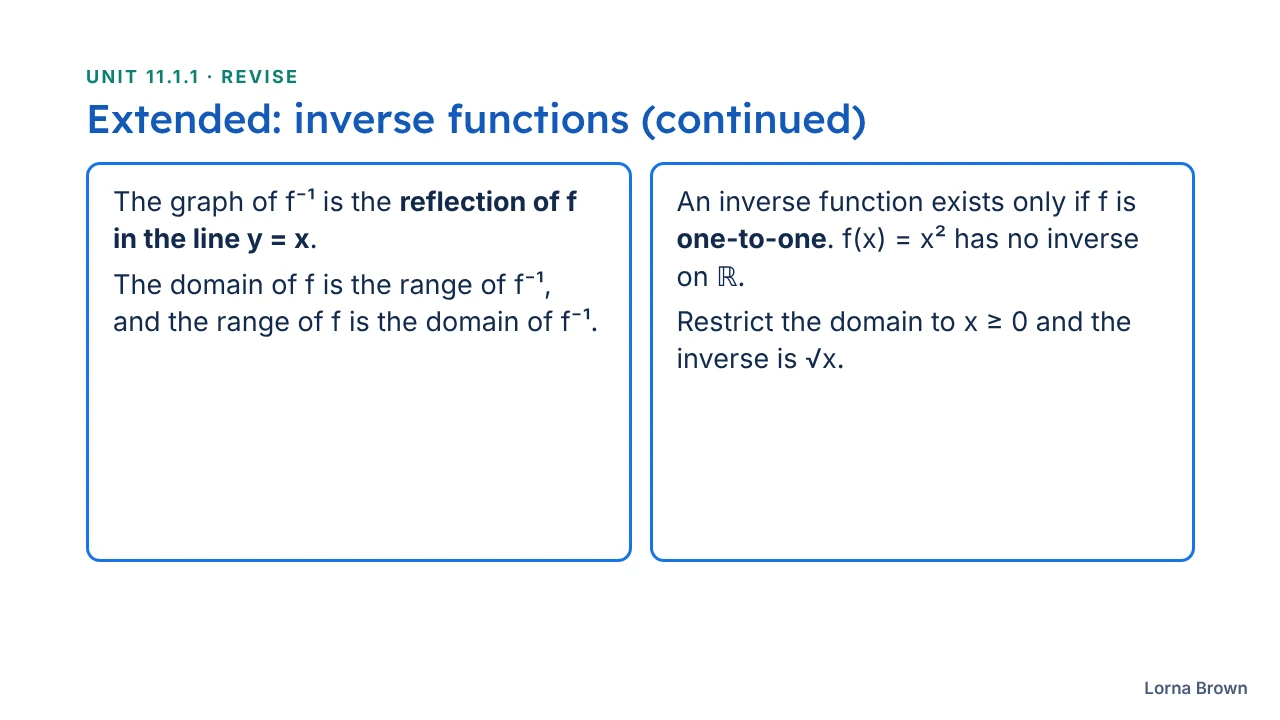
The graph of f⁻¹ is the reflection of f in the line y = x.
The domain of f is the range of f⁻¹, and the range of f is the domain of f⁻¹.
An inverse function exists only if f is one-to-one. f(x) = x² has no inverse on ℝ.
Restrict the domain to x ≥ 0 and the inverse is √x.
Slide 19: Extended: composite functions
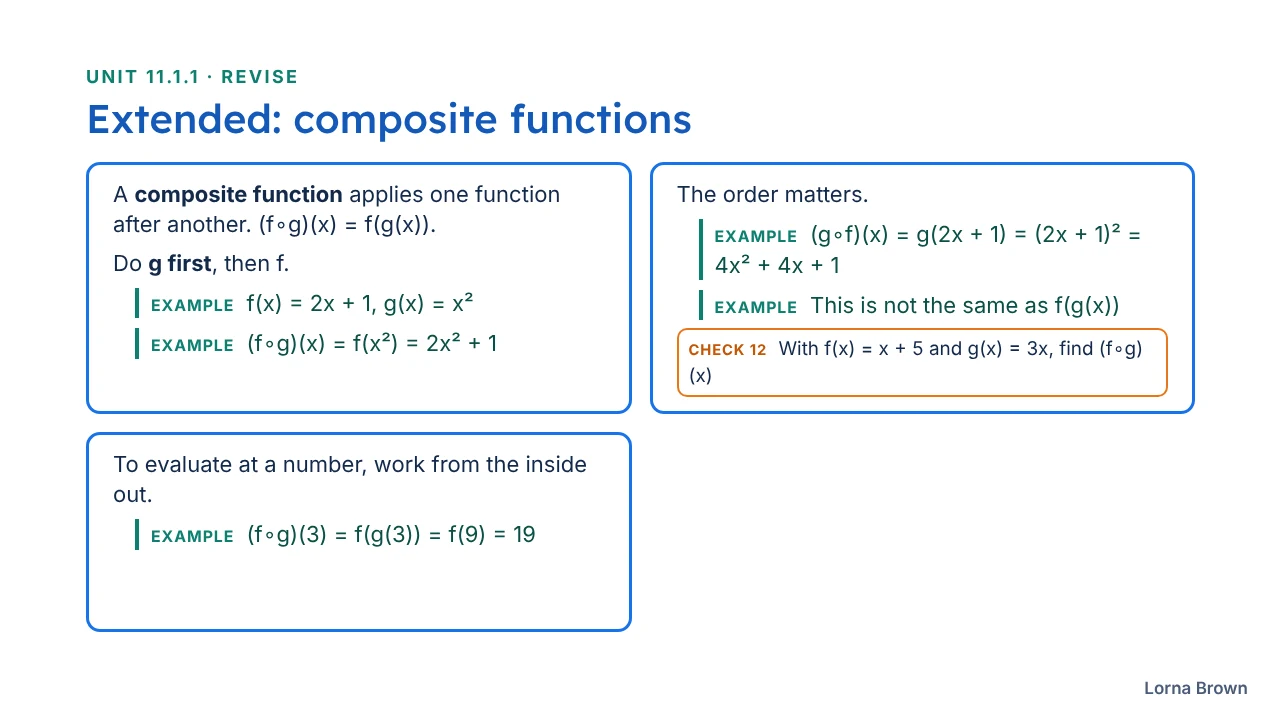
A composite function applies one function after another. (f∘g)(x) = f(g(x)).
Do g first, then f.
f(x) = 2x + 1, g(x) = x²
(f∘g)(x) = f(x²) = 2x² + 1
The order matters.
(g∘f)(x) = g(2x + 1) = (2x + 1)² = 4x² + 4x + 1
This is not the same as f(g(x))
Check 12 With f(x) = x + 5 and g(x) = 3x, find (f∘g)(x)
To evaluate at a number, work from the inside out.
(f∘g)(3) = f(g(3)) = f(9) = 19
Slide 20: Extended: composite functions (continued)
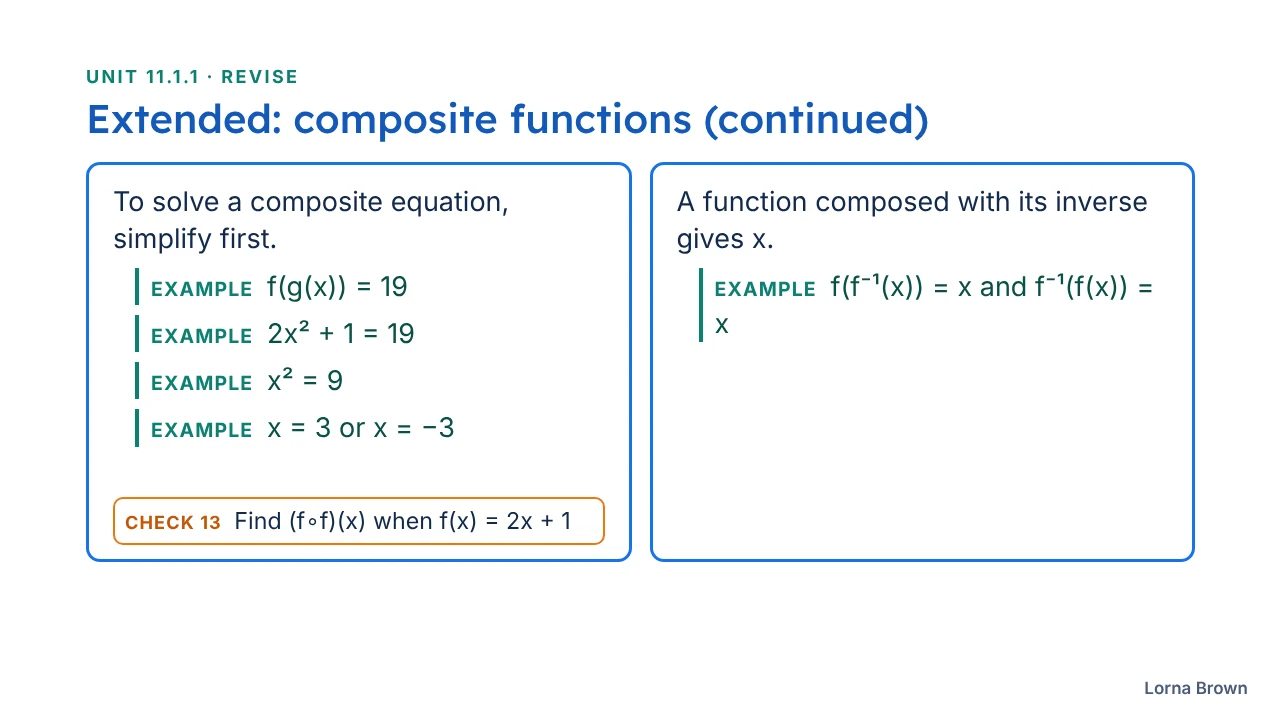
To solve a composite equation, simplify first.
f(g(x)) = 19
2x² + 1 = 19
x² = 9
x = 3 or x = −3
Check 13 Find (f∘f)(x) when f(x) = 2x + 1
A function composed with its inverse gives x.
f(f⁻¹(x)) = x and f⁻¹(f(x)) = x
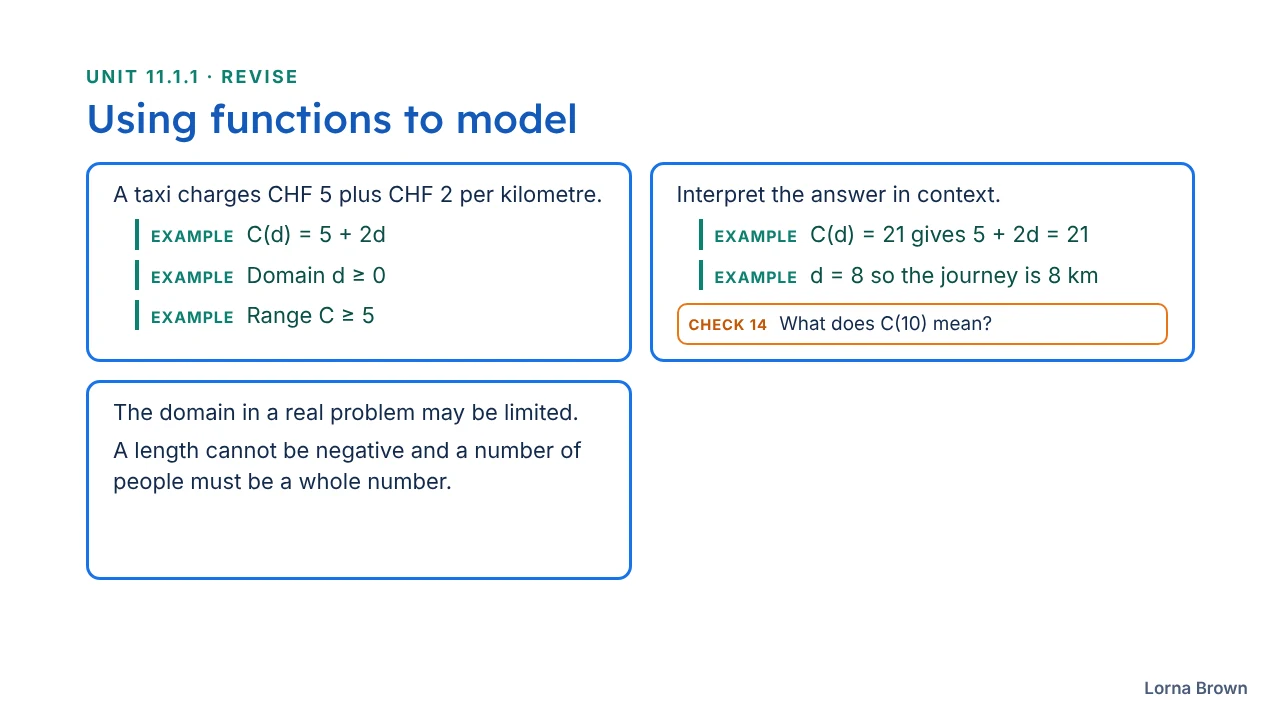
Slide 21: Using functions to model
A taxi charges CHF 5 plus CHF 2 per kilometre.
C(d) = 5 + 2d
Domain d ≥ 0
Range C ≥ 5
Interpret the answer in context.
C(d) = 21 gives 5 + 2d = 21
d = 8 so the journey is 8 km
Check 14 What does C(10) mean?
The domain in a real problem may be limited.
A length cannot be negative and a number of people must be a whole number.
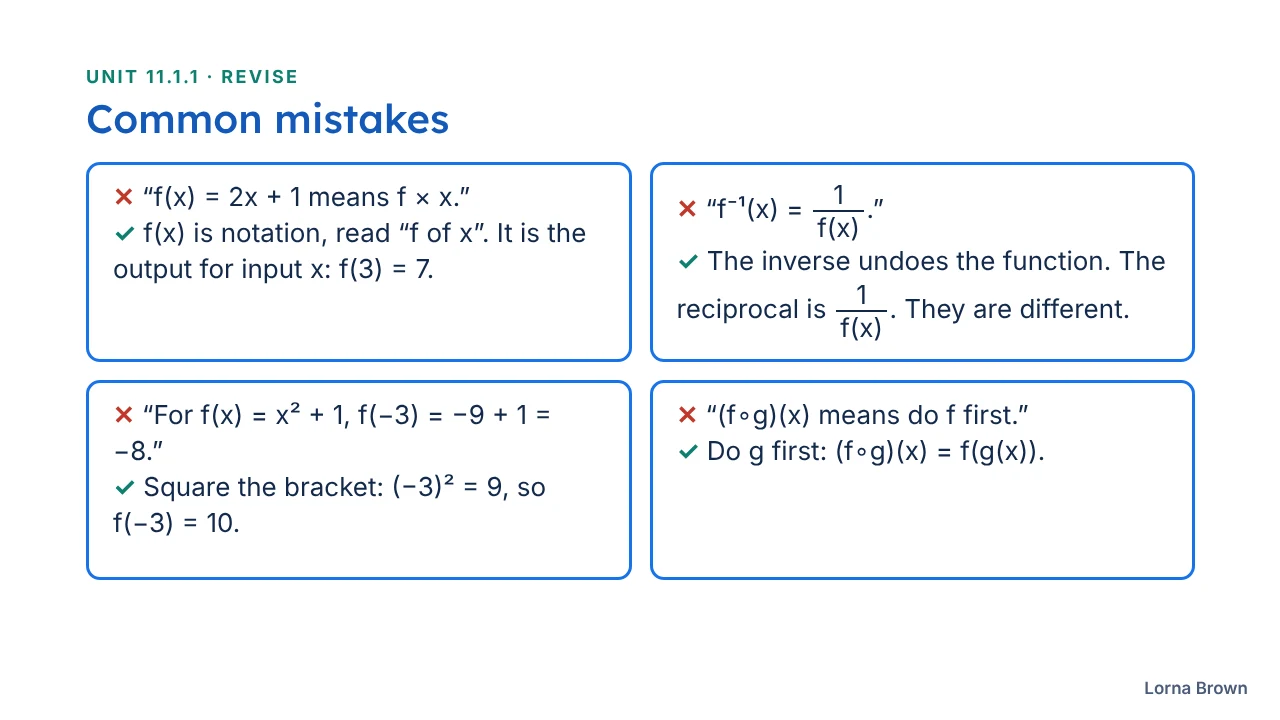
Slide 22: Common mistakes
✕ “f(x) = 2x + 1 means f × x.”
✓ f(x) is notation, read “f of x”. It is the output for input x: f(3) = 7.
✕ “f⁻¹(x) = 1f(x).”
✓ The inverse undoes the function. The reciprocal is 1f(x). They are different.
✕ “For f(x) = x² + 1, f(−3) = −9 + 1 = −8.”
✓ Square the bracket: (−3)² = 9, so f(−3) = 10.
✕ “(f∘g)(x) means do f first.”
✓ Do g first: (f∘g)(x) = f(g(x)).
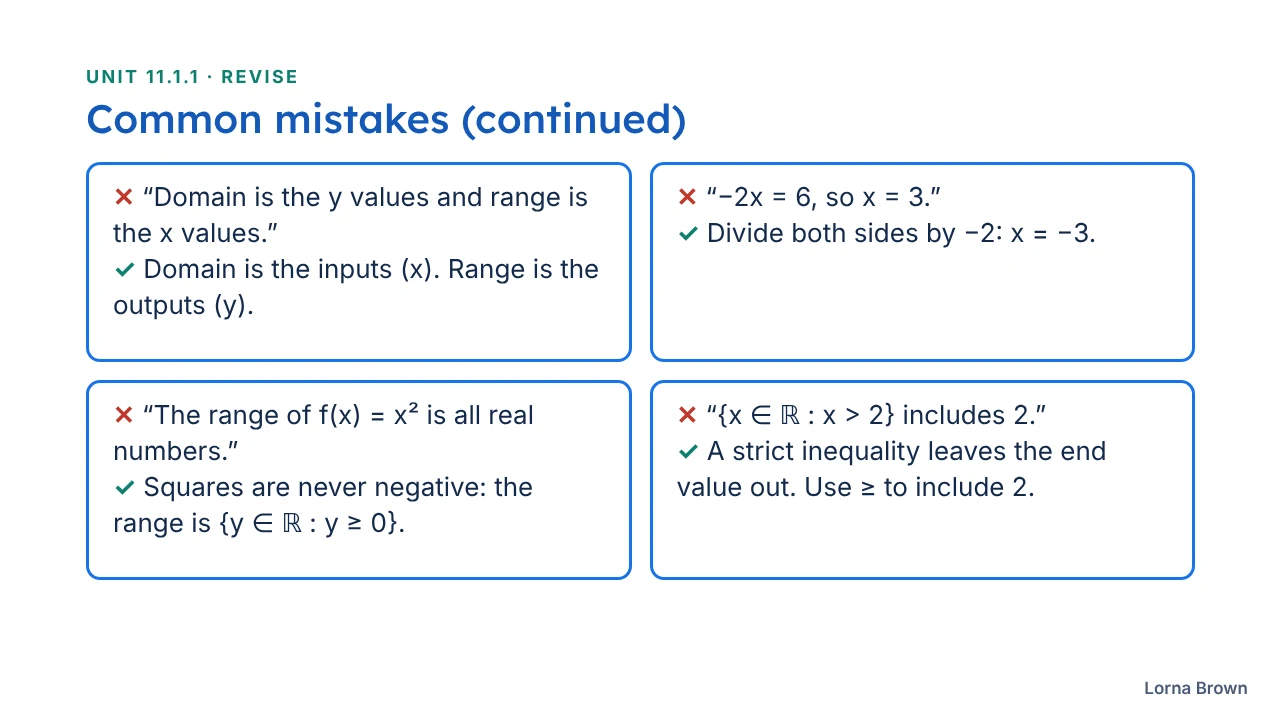
Slide 23: Common mistakes (continued)
✕ “Domain is the y values and range is the x values.”
✓ Domain is the inputs (x). Range is the outputs (y).
✕ “−2x = 6, so x = 3.”
✓ Divide both sides by −2: x = −3.
✕ “The range of f(x) = x² is all real numbers.”
✓ Squares are never negative: the range is {y ∈ ℝ : y ≥ 0}.
✕ “{x ∈ ℝ : x > 2} includes 2.”
✓ A strict inequality leaves the end value out. Use ≥ to include 2.
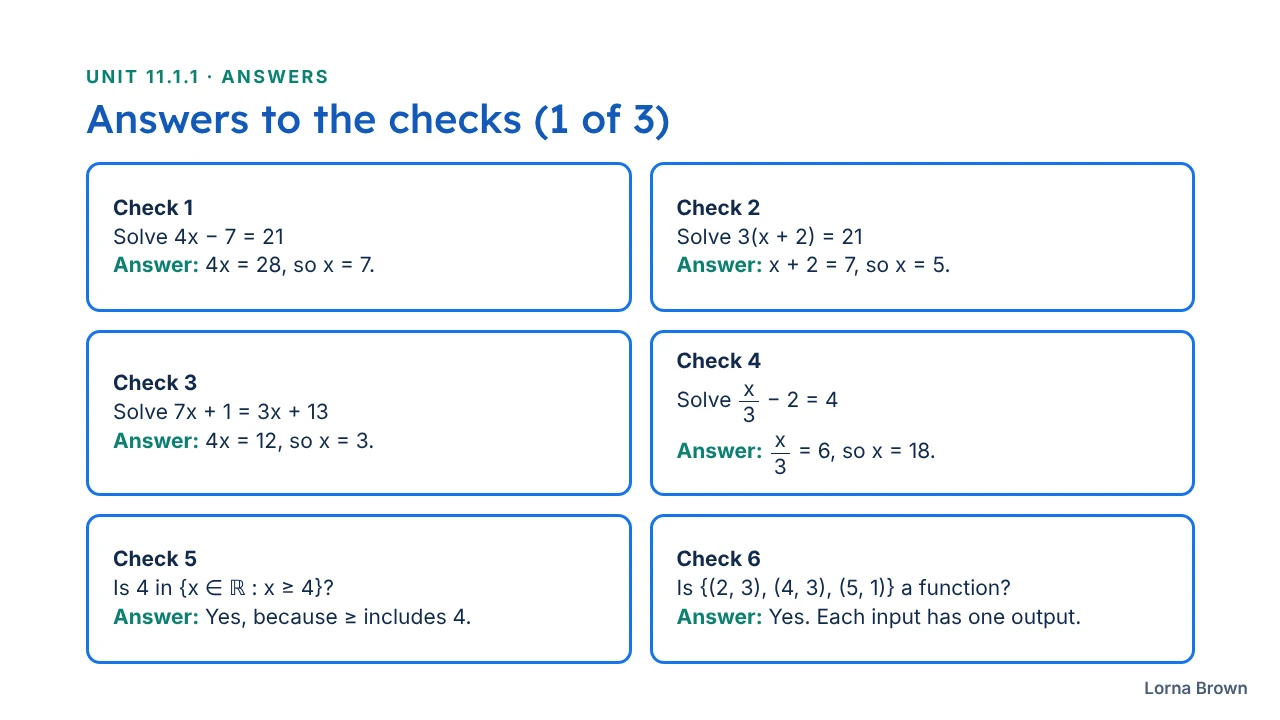
Slide 24: Answers to the checks (1 of 3)
Check 1
Solve 4x − 7 = 21
Answer: 4x = 28, so x = 7.
Check 2
Solve 3(x + 2) = 21
Answer: x + 2 = 7, so x = 5.
Check 3
Solve 7x + 1 = 3x + 13
Answer: 4x = 12, so x = 3.
Check 4
Solve x3 − 2 = 4
Answer: x3 = 6, so x = 18.
Check 5
Is 4 in {x ∈ ℝ : x ≥ 4}?
Answer: Yes, because ≥ includes 4.
Check 6
Is {(2, 3), (4, 3), (5, 1)} a function?
Answer: Yes. Each input has one output.
Slide 25: Answers to the checks (2 of 3)
Check 7
Find the range of f(x) = x + 4 for x ∈ {1, 2, 3}
Answer: {5, 6, 7}
Check 8
State the domain of f(x) = 1x − 3
Answer: {x ∈ ℝ : x ≠ 3}
Check 9
If f(x) = 5 − 2x, find f(3)
Answer: 5 − 6 = −1
Check 10
If f(x) = 2x + 3, solve f(x) = 11
Answer: 2x + 3 = 11, so x = 4.
Check 11
Find the inverse of f(x) = 2x + 3
Answer: x = 2y + 3, so f⁻¹(x) = x − 32
Check 12
With f(x) = x + 5 and g(x) = 3x, find (f∘g)(x)
Answer: f(3x) = 3x + 5
Slide 26: Answers to the checks (3 of 3)
Check 13
Find (f∘f)(x) when f(x) = 2x + 1
Answer: 2(2x + 1) + 1 = 4x + 3
Check 14
What does C(10) mean?
Answer: The cost of a 10 km journey: 5 + 20 = CHF 25.
11.1.2 Solving Quadratic Equations
11.1.2 Solving Quadratic Equations Flash cards
Click a card to flip it. Say the answer first, then check.
Print the cards (PDF): word on the front, answer on the back, double-sided, flip on the long edge
11.1.2 Solving Quadratic Equations Quizzes
Pick an answer to see if you are right. Your score shows at the end of each quiz.
11.1.2 Solving Quadratic Equations Revision notes
Download and print the revision notes (PDF, A4)
The big idea. Every quadratic equation can be solved, and the method depends on the equation: factorising, the quadratic formula, and, in the extended class, completing the square and the discriminant.
Key vocabulary
| Word | Meaning |
|---|---|
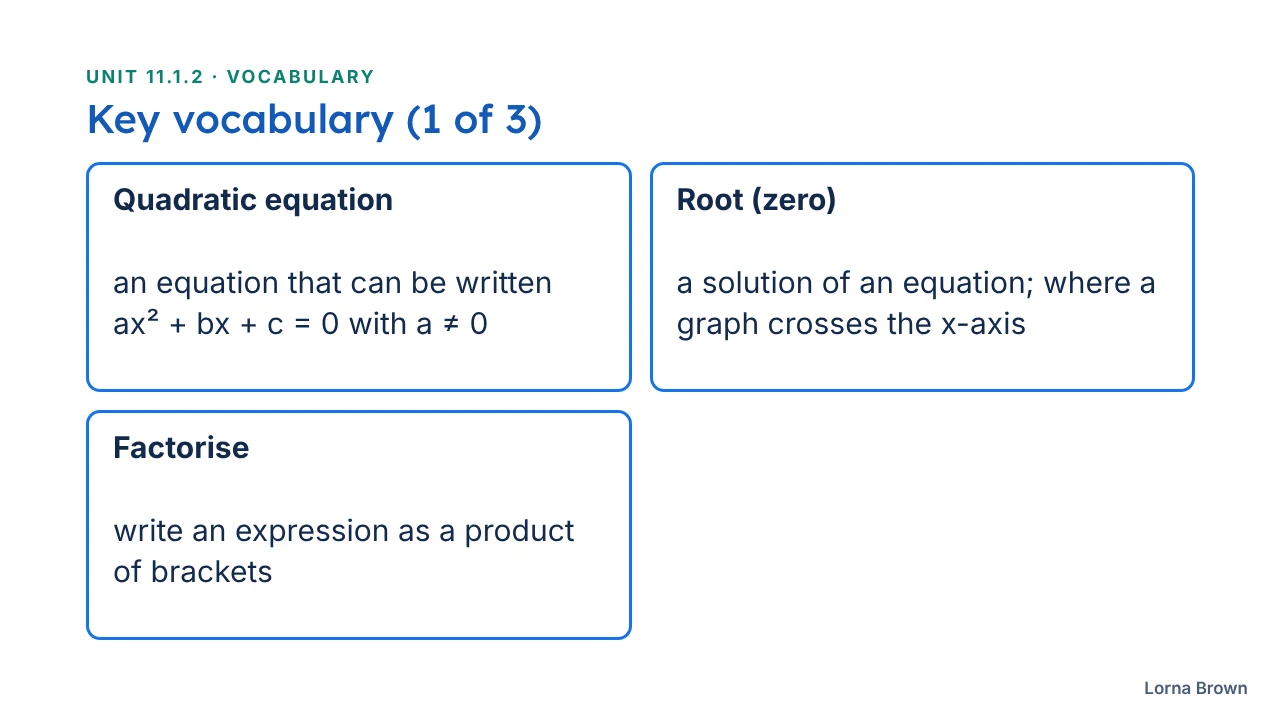
| Quadratic equation | an equation that can be written ax² + bx + c = 0 with a ≠ 0 |
| Root (zero) | a solution of an equation; where a graph crosses the x-axis |
| Factorise | write an expression as a product of brackets |
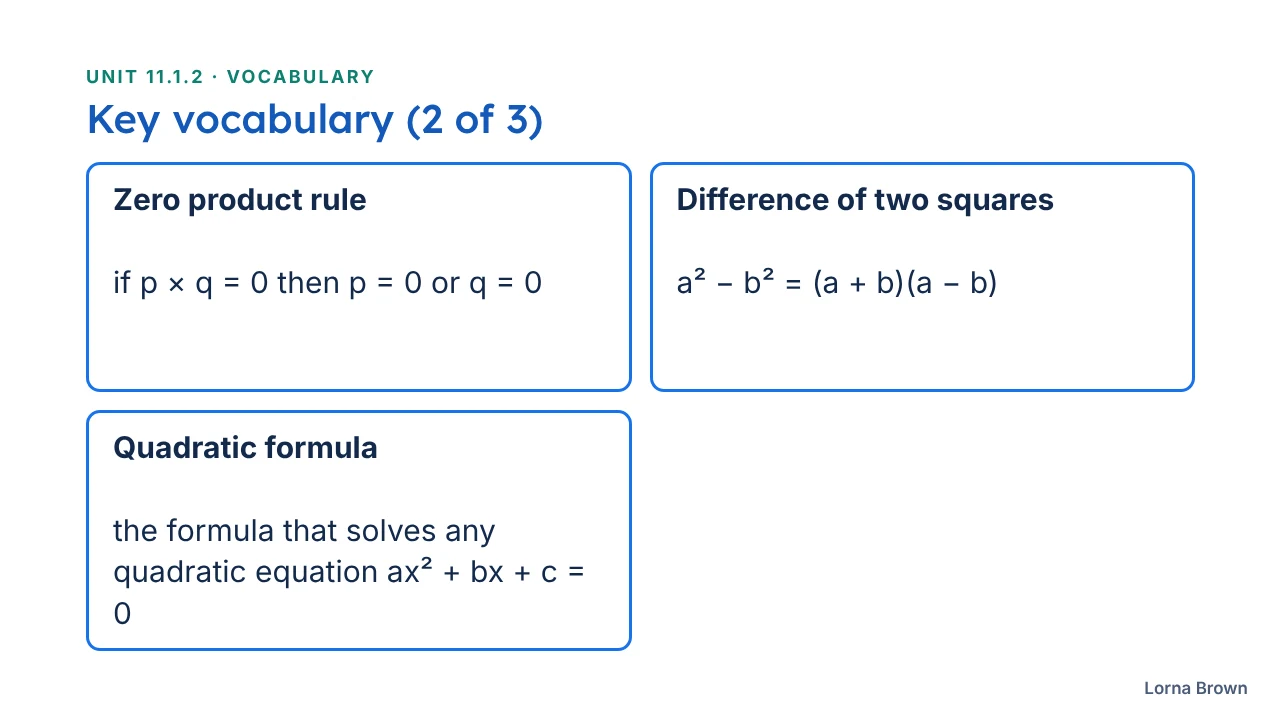
| Zero product rule | if p × q = 0 then p = 0 or q = 0 |
| Difference of two squares | a² − b² = (a + b)(a − b) |
| Quadratic formula | the formula that solves any quadratic equation ax² + bx + c = 0 |
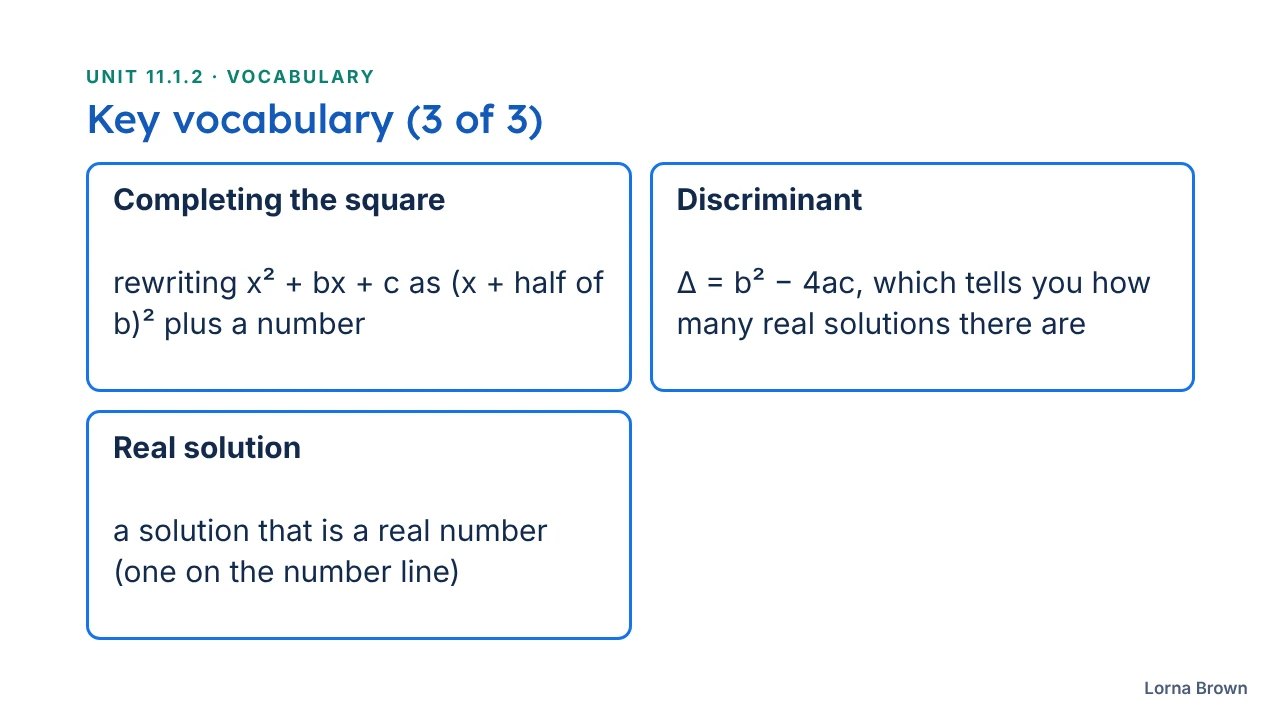
| Completing the square | rewriting x² + bx + c as (x + half of b)² plus a number |
| Discriminant | Δ = b² − 4ac, which tells you how many real solutions there are |
| Real solution | a solution that is a real number (one on the number line) |
Quadratic equations and the zero product rule
Solving by factorising: common factors
Solving by factorising: difference of two squares
Solving by factorising: product and sum (a = 1)
Solving by factorising: a ≠ 1
The quadratic formula
Which method should I use?
Extended: solving by completing the square
Extended: the discriminant
Common mistakes
✓ The zero product rule needs 0 on one side. Expand: x² − x − 12 = 0, then (x − 4)(x + 3) = 0, so x = 4 or x = −3.
✓ There are two solutions: x = 3 or x = −3.
✓ Dividing by x loses a solution. x² − 5x = 0 gives x(x − 5) = 0, so x = 0 or x = 5.
✓ −b = −(−5) = 5. Put negative numbers in brackets.
✓ The whole numerator, −b ± √(b² − 4ac), is divided by 2a.
✓ Use ±: x + 3 = ±√7, so x = −3 ± √7.
✓ It has no real solutions, and the graph does not cross the x-axis.
Answers to the checks
Cover this page until you have tried the check yourself.
| Check | Answer |
|---|---|
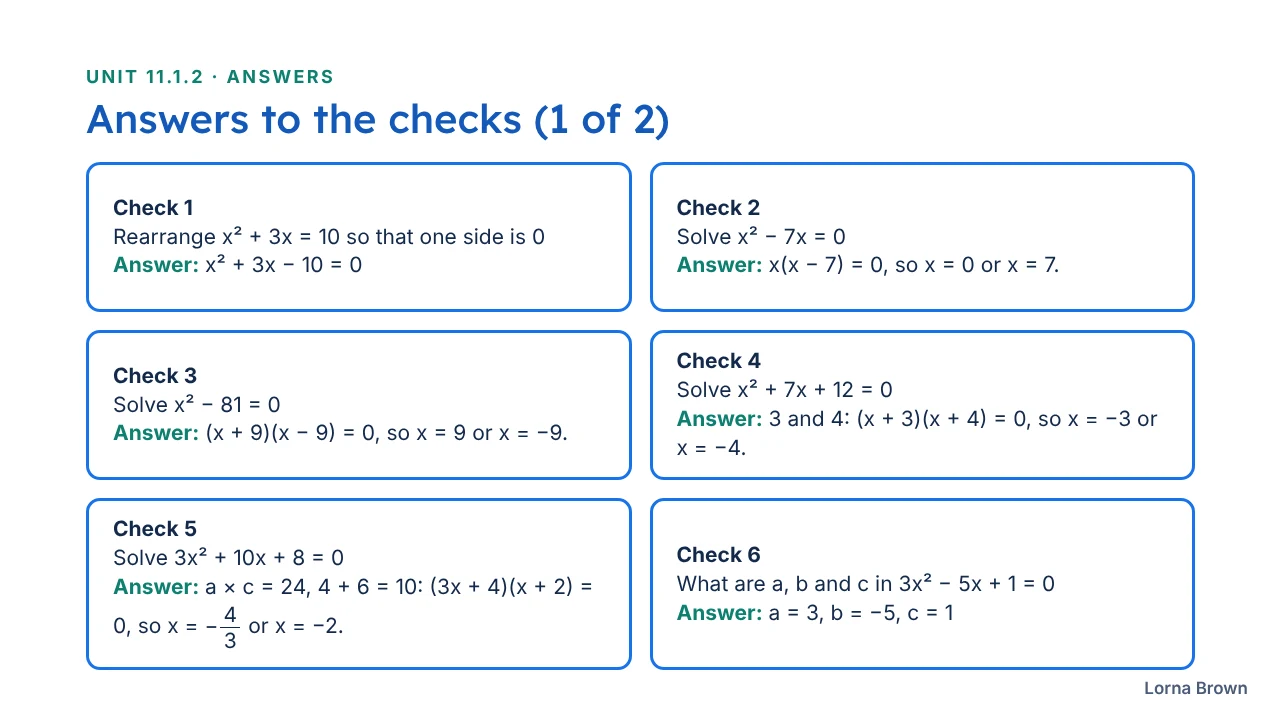
| Check 1 | Rearrange x² + 3x = 10 so that one side is 0 Answer: x² + 3x − 10 = 0 |
| Check 2 | Solve x² − 7x = 0 Answer: x(x − 7) = 0, so x = 0 or x = 7. |
| Check 3 | Solve x² − 81 = 0 Answer: (x + 9)(x − 9) = 0, so x = 9 or x = −9. |
| Check 4 | Solve x² + 7x + 12 = 0 Answer: 3 and 4: (x + 3)(x + 4) = 0, so x = −3 or x = −4. |
| Check 5 | Solve 3x² + 10x + 8 = 0 Answer: a × c = 24, 4 + 6 = 10: (3x + 4)(x + 2) = 0, so x = −43 or x = −2. |
| Check 6 | What are a, b and c in 3x² − 5x + 1 = 0 Answer: a = 3, b = −5, c = 1 |
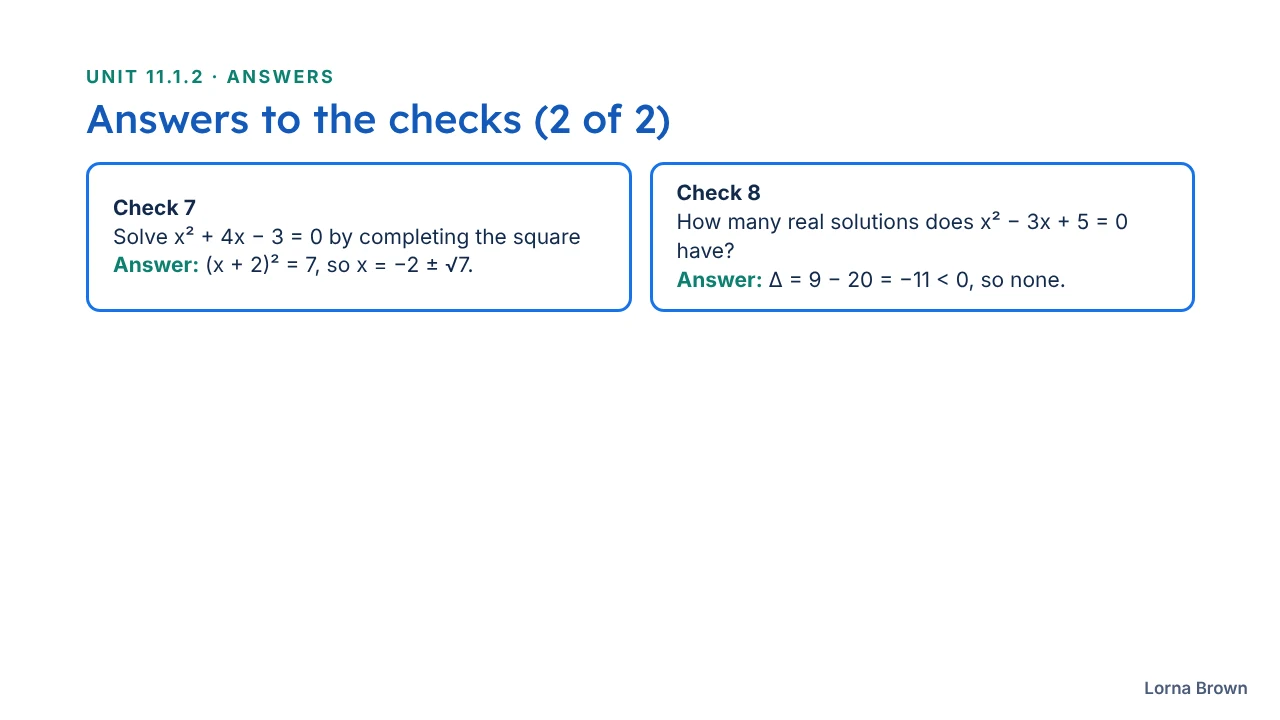
| Check 7 | Solve x² + 4x − 3 = 0 by completing the square Answer: (x + 2)² = 7, so x = −2 ± √7. |
| Check 8 | How many real solutions does x² − 3x + 5 = 0 have? Answer: Δ = 9 − 20 = −11 < 0, so none. |
11.1.2 Solving Quadratic Equations Which method? sheet
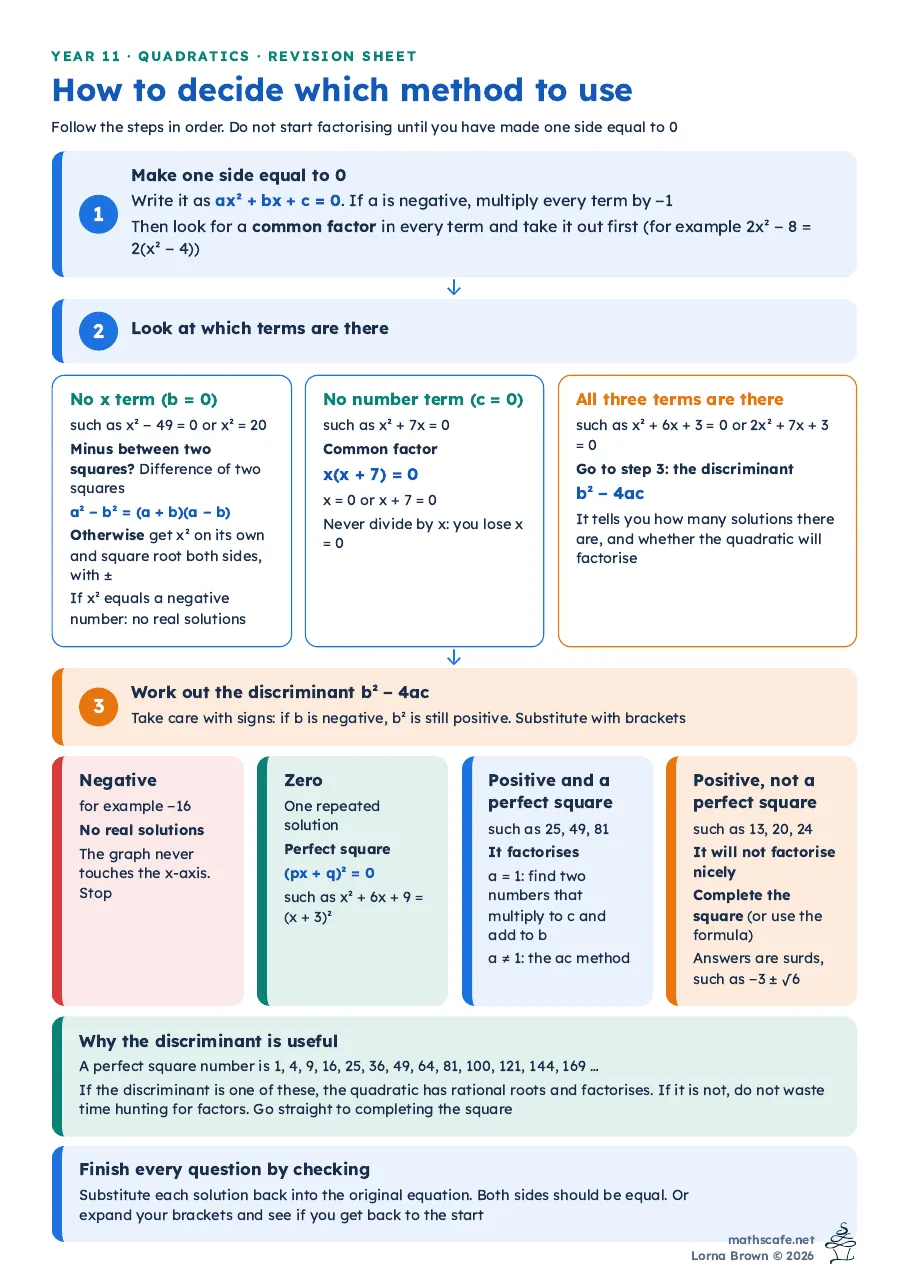
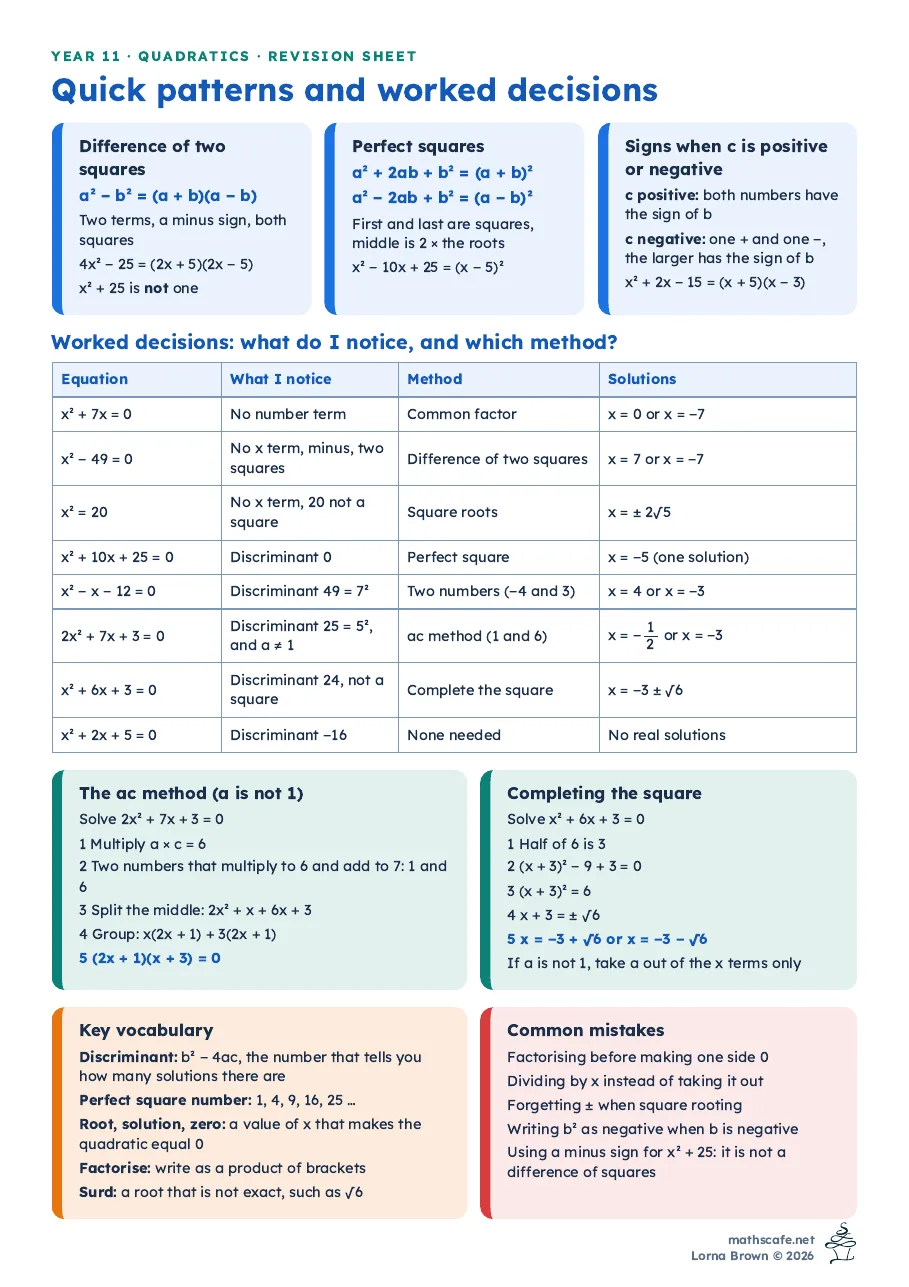
Follow the steps in order to decide which method to use. Make one side equal to 0, look at which terms are there, then use the discriminant.
Print the revision sheet (PDF, 2 pages)
11.1.2 Solving Quadratic Equations Method practice cards
Click a card to flip it. Decide which method you would use and why, then check the back. The back explains the method, how to decide, and the answer. Extended cards (a is not 1) are labelled.
11.1.2 Solving Quadratic Equations Method quiz
Pick an answer to see if you are right. Your score shows at the end of the quiz.
11.1.2 Solving Quadratic Equations Quadratics key cards
Click a card to flip it. Say the answer first, then check.
11.1.2 Solving Quadratic Equations Revision slides as text (easy to translate)
This is a plain-text version of the revision slides. Your browser can translate it into any language.
Slide 1: Solving Quadratic Equations
Revision slides: everything you need for the test, one idea per slide.
Slide 2: Key vocabulary (1 of 3)
Quadratic equation: an equation that can be written ax² + bx + c = 0 with a ≠ 0
Root (zero): a solution of an equation; where a graph crosses the x-axis
Factorise: write an expression as a product of brackets
Slide 3: Key vocabulary (2 of 3)
Zero product rule: if p × q = 0 then p = 0 or q = 0
Difference of two squares: a² − b² = (a + b)(a − b)
Quadratic formula: the formula that solves any quadratic equation ax² + bx + c = 0
Slide 4: Key vocabulary (3 of 3)
Completing the square: rewriting x² + bx + c as (x + half of b)² plus a number
Discriminant: Δ = b² − 4ac, which tells you how many real solutions there are
Real solution: a solution that is a real number (one on the number line)
Slide 5: Quadratic equations and the zero product rule
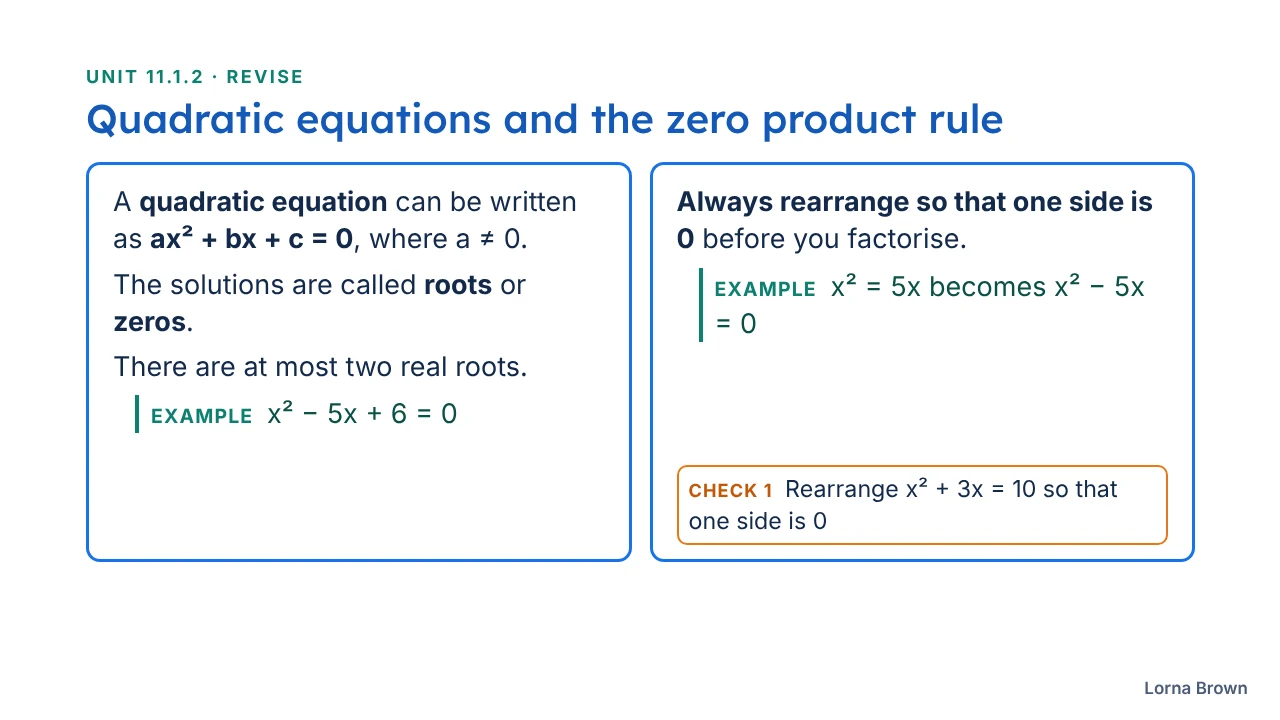
A quadratic equation can be written as ax² + bx + c = 0, where a ≠ 0.
The solutions are called roots or zeros.
There are at most two real roots.
x² − 5x + 6 = 0
Always rearrange so that one side is 0 before you factorise.
x² = 5x becomes x² − 5x = 0
Check 1 Rearrange x² + 3x = 10 so that one side is 0
Slide 6: Quadratic equations and the zero product rule (continued)
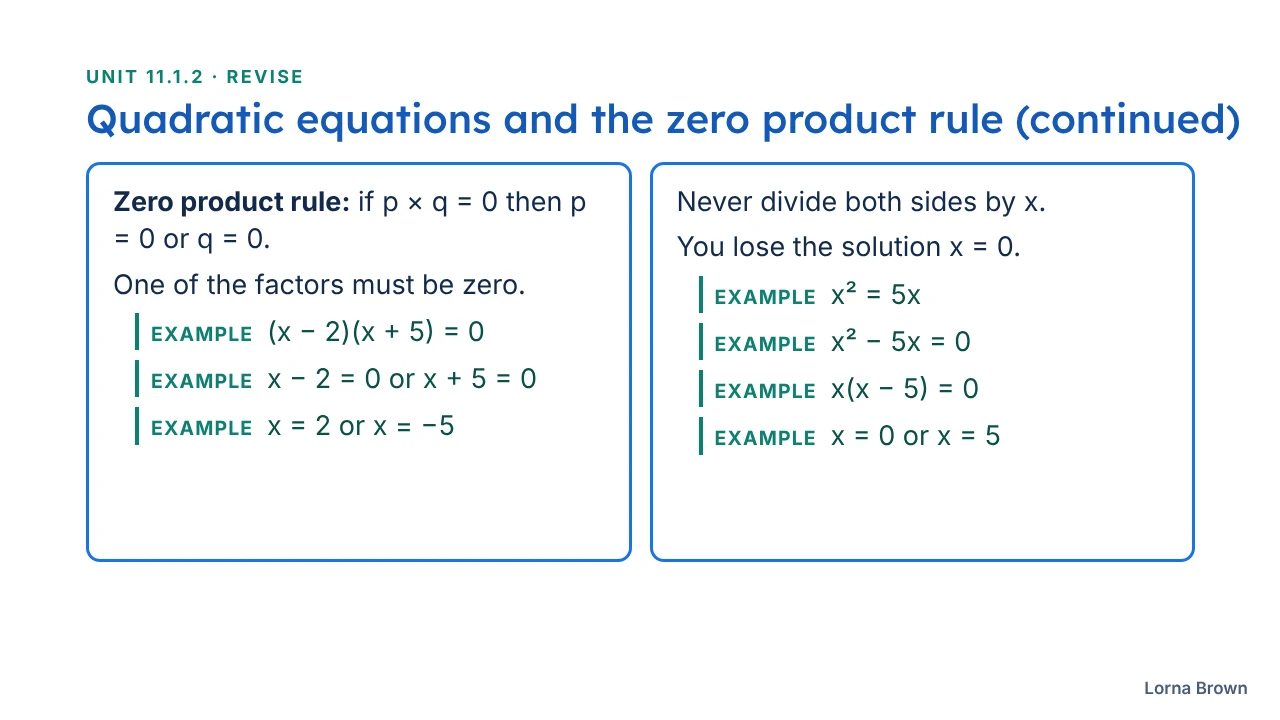
Zero product rule: if p × q = 0 then p = 0 or q = 0.
One of the factors must be zero.
(x − 2)(x + 5) = 0
x − 2 = 0 or x + 5 = 0
x = 2 or x = −5
Never divide both sides by x.
You lose the solution x = 0.
x² = 5x
x² − 5x = 0
x(x − 5) = 0
x = 0 or x = 5
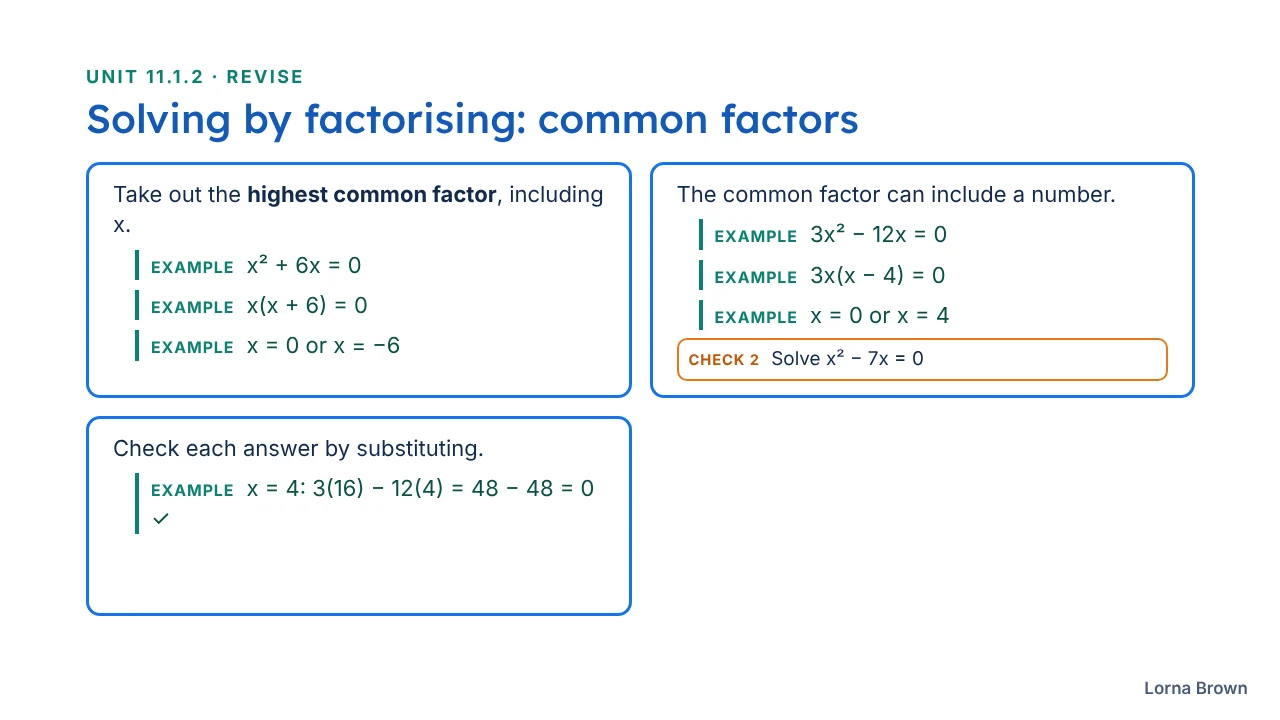
Slide 7: Solving by factorising: common factors
Take out the highest common factor, including x.
x² + 6x = 0
x(x + 6) = 0
x = 0 or x = −6
The common factor can include a number.
3x² − 12x = 0
3x(x − 4) = 0
x = 0 or x = 4
Check 2 Solve x² − 7x = 0
Check each answer by substituting.
x = 4: 3(16) − 12(4) = 48 − 48 = 0 ✓
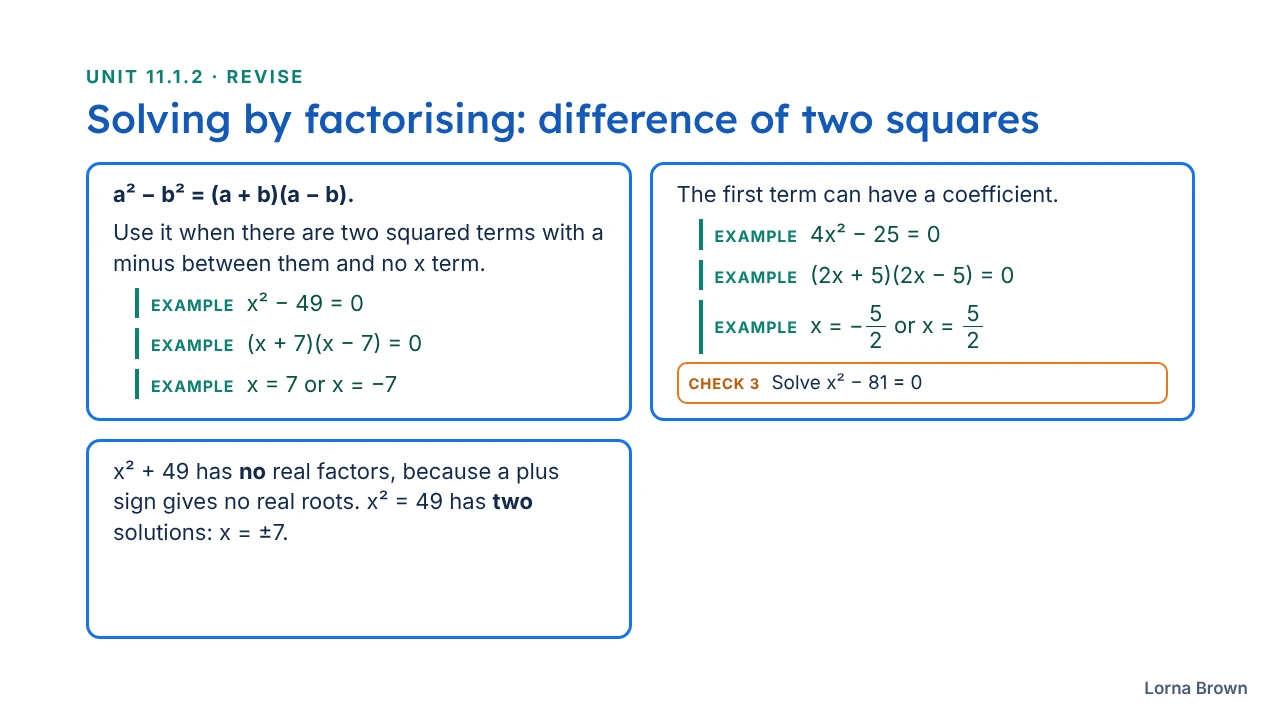
Slide 8: Solving by factorising: difference of two squares
a² − b² = (a + b)(a − b).
Use it when there are two squared terms with a minus between them and no x term.
x² − 49 = 0
(x + 7)(x − 7) = 0
x = 7 or x = −7
The first term can have a coefficient.
4x² − 25 = 0
(2x + 5)(2x − 5) = 0
x = −52 or x = 52
Check 3 Solve x² − 81 = 0
x² + 49 has no real factors, because a plus sign gives no real roots. x² = 49 has two solutions: x = ±7.
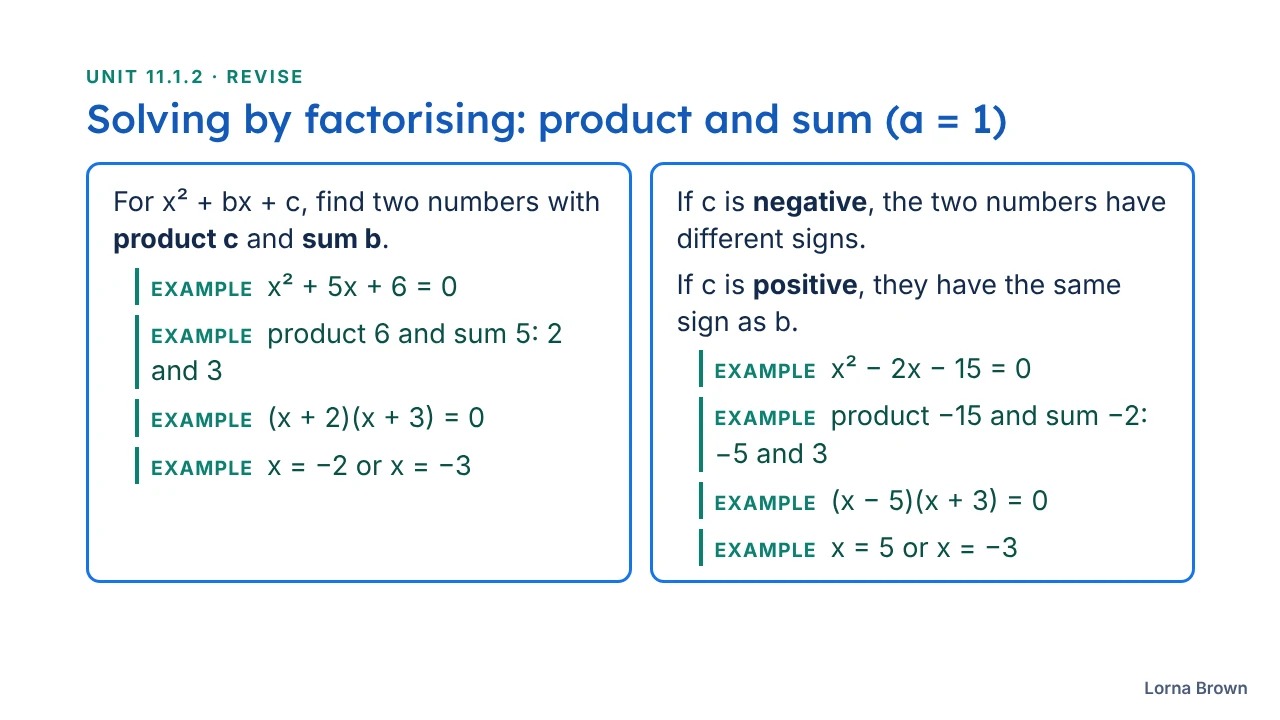
Slide 9: Solving by factorising: product and sum (a = 1)
For x² + bx + c, find two numbers with product c and sum b.
x² + 5x + 6 = 0
product 6 and sum 5: 2 and 3
(x + 2)(x + 3) = 0
x = −2 or x = −3
If c is negative, the two numbers have different signs.
If c is positive, they have the same sign as b.
x² − 2x − 15 = 0
product −15 and sum −2: −5 and 3
(x − 5)(x + 3) = 0
x = 5 or x = −3
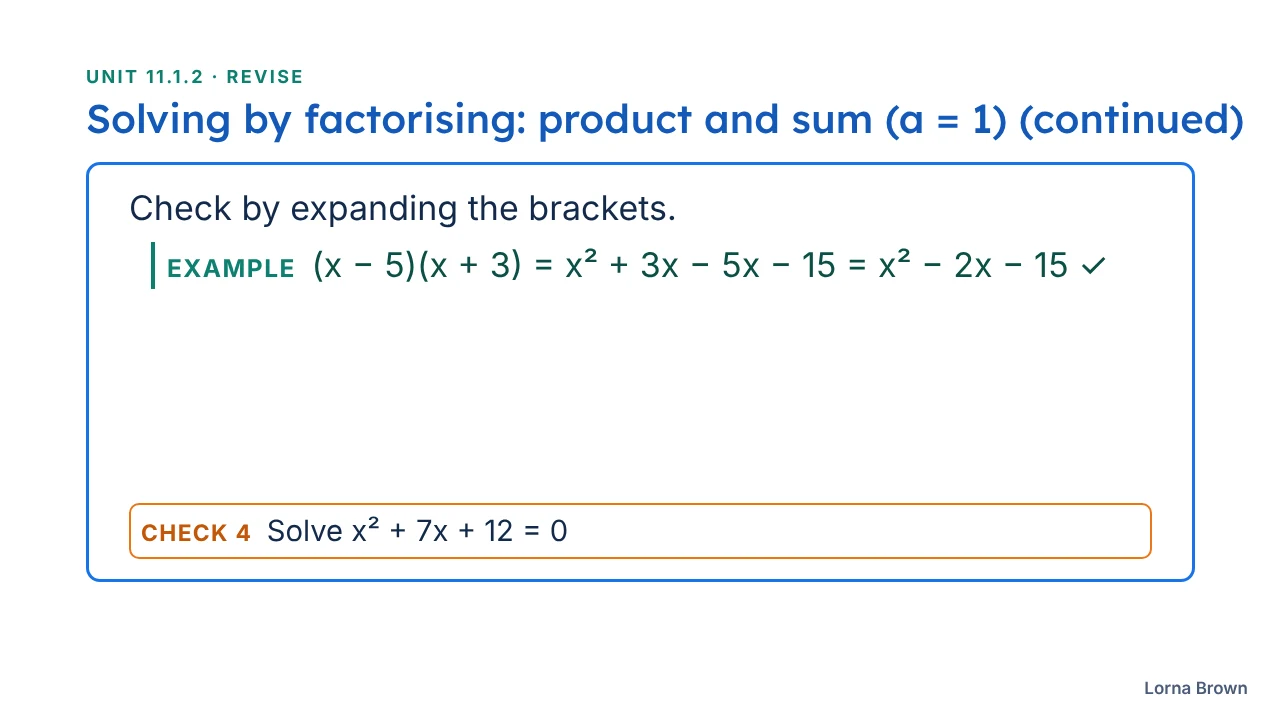
Slide 10: Solving by factorising: product and sum (a = 1) (continued)
Check by expanding the brackets.
(x − 5)(x + 3) = x² + 3x − 5x − 15 = x² − 2x − 15 ✓
Check 4 Solve x² + 7x + 12 = 0
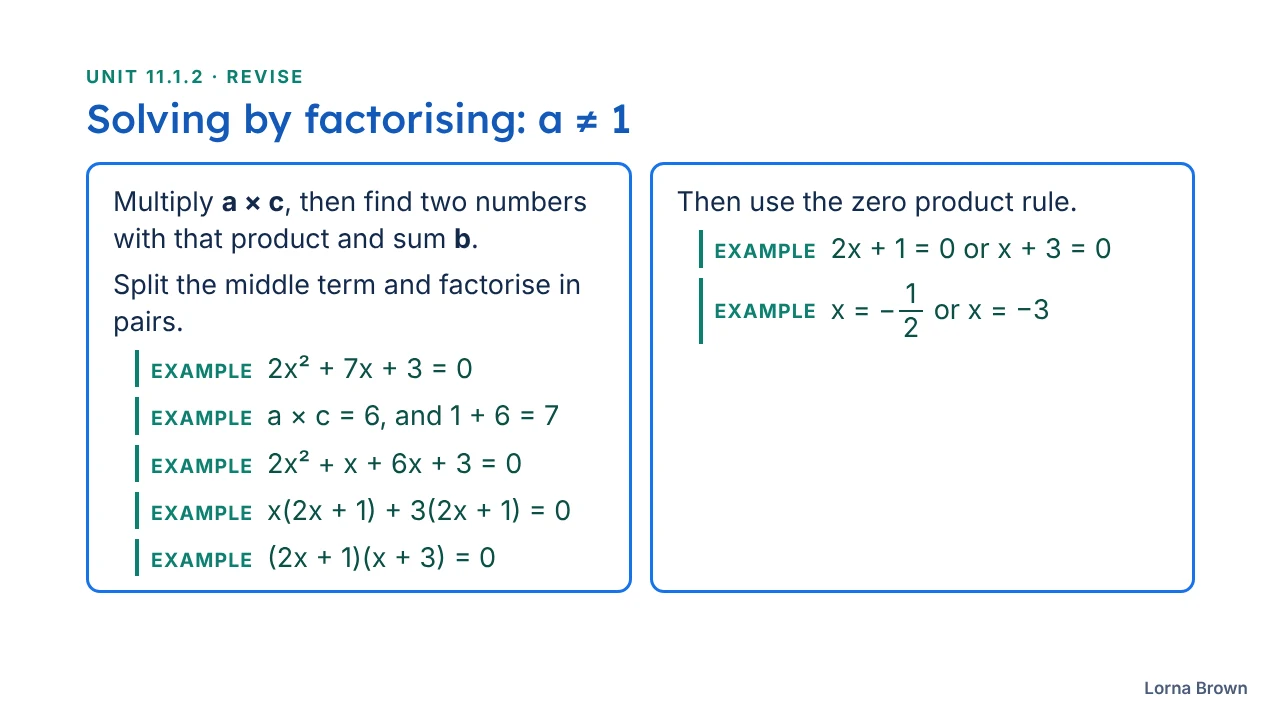
Slide 11: Solving by factorising: a ≠ 1
Multiply a × c, then find two numbers with that product and sum b.
Split the middle term and factorise in pairs.
2x² + 7x + 3 = 0
a × c = 6, and 1 + 6 = 7
2x² + x + 6x + 3 = 0
x(2x + 1) + 3(2x + 1) = 0
(2x + 1)(x + 3) = 0
Then use the zero product rule.
2x + 1 = 0 or x + 3 = 0
x = −12 or x = −3
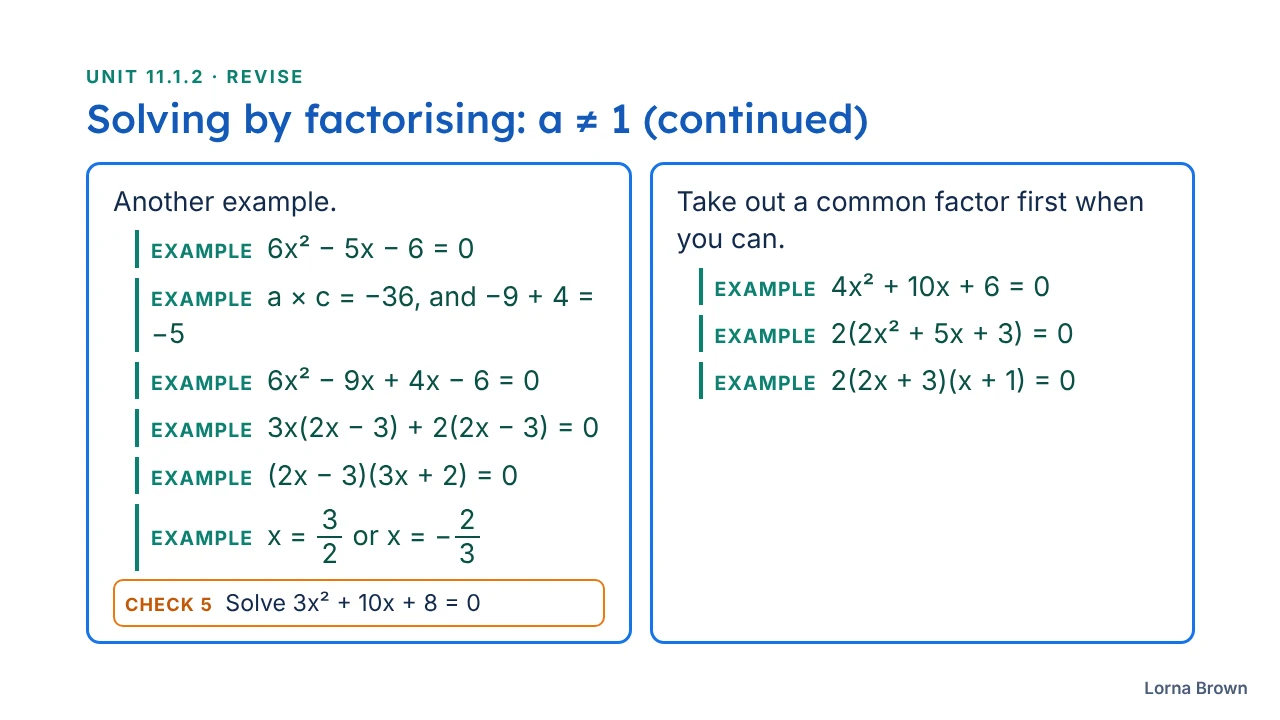
Slide 12: Solving by factorising: a ≠ 1 (continued)
Another example.
6x² − 5x − 6 = 0
a × c = −36, and −9 + 4 = −5
6x² − 9x + 4x − 6 = 0
3x(2x − 3) + 2(2x − 3) = 0
(2x − 3)(3x + 2) = 0
x = 32 or x = −23
Check 5 Solve 3x² + 10x + 8 = 0
Take out a common factor first when you can.
4x² + 10x + 6 = 0
2(2x² + 5x + 3) = 0
2(2x + 3)(x + 1) = 0
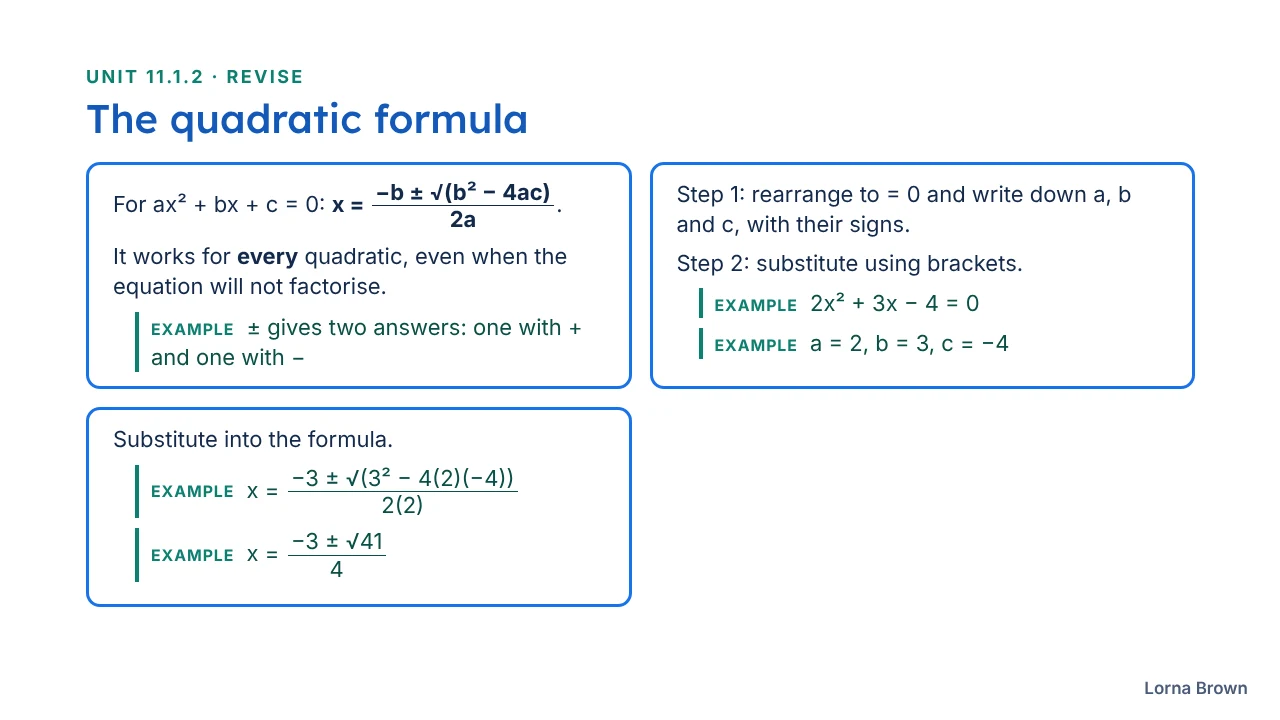
Slide 13: The quadratic formula
For ax² + bx + c = 0: x = −b ± √(b² − 4ac)2a.
It works for every quadratic, even when the equation will not factorise.
± gives two answers: one with + and one with −
Step 1: rearrange to = 0 and write down a, b and c, with their signs.
Step 2: substitute using brackets.
2x² + 3x − 4 = 0
a = 2, b = 3, c = −4
Substitute into the formula.
x = −3 ± √(3² − 4(2)(−4))2(2)
x = −3 ± √414
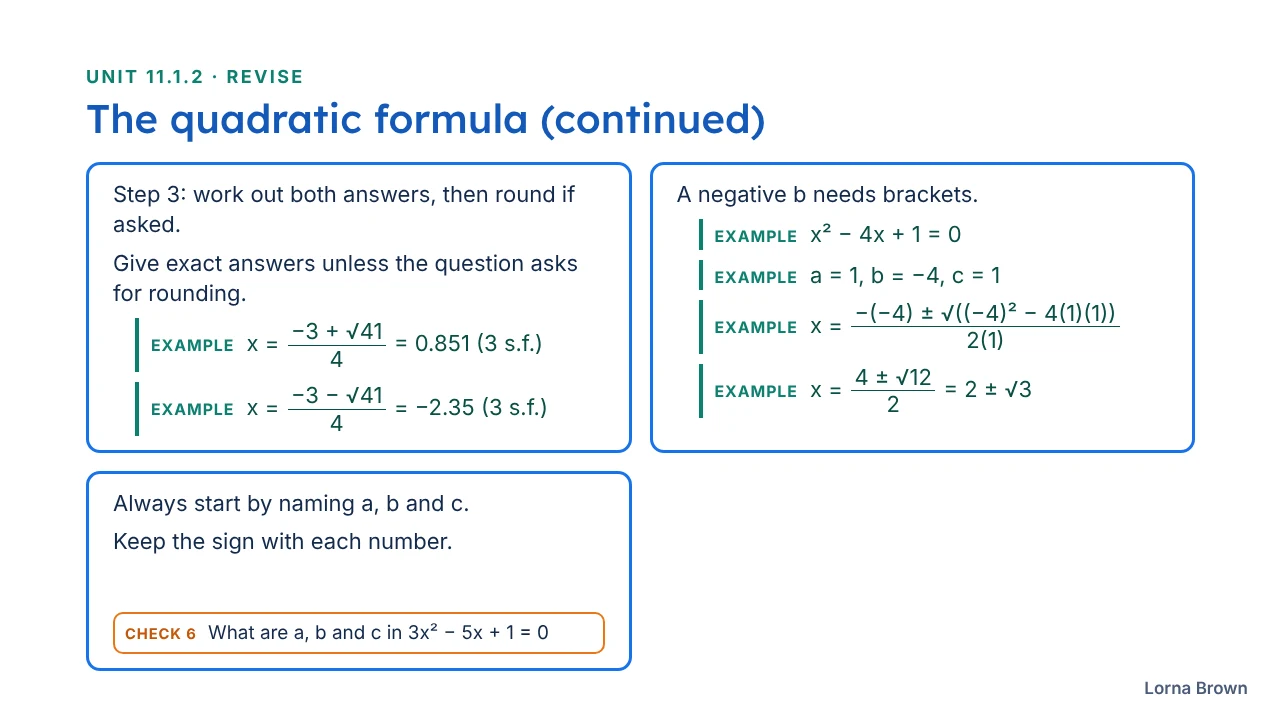
Slide 14: The quadratic formula (continued)
Step 3: work out both answers, then round if asked.
Give exact answers unless the question asks for rounding.
x = −3 + √414 = 0.851 (3 s.f.)
x = −3 − √414 = −2.35 (3 s.f.)
A negative b needs brackets.
x² − 4x + 1 = 0
a = 1, b = −4, c = 1
x = −(−4) ± √((−4)² − 4(1)(1))2(1)
x = 4 ± √122 = 2 ± √3
Always start by naming a, b and c.
Keep the sign with each number.
Check 6 What are a, b and c in 3x² − 5x + 1 = 0
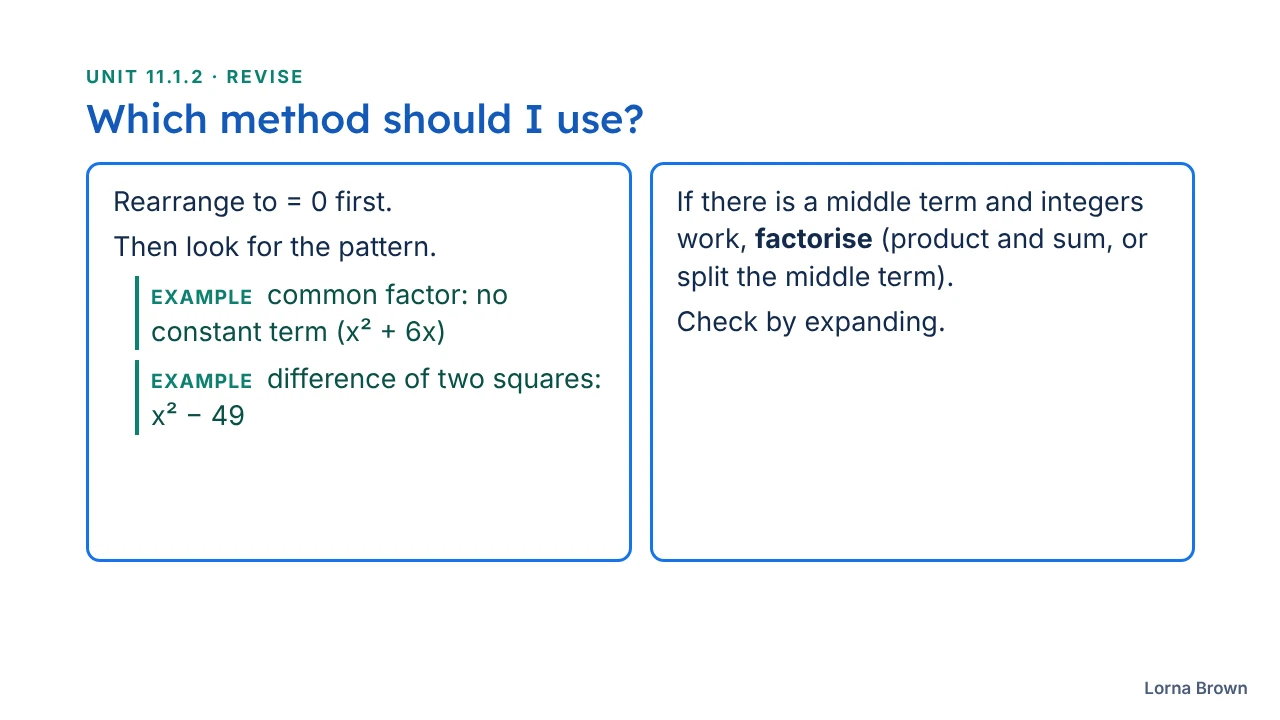
Slide 15: Which method should I use?
Rearrange to = 0 first.
Then look for the pattern.
common factor: no constant term (x² + 6x)
difference of two squares: x² − 49
If there is a middle term and integers work, factorise (product and sum, or split the middle term).
Check by expanding.
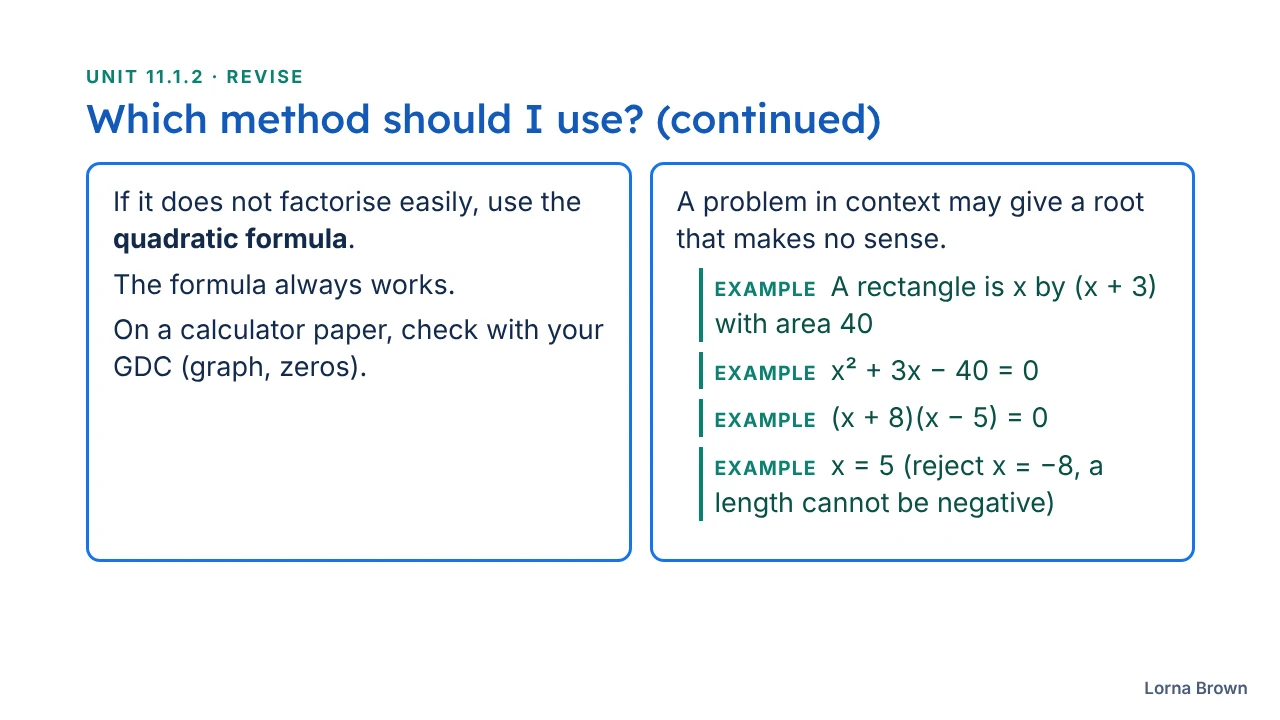
Slide 16: Which method should I use? (continued)
If it does not factorise easily, use the quadratic formula.
The formula always works.
On a calculator paper, check with your GDC (graph, zeros).
A problem in context may give a root that makes no sense.
A rectangle is x by (x + 3) with area 40
x² + 3x − 40 = 0
(x + 8)(x − 5) = 0
x = 5 (reject x = −8, a length cannot be negative)
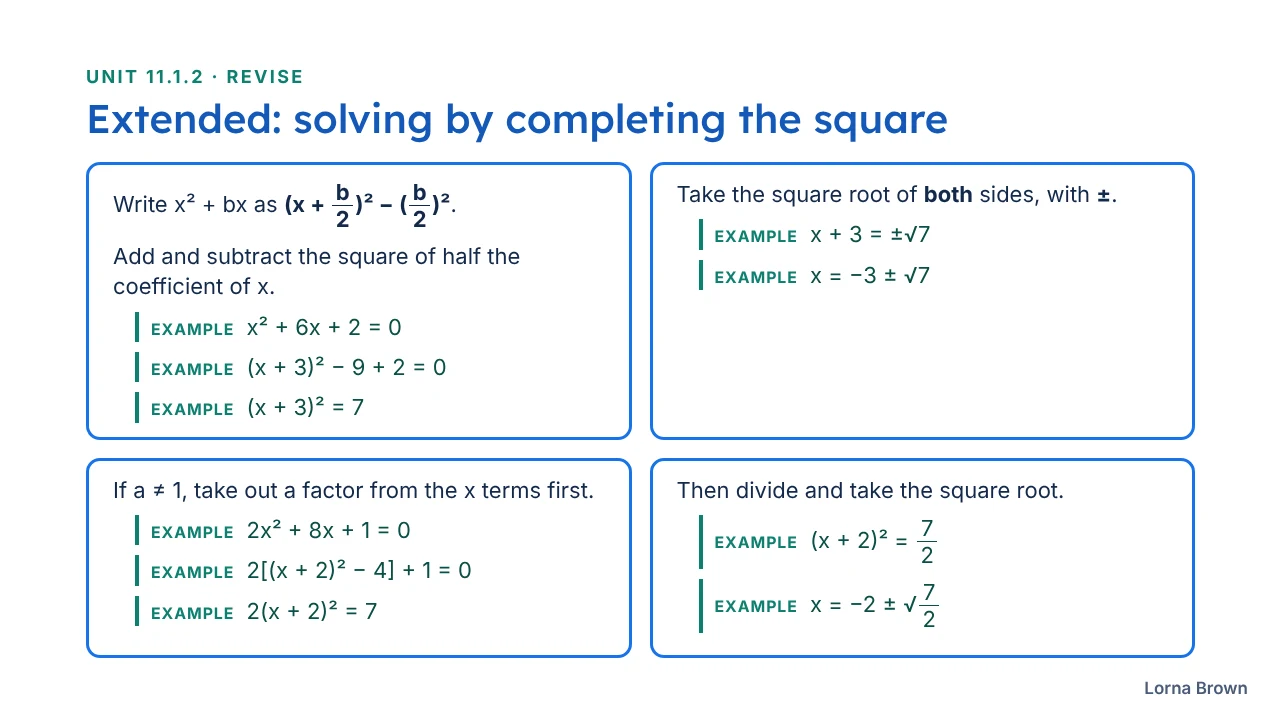
Slide 17: Extended: solving by completing the square
Write x² + bx as (x + b2)² − (b2)².
Add and subtract the square of half the coefficient of x.
x² + 6x + 2 = 0
(x + 3)² − 9 + 2 = 0
(x + 3)² = 7
Take the square root of both sides, with ±.
x + 3 = ±√7
x = −3 ± √7
If a ≠ 1, take out a factor from the x terms first.
2x² + 8x + 1 = 0
2[(x + 2)² − 4] + 1 = 0
2(x + 2)² = 7
Then divide and take the square root.
(x + 2)² = 72
x = −2 ± √72
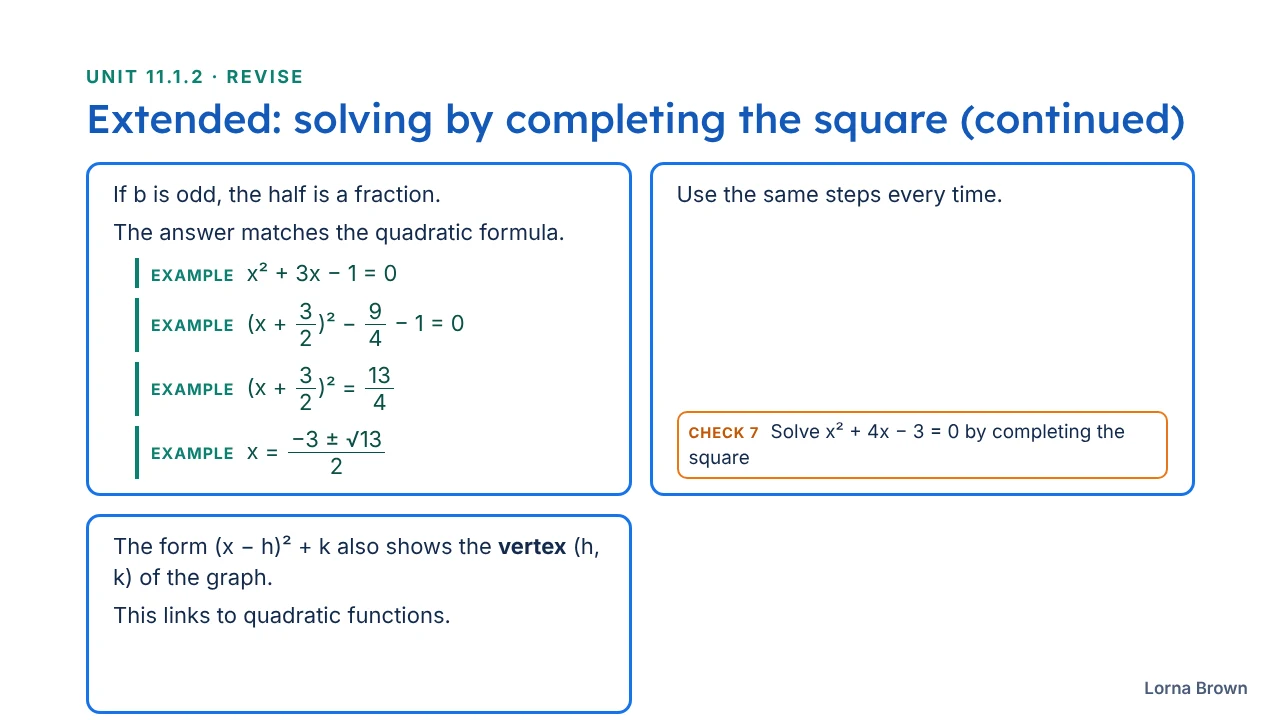
Slide 18: Extended: solving by completing the square (continued)
If b is odd, the half is a fraction.
The answer matches the quadratic formula.
x² + 3x − 1 = 0
(x + 32)² − 94 − 1 = 0
(x + 32)² = 134
x = −3 ± √132
Use the same steps every time.
Check 7 Solve x² + 4x − 3 = 0 by completing the square
The form (x − h)² + k also shows the vertex (h, k) of the graph.
This links to quadratic functions.
Slide 19: Extended: the discriminant
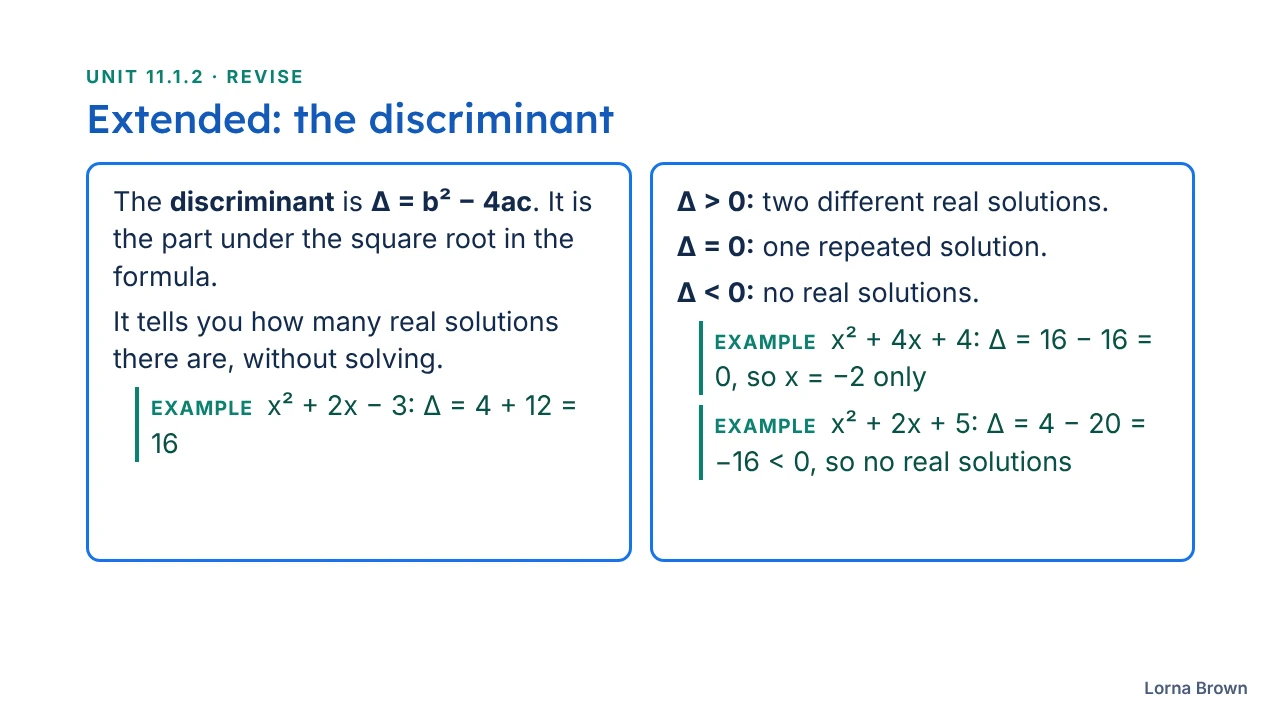
The discriminant is Δ = b² − 4ac. It is the part under the square root in the formula.
It tells you how many real solutions there are, without solving.
x² + 2x − 3: Δ = 4 + 12 = 16
Δ > 0: two different real solutions.
Δ = 0: one repeated solution.
Δ < 0: no real solutions.
x² + 4x + 4: Δ = 16 − 16 = 0, so x = −2 only
x² + 2x + 5: Δ = 4 − 20 = −16 < 0, so no real solutions
Slide 20: Extended: the discriminant (continued)
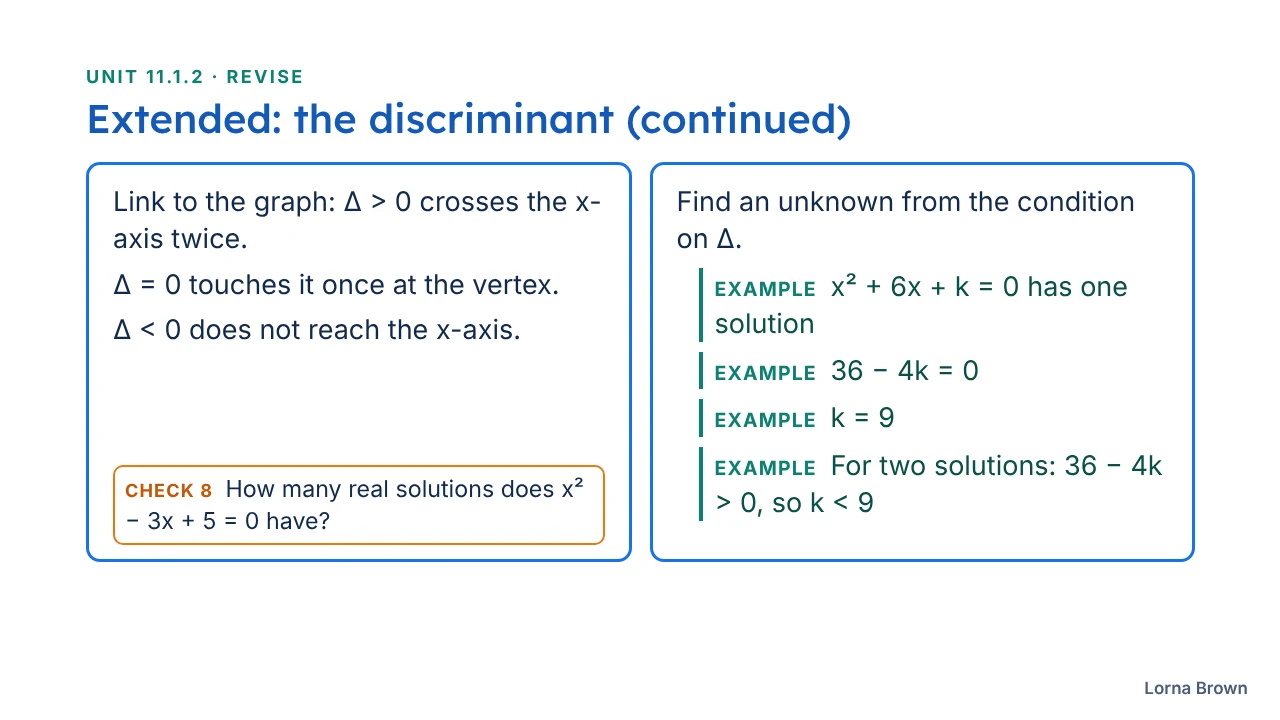
Link to the graph: Δ > 0 crosses the x-axis twice.
Δ = 0 touches it once at the vertex.
Δ < 0 does not reach the x-axis.
Check 8 How many real solutions does x² − 3x + 5 = 0 have?
Find an unknown from the condition on Δ.
x² + 6x + k = 0 has one solution
36 − 4k = 0
k = 9
For two solutions: 36 − 4k > 0, so k < 9
Slide 21: Common mistakes
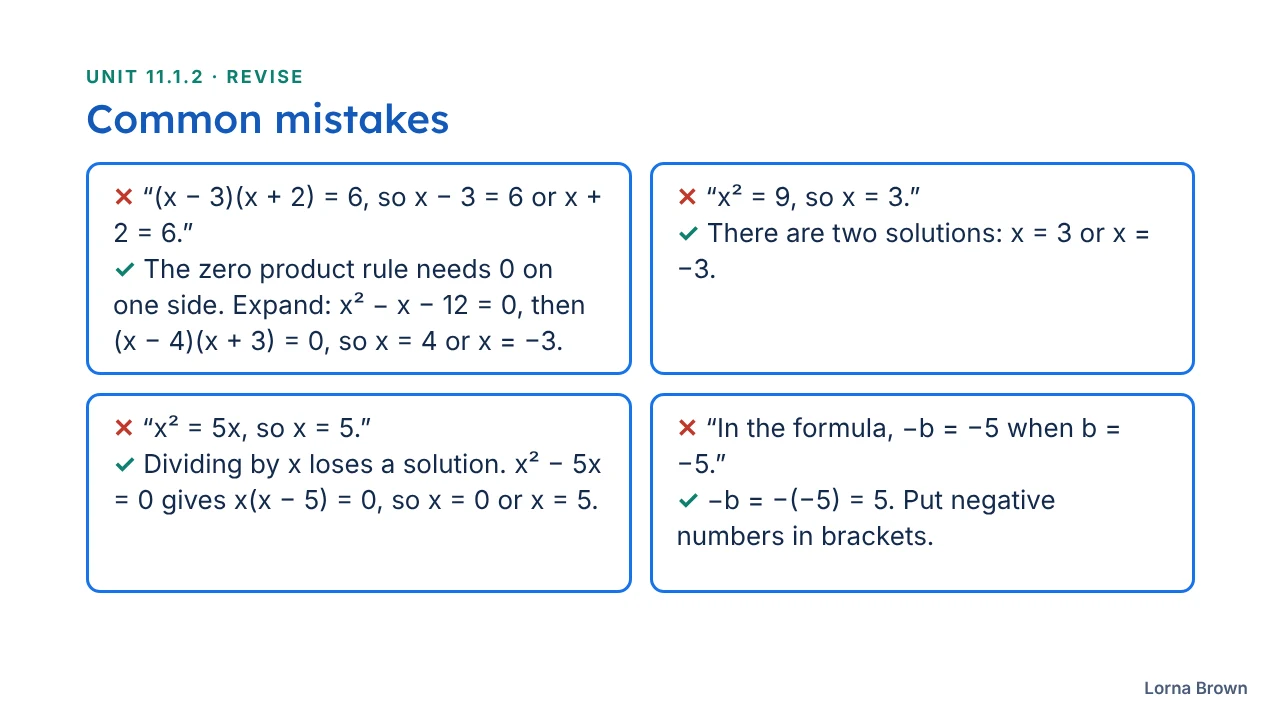
✕ “(x − 3)(x + 2) = 6, so x − 3 = 6 or x + 2 = 6.”
✓ The zero product rule needs 0 on one side. Expand: x² − x − 12 = 0, then (x − 4)(x + 3) = 0, so x = 4 or x = −3.
✕ “x² = 9, so x = 3.”
✓ There are two solutions: x = 3 or x = −3.
✕ “x² = 5x, so x = 5.”
✓ Dividing by x loses a solution. x² − 5x = 0 gives x(x − 5) = 0, so x = 0 or x = 5.
✕ “In the formula, −b = −5 when b = −5.”
✓ −b = −(−5) = 5. Put negative numbers in brackets.
Slide 22: Common mistakes (continued)
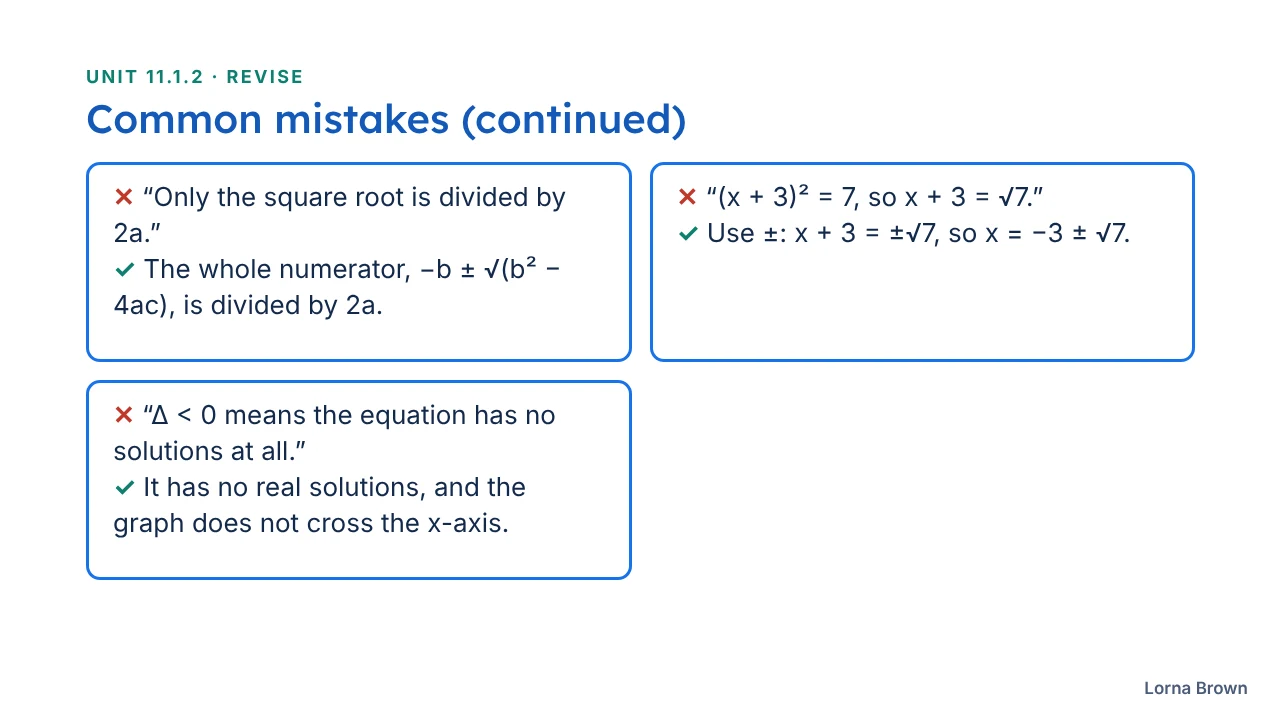
✕ “Only the square root is divided by 2a.”
✓ The whole numerator, −b ± √(b² − 4ac), is divided by 2a.
✕ “(x + 3)² = 7, so x + 3 = √7.”
✓ Use ±: x + 3 = ±√7, so x = −3 ± √7.
✕ “Δ < 0 means the equation has no solutions at all.”
✓ It has no real solutions, and the graph does not cross the x-axis.
Slide 23: Answers to the checks (1 of 2)
Check 1
Rearrange x² + 3x = 10 so that one side is 0
Answer: x² + 3x − 10 = 0
Check 2
Solve x² − 7x = 0
Answer: x(x − 7) = 0, so x = 0 or x = 7.
Check 3
Solve x² − 81 = 0
Answer: (x + 9)(x − 9) = 0, so x = 9 or x = −9.
Check 4
Solve x² + 7x + 12 = 0
Answer: 3 and 4: (x + 3)(x + 4) = 0, so x = −3 or x = −4.
Check 5
Solve 3x² + 10x + 8 = 0
Answer: a × c = 24, 4 + 6 = 10: (3x + 4)(x + 2) = 0, so x = −43 or x = −2.
Check 6
What are a, b and c in 3x² − 5x + 1 = 0
Answer: a = 3, b = −5, c = 1
Slide 24: Answers to the checks (2 of 2)
Check 7
Solve x² + 4x − 3 = 0 by completing the square
Answer: (x + 2)² = 7, so x = −2 ± √7.
Check 8
How many real solutions does x² − 3x + 5 = 0 have?
Answer: Δ = 9 − 20 = −11 < 0, so none.
11.1.3 Quadratic Functions
11.1.3 Quadratic Functions Flash cards
Click a card to flip it. Say the answer first, then check.
Print the cards (PDF): word on the front, answer on the back, double-sided, flip on the long edge
11.1.3 Quadratic Functions Quizzes
Pick an answer to see if you are right. Your score shows at the end of each quiz.
11.1.3 Quadratic Functions Revision notes
Download and print the revision notes (PDF, A4)
The big idea. A quadratic function draws a parabola. Its equation can be written in three forms, and each form shows something different: the y-intercept, the x-intercepts or the vertex. Use the axis of symmetry, intercepts, domain, range and your GDC to describe the graph.
Key vocabulary
| Word | Meaning |
|---|---|
| Quadratic function | a function of the form f(x) = ax² + bx + c with a ≠ 0 |
| Parabola | the curved graph of a quadratic function |
| Vertex | the turning point of a parabola: a minimum or a maximum |
| Axis of symmetry | the vertical line through the vertex; the graph is the same on both sides |
| y-intercept | the point where the graph crosses the y-axis (x = 0) |
| x-intercept (zero) | a point where the graph crosses the x-axis (y = 0) |
| Standard form | y = ax² + bx + c |
| Factorised form | y = a(x − p)(x − q) |
| Vertex form | y = a(x − h)² + k |
| Domain and range | the allowed inputs (x) and the outputs (y) of the function |
Quadratic functions and parabolas
Intercepts and the axis of symmetry
The three forms of a quadratic
Converting between the forms
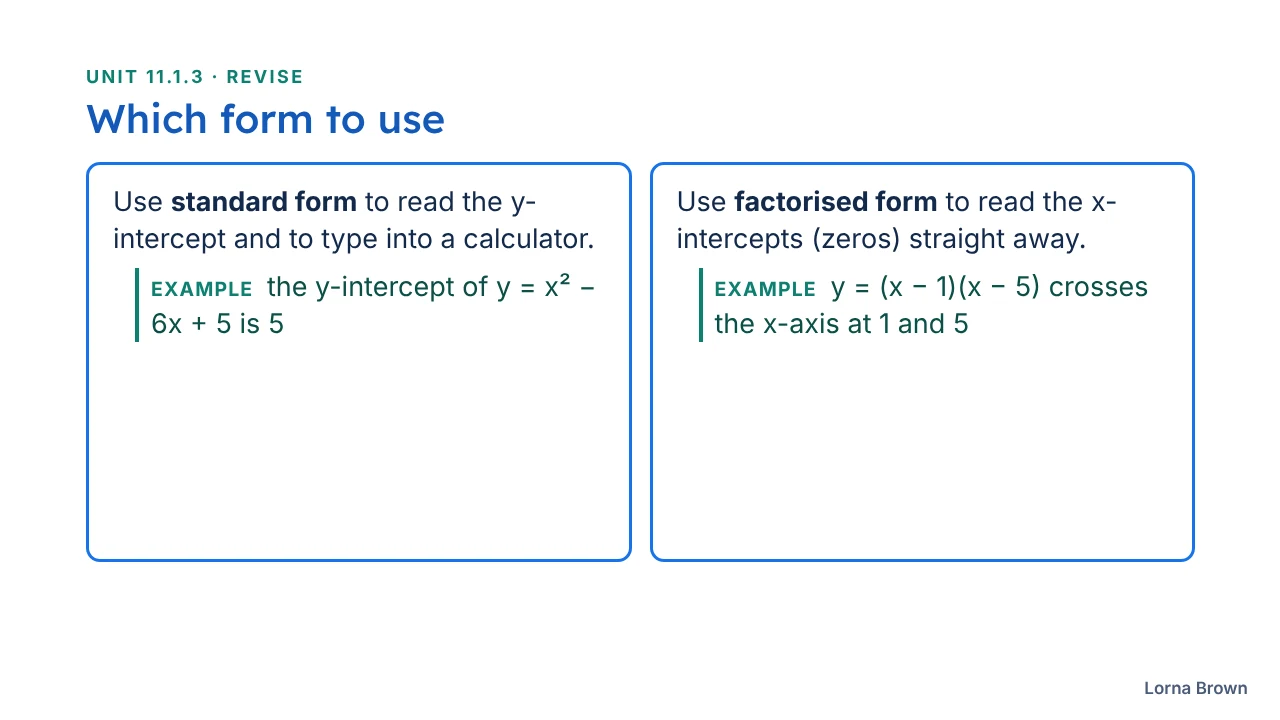
Which form to use
Domain and range
Sketching a quadratic by hand
GDC skills: TI-Nspire
Using quadratic functions to model
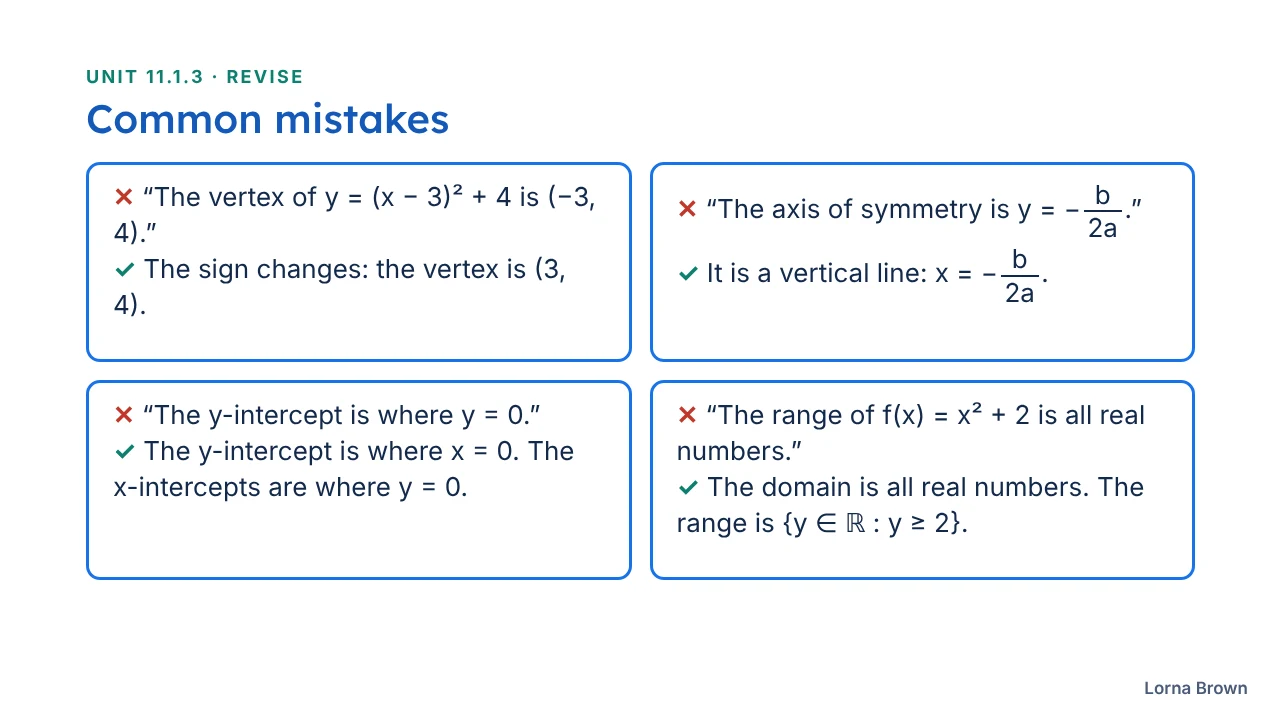
Common mistakes
✓ The sign changes: the vertex is (3, 4).
✓ It is a vertical line: x = −b2a.
✓ The y-intercept is where x = 0. The x-intercepts are where y = 0.
✓ The domain is all real numbers. The range is {y ∈ ℝ : y ≥ 2}.
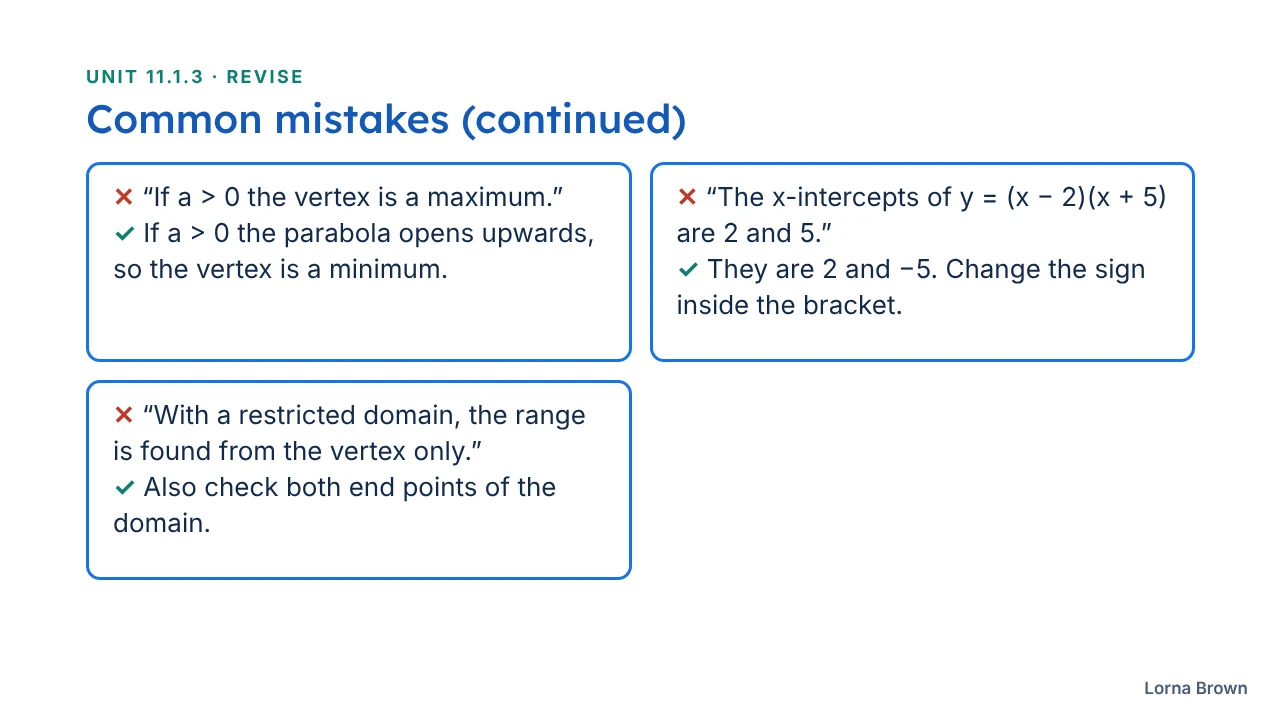
✓ If a > 0 the parabola opens upwards, so the vertex is a minimum.
✓ They are 2 and −5. Change the sign inside the bracket.
✓ Also check both end points of the domain.
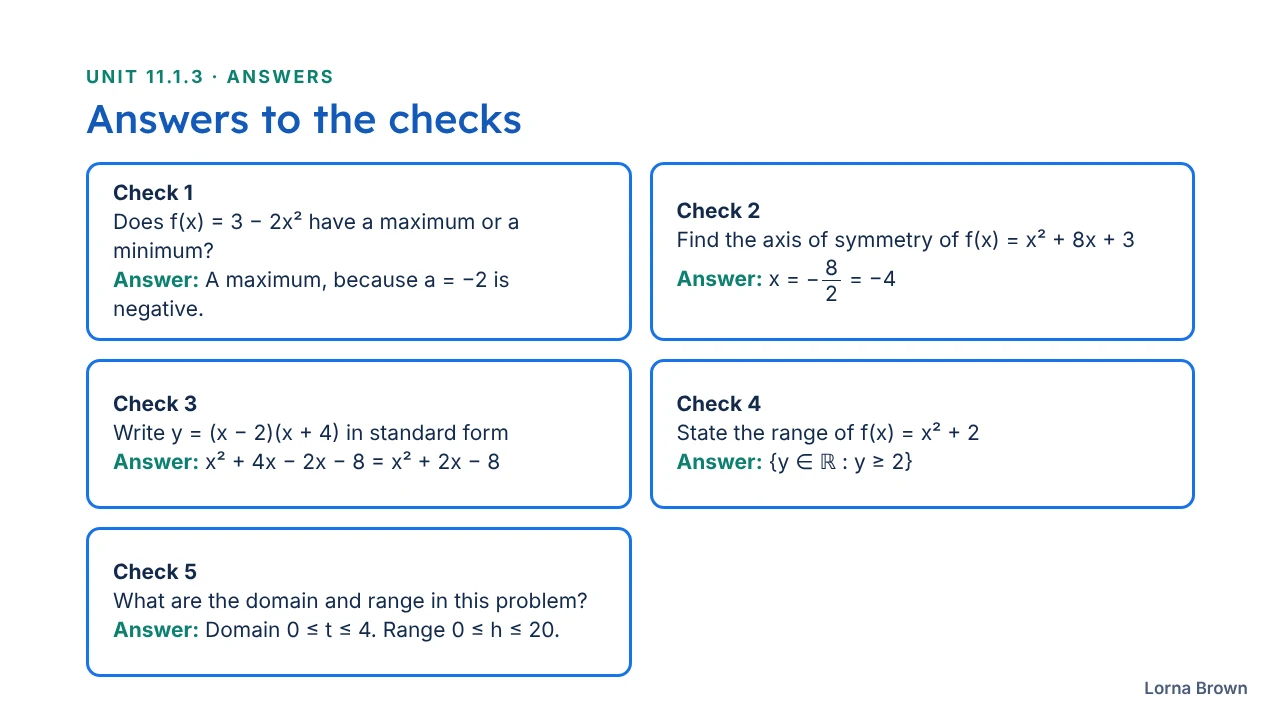
Answers to the checks
Cover this page until you have tried the check yourself.
| Check | Answer |
|---|---|
| Check 1 | Does f(x) = 3 − 2x² have a maximum or a minimum? Answer: A maximum, because a = −2 is negative. |
| Check 2 | Find the axis of symmetry of f(x) = x² + 8x + 3 Answer: x = −82 = −4 |
| Check 3 | Write y = (x − 2)(x + 4) in standard form Answer: x² + 4x − 2x − 8 = x² + 2x − 8 |
| Check 4 | State the range of f(x) = x² + 2 Answer: {y ∈ ℝ : y ≥ 2} |
| Check 5 | What are the domain and range in this problem? Answer: Domain 0 ≤ t ≤ 4. Range 0 ≤ h ≤ 20. |
11.1.3 Quadratic Functions Revision slides as text (easy to translate)
This is a plain-text version of the revision slides. Your browser can translate it into any language.
Slide 1: Quadratic Functions
Revision slides: everything you need for the test, one idea per slide.
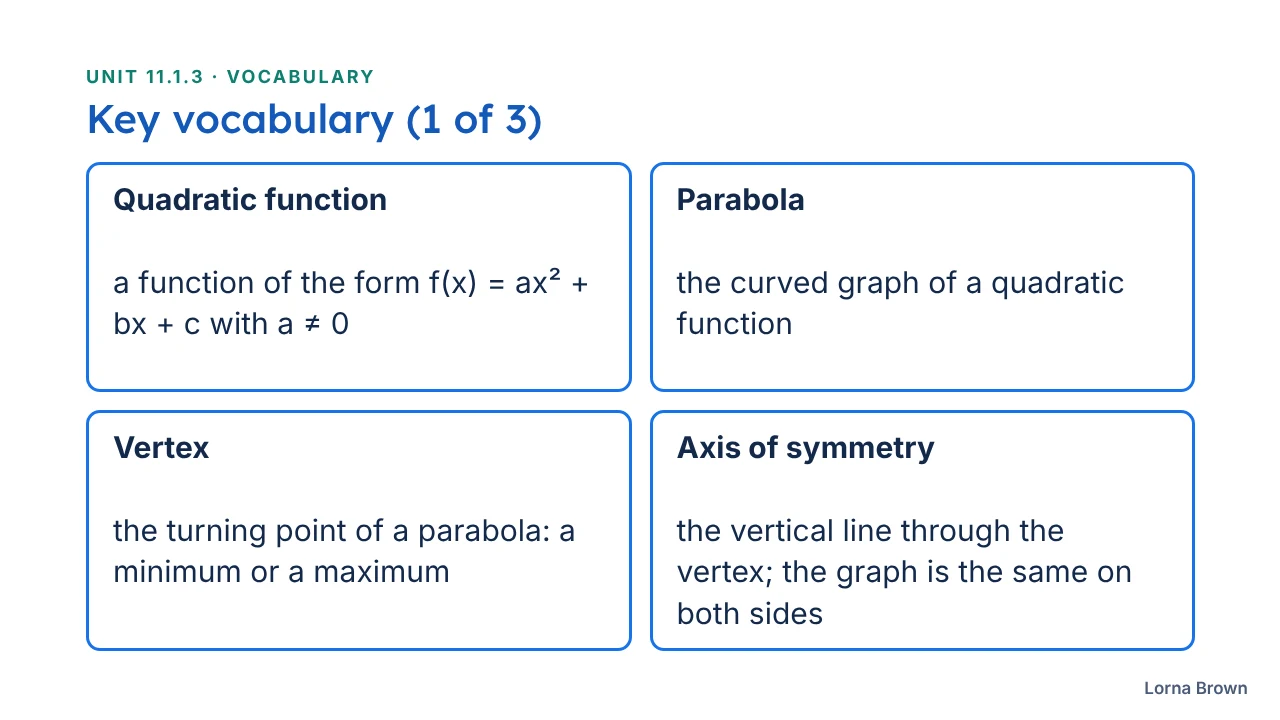
Slide 2: Key vocabulary (1 of 3)
Quadratic function: a function of the form f(x) = ax² + bx + c with a ≠ 0
Parabola: the curved graph of a quadratic function
Vertex: the turning point of a parabola: a minimum or a maximum
Axis of symmetry: the vertical line through the vertex; the graph is the same on both sides
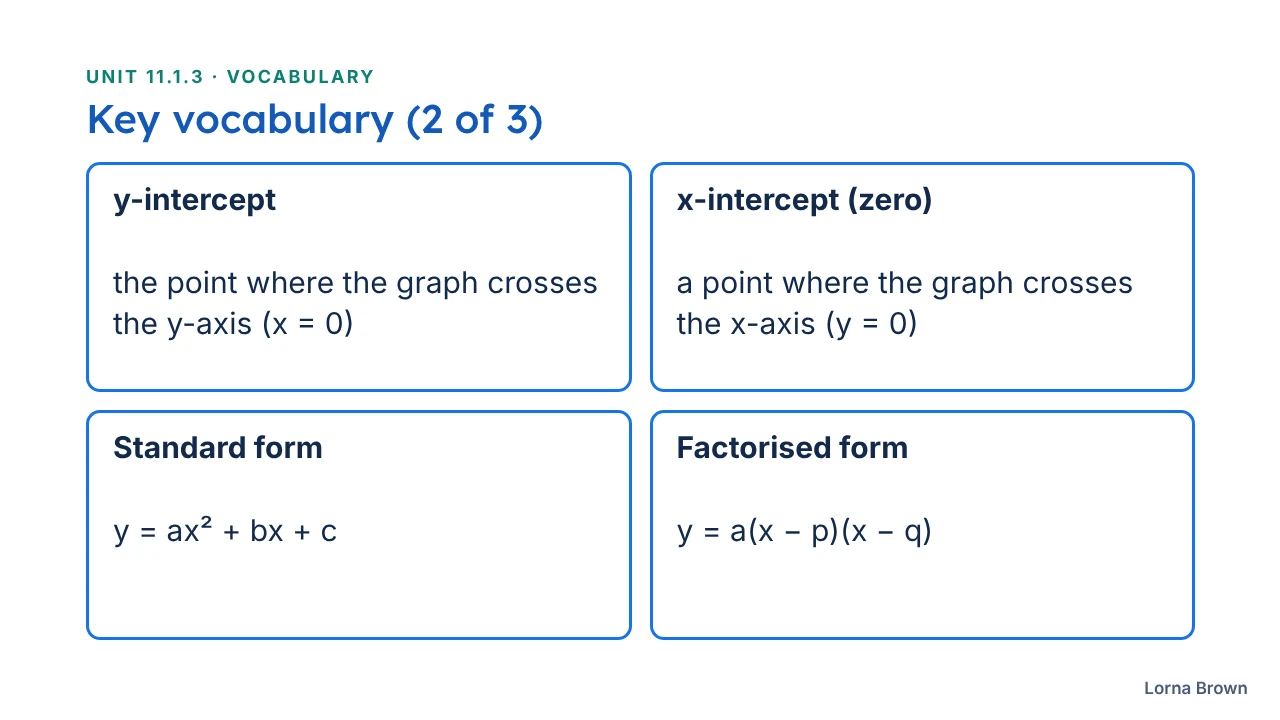
Slide 3: Key vocabulary (2 of 3)
y-intercept: the point where the graph crosses the y-axis (x = 0)
x-intercept (zero): a point where the graph crosses the x-axis (y = 0)
Standard form: y = ax² + bx + c
Factorised form: y = a(x − p)(x − q)
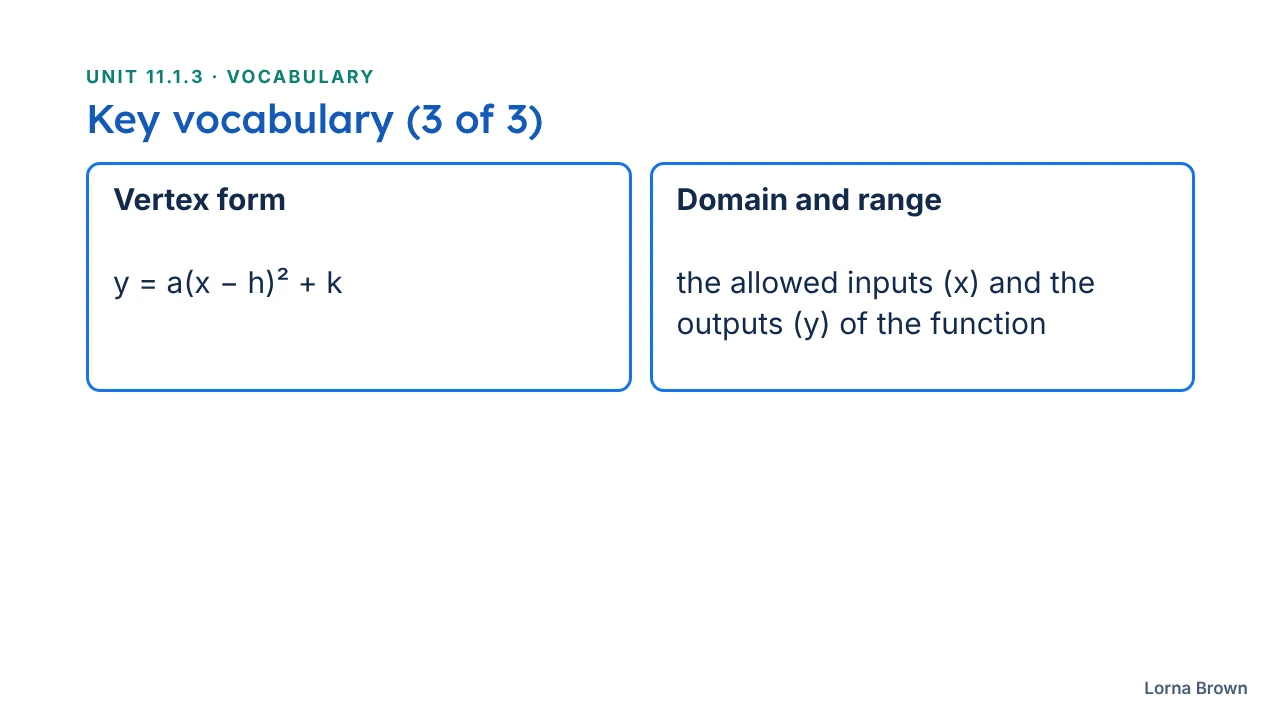
Slide 4: Key vocabulary (3 of 3)
Vertex form: y = a(x − h)² + k
Domain and range: the allowed inputs (x) and the outputs (y) of the function
Slide 5: Quadratic functions and parabolas
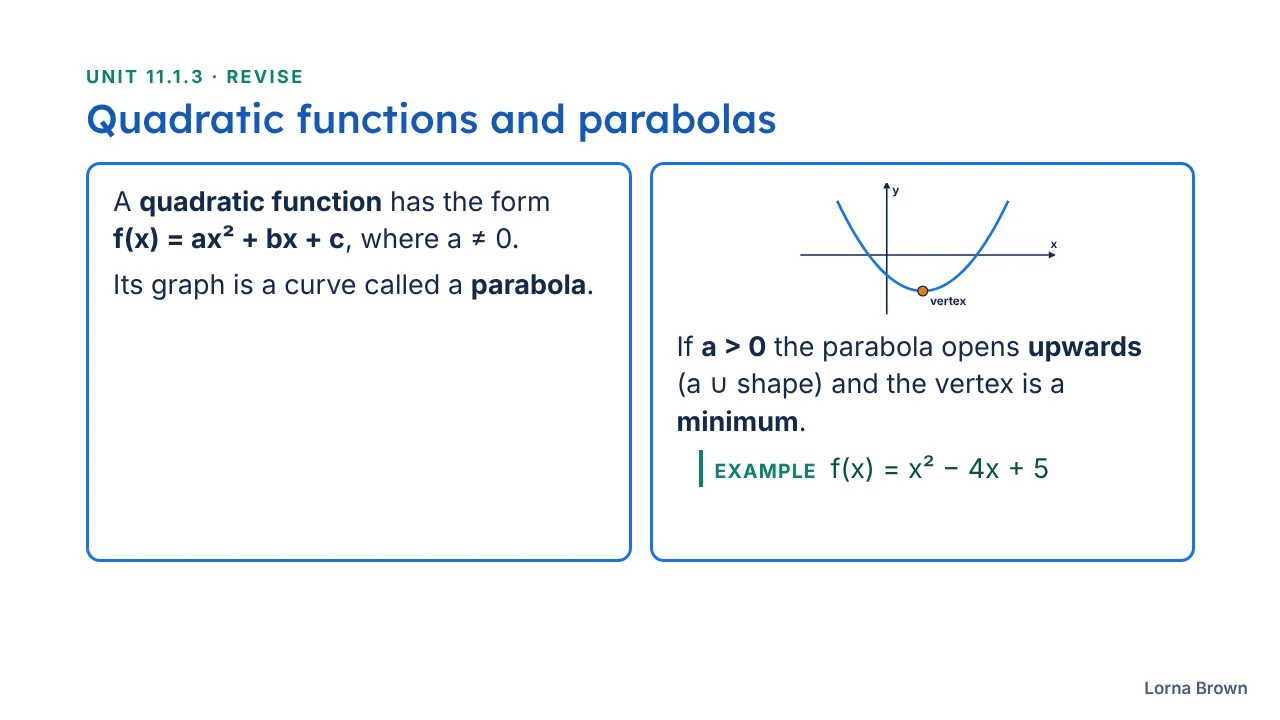
A quadratic function has the form f(x) = ax² + bx + c, where a ≠ 0.
Its graph is a curve called a parabola.
[diagram]
If a > 0 the parabola opens upwards (a ∪ shape) and the vertex is a minimum.
f(x) = x² − 4x + 5
Slide 6: Quadratic functions and parabolas (continued)
[diagram]
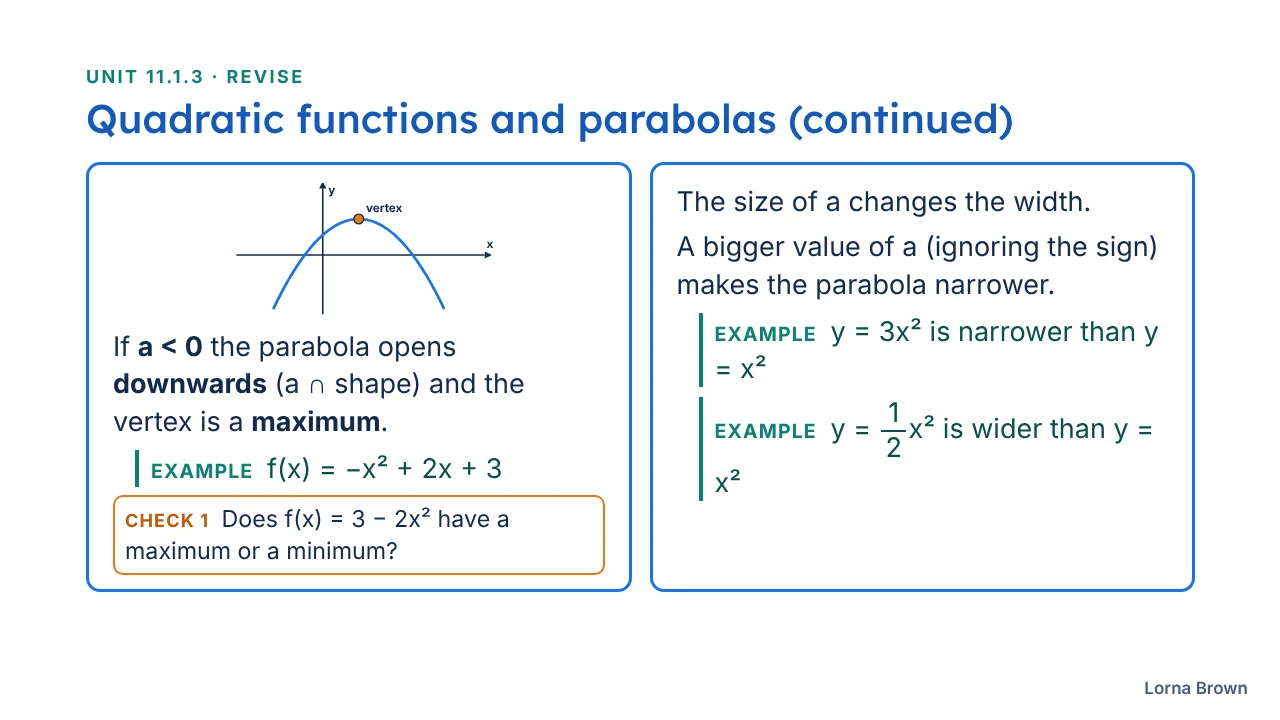
If a < 0 the parabola opens downwards (a ∩ shape) and the vertex is a maximum.
f(x) = −x² + 2x + 3
Check 1 Does f(x) = 3 − 2x² have a maximum or a minimum?
The size of a changes the width.
A bigger value of a (ignoring the sign) makes the parabola narrower.
y = 3x² is narrower than y = x²
y = 12x² is wider than y = x²
Slide 7: Intercepts and the axis of symmetry
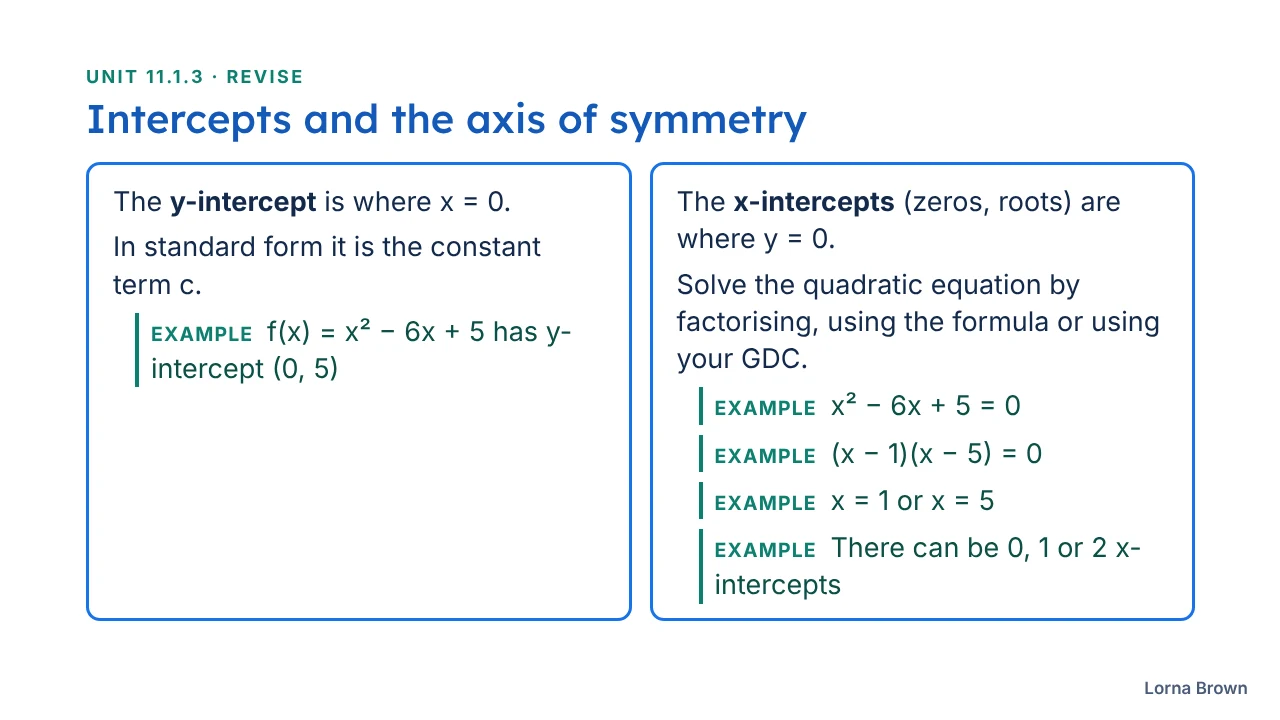
The y-intercept is where x = 0.
In standard form it is the constant term c.
f(x) = x² − 6x + 5 has y-intercept (0, 5)
The x-intercepts (zeros, roots) are where y = 0.
Solve the quadratic equation by factorising, using the formula or using your GDC.
x² − 6x + 5 = 0
(x − 1)(x − 5) = 0
x = 1 or x = 5
There can be 0, 1 or 2 x-intercepts
Slide 8: Intercepts and the axis of symmetry (continued)
[diagram]
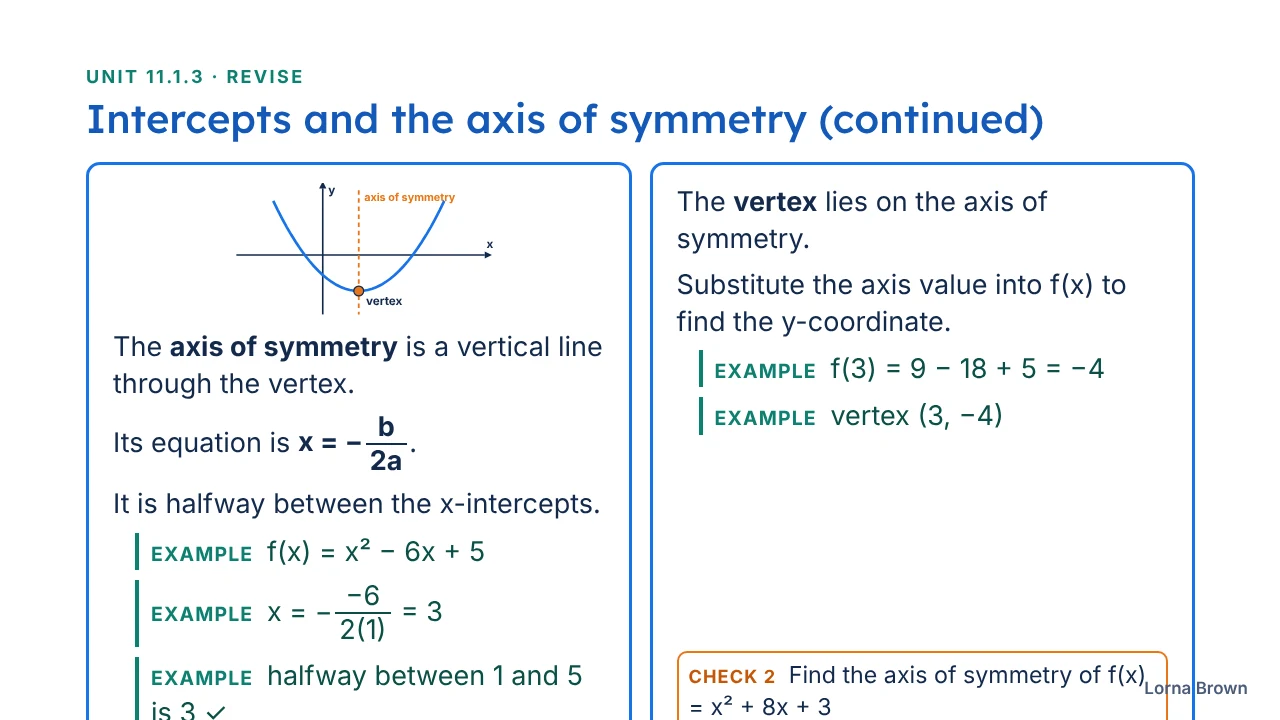
The axis of symmetry is a vertical line through the vertex.
Its equation is x = −b2a.
It is halfway between the x-intercepts.
f(x) = x² − 6x + 5
x = −−62(1) = 3
halfway between 1 and 5 is 3 ✓
The vertex lies on the axis of symmetry.
Substitute the axis value into f(x) to find the y-coordinate.
f(3) = 9 − 18 + 5 = −4
vertex (3, −4)
Check 2 Find the axis of symmetry of f(x) = x² + 8x + 3
Slide 9: The three forms of a quadratic
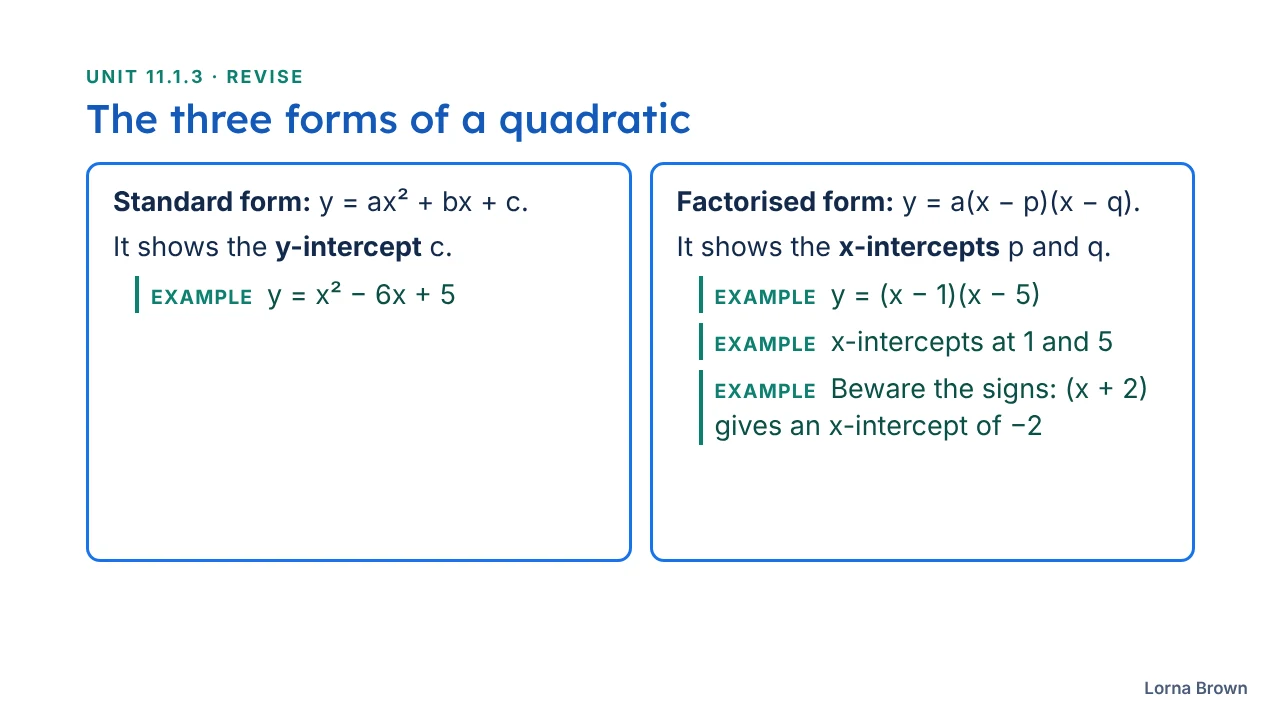
Standard form: y = ax² + bx + c.
It shows the y-intercept c.
y = x² − 6x + 5
Factorised form: y = a(x − p)(x − q).
It shows the x-intercepts p and q.
y = (x − 1)(x − 5)
x-intercepts at 1 and 5
Beware the signs: (x + 2) gives an x-intercept of −2
Slide 10: The three forms of a quadratic (continued)
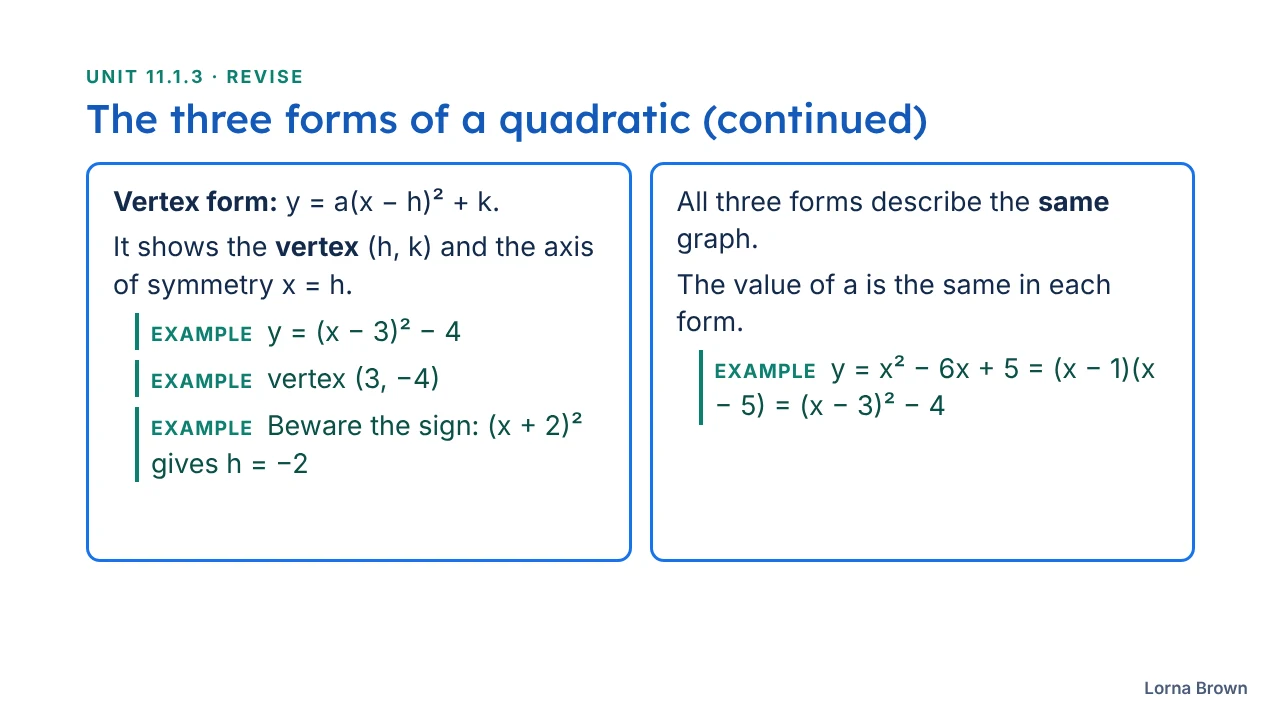
Vertex form: y = a(x − h)² + k.
It shows the vertex (h, k) and the axis of symmetry x = h.
y = (x − 3)² − 4
vertex (3, −4)
Beware the sign: (x + 2)² gives h = −2
All three forms describe the same graph.
The value of a is the same in each form.
y = x² − 6x + 5 = (x − 1)(x − 5) = (x − 3)² − 4
Slide 11: Converting between the forms
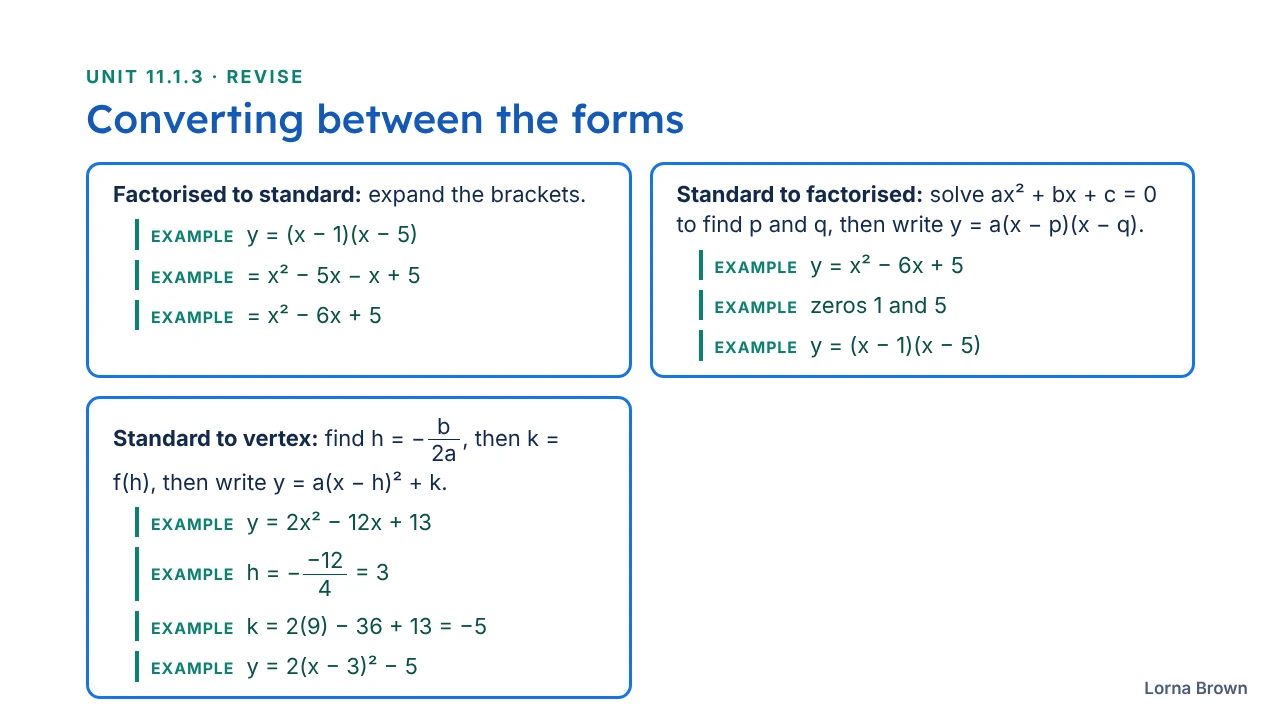
Factorised to standard: expand the brackets.
y = (x − 1)(x − 5)
= x² − 5x − x + 5
= x² − 6x + 5
Standard to factorised: solve ax² + bx + c = 0 to find p and q, then write y = a(x − p)(x − q).
y = x² − 6x + 5
zeros 1 and 5
y = (x − 1)(x − 5)
Standard to vertex: find h = −b2a, then k = f(h), then write y = a(x − h)² + k.
y = 2x² − 12x + 13
h = −−124 = 3
k = 2(9) − 36 + 13 = −5
y = 2(x − 3)² − 5
Slide 12: Converting between the forms (continued)
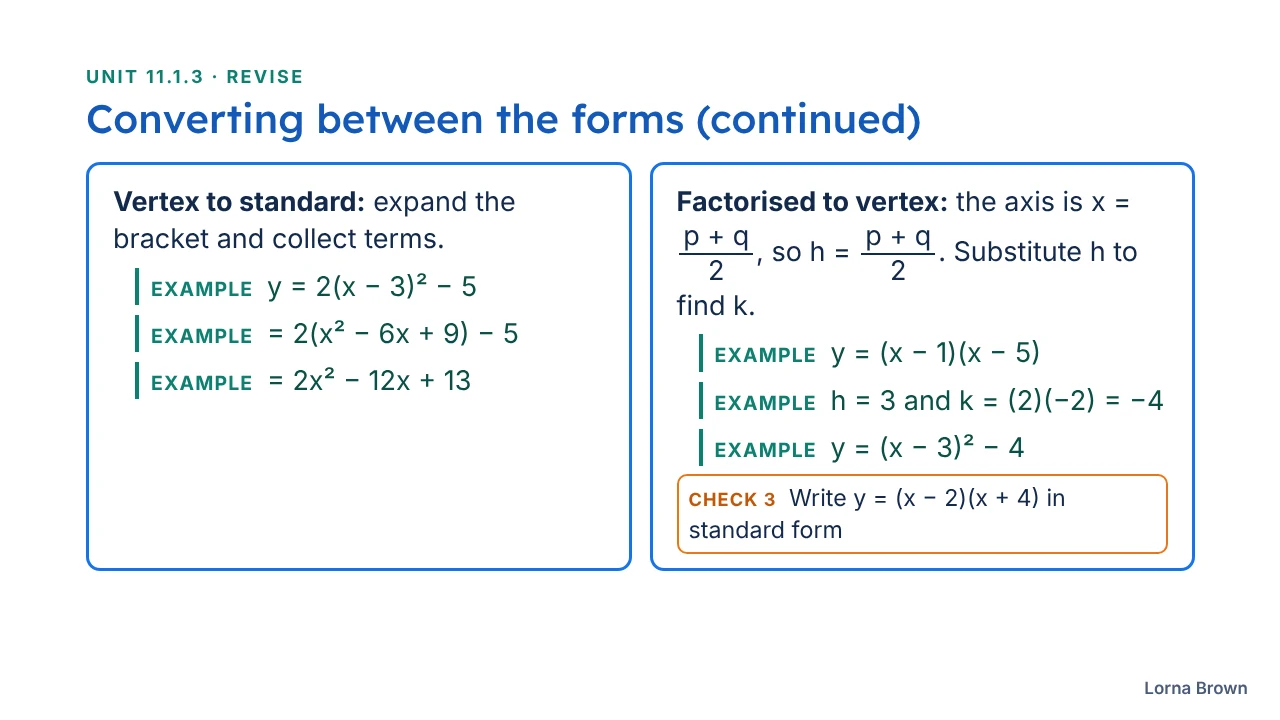
Vertex to standard: expand the bracket and collect terms.
y = 2(x − 3)² − 5
= 2(x² − 6x + 9) − 5
= 2x² − 12x + 13
Factorised to vertex: the axis is x = p + q2, so h = p + q2. Substitute h to find k.
y = (x − 1)(x − 5)
h = 3 and k = (2)(−2) = −4
y = (x − 3)² − 4
Check 3 Write y = (x − 2)(x + 4) in standard form
Slide 13: Which form to use
Use standard form to read the y-intercept and to type into a calculator.
the y-intercept of y = x² − 6x + 5 is 5
Use factorised form to read the x-intercepts (zeros) straight away.
y = (x − 1)(x − 5) crosses the x-axis at 1 and 5
Slide 14: Which form to use (continued)
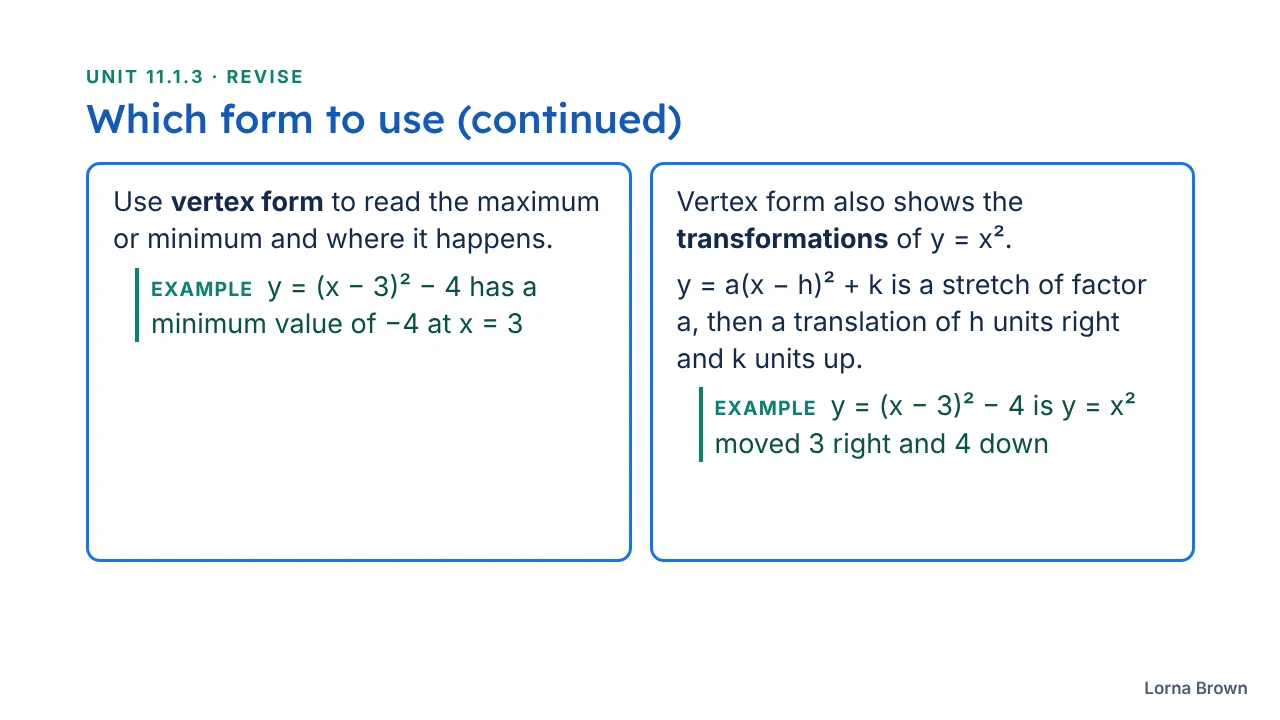
Use vertex form to read the maximum or minimum and where it happens.
y = (x − 3)² − 4 has a minimum value of −4 at x = 3
Vertex form also shows the transformations of y = x².
y = a(x − h)² + k is a stretch of factor a, then a translation of h units right and k units up.
y = (x − 3)² − 4 is y = x² moved 3 right and 4 down
Slide 15: Domain and range
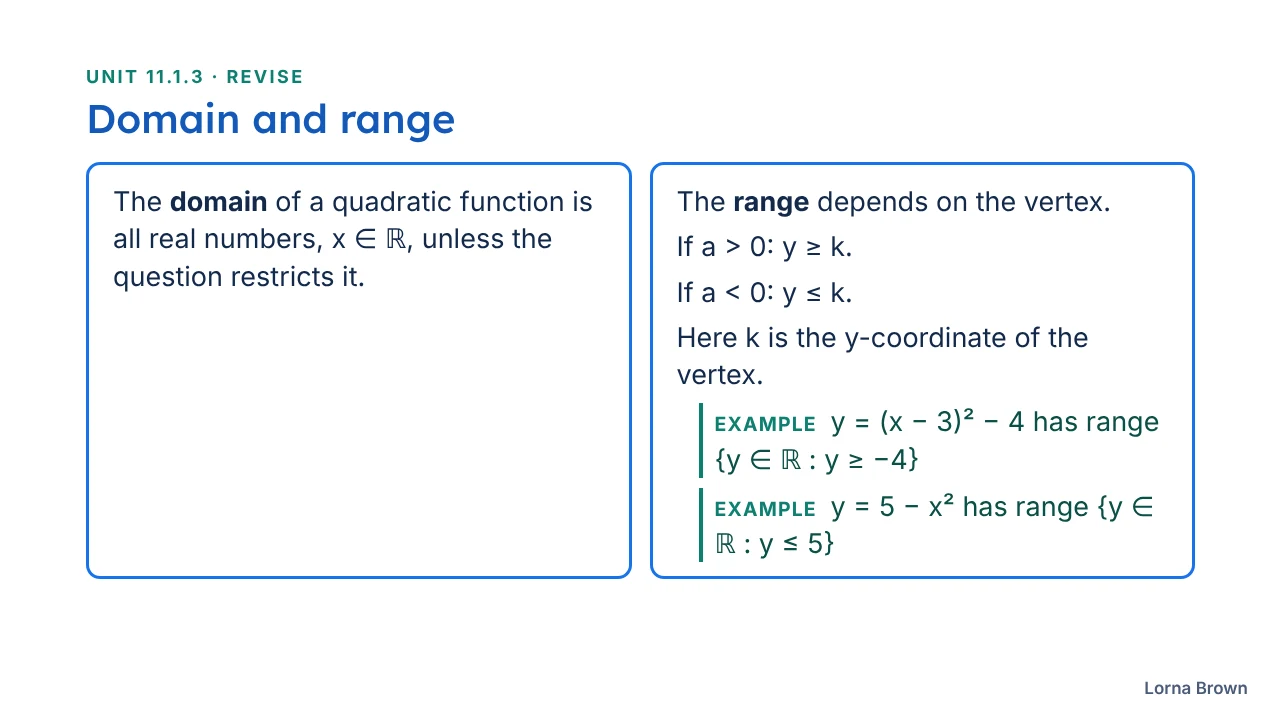
The domain of a quadratic function is all real numbers, x ∈ ℝ, unless the question restricts it.
The range depends on the vertex.
If a > 0: y ≥ k.
If a < 0: y ≤ k.
Here k is the y-coordinate of the vertex.
y = (x − 3)² − 4 has range {y ∈ ℝ : y ≥ −4}
y = 5 − x² has range {y ∈ ℝ : y ≤ 5}
Slide 16: Domain and range (continued)
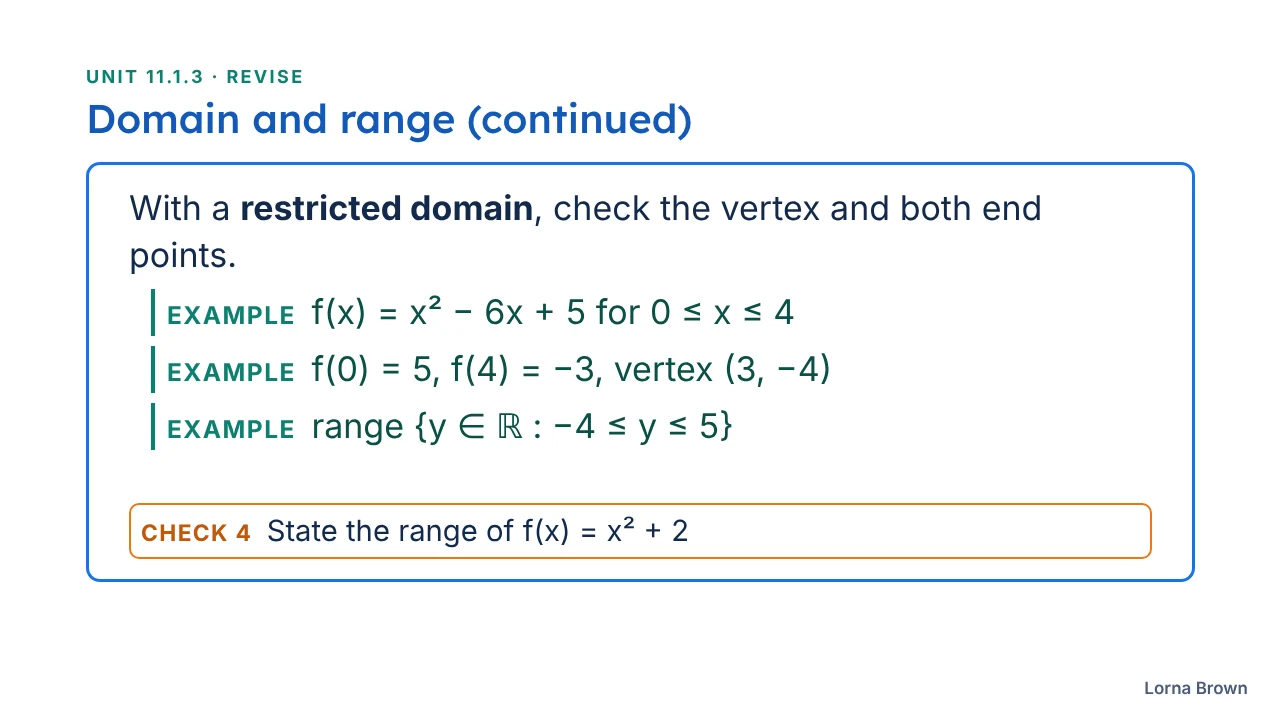
With a restricted domain, check the vertex and both end points.
f(x) = x² − 6x + 5 for 0 ≤ x ≤ 4
f(0) = 5, f(4) = −3, vertex (3, −4)
range {y ∈ ℝ : −4 ≤ y ≤ 5}
Check 4 State the range of f(x) = x² + 2
Slide 17: Sketching a quadratic by hand
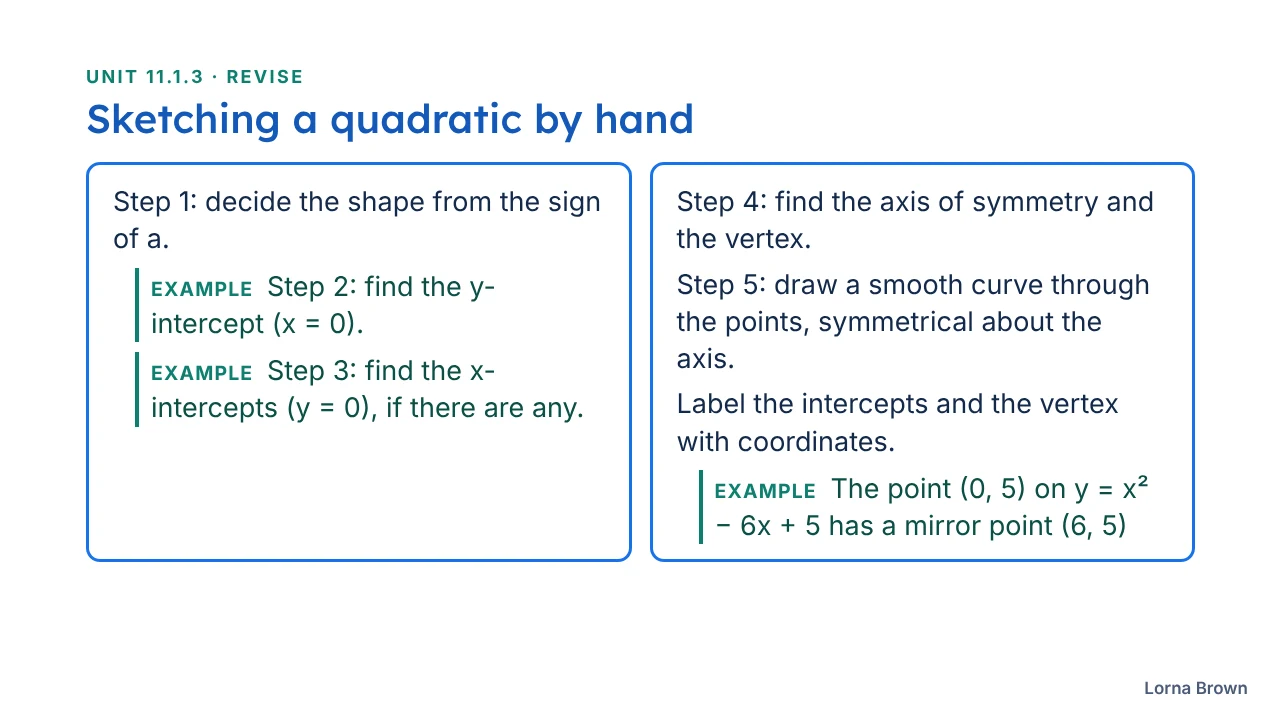
Step 1: decide the shape from the sign of a.
Step 2: find the y-intercept (x = 0).
Step 3: find the x-intercepts (y = 0), if there are any.
Step 4: find the axis of symmetry and the vertex.
Step 5: draw a smooth curve through the points, symmetrical about the axis.
Label the intercepts and the vertex with coordinates.
The point (0, 5) on y = x² − 6x + 5 has a mirror point (6, 5)
Slide 18: GDC skills: TI-Nspire
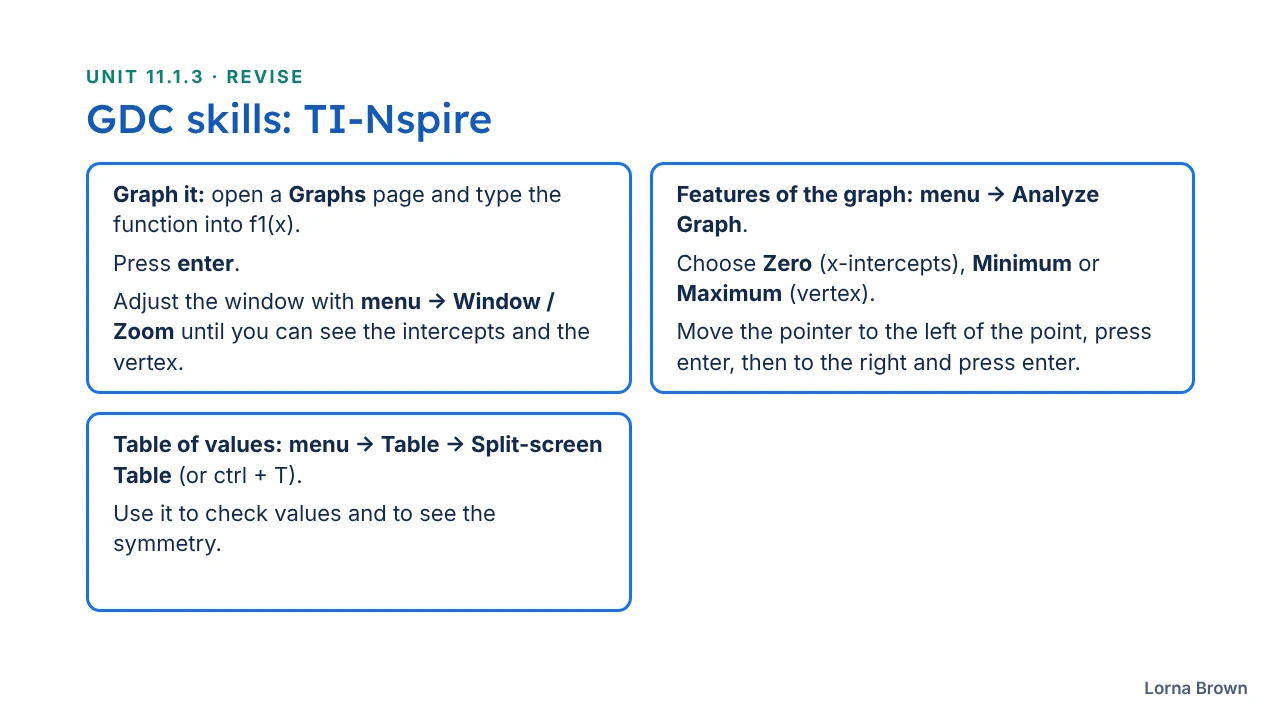
Graph it: open a Graphs page and type the function into f1(x).
Press enter.
Adjust the window with menu → Window / Zoom until you can see the intercepts and the vertex.
Features of the graph: menu → Analyze Graph.
Choose Zero (x-intercepts), Minimum or Maximum (vertex).
Move the pointer to the left of the point, press enter, then to the right and press enter.
Table of values: menu → Table → Split-screen Table (or ctrl + T).
Use it to check values and to see the symmetry.
Slide 19: GDC skills: TI-Nspire (continued)
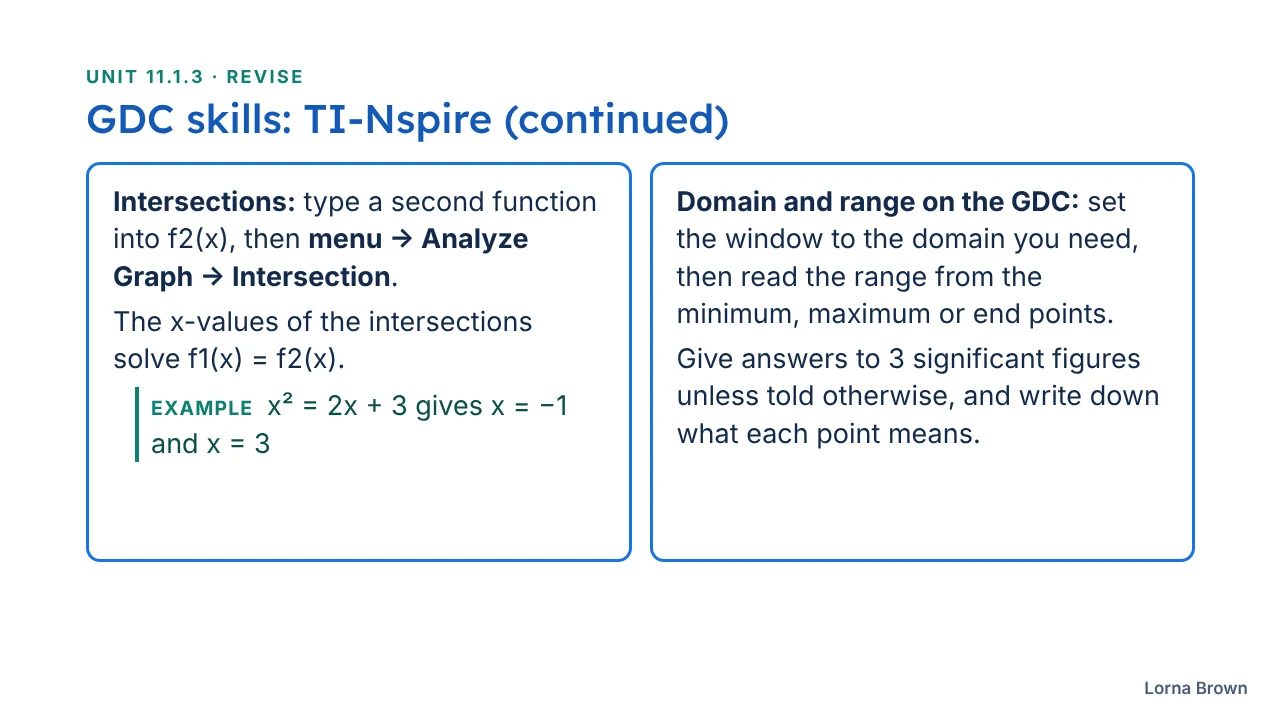
Intersections: type a second function into f2(x), then menu → Analyze Graph → Intersection.
The x-values of the intersections solve f1(x) = f2(x).
x² = 2x + 3 gives x = −1 and x = 3
Domain and range on the GDC: set the window to the domain you need, then read the range from the minimum, maximum or end points.
Give answers to 3 significant figures unless told otherwise, and write down what each point means.
Slide 20: Using quadratic functions to model
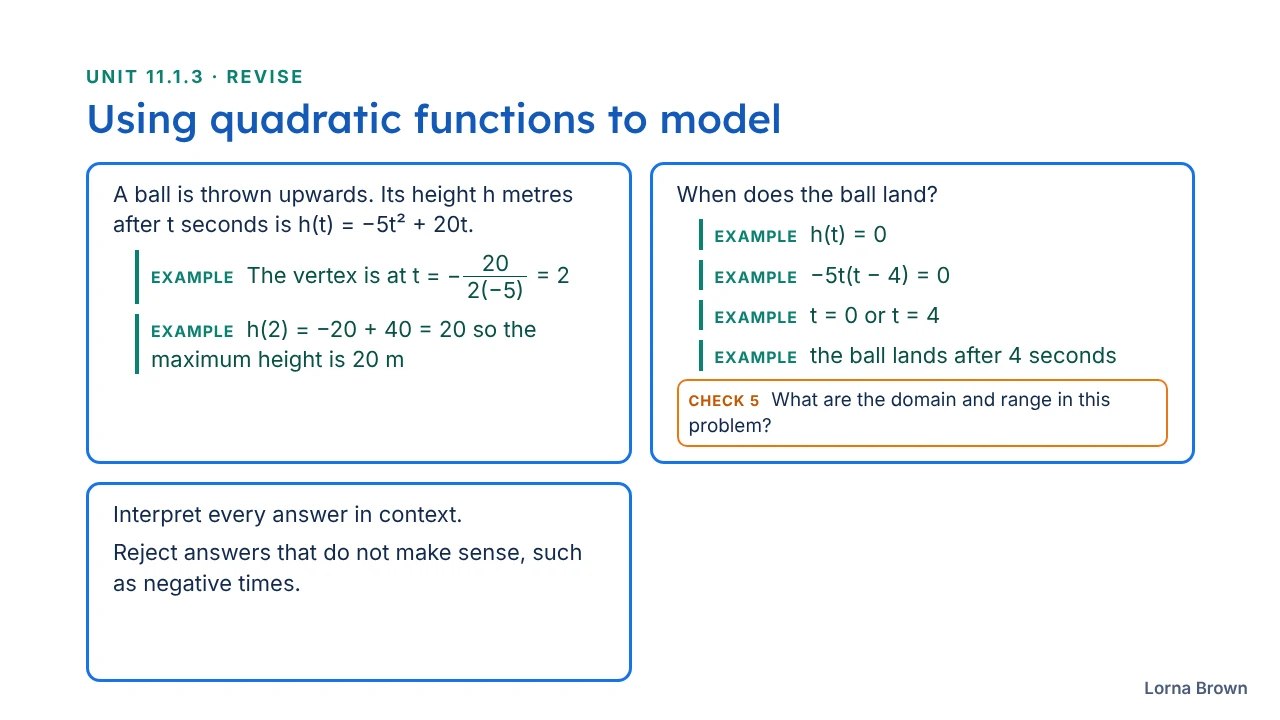
A ball is thrown upwards. Its height h metres after t seconds is h(t) = −5t² + 20t.
The vertex is at t = −202(−5) = 2
h(2) = −20 + 40 = 20 so the maximum height is 20 m
When does the ball land?
h(t) = 0
−5t(t − 4) = 0
t = 0 or t = 4
the ball lands after 4 seconds
Check 5 What are the domain and range in this problem?
Interpret every answer in context.
Reject answers that do not make sense, such as negative times.
Slide 21: Common mistakes
✕ “The vertex of y = (x − 3)² + 4 is (−3, 4).”
✓ The sign changes: the vertex is (3, 4).
✕ “The axis of symmetry is y = −b2a.”
✓ It is a vertical line: x = −b2a.
✕ “The y-intercept is where y = 0.”
✓ The y-intercept is where x = 0. The x-intercepts are where y = 0.
✕ “The range of f(x) = x² + 2 is all real numbers.”
✓ The domain is all real numbers. The range is {y ∈ ℝ : y ≥ 2}.
Slide 22: Common mistakes (continued)
✕ “If a > 0 the vertex is a maximum.”
✓ If a > 0 the parabola opens upwards, so the vertex is a minimum.
✕ “The x-intercepts of y = (x − 2)(x + 5) are 2 and 5.”
✓ They are 2 and −5. Change the sign inside the bracket.
✕ “With a restricted domain, the range is found from the vertex only.”
✓ Also check both end points of the domain.
Slide 23: Answers to the checks
Check 1
Does f(x) = 3 − 2x² have a maximum or a minimum?
Answer: A maximum, because a = −2 is negative.
Check 2
Find the axis of symmetry of f(x) = x² + 8x + 3
Answer: x = −82 = −4
Check 3
Write y = (x − 2)(x + 4) in standard form
Answer: x² + 4x − 2x − 8 = x² + 2x − 8
Check 4
State the range of f(x) = x² + 2
Answer: {y ∈ ℝ : y ≥ 2}
Check 5
What are the domain and range in this problem?
Answer: Domain 0 ≤ t ≤ 4. Range 0 ≤ h ≤ 20.