10.2 Exponents and Indices
Revision slides, flash cards, quizzes, revision notes and a text version of the slides for this unit. Open to everyone, no password needed.
Flash cards
Click a card to flip it. Say the answer first, then check.
Print the cards (PDF): word on the front, answer on the back, double-sided, flip on the long edge
Quizzes
Pick an answer to see if you are right. Your score shows at the end of each quiz.
Revision notes
Download and print the revision notes (PDF, A4)
The big idea. Why keep an answer exact when a calculator gives a decimal? Index laws, negative and fractional indices, exponential equations, surds and rationalising denominators.
Key vocabulary
| Word | Meaning |
|---|---|
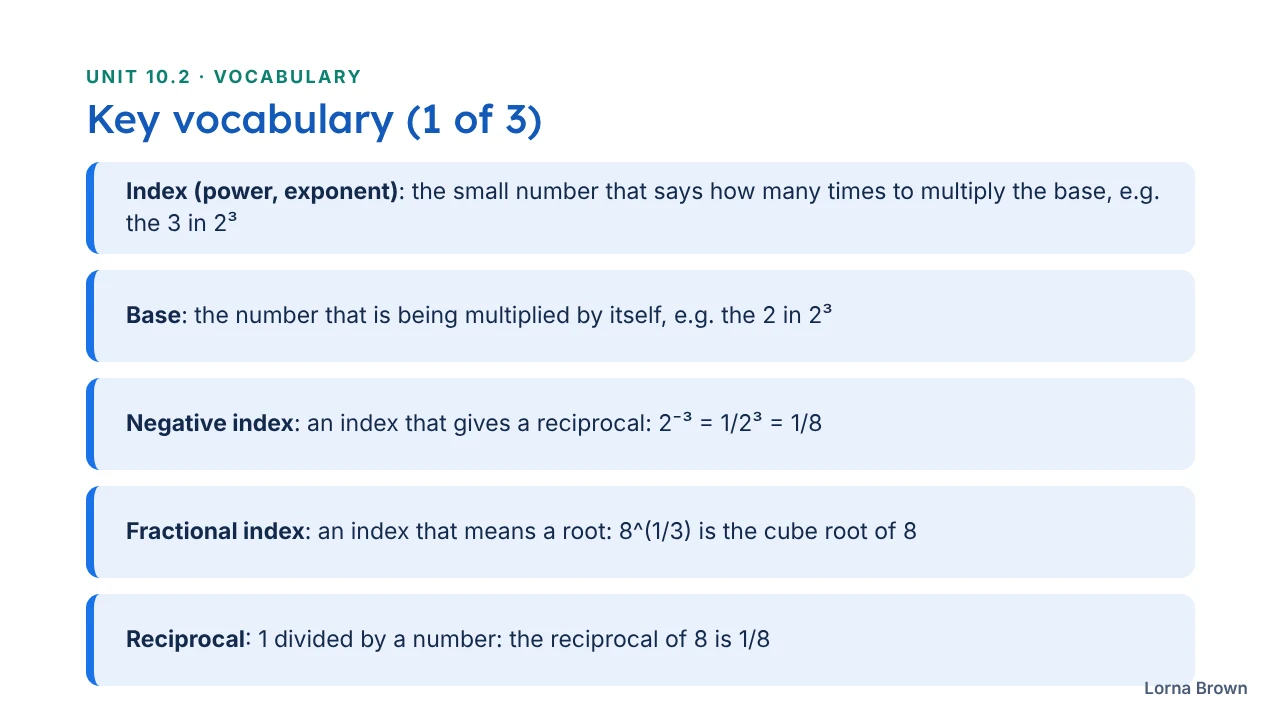
| Index (power, exponent) | the small number that says how many times to multiply the base, e.g. the 3 in 2³ |
| Base | the number that is being multiplied by itself, e.g. the 2 in 2³ |
| Negative index | an index that gives a reciprocal: 2⁻³ = 1/2³ = 1/8 |
| Fractional index | an index that means a root: 8^(1/3) is the cube root of 8 |
| Reciprocal | 1 divided by a number: the reciprocal of 8 is 1/8 |
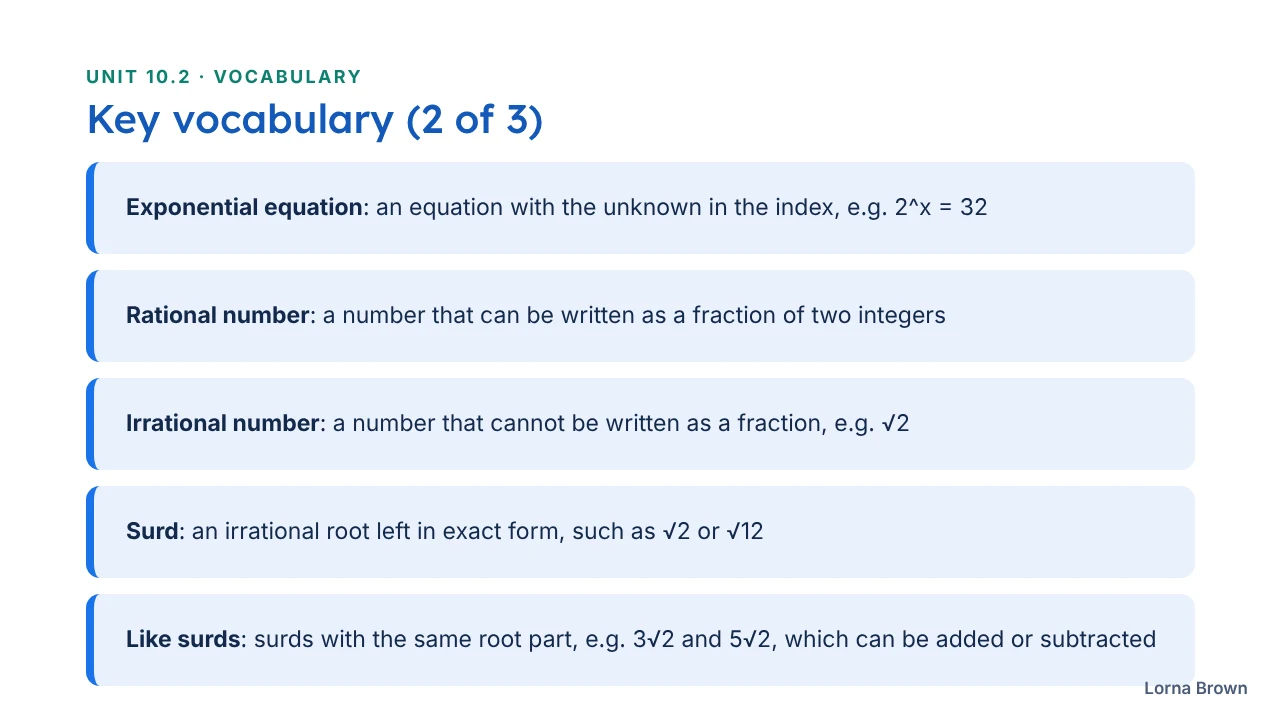
| Exponential equation | an equation with the unknown in the index, e.g. 2^x = 32 |
| Rational number | a number that can be written as a fraction of two integers |
| Irrational number | a number that cannot be written as a fraction, e.g. √2 |
| Surd | an irrational root left in exact form, such as √2 or √12 |
| Like surds | surds with the same root part, e.g. 3√2 and 5√2, which can be added or subtracted |
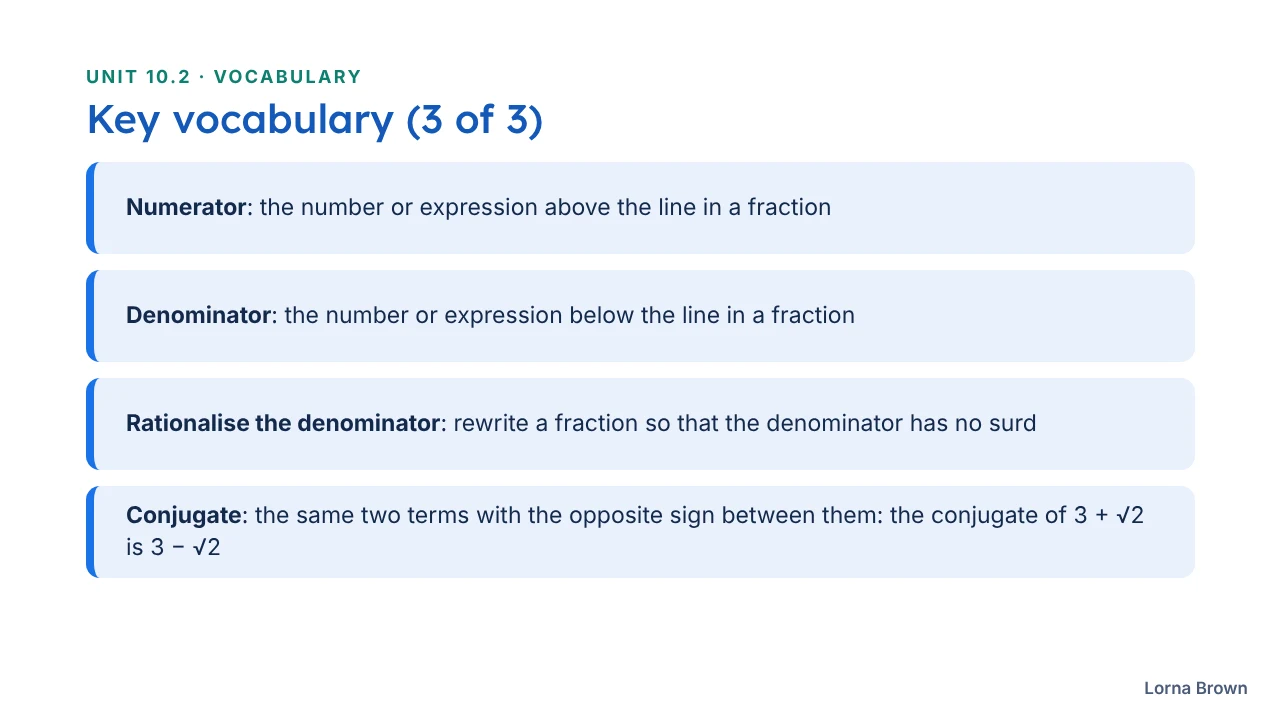
| Numerator | the number or expression above the line in a fraction |
| Denominator | the number or expression below the line in a fraction |
| Rationalise the denominator | rewrite a fraction so that the denominator has no surd |
| Conjugate | the same two terms with the opposite sign between them: the conjugate of 3 + √2 is 3 − √2 |
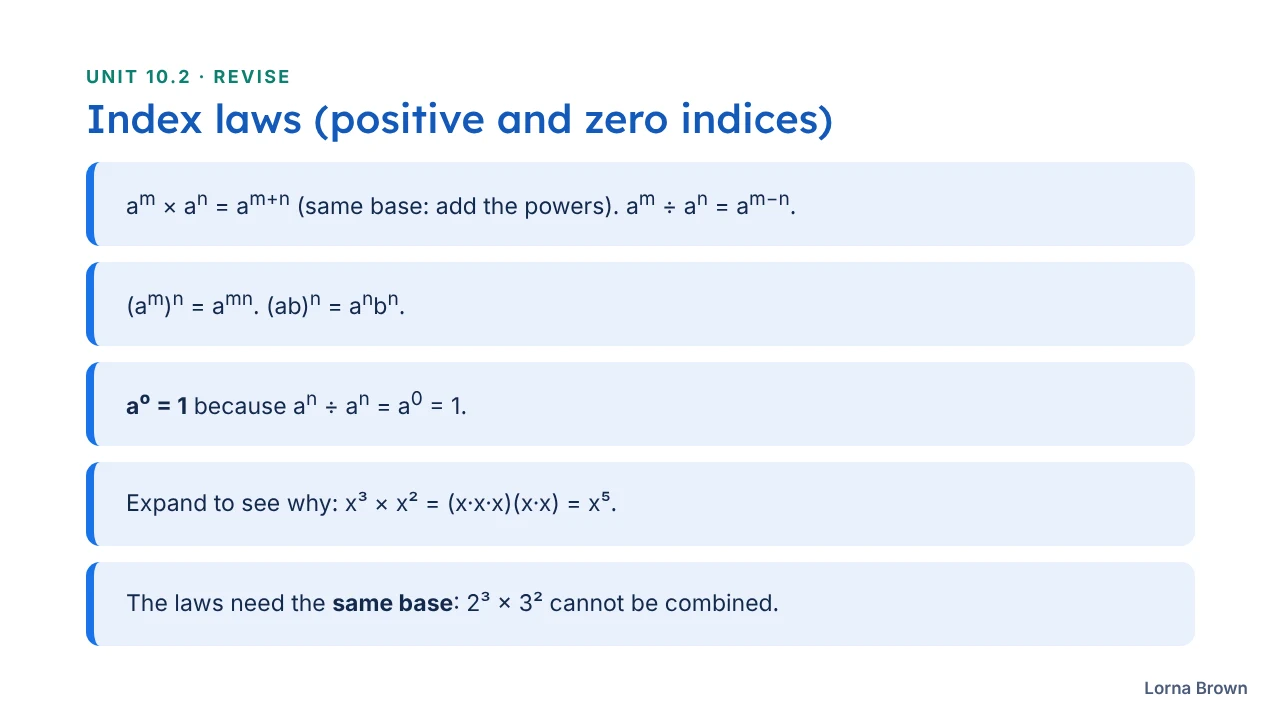
Index laws (positive and zero indices)
- am × an = am+n (same base: add the powers). am ÷ an = am−n.
- (am)n = amn. (ab)n = anbn.
- a⁰ = 1 because an ÷ an = a0 = 1.
- Expand to see why: x³ × x² = (x·x·x)(x·x) = x⁵.
- The laws need the same base: 2³ × 3² cannot be combined.
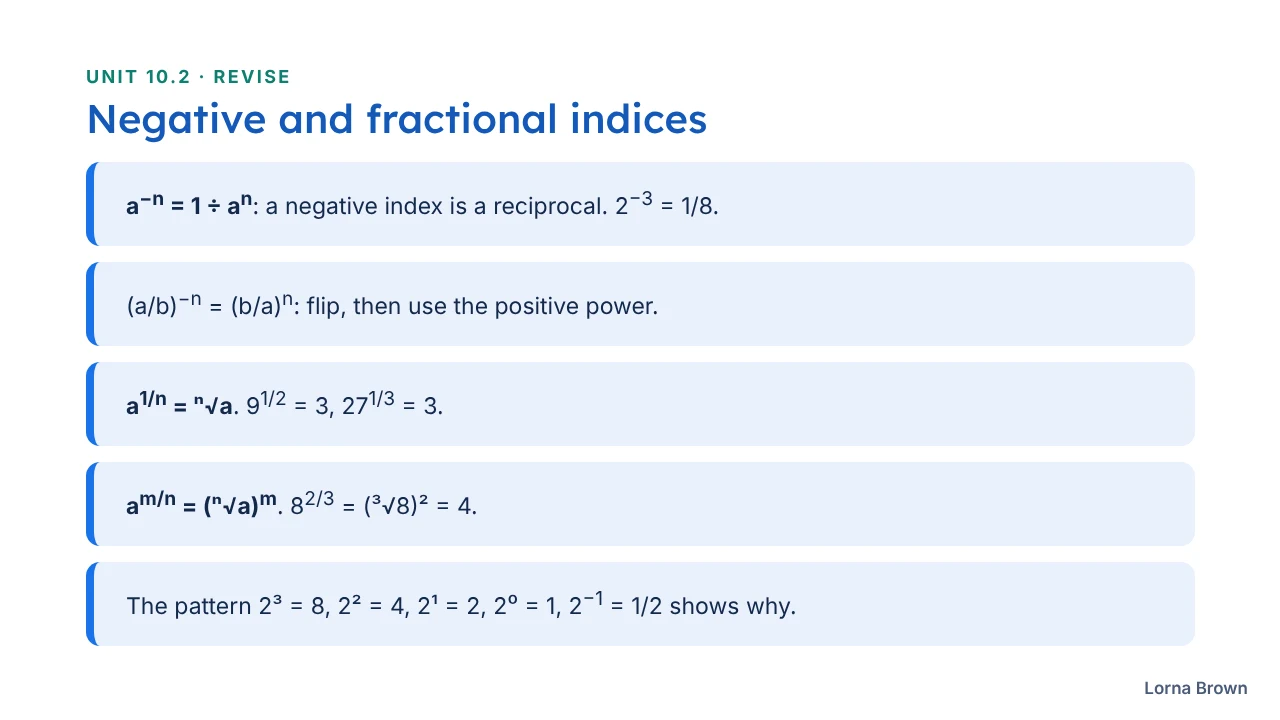
Negative and fractional indices
- a−n = 1 ÷ an: a negative index is a reciprocal. 2−3 = 1/8.
- (a/b)−n = (b/a)n: flip, then use the positive power.
- a1/n = ⁿ√a. 91/2 = 3, 271/3 = 3.
- am/n = (ⁿ√a)m. 82/3 = (³√8)² = 4.
- The pattern 2³ = 8, 2² = 4, 2¹ = 2, 2⁰ = 1, 2−1 = 1/2 shows why.
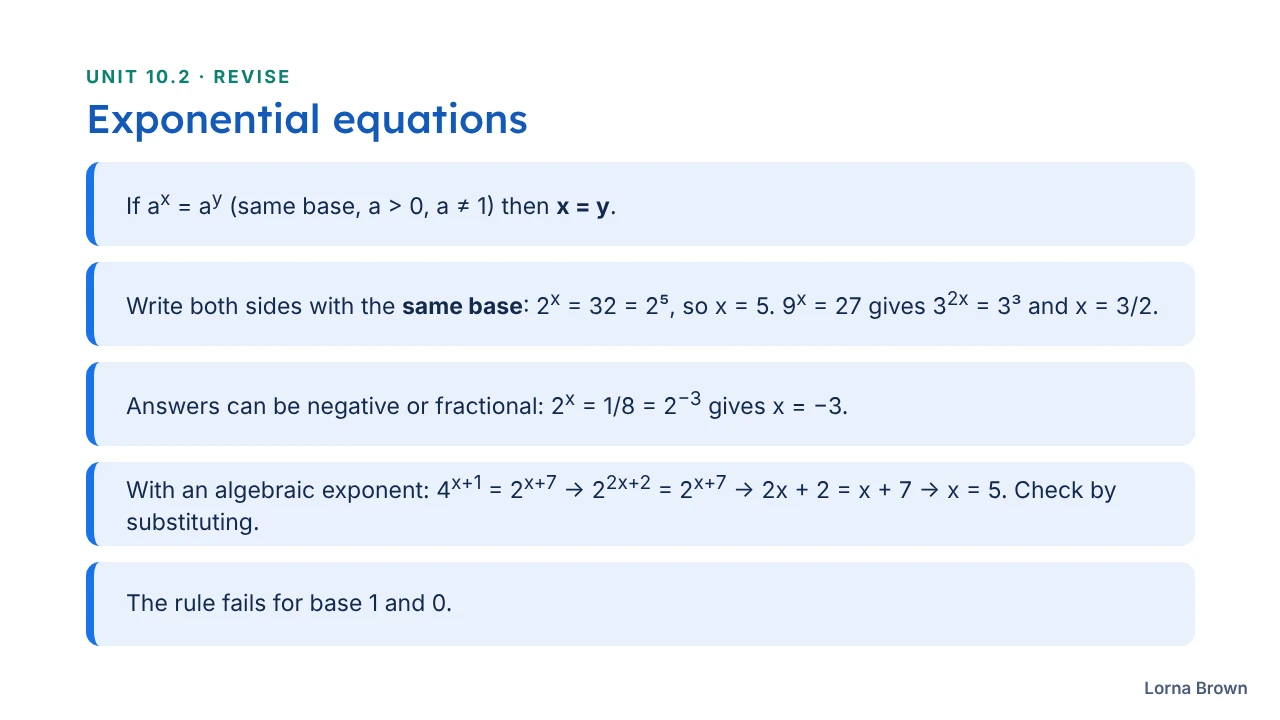
Exponential equations
- If ax = ay (same base, a > 0, a ≠ 1) then x = y.
- Write both sides with the same base: 2x = 32 = 2⁵, so x = 5. 9x = 27 gives 32x = 3³ and x = 3/2.
- Answers can be negative or fractional: 2x = 1/8 = 2−3 gives x = −3.
- With an algebraic exponent: 4x+1 = 2x+7 → 22x+2 = 2x+7 → 2x + 2 = x + 7 → x = 5. Check by substituting.
- The rule fails for base 1 and 0.
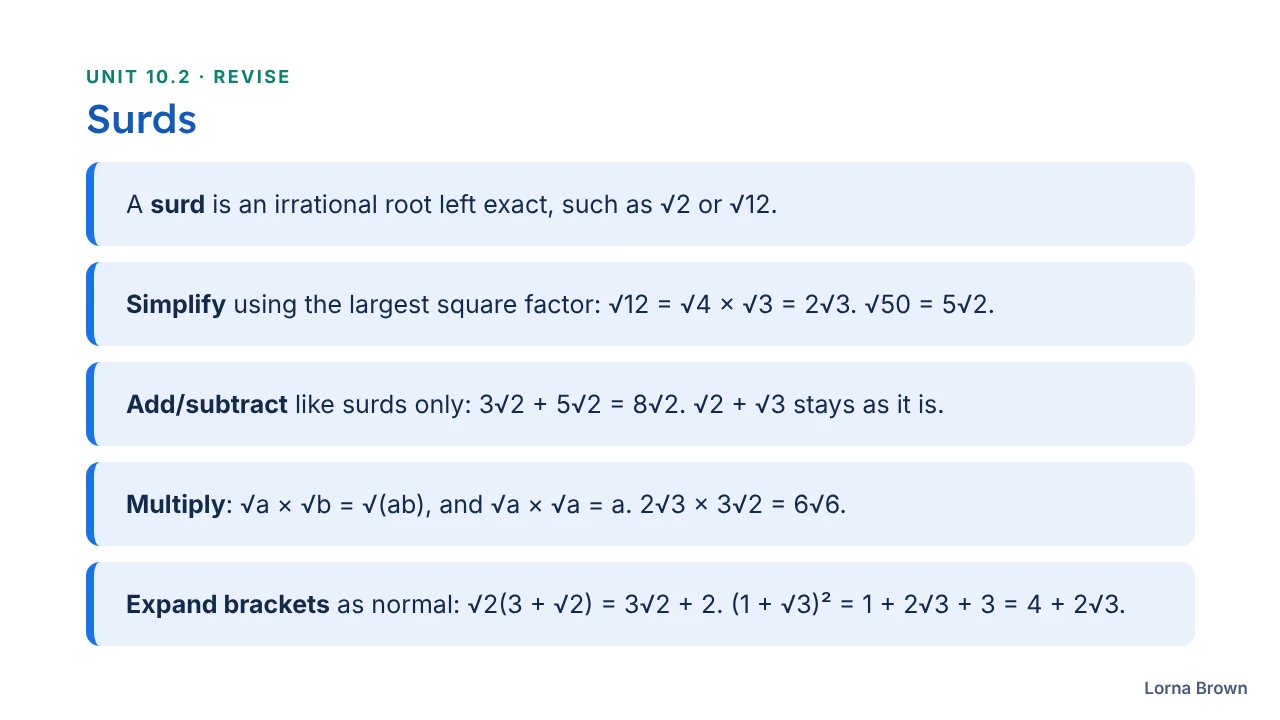
Surds
- A surd is an irrational root left exact, such as √2 or √12.
- Simplify using the largest square factor: √12 = √4 × √3 = 2√3. √50 = 5√2.
- Add/subtract like surds only: 3√2 + 5√2 = 8√2. √2 + √3 stays as it is.
- Multiply: √a × √b = √(ab), and √a × √a = a. 2√3 × 3√2 = 6√6.
- Expand brackets as normal: √2(3 + √2) = 3√2 + 2. (1 + √3)² = 1 + 2√3 + 3 = 4 + 2√3.
Rationalising the denominator
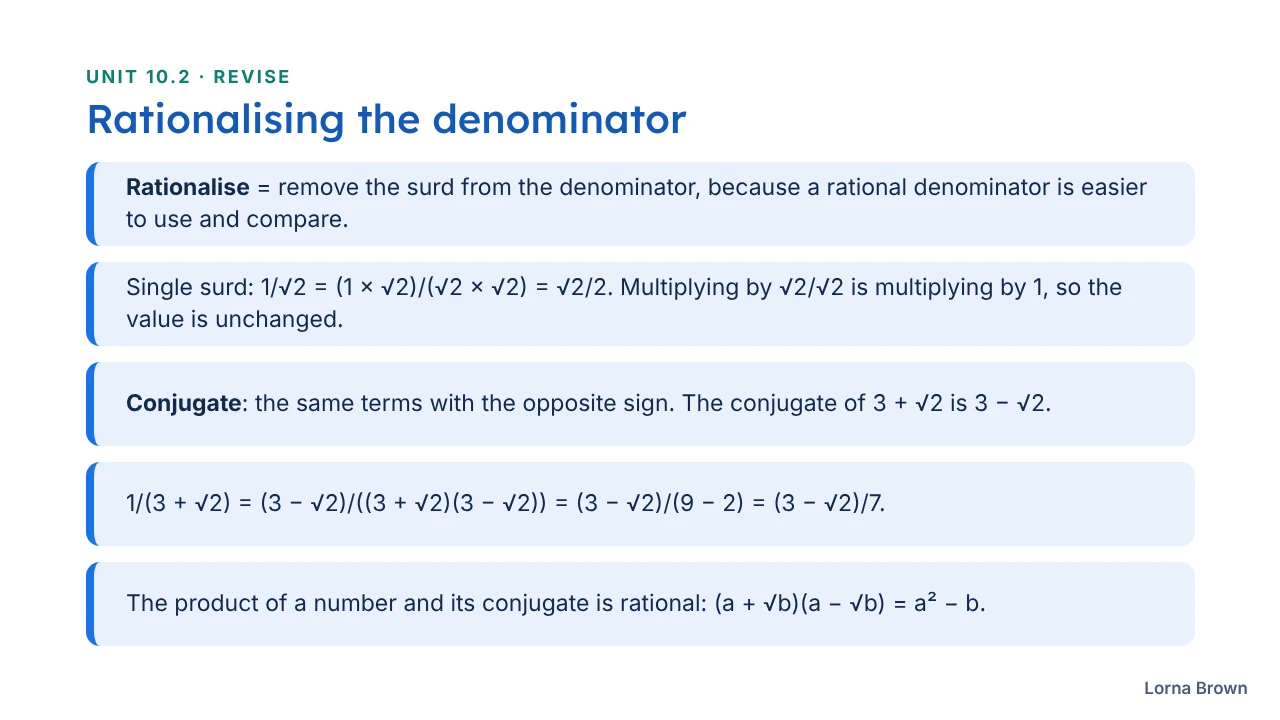
- Rationalise = remove the surd from the denominator, because a rational denominator is easier to use and compare.
- Single surd: 1/√2 = (1 × √2)/(√2 × √2) = √2/2. Multiplying by √2/√2 is multiplying by 1, so the value is unchanged.
- Conjugate: the same terms with the opposite sign. The conjugate of 3 + √2 is 3 − √2.
- 1/(3 + √2) = (3 − √2)/((3 + √2)(3 − √2)) = (3 − √2)/(9 − 2) = (3 − √2)/7.
- The product of a number and its conjugate is rational: (a + √b)(a − √b) = a² − b.
Sequences with surd terms
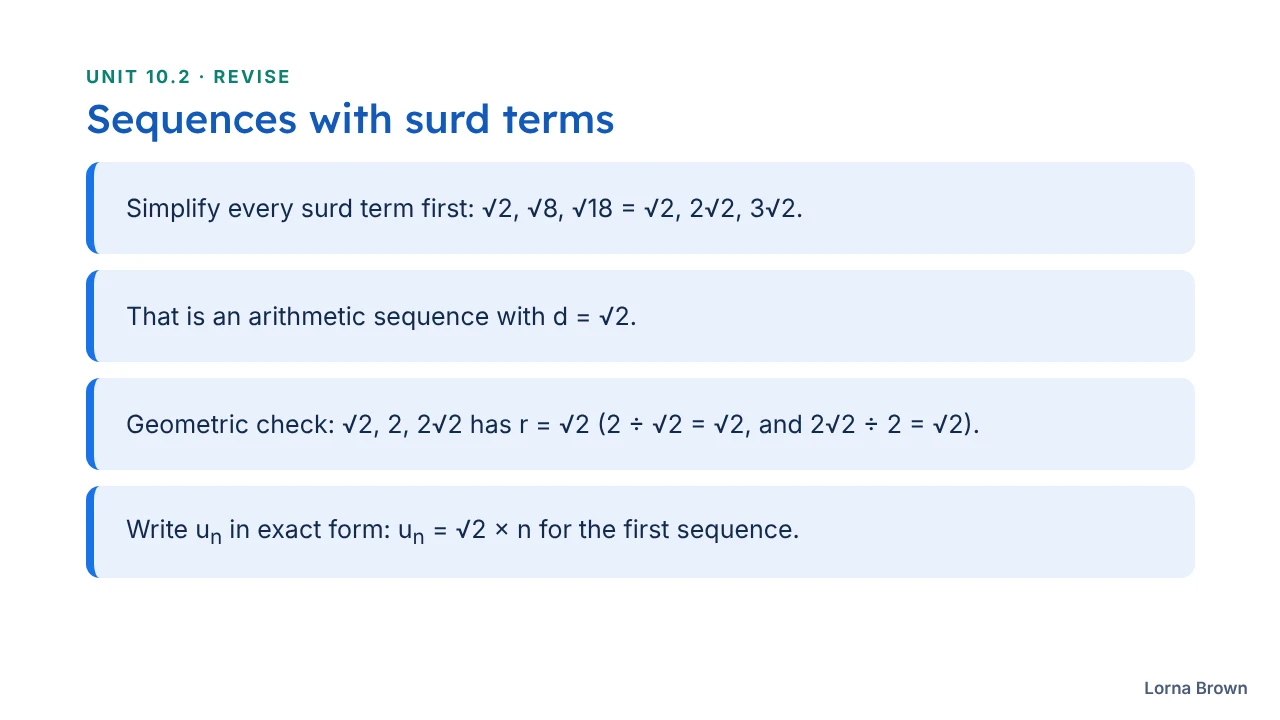
- Simplify every surd term first: √2, √8, √18 = √2, 2√2, 3√2.
- That is an arithmetic sequence with d = √2.
- Geometric check: √2, 2, 2√2 has r = √2 (2 ÷ √2 = √2, and 2√2 ÷ 2 = √2).
- Write un in exact form: un = √2 × n for the first sequence.
Common mistakes
- ✕ “x³ × x² = x⁶.” ✓ Add the powers: x⁵.
- ✕ “2−3 = −8.” ✓ A negative index gives a reciprocal: 1/8.
- ✕ “81/3 = 8/3.” ✓ A power of 1/3 is a cube root: 2.
- ✕ “√2 + √3 = √5.” ✓ Unlike surds cannot be added: √2 + √3 stays as it is.
- ✕ “(a + b)2 = a² + b².” ✓ Expand: a² + 2ab + b². So (1 + √3)² = 4 + 2√3.
Practice booklet
 mathscafe.net
Lorna Brown © 2026
Practice Booklet
- 10.2.1
- Index laws · Questions 1–20
- 10.2.1b
- Negative and fractional indices · Questions 21–38
- 10.2.2
- Comparing exponents · Questions 39–57
- 10.2.3
- Algebraic exponents · Questions 58–76
- 10.2.4 (a)
- Surds: what they are and simplifying · Questions 77–95
- 10.2.4 (b)
- Multiplying and collecting surds · Questions 96–114
- 10.2.4b
- Rationalising the denominator · Questions 115–132
- 10.2.5
- Sequences with surds · Questions 133–151
- Homework
- Homework page and checking record
- Answers
- For checking and correcting in green pen
How to use this booklet and your homework
Read this firstChoosing your level
Every part of the unit has four levels. Start where you feel comfortable and move between them freely. Most questions ask you to explain as well as answer, because being able to say why is what makes a method stick.
Learning
The standard case with small numbers, with the method set out for you.
Practising
The method on its own, with your reasoning written out.
Challenging
Harder, with several steps, and finding what is wrong with someone else's working.
Mastery
Explaining why a rule must be true, and testing it on new cases.
Working on your homework
Pens and setting out
- Answers in blue or black non-erasable pen, or in pencil.
- Colour and highlighters are for annotating your work and showing the steps of a method.
- Never erase a mistake. Rework it underneath so you can see what changed.
- Got it wrong? Circle the question number, then make your correction and write your error analysis in green pen.
- Still can’t work out how to solve it? Put a star ★ next to the question number, so we know to go over it in class.
Each sheet
- Your name goes on every sheet, because they are handed in one at a time.
- Each question is worth up to 3 marks. If a question has parts (a, b, c…), each part is marked out of 3. At the end of each level, write your score out of the total for that level.
- Questions are numbered 1, 2, 3… all the way through the booklet, so we can say exactly which ones to do.
- If you are stuck after trying, ask for help. Showing me what you tried is a good start.
mathscafe.netLorna Brown © 2026page 2
10.2.1 Index laws
Learning · PractisingKey vocabulary
| Word | Meaning | Example |
|---|---|---|
| base | the number being multiplied by itself | 2 in 23 |
| index | how many times the base is used as a factor | 3 in 23 |
| power | a base with an index | 23 = 8 |
| same base | the same number or letter | 52 and 54 |
Laws (same base only): am × an = am+n · am ÷ an = am−n · (am)n = amn · a0 = 1
Learning
Practising
mathscafe.netLorna Brown © 2026page 3
10.2.1 Index laws
Challenging · MasteryChallenging
Mastery
mathscafe.netLorna Brown © 2026page 4
10.2.1b Negative and fractional indices
Learning · PractisingKey vocabulary
| Word | Meaning | Example |
|---|---|---|
| reciprocal | a fraction turned upside down | the reciprocal of 4 is 14 |
| negative index | means take the reciprocal | a−n = 1an |
| fractional index | means a root; the denominator is the root | amn = (n-th root of a)m |
| root | undoes a power | the cube root of 8 is 2 |
Do the root first, then the power.
Learning
Practising
mathscafe.netLorna Brown © 2026page 5
10.2.1b Negative and fractional indices
Challenging · MasteryChallenging
Mastery
mathscafe.netLorna Brown © 2026page 6
10.2.2 Comparing exponents
Learning · PractisingKey vocabulary
| Word | Meaning | Example |
|---|---|---|
| common base | the same base on both sides | 4 and 8 are both powers of 2 |
| equate | make two things equal | 2x = 25, so x = 5 |
Steps: 1 choose a common base. 2 rewrite each side as a power of it. 3 equate the exponents. 4 solve and check.
Learning
Practising
mathscafe.netLorna Brown © 2026page 7
10.2.2 Comparing exponents
Challenging · MasteryChallenging
Mastery
mathscafe.netLorna Brown © 2026page 8
10.2.3 Algebraic exponents
Learning · PractisingKey vocabulary and steps
| Word | Meaning |
|---|---|
| exponent | the power; here it contains x |
| common base | write both sides as powers of the same base |
| equate | make the exponents equal, then solve |
Steps: 1 match the bases. 2 use the index laws on the exponents. 3 equate the exponents and solve. 4 check by substitution.
Learning
Practising
mathscafe.netLorna Brown © 2026page 9
10.2.3 Algebraic exponents
Challenging · MasteryChallenging
Mastery
mathscafe.netLorna Brown © 2026page 10
10.2.4 (a) Surds: what they are and simplifying
Learning · PractisingKey vocabulary
| Word | Meaning | Example |
|---|---|---|
| surd | a root that cannot be written exactly as a whole number or fraction | √7 |
| irrational | a number whose decimal never ends or repeats | √2 |
| perfect square | a whole number squared | 1, 4, 9, 16, 25, 36, 49 |
| highest perfect square factor | the largest square that divides the number | for 72 it is 36 |
| simplest form | the number under the root has no square factor | 6√2 |
Rule: √ab = √a × √b. Pull out the highest perfect square factor.
Learning
Practising
mathscafe.netLorna Brown © 2026page 11
10.2.4 (a) Surds: what they are and simplifying
Challenging · MasteryChallenging
Mastery
mathscafe.netLorna Brown © 2026page 12
10.2.4 (b) Multiplying and collecting surds
Learning · PractisingKey vocabulary
| Word | Meaning | Example |
|---|---|---|
| like surds | surds with the same number under the root | 3√2 and 5√2 |
| unlike surds | different numbers under the root, so they cannot be collected | √2 and √3 |
Rules: √a × √b = √ab · √a × √a = a · collect like surds · expand with the box method, then simplify
Learning
Practising
mathscafe.netLorna Brown © 2026page 13
10.2.4 (b) Multiplying and collecting surds
Challenging · MasteryChallenging
Mastery
mathscafe.netLorna Brown © 2026page 14
10.2.4b Rationalising the denominator
Learning · PractisingKey vocabulary
| Word | Meaning | Example |
|---|---|---|
| rationalise | rewrite so the denominator is a whole number | 1√2 = √22 |
| conjugate | same terms, opposite sign between them | 3 + √2 and 3 − √2 |
| difference of two squares | (a + b)(a − b) = a2 − b2 | (3 + √2)(3 − √2) = 7 |
Multiply top and bottom by √b, or by the conjugate of the denominator.
Learning
Practising
mathscafe.netLorna Brown © 2026page 15
10.2.4b Rationalising the denominator
Challenging · MasteryChallenging
Mastery
mathscafe.netLorna Brown © 2026page 16
10.2.5 Sequences with surds
Learning · PractisingKey vocabulary
| Word | Meaning | Example |
|---|---|---|
| common difference | d: the gap between terms in an arithmetic sequence | √3, 2√3, 3√3: d = √3 |
| common ratio | r: what you multiply by each time in a geometric sequence | 1, √5, 5: r = √5 |
| general term | un: the rule for any term | un = n√3 |
Arithmetic: un = u1 + (n − 1)d. Geometric: un = u1 × rn−1. Simplify every surd first.
Learning
Practising
mathscafe.netLorna Brown © 2026page 17
10.2.5 Sequences with surds
Challenging · MasteryChallenging
Mastery
mathscafe.netLorna Brown © 2026page 18
Homework and checking record
Hand this page in with your sheetsYour teacher will tell you which sheet and questions to do. Choose your level, set out your work in pen or pencil, then check it with the answers at the back using a green pen: circle wrong question numbers, and star ★ any you still cannot solve.
| Sheet | Questions | Which ones I did | Checked in green ✓ | Teacher |
|---|---|---|---|---|
| 10.2.1 Index laws | Q1–20 | |||
| 10.2.1b Negative and fractional indices | Q21–38 | |||
| 10.2.2 Comparing exponents | Q39–57 | |||
| 10.2.3 Algebraic exponents | Q58–76 | |||
| 10.2.4 (a) Surds: what they are and simplifying | Q77–95 | |||
| 10.2.4 (b) Multiplying and collecting surds | Q96–114 | |||
| 10.2.4b Rationalising the denominator | Q115–132 | |||
| 10.2.5 Sequences with surds | Q133–151 |
Error analysis
Circle the number of any question you got wrong. Star ★ it if you still cannot solve it after correcting. Then write the questions you need to rework, and what you will do differently:
One thing I understand better now
mathscafe.netLorna Brown © 2026page 19
Answers
Check in green pen10.2.1 Index laws
10.2.1b Negative and fractional indices
10.2.2 Comparing exponents
10.2.3 Algebraic exponents
10.2.4 (a) Surds: what they are and simplifying
10.2.4 (b) Multiplying and collecting surds
10.2.4b Rationalising the denominator
10.2.5 Sequences with surds
Revision slides as text (easy to translate)
This is a plain-text version of the revision slides. Your browser can translate it into any language.
Slide 1: Exponents and Indices
Revision slides: everything you need for the test, one idea per slide.
Slide 2: Key vocabulary (1 of 3)
Index (power, exponent): the small number that says how many times to multiply the base, e.g. the 3 in 2³
Base: the number that is being multiplied by itself, e.g. the 2 in 2³
Negative index: an index that gives a reciprocal: 2⁻³ = 12³ = 18
Fractional index: an index that means a root: 813 is the cube root of 8
Reciprocal: 1 divided by a number: the reciprocal of 8 is 18
Slide 3: Key vocabulary (2 of 3)
Exponential equation: an equation with the unknown in the index, e.g. 2x = 32
Rational number: a number that can be written as a fraction of two integers
Irrational number: a number that cannot be written as a fraction, e.g. √2
Surd: an irrational root left in exact form, such as √2 or √12
Like surds: surds with the same root part, e.g. 3√2 and 5√2, which can be added or subtracted
Slide 4: Key vocabulary (3 of 3)
Numerator: the number or expression above the line in a fraction
Denominator: the number or expression below the line in a fraction
Rationalise the denominator: rewrite a fraction so that the denominator has no surd
Conjugate: the same two terms with the opposite sign between them: the conjugate of 3 + √2 is 3 − √2
Slide 5: Index laws (positive and zero indices)
am × an = am+n (same base: add the powers). am ÷ an = am−n.
(am)n = amn. (ab)n = anbn.
a⁰ = 1 because an ÷ an = a0 = 1.
Expand to see why: x³ × x² = (x·x·x)(x·x) = x⁵.
The laws need the same base: 2³ × 3² cannot be combined.
Slide 6: Negative and fractional indices
a−n = 1 ÷ an: a negative index is a reciprocal. 2−3 = 18.
(a/b)−n = (b/a)n: flip, then use the positive power.
a1n = ⁿ√a. 912 = 3, 2713 = 3.
am/n = (ⁿ√a)m. 823 = (³√8)² = 4.
The pattern 2³ = 8, 2² = 4, 2¹ = 2, 2⁰ = 1, 2−1 = 12 shows why.
Slide 7: Exponential equations
If ax = ay (same base, a > 0, a ≠ 1) then x = y.
Write both sides with the same base: 2x = 32 = 2⁵, so x = 5. 9x = 27 gives 32x = 3³ and x = 32.
Answers can be negative or fractional: 2x = 18 = 2−3 gives x = −3.
With an algebraic exponent: 4x+1 = 2x+7 → 22x+2 = 2x+7 → 2x + 2 = x + 7 → x = 5. Check by substituting.
The rule fails for base 1 and 0.
Slide 8: Surds
A surd is an irrational root left exact, such as √2 or √12.
Simplify using the largest square factor: √12 = √4 × √3 = 2√3. √50 = 5√2.
Add/subtract like surds only: 3√2 + 5√2 = 8√2. √2 + √3 stays as it is.
Multiply: √a × √b = √(ab), and √a × √a = a. 2√3 × 3√2 = 6√6.
Expand brackets as normal: √2(3 + √2) = 3√2 + 2. (1 + √3)² = 1 + 2√3 + 3 = 4 + 2√3.
Slide 9: Rationalising the denominator
Rationalise = remove the surd from the denominator, because a rational denominator is easier to use and compare.
Single surd: 1/√2 = 1 × √2√2 × √2 = √22. Multiplying by √2/√2 is multiplying by 1, so the value is unchanged.
Conjugate: the same terms with the opposite sign. The conjugate of 3 + √2 is 3 − √2.
13 + √2 = (3 − √2)/((3 + √2)(3 − √2)) = 3 − √29 − 2 = 3 − √27.
The product of a number and its conjugate is rational: (a + √b)(a − √b) = a² − b.
Slide 10: Sequences with surd terms
Simplify every surd term first: √2, √8, √18 = √2, 2√2, 3√2.
That is an arithmetic sequence with d = √2.
Geometric check: √2, 2, 2√2 has r = √2 (2 ÷ √2 = √2, and 2√2 ÷ 2 = √2).
Write un in exact form: un = √2 × n for the first sequence.
Slide 11: Common mistakes
✕ “x³ × x² = x⁶.”
✓ Add the powers: x⁵.
✕ “2−3 = −8.”
✓ A negative index gives a reciprocal: 18.
✕ “813 = 83.”
✓ A power of 13 is a cube root: 2.
✕ “√2 + √3 = √5.”
✓ Unlike surds cannot be added: √2 + √3 stays as it is.
Slide 12: Common mistakes (continued)
✕ “(a + b)2 = a² + b².”
✓ Expand: a² + 2ab + b². So (1 + √3)² = 4 + 2√3.