Maths
Units
Unit 8.1 Fractions, Decimals and Percentages
Unit information
Revise from the slides, test yourself with the flash cards and quizzes, then use the revision notes as your checklist for the test.
Revision slides
Flash cards
Click a card to flip it. Say the answer first, then check.
Print the cards (PDF): word on the front, answer on the back, double-sided, flip on the long edge
Quizzes
Pick an answer to see if you are right. Your score shows at the end of each quiz.
Revision notes
Download and print the revision notes (PDF, A4)
The big idea. Equivalence and relationships between fractions, decimals and percentages: write quantities in different forms, convert between them, and calculate percentage increase and decrease.
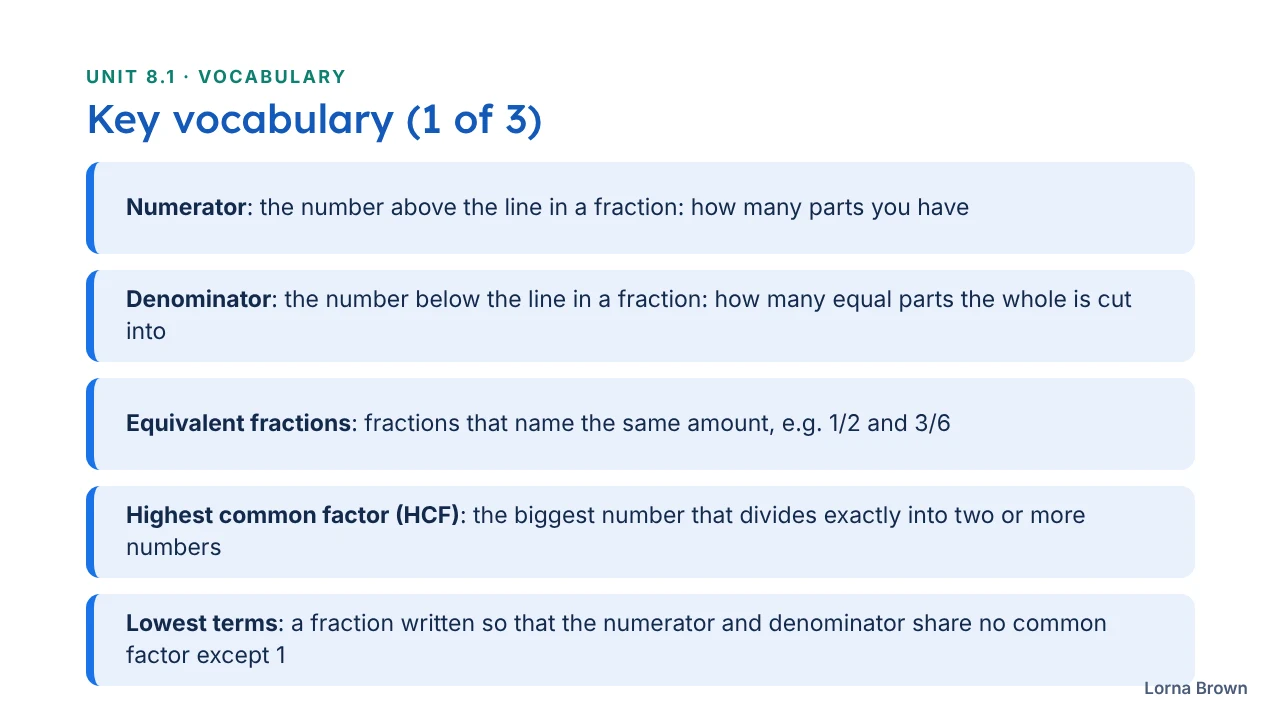
Key vocabulary
| Word | Meaning |
|---|---|
| Numerator | the number above the line in a fraction: how many parts you have |
| Denominator | the number below the line in a fraction: how many equal parts the whole is cut into |
| Equivalent fractions | fractions that name the same amount, e.g. 1/2 and 3/6 |
| Highest common factor (HCF) | the biggest number that divides exactly into two or more numbers |
| Lowest terms | a fraction written so that the numerator and denominator share no common factor except 1 |
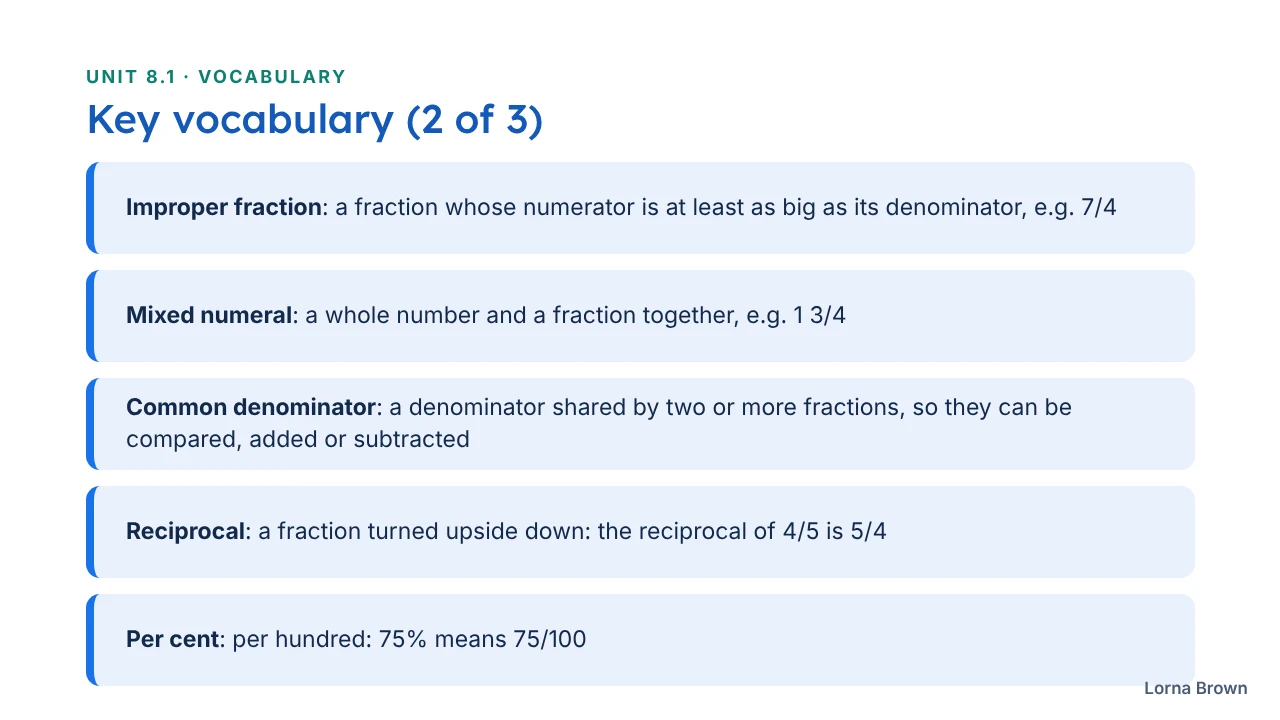
| Improper fraction | a fraction whose numerator is at least as big as its denominator, e.g. 7/4 |
| Mixed numeral | a whole number and a fraction together, e.g. 1 3/4 |
| Common denominator | a denominator shared by two or more fractions, so they can be compared, added or subtracted |
| Reciprocal | a fraction turned upside down: the reciprocal of 4/5 is 5/4 |
| Per cent | per hundred: 75% means 75/100 |
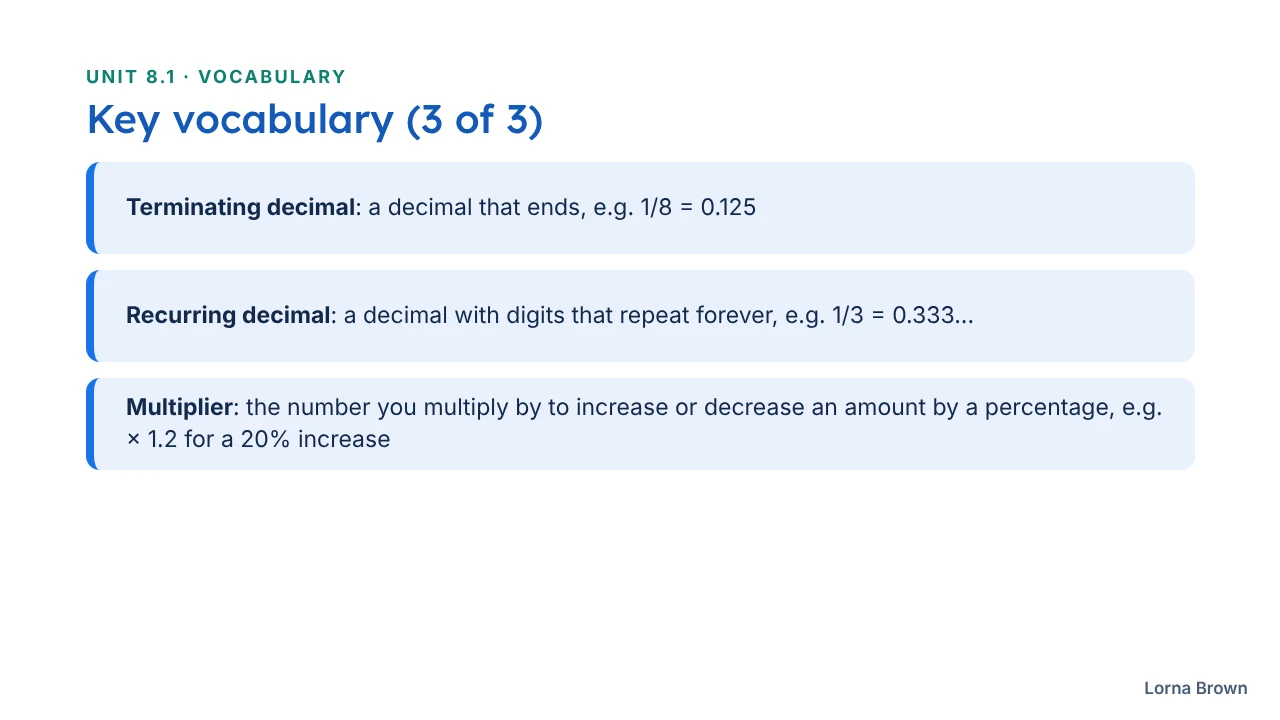
| Terminating decimal | a decimal that ends, e.g. 1/8 = 0.125 |
| Recurring decimal | a decimal with digits that repeat forever, e.g. 1/3 = 0.333... |
| Multiplier | the number you multiply by to increase or decrease an amount by a percentage, e.g. × 1.2 for a 20% increase |
Forms of fractions
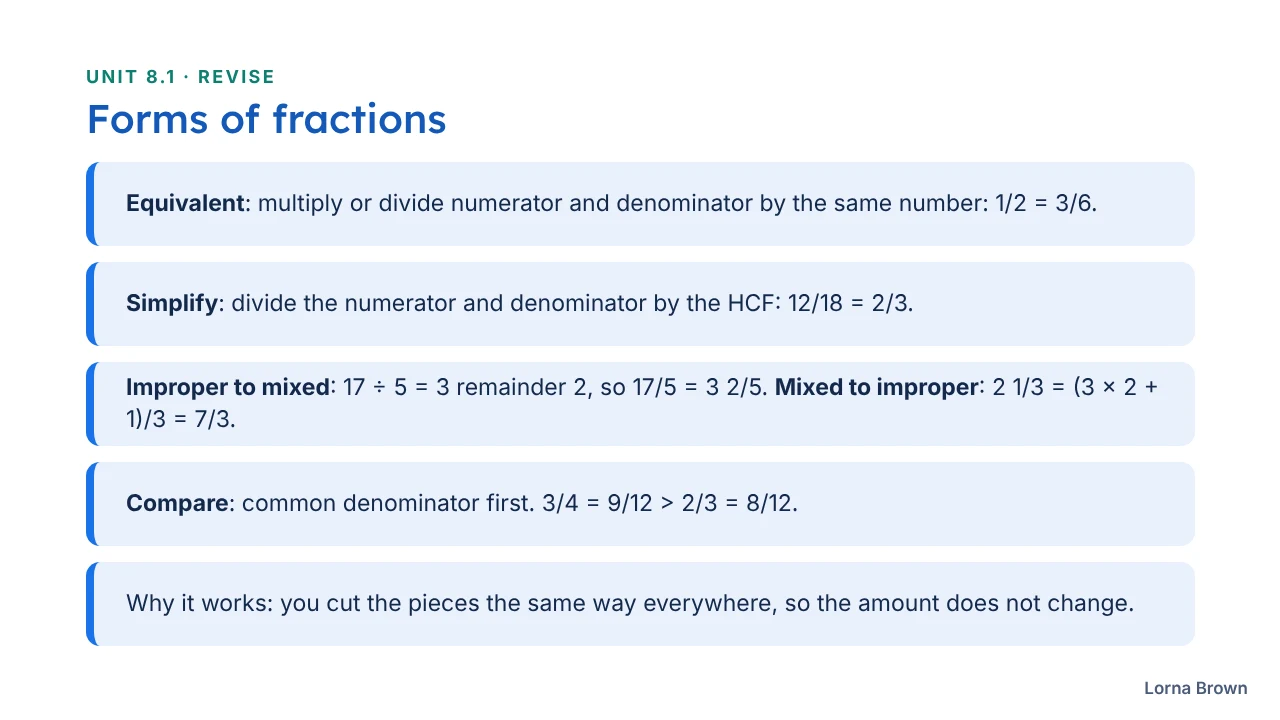
- Equivalent: multiply or divide numerator and denominator by the same number: 1/2 = 3/6.
- Simplify: divide the numerator and denominator by the HCF: 12/18 = 2/3.
- Improper to mixed: 17 ÷ 5 = 3 remainder 2, so 17/5 = 3 2/5. Mixed to improper: 2 1/3 = (3 × 2 + 1)/3 = 7/3.
- Compare: common denominator first. 3/4 = 9/12 > 2/3 = 8/12.
- Why it works: you cut the pieces the same way everywhere, so the amount does not change.
Four operations with fractions
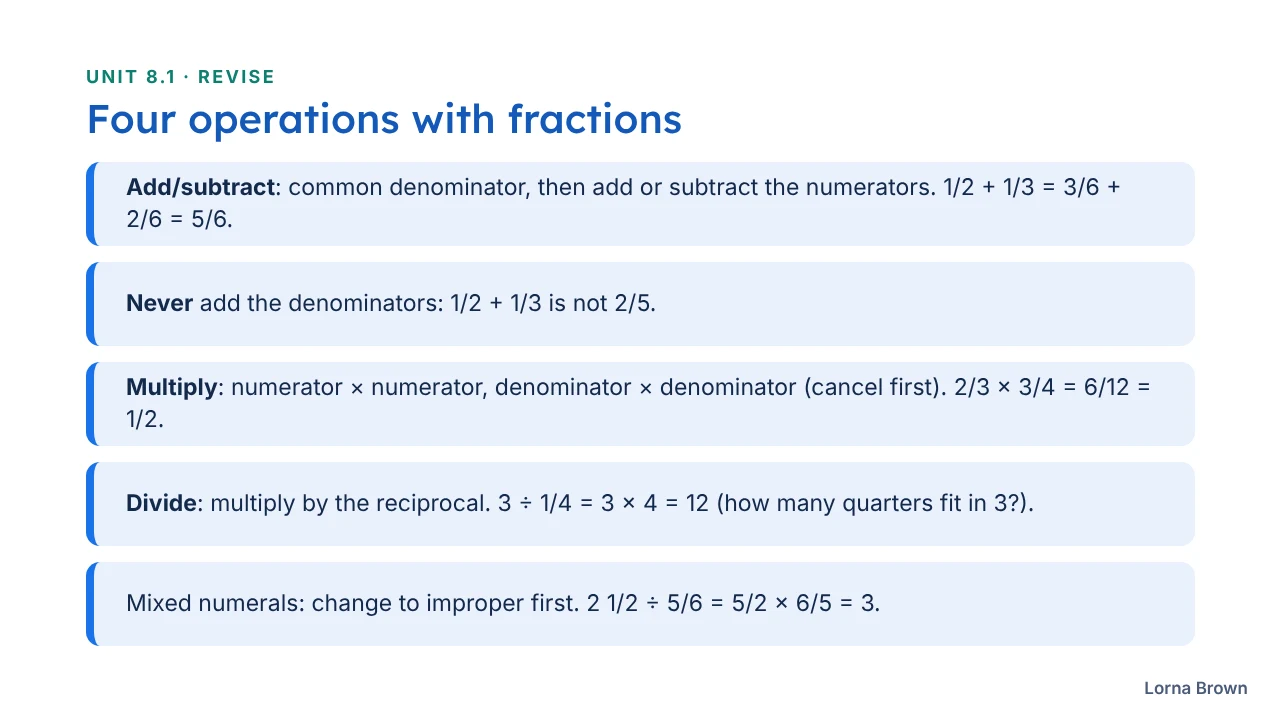
- Add/subtract: common denominator, then add or subtract the numerators. 1/2 + 1/3 = 3/6 + 2/6 = 5/6.
- Never add the denominators: 1/2 + 1/3 is not 2/5.
- Multiply: numerator × numerator, denominator × denominator (cancel first). 2/3 × 3/4 = 6/12 = 1/2.
- Divide: multiply by the reciprocal. 3 ÷ 1/4 = 3 × 4 = 12 (how many quarters fit in 3?).
- Mixed numerals: change to improper first. 2 1/2 ÷ 5/6 = 5/2 × 6/5 = 3.
Fractions, decimals and percentages
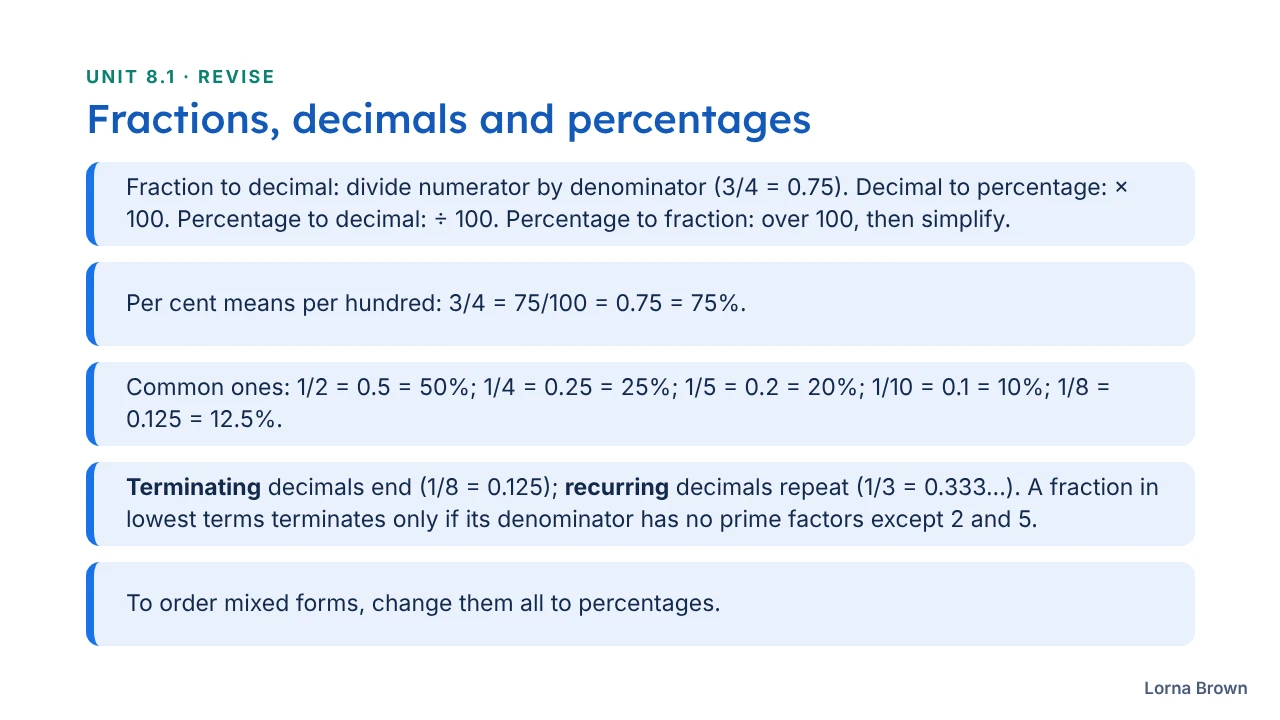
- Fraction to decimal: divide numerator by denominator (3/4 = 0.75). Decimal to percentage: × 100. Percentage to decimal: ÷ 100. Percentage to fraction: over 100, then simplify.
- Per cent means per hundred: 3/4 = 75/100 = 0.75 = 75%.
- Common ones: 1/2 = 0.5 = 50%; 1/4 = 0.25 = 25%; 1/5 = 0.2 = 20%; 1/10 = 0.1 = 10%; 1/8 = 0.125 = 12.5%.
- Terminating decimals end (1/8 = 0.125); recurring decimals repeat (1/3 = 0.333...). A fraction in lowest terms terminates only if its denominator has no prime factors except 2 and 5.
- To order mixed forms, change them all to percentages.
Percentage increase and decrease
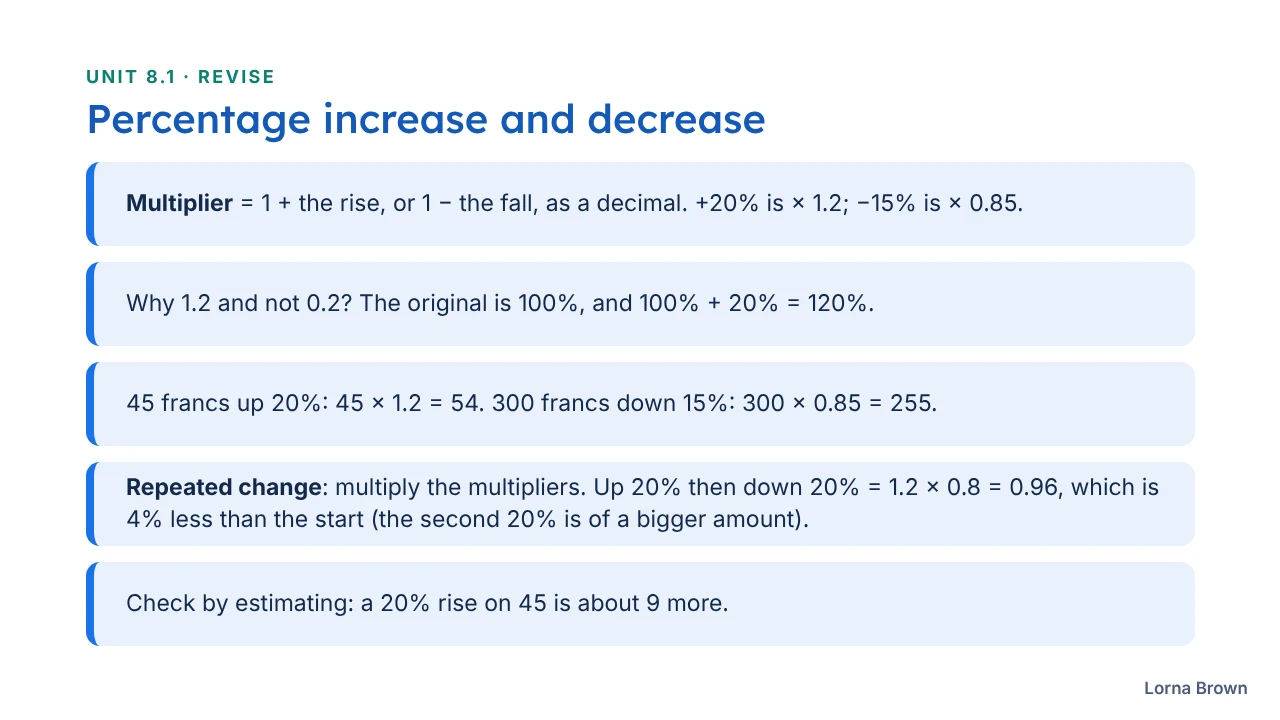
- Multiplier = 1 + the rise, or 1 − the fall, as a decimal. +20% is × 1.2; −15% is × 0.85.
- Why 1.2 and not 0.2? The original is 100%, and 100% + 20% = 120%.
- 45 francs up 20%: 45 × 1.2 = 54. 300 francs down 15%: 300 × 0.85 = 255.
- Repeated change: multiply the multipliers. Up 20% then down 20% = 1.2 × 0.8 = 0.96, which is 4% less than the start (the second 20% is of a bigger amount).
- Check by estimating: a 20% rise on 45 is about 9 more.
Common mistakes
- ✕ “1/2 + 1/3 = 2/5.” ✓ Find a common denominator first: 3/6 + 2/6 = 5/6.
- ✕ “3 ÷ 1/4 = 3/4.” ✓ Dividing by 1/4 multiplies by 4: 3 × 4 = 12.
- ✕ “A 20% rise is × 0.2.” ✓ It is × 1.2, because the original stays (100% + 20%).
- ✕ “Up 20% then down 20% gets you back to the start.” ✓ It gives 96% of the start: 1.2 × 0.8 = 0.96.
- ✕ “Leave 12/18 as it is.” ✓ Simplify to lowest terms: 2/3.
Unit 8.2 Ratio and Proportion
Unit information
Revise from the slides, test yourself with the flash cards and quizzes, then use the revision notes as your checklist for the test.
Revision slides
Flash cards
Quizzes
Pick an answer to see if you are right. Your score shows at the end of each quiz.
Revision notes
Download and print the revision notes (PDF, A4)
The big idea. Relationships and equivalence between quantities: similarity and scale factor, ratio, direct proportion, conversion graphs, scale diagrams and map scales.
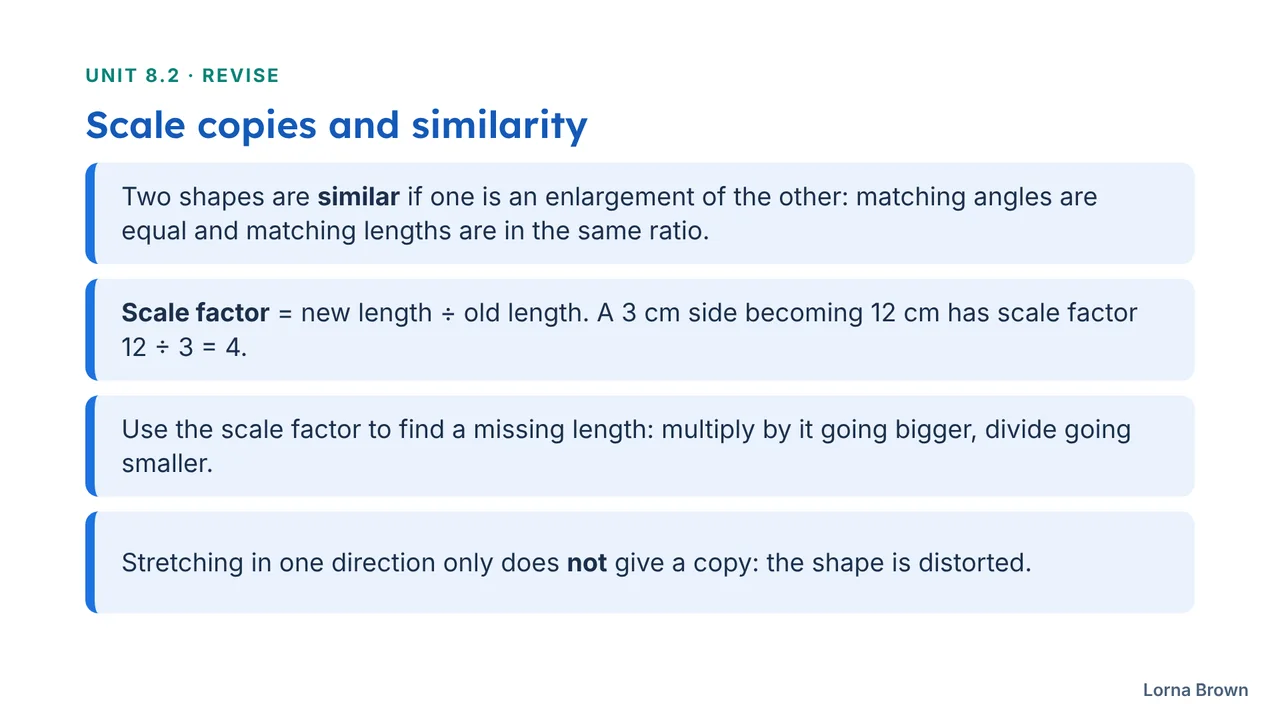
Scale copies and similarity
- Two shapes are similar if one is an enlargement of the other: matching angles are equal and matching lengths are in the same ratio.
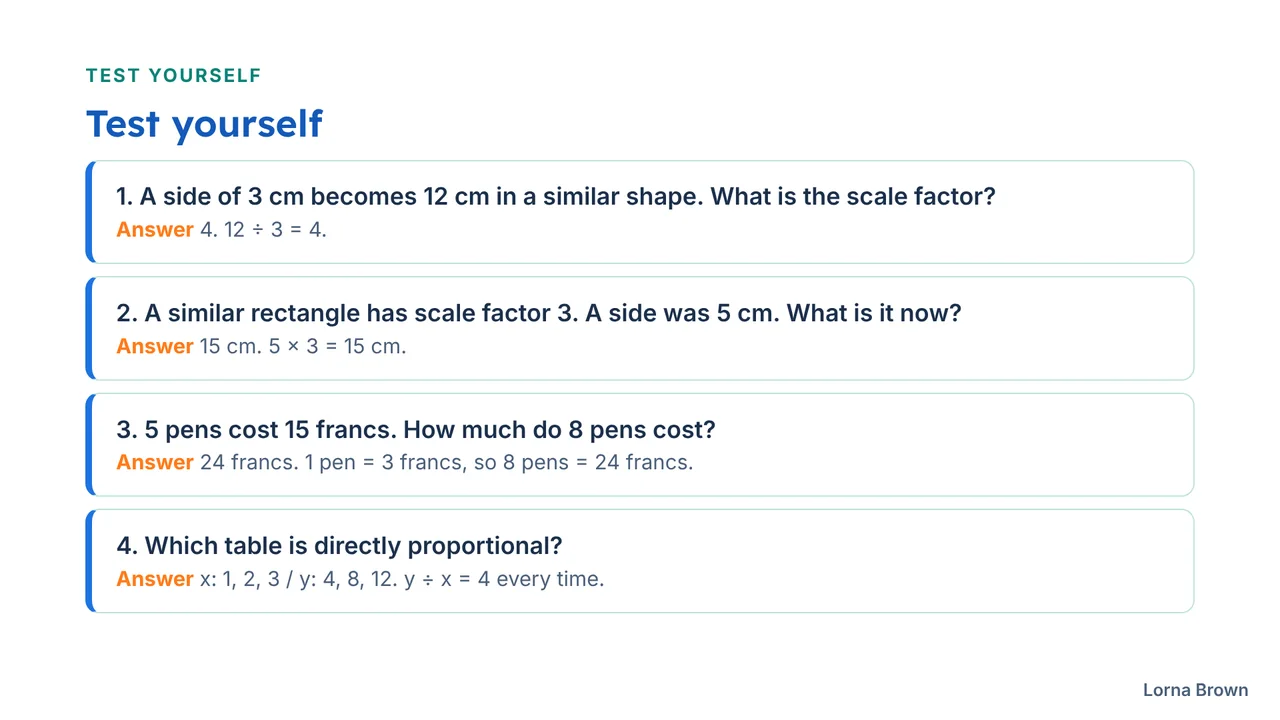
- Scale factor = new length ÷ old length. A 3 cm side becoming 12 cm has scale factor 12 ÷ 3 = 4.
- Use the scale factor to find a missing length: multiply by it going bigger, divide going smaller.
- Stretching in one direction only does not give a copy: the shape is distorted.
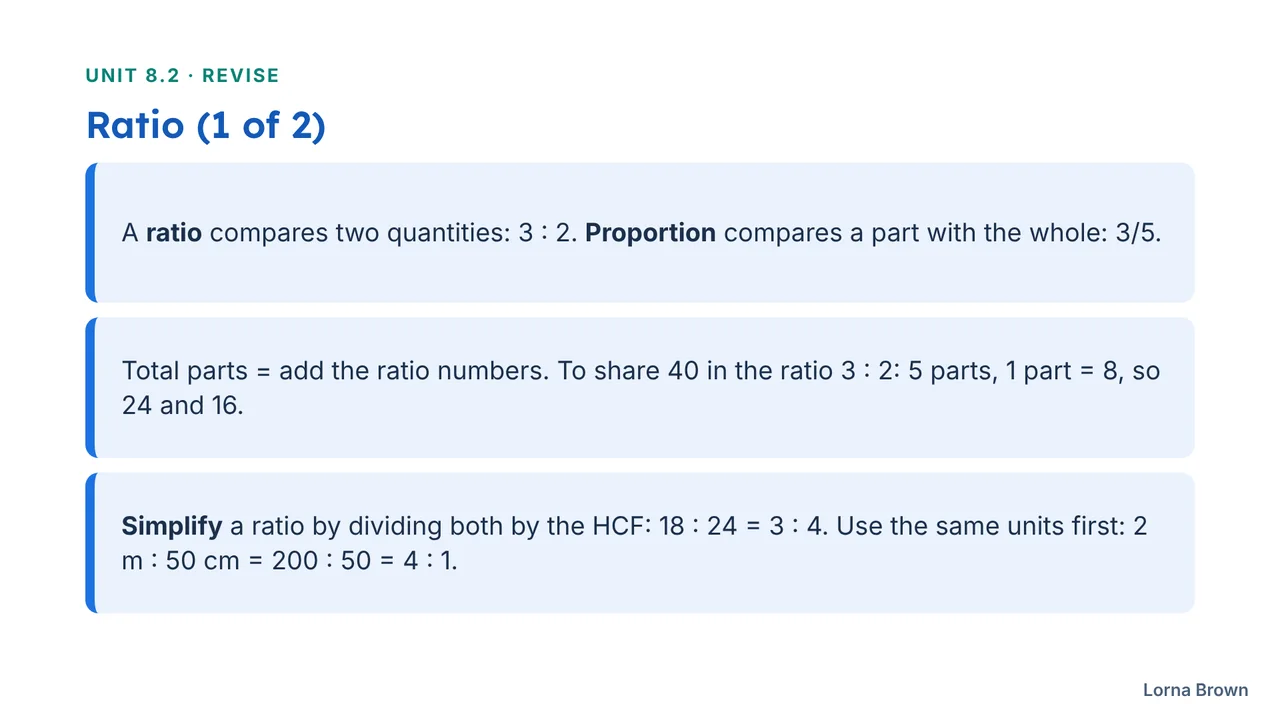
Ratio
- A ratio compares two quantities: 3 : 2. Proportion compares a part with the whole: 3/5.
- Total parts = add the ratio numbers. To share 40 in the ratio 3 : 2: 5 parts, 1 part = 8, so 24 and 16.
- Simplify a ratio by dividing both by the HCF: 18 : 24 = 3 : 4. Use the same units first: 2 m : 50 cm = 200 : 50 = 4 : 1.
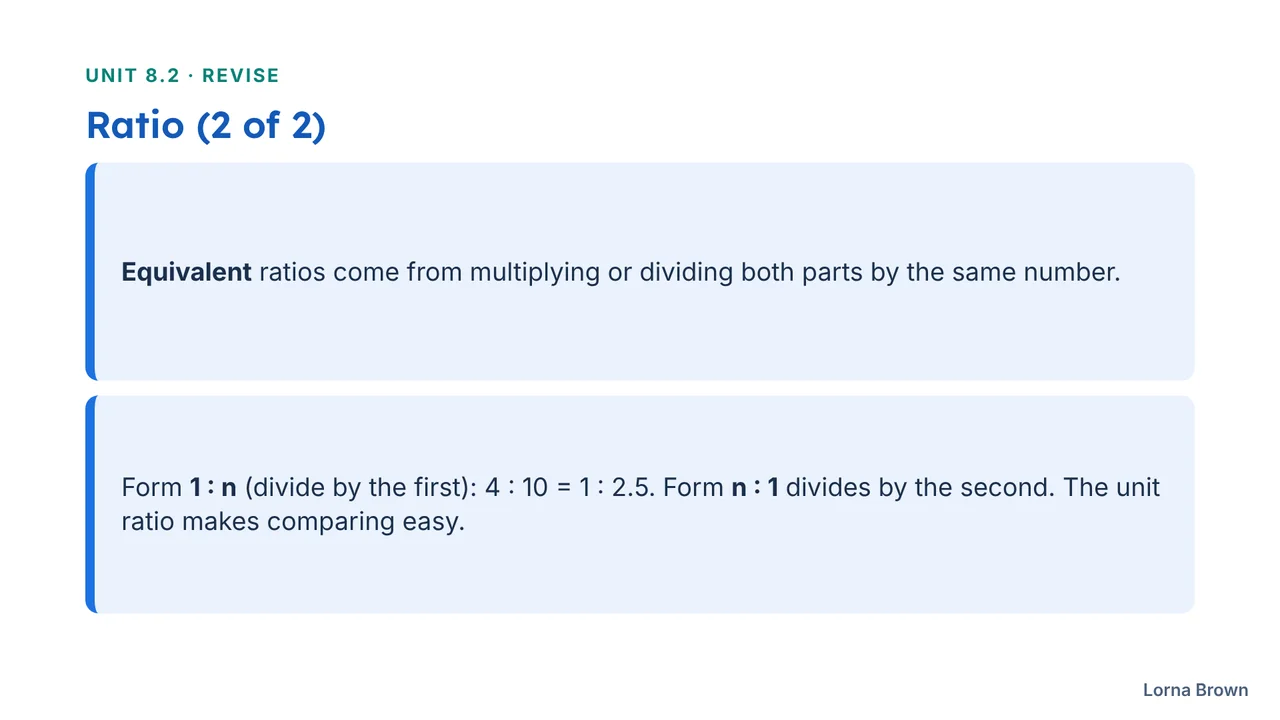
- Equivalent ratios come from multiplying or dividing both parts by the same number.
- Form 1 : n (divide by the first): 4 : 10 = 1 : 2.5. Form n : 1 divides by the second. The unit ratio makes comparing easy.
Ratio and fractions
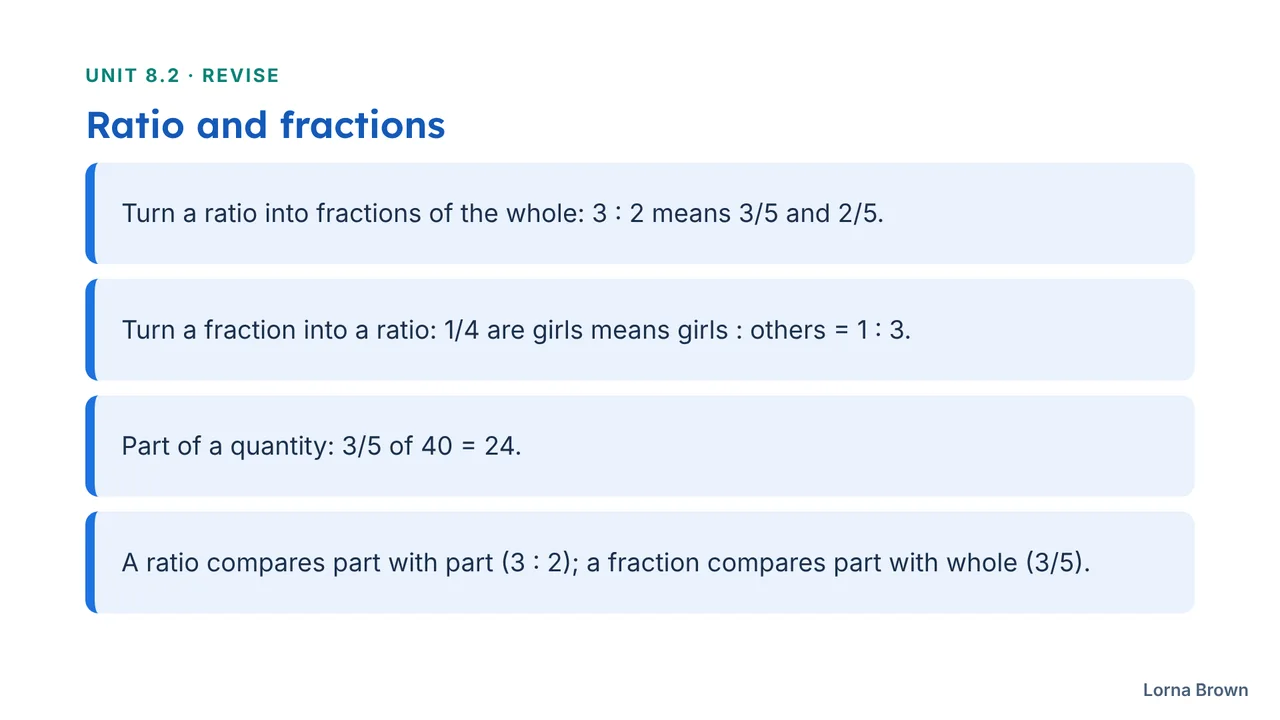
- Turn a ratio into fractions of the whole: 3 : 2 means 3/5 and 2/5.
- Turn a fraction into a ratio: 1/4 are girls means girls : others = 1 : 3.
- Part of a quantity: 3/5 of 40 = 24.
- A ratio compares part with part (3 : 2); a fraction compares part with whole (3/5).
Direct proportion
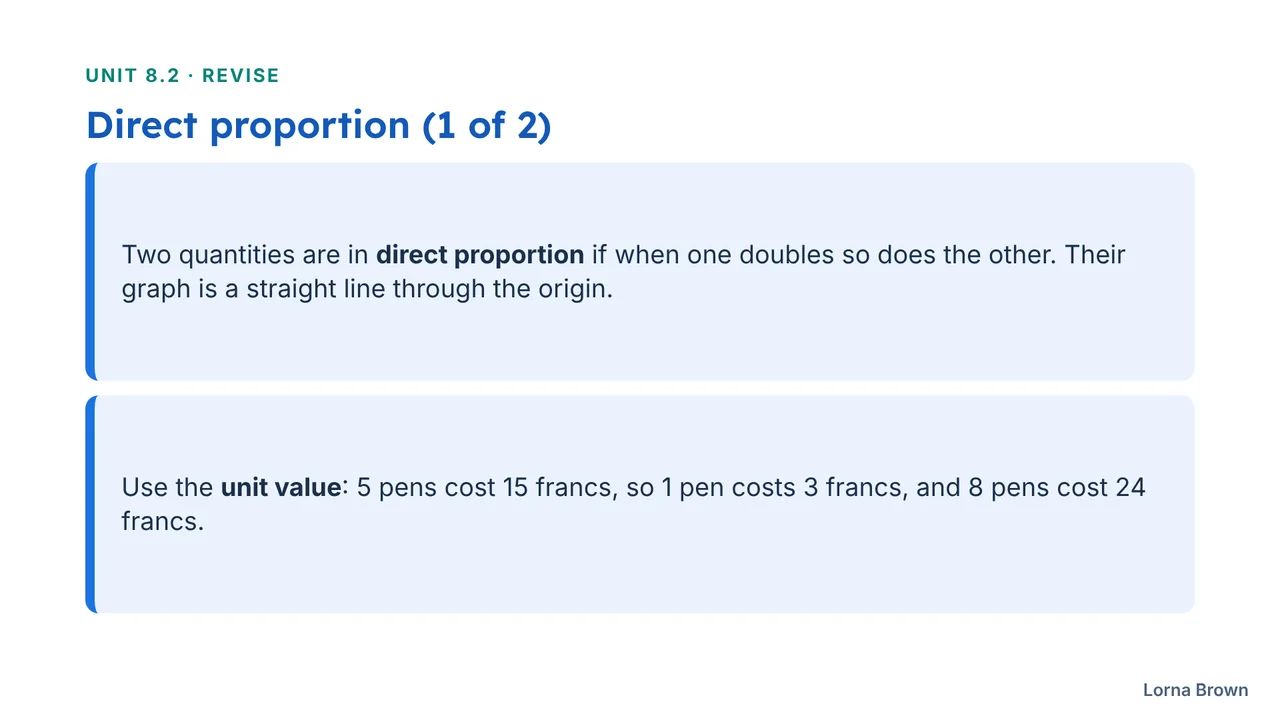
- Two quantities are in direct proportion if when one doubles so does the other. Their graph is a straight line through the origin.
- Use the unit value: 5 pens cost 15 francs, so 1 pen costs 3 francs, and 8 pens cost 24 francs.
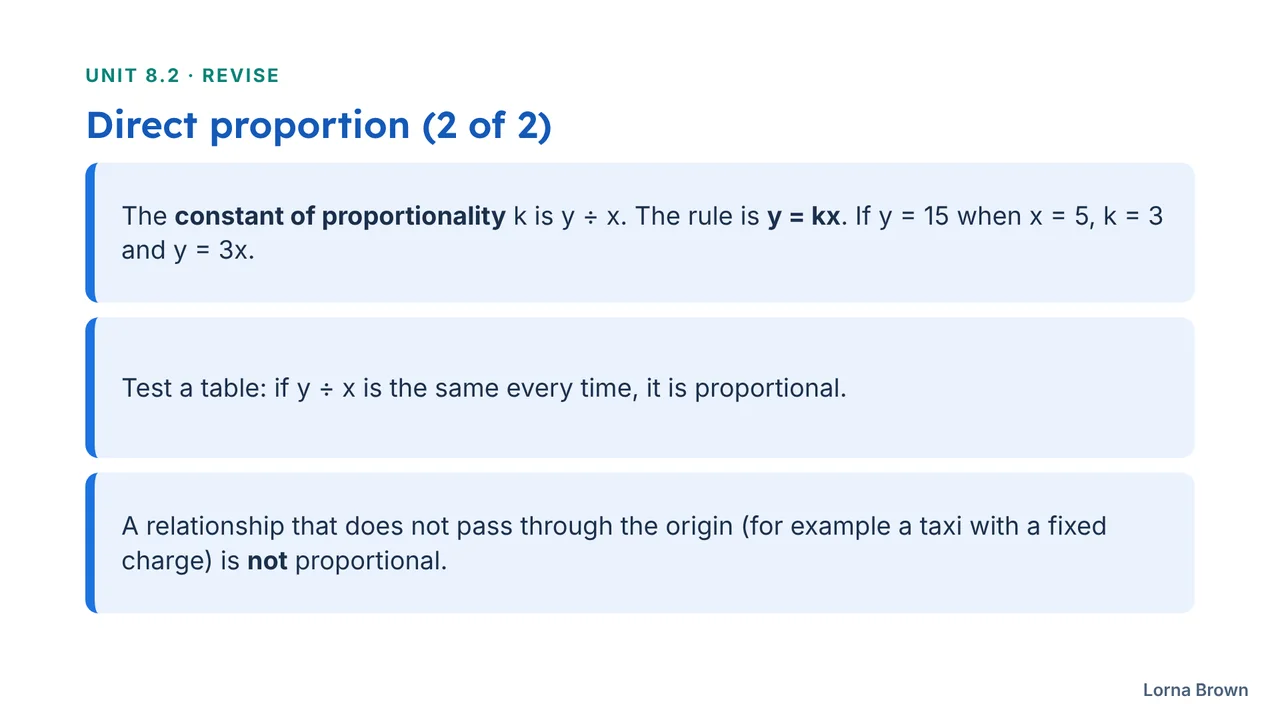
- The constant of proportionality k is y ÷ x. The rule is y = kx. If y = 15 when x = 5, k = 3 and y = 3x.
- Test a table: if y ÷ x is the same every time, it is proportional.
- A relationship that does not pass through the origin (for example a taxi with a fixed charge) is not proportional.
Conversion graphs
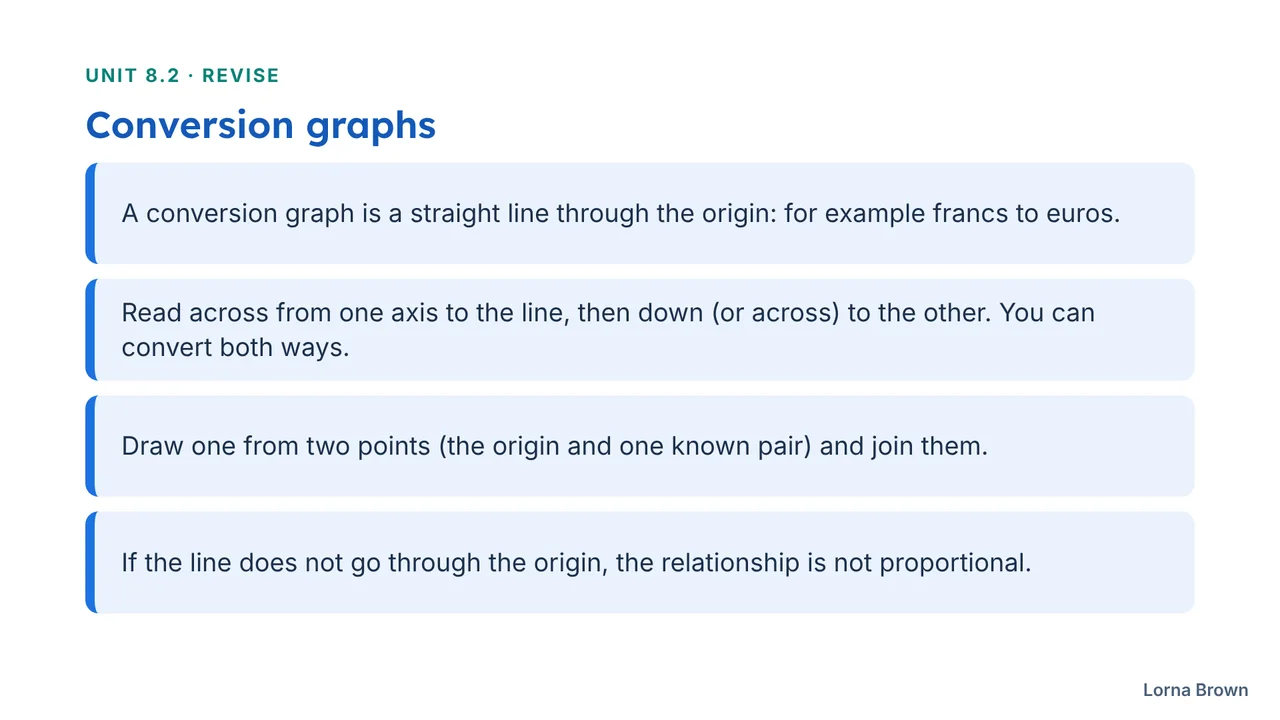
- A conversion graph is a straight line through the origin: for example francs to euros.
- Read across from one axis to the line, then down (or across) to the other. You can convert both ways.
- Draw one from two points (the origin and one known pair) and join them.
- If the line does not go through the origin, the relationship is not proportional.
Scale diagrams and map scales
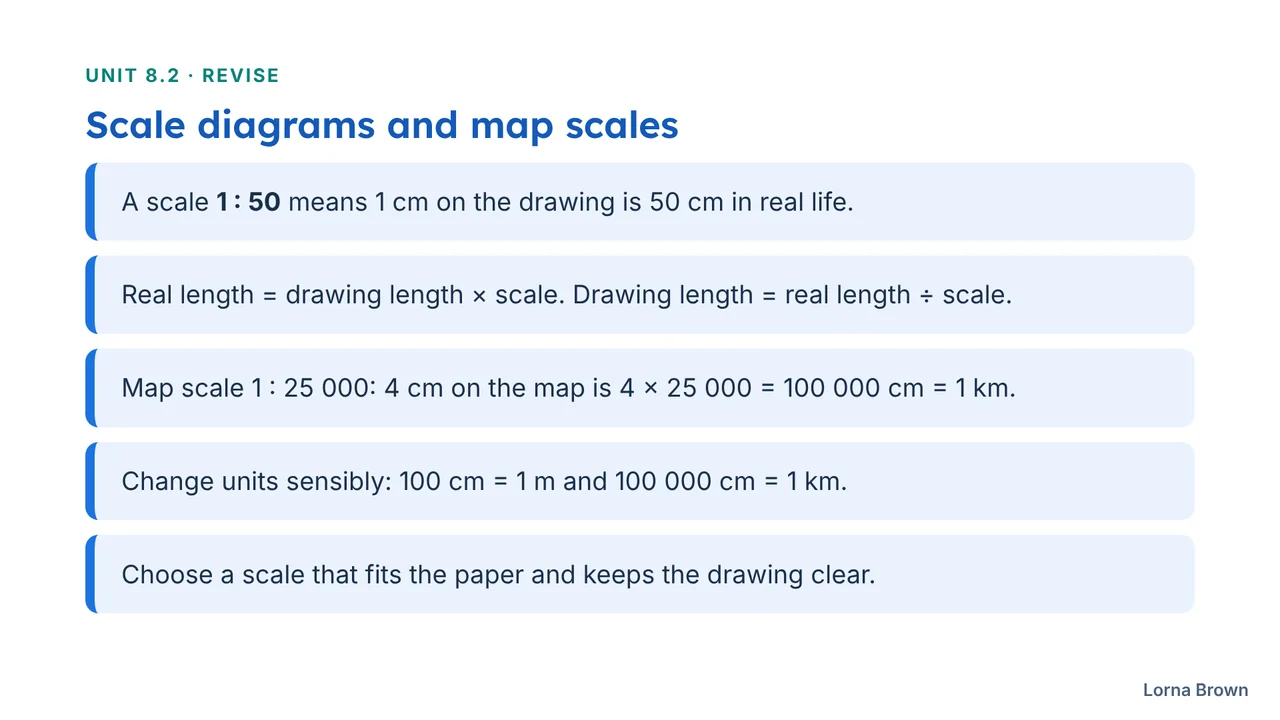
- A scale 1 : 50 means 1 cm on the drawing is 50 cm in real life.
- Real length = drawing length × scale. Drawing length = real length ÷ scale.
- Map scale 1 : 25 000: 4 cm on the map is 4 × 25 000 = 100 000 cm = 1 km.
- Change units sensibly: 100 cm = 1 m and 100 000 cm = 1 km.
- Choose a scale that fits the paper and keeps the drawing clear.
Common mistakes
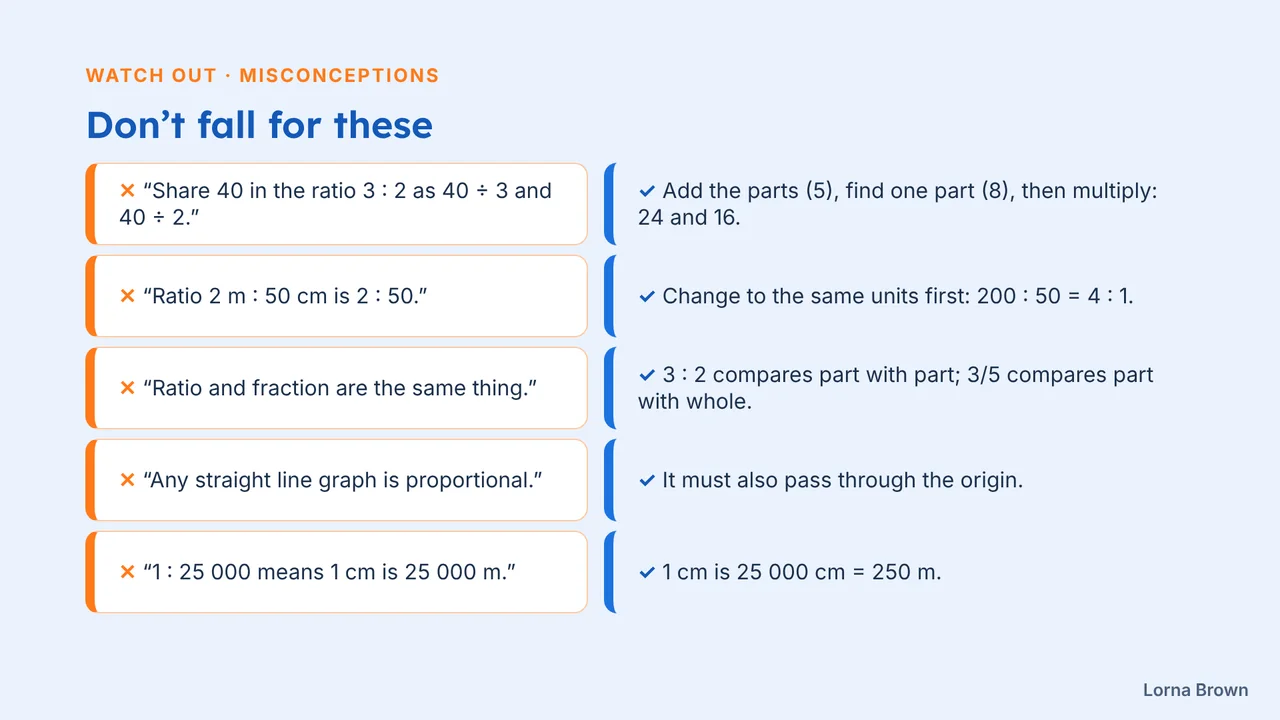
- ✕ “Share 40 in the ratio 3 : 2 as 40 ÷ 3 and 40 ÷ 2.” ✓ Add the parts (5), find one part (8), then multiply: 24 and 16.
- ✕ “Ratio 2 m : 50 cm is 2 : 50.” ✓ Change to the same units first: 200 : 50 = 4 : 1.
- ✕ “Ratio and fraction are the same thing.” ✓ 3 : 2 compares part with part; 3/5 compares part with whole.
- ✕ “Any straight line graph is proportional.” ✓ It must also pass through the origin.
- ✕ “1 : 25 000 means 1 cm is 25 000 m.” ✓ 1 cm is 25 000 cm = 250 m.
Unit 8.3 Number
Unit information
Revise from the slides, test yourself with the flash cards and quizzes, then use the revision notes as your checklist for the test.
Revision slides
Flash cards
Quizzes
Pick an answer to see if you are right. Your score shows at the end of each quiz.
Revision notes
Download and print the revision notes (PDF, A4)
The big idea. Directed numbers, the order of operations with exponents, and the distributive property (expanding a single bracket).
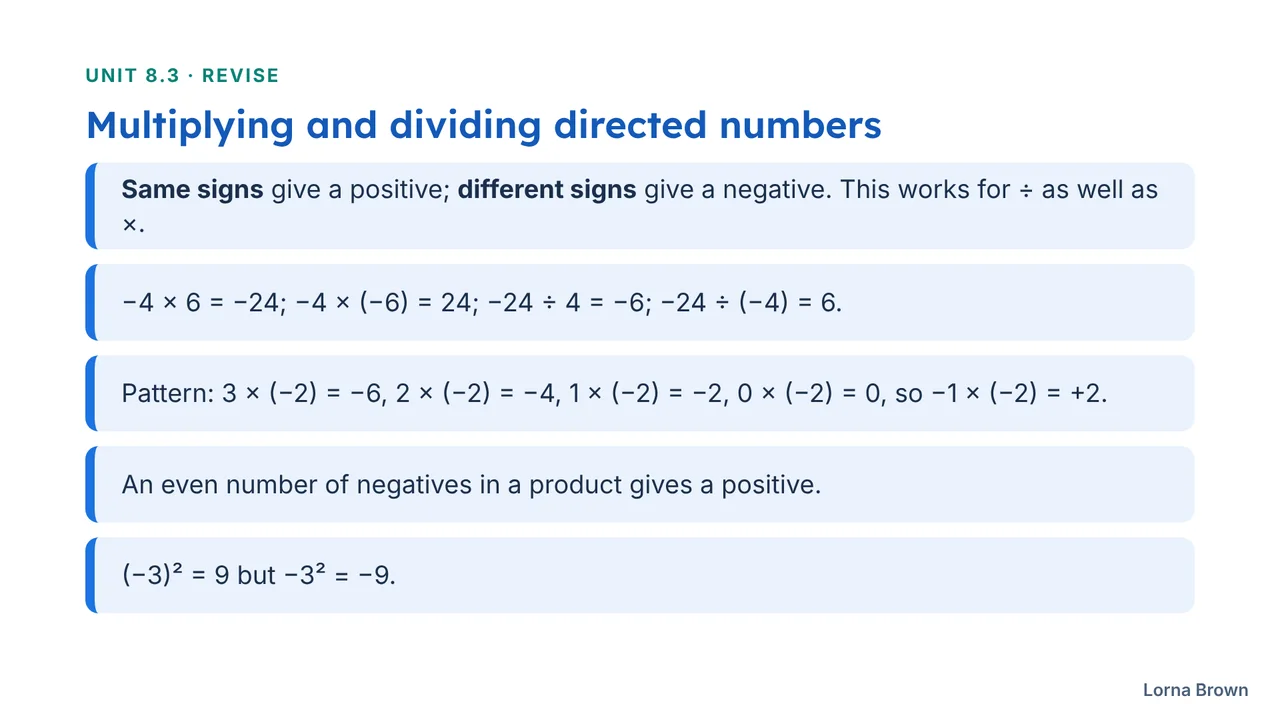
Multiplying and dividing directed numbers
- Same signs give a positive; different signs give a negative. This works for ÷ as well as ×.
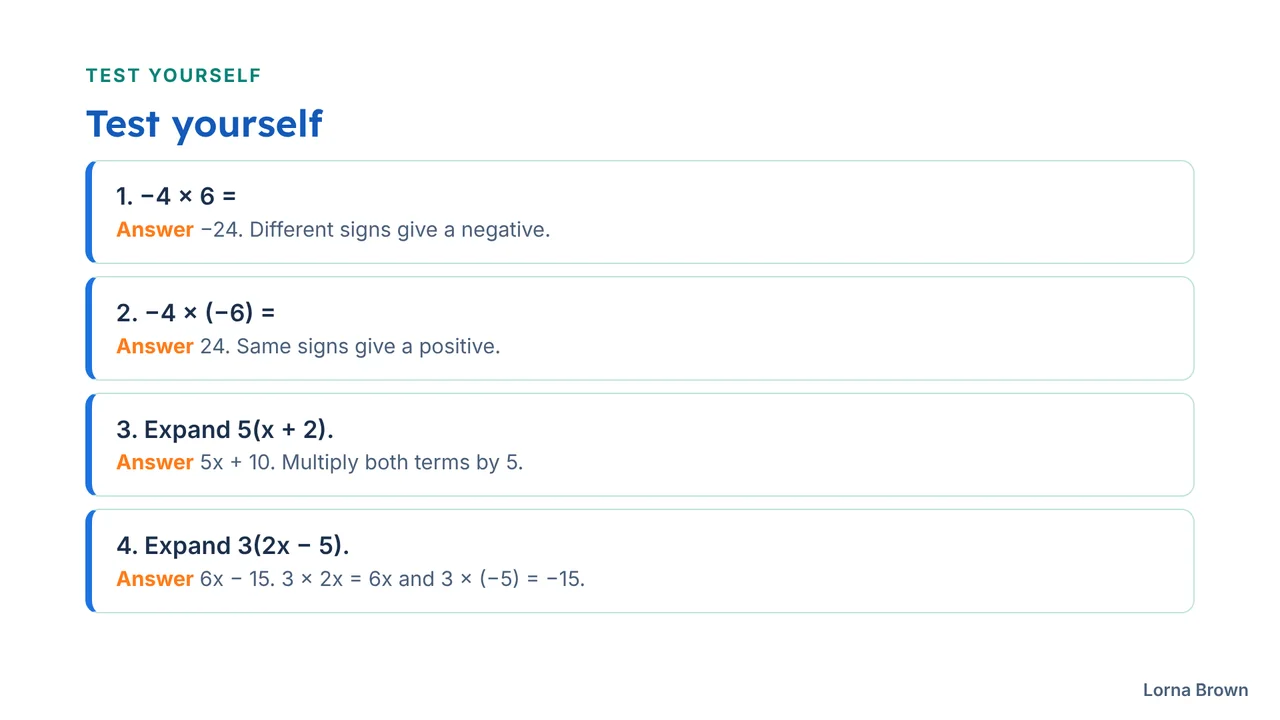
- −4 × 6 = −24; −4 × (−6) = 24; −24 ÷ 4 = −6; −24 ÷ (−4) = 6.
- Pattern: 3 × (−2) = −6, 2 × (−2) = −4, 1 × (−2) = −2, 0 × (−2) = 0, so −1 × (−2) = +2.
- An even number of negatives in a product gives a positive.
- (−3)² = 9 but −3² = −9.
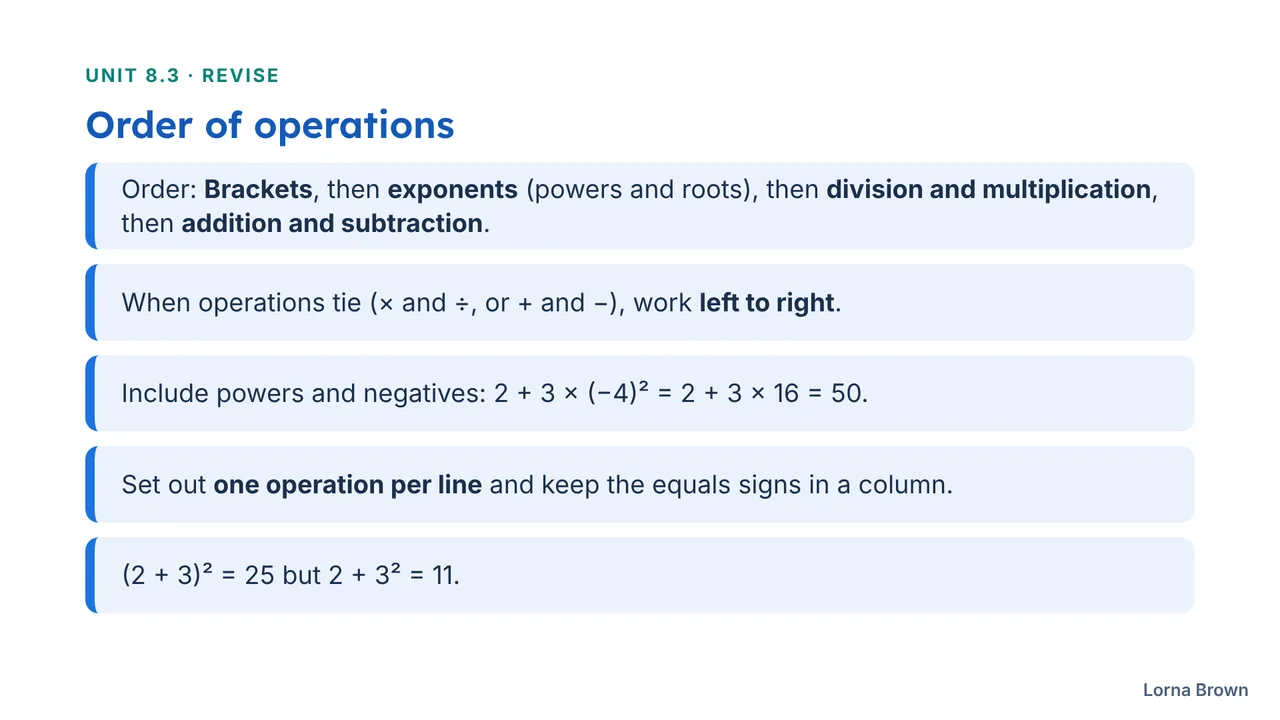
Order of operations
- Order: Brackets, then exponents (powers and roots), then division and multiplication, then addition and subtraction.
- When operations tie (× and ÷, or + and −), work left to right.
- Include powers and negatives: 2 + 3 × (−4)² = 2 + 3 × 16 = 50.
- Set out one operation per line and keep the equals signs in a column.
- (2 + 3)² = 25 but 2 + 3² = 11.
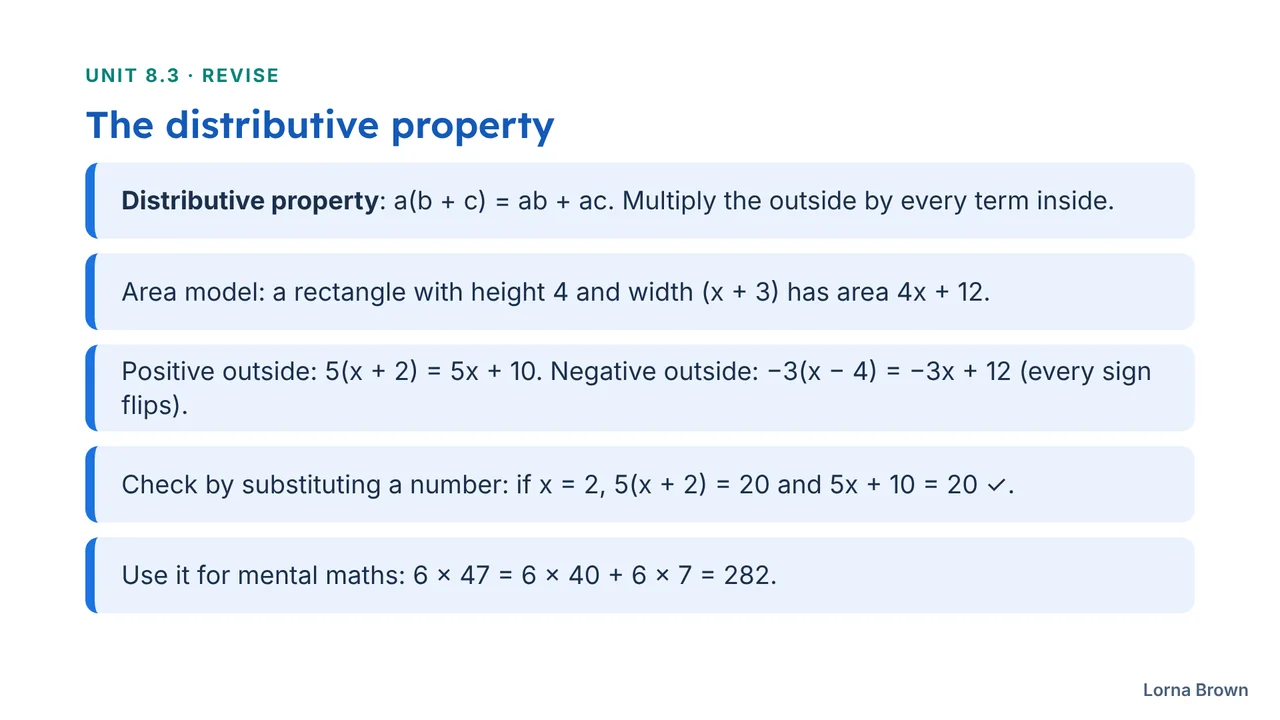
The distributive property
- Distributive property: a(b + c) = ab + ac. Multiply the outside by every term inside.
- Area model: a rectangle with height 4 and width (x + 3) has area 4x + 12.
- Positive outside: 5(x + 2) = 5x + 10. Negative outside: −3(x − 4) = −3x + 12 (every sign flips).
- Check by substituting a number: if x = 2, 5(x + 2) = 20 and 5x + 10 = 20 ✓.
- Use it for mental maths: 6 × 47 = 6 × 40 + 6 × 7 = 282.
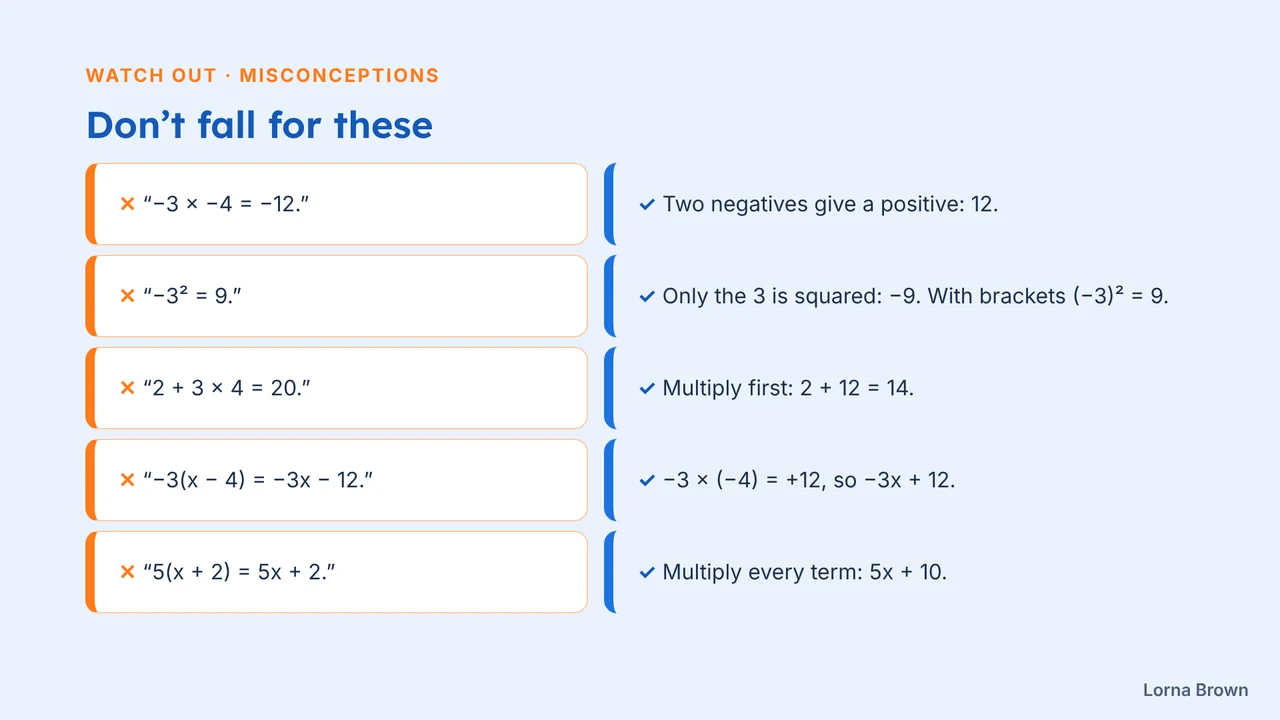
Common mistakes
- ✕ “−3 × −4 = −12.” ✓ Two negatives give a positive: 12.
- ✕ “−3² = 9.” ✓ Only the 3 is squared: −9. With brackets (−3)² = 9.
- ✕ “2 + 3 × 4 = 20.” ✓ Multiply first: 2 + 12 = 14.
- ✕ “−3(x − 4) = −3x − 12.” ✓ −3 × (−4) = +12, so −3x + 12.
- ✕ “5(x + 2) = 5x + 2.” ✓ Multiply every term: 5x + 10.