Year 10 · Unit 10.1

10.1 Sequences

Revision slides, flash cards, quizzes, revision notes and a text version of the slides for this unit. Open to everyone, no password needed.
10.1 slide 1 of 10
10.1 slide 2 of 10
10.1 slide 3 of 10
10.1 slide 4 of 10
10.1 slide 5 of 10
10.1 slide 6 of 10
10.1 slide 7 of 10
10.1 slide 8 of 10
10.1 slide 9 of 10
10.1 slide 10 of 10
Slide 1 of 10

10.1 revision slides as a PDF

Flash cards

Quizzes

Pick an answer to see if you are right. Your score shows at the end of each quiz.

Revision notes

Download and print the revision notes (PDF, A4)

The big idea. How can we be sure a pattern will keep working? Represent sequences, find general rules for arithmetic, geometric and quadratic sequences, and use recursive definitions.

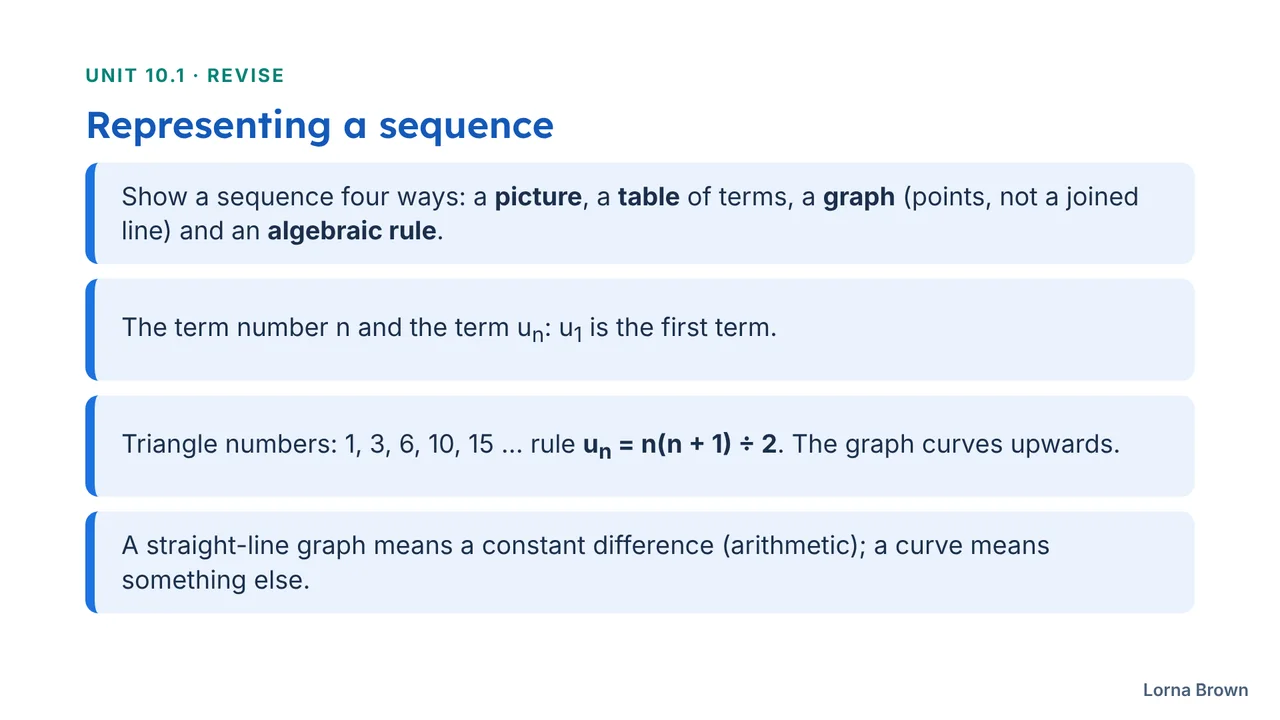
Representing a sequence
  • Show a sequence four ways: a picture, a table of terms, a graph (points, not a joined line) and an algebraic rule.
  • The term number n and the term un: u1 is the first term.
  • Triangle numbers: 1, 3, 6, 10, 15 ... rule un = n(n + 1) ÷ 2. The graph curves upwards.
  • A straight-line graph means a constant difference (arithmetic); a curve means something else.
Shifting a known pattern
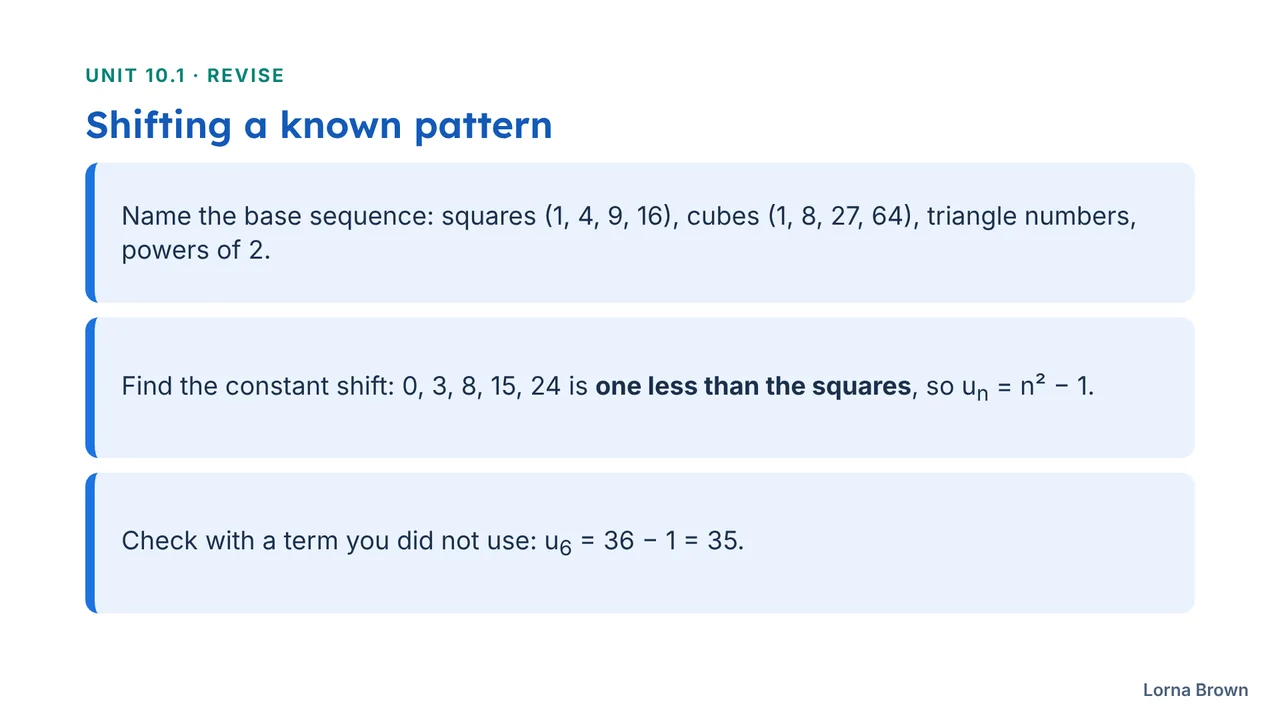
  • Name the base sequence: squares (1, 4, 9, 16), cubes (1, 8, 27, 64), triangle numbers, powers of 2.
  • Find the constant shift: 0, 3, 8, 15, 24 is one less than the squares, so un = n² − 1.
  • Check with a term you did not use: u6 = 36 − 1 = 35.
Quadratic sequences (second differences)
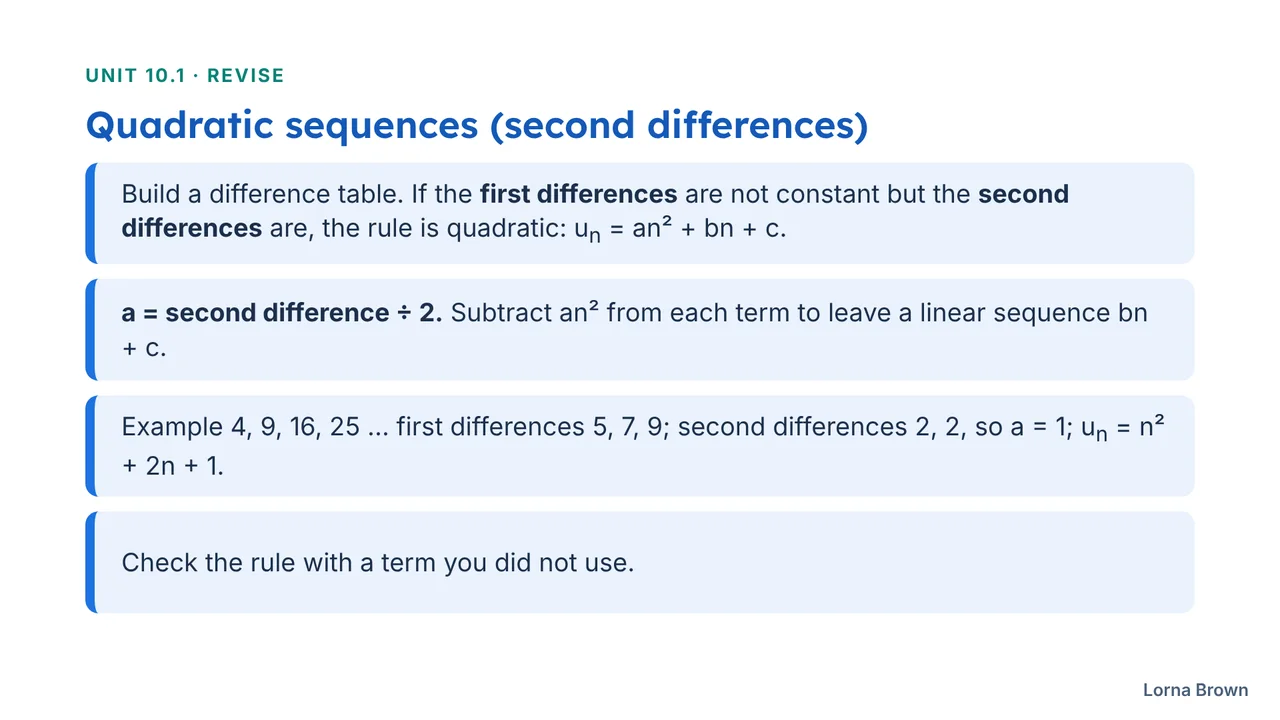
  • Build a difference table. If the first differences are not constant but the second differences are, the rule is quadratic: un = an² + bn + c.
  • a = second difference ÷ 2. Subtract an² from each term to leave a linear sequence bn + c.
  • Example 4, 9, 16, 25 ... first differences 5, 7, 9; second differences 2, 2, so a = 1; un = n² + 2n + 1.
  • Check the rule with a term you did not use.
Arithmetic sequences
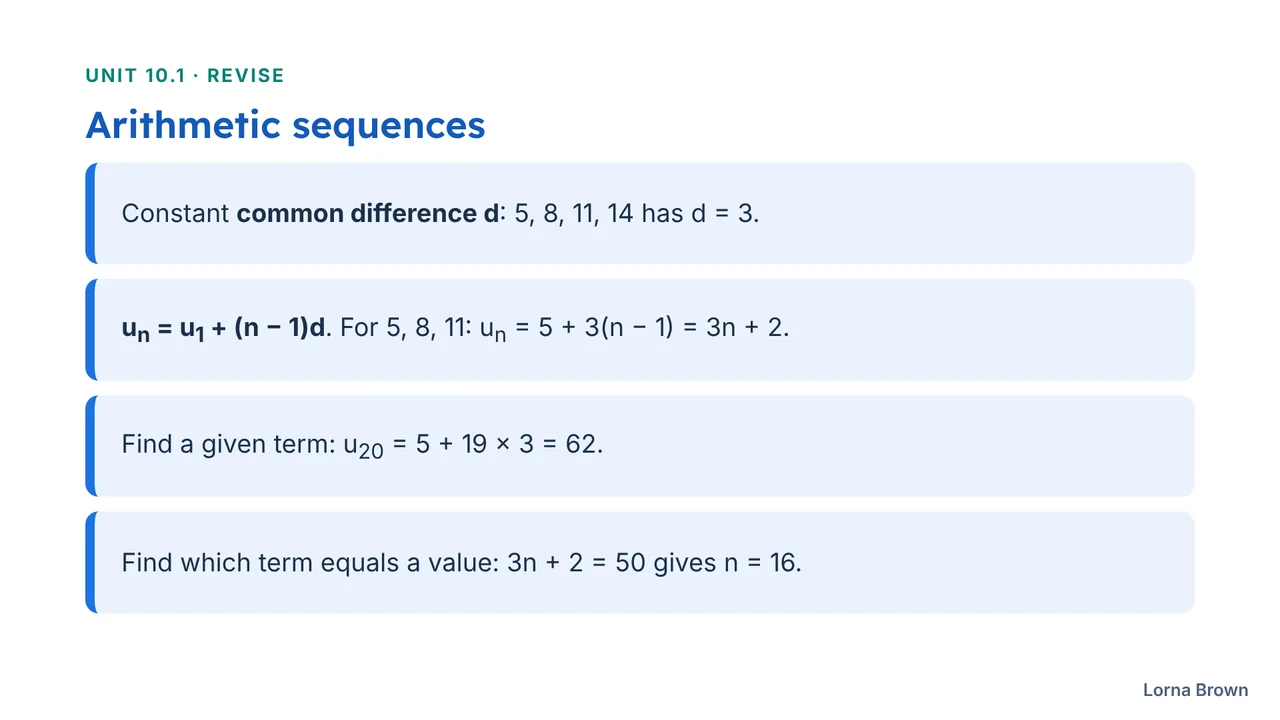
  • Constant common difference d: 5, 8, 11, 14 has d = 3.
  • un = u1 + (n − 1)d. For 5, 8, 11: un = 5 + 3(n − 1) = 3n + 2.
  • Find a given term: u20 = 5 + 19 × 3 = 62.
  • Find which term equals a value: 3n + 2 = 50 gives n = 16.
Geometric sequences
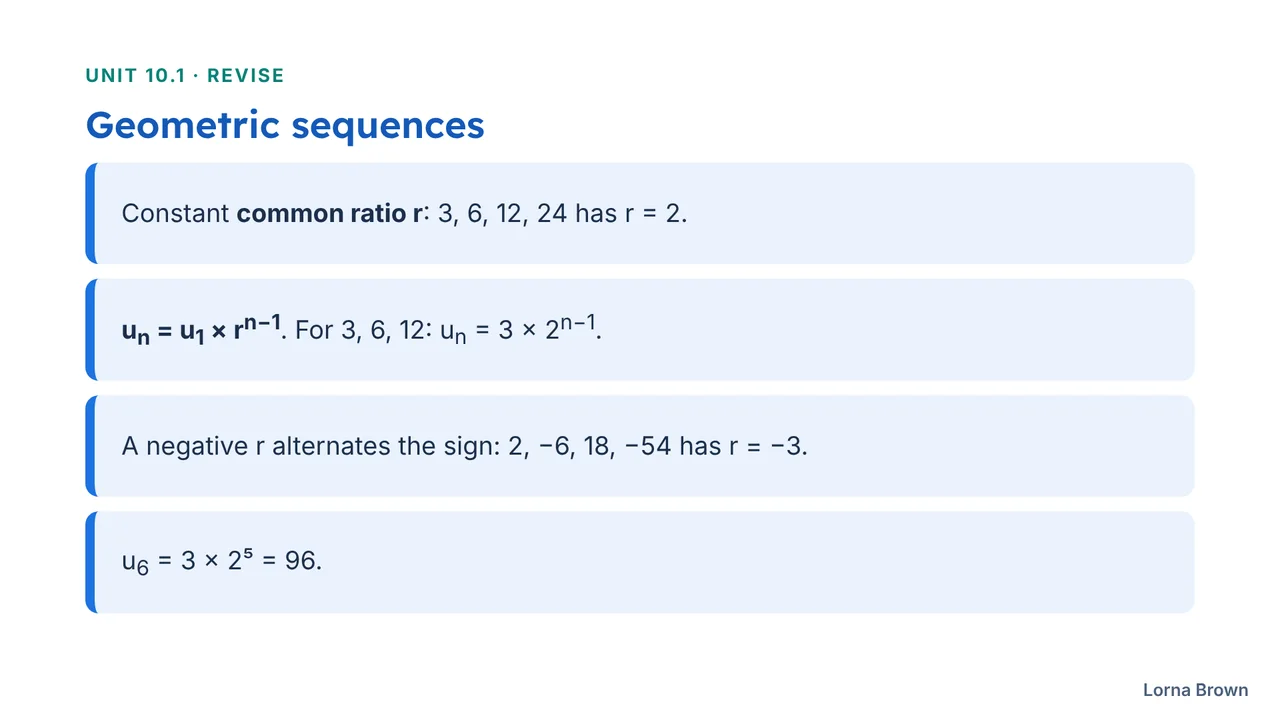
  • Constant common ratio r: 3, 6, 12, 24 has r = 2.
  • un = u1 × rn−1. For 3, 6, 12: un = 3 × 2n−1.
  • A negative r alternates the sign: 2, −6, 18, −54 has r = −3.
  • u6 = 3 × 2⁵ = 96.
Working backwards and equal properties
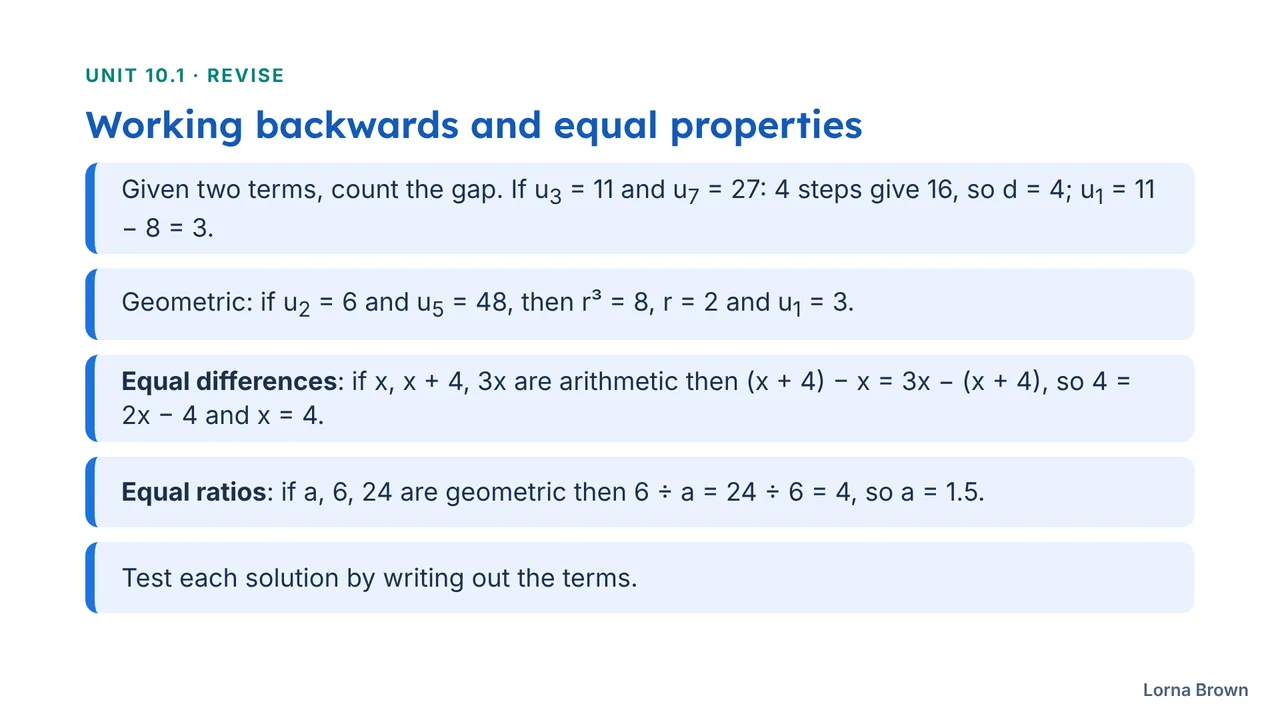
  • Given two terms, count the gap. If u3 = 11 and u7 = 27: 4 steps give 16, so d = 4; u1 = 11 − 8 = 3.
  • Geometric: if u2 = 6 and u5 = 48, then r³ = 8, r = 2 and u1 = 3.
  • Equal differences: if x, x + 4, 3x are arithmetic then (x + 4) − x = 3x − (x + 4), so 4 = 2x − 4 and x = 4.
  • Equal ratios: if a, 6, 24 are geometric then 6 ÷ a = 24 ÷ 6 = 4, so a = 1.5.
  • Test each solution by writing out the terms.
Recursive definitions
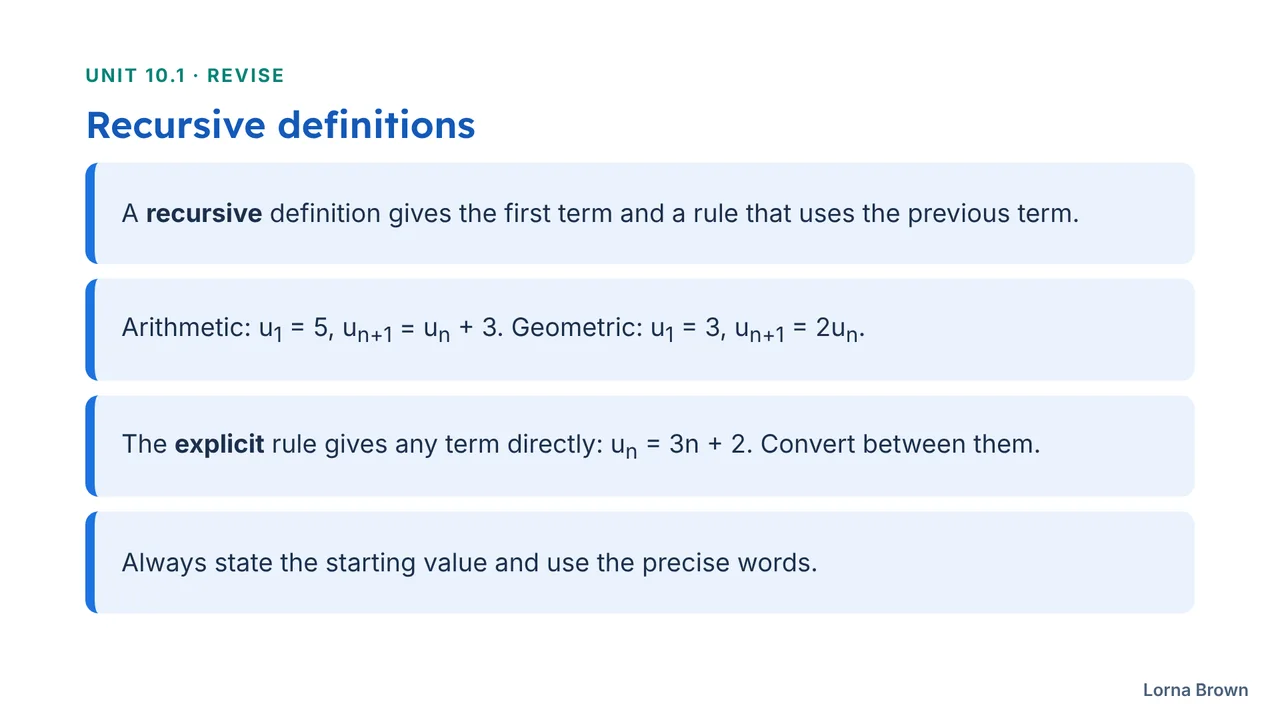
  • A recursive definition gives the first term and a rule that uses the previous term.
  • Arithmetic: u1 = 5, un+1 = un + 3. Geometric: u1 = 3, un+1 = 2un.
  • The explicit rule gives any term directly: un = 3n + 2. Convert between them.
  • Always state the starting value and use the precise words.
Common mistakes
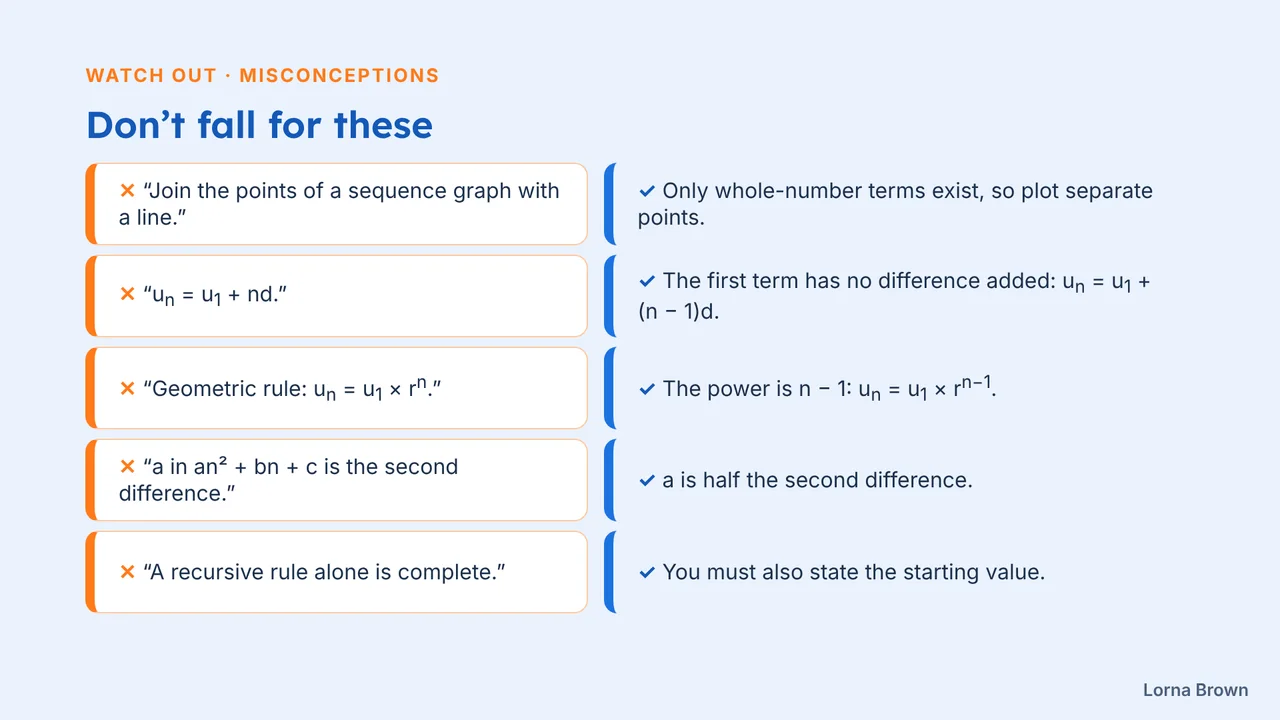
  • ✕ “Join the points of a sequence graph with a line.” ✓ Only whole-number terms exist, so plot separate points.
  • ✕ “un = u1 + nd.” ✓ The first term has no difference added: un = u1 + (n − 1)d.
  • ✕ “Geometric rule: un = u1 × rn.” ✓ The power is n − 1: un = u1 × rn−1.
  • ✕ “a in an² + bn + c is the second difference.” ✓ a is half the second difference.
  • ✕ “A recursive rule alone is complete.” ✓ You must also state the starting value.

Practice booklet

Unit 10.1 Practice Booklet
mathscafe.net
Lorna Brown © 2026
Ms B’s mathscafe

Practice Booklet

MYP 4 · Year 10 Mathematics (Extended)
Unit 10.1 · Sequences
Name:
10.1.1
Representing sequences · Questions 1–15
10.1.2
Shifted sequences · Questions 16–30
10.1.2b
Second differences · Questions 31–45
10.1.3
Arithmetic sequences · Questions 46–60
10.1.4
Geometric sequences · Questions 61–75
10.1.5
Working backwards · Questions 76–90
10.1.6
Equal differences and equal ratios · Questions 91–105
10.1.7
Recursive rules · Questions 106–120
Homework
Homework page and checking record
Answers
For checking and correcting in green pen
MYP 4 · Year 10 · Unit 10.1 Sequences · Practice BookletMs B’s mathscafe · page 1

How to use this booklet and your homework

Read this first

Choosing your level

Every part of the unit has four levels. Start where you feel comfortable and move between them freely. Most questions ask you to explain as well as answer, because being able to say why is what makes a method stick.

Learning

Small numbers, with counters or a diagram beside you.

Practising

The standard question, with your reasoning written out.

Challenging

Working backwards, and finding what is wrong with someone else's thinking.

Mastery

Explaining why a rule must be true, and testing it on new cases.

Working on your homework

Pens and setting out

  • Answers in blue or black non-erasable pen, or in pencil.
  • Colour and highlighters are for annotating your work and showing the steps of a method.
  • Never erase a mistake. Rework it underneath so you can see what changed.
Green pen is for checking. When you finish, use the answers at the back to check your work.
  • Got it wrong? Circle the question number, then make your correction and write your error analysis in green pen.
  • Still can’t work out how to solve it? Put a star ★ next to the question number, so we know to go over it in class.

Each sheet

  • Your name goes on every sheet, because they are handed in one at a time.
  • Each question is worth up to 3 marks. If a question has parts (a, b, c…), each part is marked out of 3. At the end of each level, write your score out of the total for that level.
  • Questions are numbered 1, 2, 3… all the way through the booklet, so we can say exactly which ones to do.
  • If you are stuck after trying, ask for help. Showing me what you tried is a good start.
MYP 4 · Year 10 · Unit 10.1 Sequences · Practice Bookletmathscafe.net
Lorna Brown © 2026
page 2

10.1.1 Representing sequences

Learning
Name:

Key vocabulary

WordMeaningExample
sequencea list of numbers that follows a pattern1, 3, 6, 10, …
termone number in the sequencethe 3rd term is 6
term number, nthe position of a term in the listn = 4 is the 4th term
unthe term in position nu4 = 10
rulea formula that gives any term from its term numberun = n(n + 1) ÷ 2

One sequence can be shown four ways: a picture, a table, a graph and a rule.

Learning

1
The first four terms of a sequence are 1, 3, 6, 10.
a) Work out the gaps between the terms.
b) Write the next two terms.
2
A sequence has the rule un = 3n + 1. Work out u1, u2 and u3.
3
The points (1, 2), (2, 4), (3, 6), (4, 8) are plotted on a graph.
a) Write the sequence.
b) Do the points lie on a straight line? Explain.
c) Write the rule un = ____
4
Staircase pictures: step 1 has 1 square, step 2 has 4 squares (a 2 by 2 block), step 3 has 9 squares. Draw step 4, count its squares and write the rule.
Learning score / 21
Parent / guardian signature:
MYP 4 · Year 10 · Unit 10.1 Sequences · Practice Bookletmathscafe.net
Lorna Brown © 2026
page 3

10.1.1 Representing sequences

Practising
Name:

Practising

5
The triangle numbers have the rule un = n(n + 1)2. Work out
a) u8
b) u10
6
Complete the table for un = n2 + 3 with n = 1 to 5.
a) Complete the table.
b) Do the points lie on a straight line? Explain.
7
A sequence goes 5, 8, 11, 14, 17.
a) Find the gaps.
b) Will the graph be a straight line or a curve? Explain.
c) Write a rule for un.
8
Is 45 a triangle number? Solve n(n + 1) = 2 × 45 by looking for two numbers next to each other with product 90.
Practising score / 24
Parent / guardian signature:
MYP 4 · Year 10 · Unit 10.1 Sequences · Practice Bookletmathscafe.net
Lorna Brown © 2026
page 4

10.1.1 Representing sequences

Challenging · Mastery
Name:

Challenging

9
Compare 2, 6, 12, 20, 30 with the triangle numbers 1, 3, 6, 10, 15. Write the rule for un.
10
Find and describe the mistake. Dev says the sequence 1, 3, 6, 10, 15 has the rule un = 2n − 1 because u1 = 1 and u2 = 3.
11
Step 11 of the triangle pattern has 66 counters and step 12 has 78. How many counters are added, and why does that number make sense in the picture?
12
Is 100 a triangle number? Explain using n(n + 1) = 200.
Challenging score / 12

Mastery

13
Draw two copies of step 5 of the triangle pattern fitted together to make a rectangle. Use it to explain why u5 = 5 × 62.
14
Sam says that a table of five terms proves a rule. Explain why it does not, and say how the rectangle picture does prove the rule for every n.
15
A graph of a sequence has points that curve upwards. Write the first five terms of one possible sequence and explain how you know the graph curves without plotting it.
Mastery score / 9
Parent / guardian signature:
MYP 4 · Year 10 · Unit 10.1 Sequences · Practice Bookletmathscafe.net
Lorna Brown © 2026
page 5

10.1.2 Shifted sequences

Learning
Name:

Name it, shift it, check it

StepWhat you doExample: 2, 5, 10, 17, 26
Name itWhich known sequence is it close to? Squares or cubes1, 4, 9, 16, 25
Shift itSubtract. What constant is added or taken away every time?always + 1
Check itSubstitute a term you did not usen = 5: 25 + 1 = 26

Squares: 1, 4, 9, 16, 25. Cubes: 1, 8, 27, 64, 125.

Learning

16
Write the first five square numbers and the first five cube numbers.
17
Compare 0, 3, 8, 15, 24 with the squares 1, 4, 9, 16, 25.
a) What is added to each square to give the term?
b) Complete the rule un = n2 ____
18
A sequence has the rule un = n2 + 2. Work out u1, u2, u3 and u4.
19
Name it, shift it: find the rule for 2, 5, 10, 17, 26.
Learning score / 15
Parent / guardian signature:
MYP 4 · Year 10 · Unit 10.1 Sequences · Practice Bookletmathscafe.net
Lorna Brown © 2026
page 6

10.1.2 Shifted sequences

Practising
Name:

Practising

20
Find the rule for
a) 5, 8, 13, 20, 29
b) −1, 2, 7, 14, 23
21
Find the rule for
a) 0, 7, 26, 63, 124
b) 2, 9, 28, 65, 126 (compare with the cubes)
22
A sequence has the rule un = n2 − 3.
a) Find u8.
b) Which term equals 97?
c) Is 45 a term? Explain.
23
The terms 3, 6, 11, 18 were used to find the rule n2 + 2. Check the rule with the fifth term, 27.
Practising score / 24
Parent / guardian signature:
MYP 4 · Year 10 · Unit 10.1 Sequences · Practice Bookletmathscafe.net
Lorna Brown © 2026
page 7

10.1.2 Shifted sequences

Challenging · Mastery
Name:

Challenging

24
Find the rule for 3, 10, 29, 66, 127.
25
Find and describe the mistake. Ali says the rule for 4, 7, 12, 19 is n2 + 4 because the first term is 4.
26
a) Find the rule for −4, −1, 4, 11, 20. b) Which term equals 76?
27
The sequence 10, 17, 36, 73, 134 is the cubes shifted by a constant. Write the rule and find u10.
Challenging score / 15

Mastery

28
Why is it important to test a term you did not use when you build a rule? Explain.
29
How can you tell from the terms of a sequence whether to compare it with the squares or with the cubes? Use two examples.
30
Make your own sequence by shifting the squares by a number you choose. Write the first five terms and the rule, then swap with a partner to check.
Mastery score / 9
Parent / guardian signature:
MYP 4 · Year 10 · Unit 10.1 Sequences · Practice Bookletmathscafe.net
Lorna Brown © 2026
page 8

10.1.2b Second differences

Learning
Name:

Key vocabulary

WordMeaningExample: 2, 6, 12, 20, 30
first differencethe gap between one term and the next4, 6, 8, 10
second differencethe gap between one first difference and the next2, 2, 2
quadratic sequencea sequence whose second differences are constantrule an2 + bn + c

a is half of the second difference. Then b = (first gap) − 3a, and c = u1 − a − b.

Learning

31
Find the first differences and the second differences of 2, 6, 12, 20, 30.
32
Find the first and second differences of 1, 4, 9, 16, 25. Is the sequence quadratic?
33
Each sequence has a constant second difference. Find a, which is half of the second difference.
a) second difference 2
b) second difference 6
c) second difference 10
34
For un = n2 + 2n find u1 to u4. Then check that the second differences are constant.
Learning score / 18
Parent / guardian signature:
MYP 4 · Year 10 · Unit 10.1 Sequences · Practice Bookletmathscafe.net
Lorna Brown © 2026
page 9

10.1.2b Second differences

Practising
Name:

Practising

35
Find the rule for
a) 6, 9, 14, 21
b) 2, 7, 14, 23
36
Find the rule for 3, 10, 21, 36, 55.
37
Find the rule for 5, 4, 5, 8, 13.
38
A sequence has the rule un = 2n2 − 3n.
a) Find u10.
b) Which term equals 20? Try values of n.
Practising score / 18
Parent / guardian signature:
MYP 4 · Year 10 · Unit 10.1 Sequences · Practice Bookletmathscafe.net
Lorna Brown © 2026
page 10

10.1.2b Second differences

Challenging · Mastery
Name:

Challenging

39
Find the rule for 7, 18, 33, 52, 75.
40
Find and describe the mistake. Mia says that the second difference of 3, 8, 15, 24 is 2, so a = 2.
41
The sequence 5, 11, 21, 35, 53 is quadratic. Find the rule, then find u20.
42
The first differences of a quadratic sequence start 5, 9, 13 and its first term is 3. Write the first four terms and find the rule.
Challenging score / 12

Mastery

43
Explain why the second difference of an2 + bn + c is 2a. Use the terms for n = 1, 2, 3.
44
Explain why 2, 4, 8, 16, 32 is not a quadratic sequence.
45
A sequence has the rule un = n2 + bn and u2 = 10. Find b and write the first four terms.
Mastery score / 9
Parent / guardian signature:
MYP 4 · Year 10 · Unit 10.1 Sequences · Practice Bookletmathscafe.net
Lorna Brown © 2026
page 11

10.1.3 Arithmetic sequences

Learning
Name:

Key vocabulary

WordMeaningExample: 4, 9, 14, 19
arithmetic sequencethe same amount is added every time+ 5 each time
common difference, dthe amount added (negative if the terms fall)d = 5
u1the first termu1 = 4
ruleun = u1 + (n − 1)d4 + (n − 1) × 5 = 5n − 1

Learning

46
Find d for
a) 4, 9, 14, 19
b) 50, 42, 34, 26
47
An arithmetic sequence has u1 = 6 and d = 4. Write u2 to u5.
48
Use un = u1 + (n − 1)d to write the rule for 3, 7, 11, 15.
49
An arithmetic sequence has the rule un = 5n − 2. Write
a) u1
b) d
c) u10
Learning score / 21
Parent / guardian signature:
MYP 4 · Year 10 · Unit 10.1 Sequences · Practice Bookletmathscafe.net
Lorna Brown © 2026
page 12

10.1.3 Arithmetic sequences

Practising
Name:

Practising

50
Find the rule for 8, 15, 22, 29 and use it to find u40.
51
Find the rule for 90, 84, 78, 72 and use it to find u18.
52
An arithmetic sequence has u1 = 1.5 and d = 0.25. Find u12.
53
Which term of 5, 8, 11, 14, … equals 101?
Practising score / 12
Parent / guardian signature:
MYP 4 · Year 10 · Unit 10.1 Sequences · Practice Bookletmathscafe.net
Lorna Brown © 2026
page 13

10.1.3 Arithmetic sequences

Challenging · Mastery
Name:

Challenging

54
An arithmetic sequence has u1 = −4 and d = −1.5. Find un and u9.
55
Find and describe the mistake. Ben says u30 of 4, 9, 14, … is 4 + 30 × 5 = 154.
56
An arithmetic sequence has u1 = 100 and d = −7. Find the first negative term.
57
Is 250 a term of 7, 12, 17, …? Explain.
Challenging score / 12

Mastery

58
Use the jumps on a number line to explain why un = u1 + (n − 1)d and not u1 + nd.
59
A sequence has d = 0. What does its graph look like? Is it still an arithmetic sequence?
60
Show that un = 3n + 4 is arithmetic by working out un+1 − un.
Mastery score / 9
Parent / guardian signature:
MYP 4 · Year 10 · Unit 10.1 Sequences · Practice Bookletmathscafe.net
Lorna Brown © 2026
page 14

10.1.4 Geometric sequences

Learning
Name:

Key vocabulary

WordMeaningExample: 3, 6, 12, 24
geometric sequenceeach term is multiplied by the same number× 2 each time
common ratio, rthe multiplier (divide a term by the one before)r = 2
ruleun = u1 × rn − 13 × 2n − 1

Learning

61
Find r for
a) 2, 6, 18, 54
b) 400, 200, 100, 50
62
A geometric sequence has u1 = 4 and r = 3. Write u2 to u5.
63
Use un = u1 × rn − 1 to write the rule for 5, 10, 20, 40.
64
A geometric sequence has u1 = 3 and r = 2. Write u1 to u6.
Learning score / 15
Parent / guardian signature:
MYP 4 · Year 10 · Unit 10.1 Sequences · Practice Bookletmathscafe.net
Lorna Brown © 2026
page 15

10.1.4 Geometric sequences

Practising
Name:

Practising

65
Find the rule for 3, 9, 27, 81 and use it to find u8.
66
Find the rule for 1000, 500, 250, 125 and use it to find u7.
67
A geometric sequence has u1 = −2 and r = 5. Find u4.
68
Which term of 2, 6, 18, 54, … equals 1458?
Practising score / 12
Parent / guardian signature:
MYP 4 · Year 10 · Unit 10.1 Sequences · Practice Bookletmathscafe.net
Lorna Brown © 2026
page 16

10.1.4 Geometric sequences

Challenging · Mastery
Name:

Challenging

69
A geometric sequence has u1 = 6 and r = −12. Find un and u6.
70
Find and describe the mistake. Zoe says u5 of 2, 6, 18, … is 2 × 35 = 486.
71
Find the rule for 1, −2, 4, −8, … and say, without listing every term, whether u15 is positive or negative.
72
£500 is invested and grows by 4% each year. The amounts form a geometric sequence with u1 = 500 at the start. Write r and find the amount after 3 years.
Challenging score / 12

Mastery

73
Use the doubling bars picture to explain why un = u1 × rn − 1 and not u1 × rn.
74
A sequence has r = 1. What does its graph look like? Is it also an arithmetic sequence? Explain.
75
A geometric sequence has 0 < r < 1 and u1 > 0. Explain why the terms get smaller but never reach 0.
Mastery score / 9
Parent / guardian signature:
MYP 4 · Year 10 · Unit 10.1 Sequences · Practice Bookletmathscafe.net
Lorna Brown © 2026
page 17

10.1.5 Working backwards

Learning · Practising
Name:

Working backwards

SequenceJump between two termsExample
arithmeticfrom ua to ub there are (b − a) jumps, so d = (difference of terms) ÷ (b − a)u3 = 8, u6 = 23: d = 15 ÷ 3 = 5
geometricrb − a = ub ÷ ua, then take the rootu2 = 6, u5 = 162: r3 = 27

Learning

76
An arithmetic sequence has u1 = 6 and u2 = 11. Find d and u3.
77
A geometric sequence has u1 = 5 and u2 = 15. Find r and u3.
78
An arithmetic sequence has u3 = 14 and d = 4. Work back to find u1 (subtract d twice).
79
A geometric sequence has u3 = 36 and r = 3. Work back to find u1 (divide by r twice).
Learning score / 12

Practising

80
An arithmetic sequence has u3 = 8 and u6 = 23. Find d and u1.
81
A geometric sequence has u2 = 6 and u5 = 162. Find r and u1.
82
An arithmetic sequence has the rule un = 7n − 4. Which term equals 87?
83
A geometric sequence has the rule un = 2 × 3n − 1. Which term equals 486?
Practising score / 12
Parent / guardian signature:
MYP 4 · Year 10 · Unit 10.1 Sequences · Practice Bookletmathscafe.net
Lorna Brown © 2026
page 18

10.1.5 Working backwards

Challenging · Mastery
Name:

Challenging

84
A geometric sequence has u4 = 3 and u7 = 6. Find r exactly, without rounding.
85
An arithmetic sequence has u2 = 15 and u5 = −3. Find d and u1.
86
Find and describe the mistake. Kai says an arithmetic sequence with u2 = 7 and u6 = 23 has d = (23 − 7) ÷ 6.
87
An arithmetic sequence has u1 = 5, d = 4 and un = 77. How many terms are there up to un?
Challenging score / 12

Mastery

88
A geometric sequence has u2 = 4 and u6 = 64. Find both possible sequences and their u1.
89
Explain why u6 ÷ u2 = r4 for a geometric sequence.
90
An arithmetic sequence has u4 = 10 and u9 = −5. Is 0 a term? Explain.
Mastery score / 9
Parent / guardian signature:
MYP 4 · Year 10 · Unit 10.1 Sequences · Practice Bookletmathscafe.net
Lorna Brown © 2026
page 19

10.1.6 Equal differences and equal ratios

Learning
Name:

The two properties

Three consecutive terms a, b, cWhat is equalSo
arithmeticb − a = c − b (equal differences)b is the mean of a and c
geometricb ÷ a = c ÷ b (equal ratios)b2 = ac

Learning

91
x, x + 5, x + 10 are consecutive terms of an arithmetic sequence. Show that both differences equal 5 for any x.
92
4, 8, m are consecutive terms of a geometric sequence. Find m.
93
3, k, 11 are consecutive terms of an arithmetic sequence. Find k.
94
2, k, 18 are consecutive terms of a geometric sequence with k > 0. Find k.
Learning score / 12
Parent / guardian signature:
MYP 4 · Year 10 · Unit 10.1 Sequences · Practice Bookletmathscafe.net
Lorna Brown © 2026
page 20

10.1.6 Equal differences and equal ratios

Practising
Name:

Practising

95
n, 3n − 2, 4n + 1 are consecutive terms of an arithmetic sequence. Find n and the three terms.
96
5, k, 45 are consecutive terms of a geometric sequence. Find both possible values of k and the sequence each gives.
97
x + 2, 2x + 1, 4x − 3 are consecutive terms of an arithmetic sequence. Find x and the terms.
98
x, x + 4, x + 10 are consecutive terms of a geometric sequence. Find x and the common ratio.
Practising score / 12
Parent / guardian signature:
MYP 4 · Year 10 · Unit 10.1 Sequences · Practice Bookletmathscafe.net
Lorna Brown © 2026
page 21

10.1.6 Equal differences and equal ratios

Challenging · Mastery
Name:

Challenging

99
n + 1, 2n + 3, 4n are consecutive terms of an arithmetic sequence. Find n and the terms.
100
Find and describe the mistake. To find k in 3, k, 27 (geometric), Ravi writes k − 3 = 27 − k, so k = 15.
101
x − 1, x + 1, 2x + 2 are consecutive terms of a geometric sequence. Show that x2 − 2x − 3 = 0, solve it, and say which value gives a valid geometric sequence.
102
Three numbers in an arithmetic sequence add to 24 and the largest is 3 times the smallest. Find them.
Challenging score / 12

Mastery

103
Explain why the middle term of three consecutive terms of an arithmetic sequence is the mean of the other two.
104
Explain why, for three positive consecutive terms of a geometric sequence, the middle term is the square root of the product of the other two.
105
Can −5, k, −20 be consecutive terms of a geometric sequence? Find all possible values of k.
Mastery score / 9
Parent / guardian signature:
MYP 4 · Year 10 · Unit 10.1 Sequences · Practice Bookletmathscafe.net
Lorna Brown © 2026
page 22

10.1.7 Recursive rules

Learning
Name:

Key vocabulary

WordMeaningExample
recursive rulegives the first term and how to get each term from the one beforeu1 = 5, un+1 = un + 3
explicit rulegives any term straight from nun = 3n + 2

Arithmetic: un+1 = un + d. Geometric: un+1 = r × un. Always state u1.

Learning

106
A sequence is defined by u1 = 5 and un+1 = un + 3. Write u2, u3 and u4.
107
A sequence is defined by u1 = 2 and un+1 = 3un. Write u2, u3 and u4.
108
Say in words what un+1 = un − 4 means.
109
The sequence 20, 17, 14, 11 is arithmetic. Write its recursive rule.
Learning score / 12
Parent / guardian signature:
MYP 4 · Year 10 · Unit 10.1 Sequences · Practice Bookletmathscafe.net
Lorna Brown © 2026
page 23

10.1.7 Recursive rules

Practising
Name:

Practising

110
A sequence has u1 = 4 and un+1 = un + 7. Find u2 to u5, then write the explicit rule.
111
A sequence has u1 = 100 and un+1 = 0.5un. Find u2 to u5, then write the explicit rule.
112
Write a recursive rule for
a) un = 8 − 2n
b) un = 3 × 2n − 1
113
A sequence has u1 = 6 and un+1 = −3un. Write the explicit rule.
Practising score / 15
Parent / guardian signature:
MYP 4 · Year 10 · Unit 10.1 Sequences · Practice Bookletmathscafe.net
Lorna Brown © 2026
page 24

10.1.7 Recursive rules

Challenging · Mastery
Name:

Challenging

114
A sequence has u1 = 2 and un+1 = 2un + 1. Find u2 to u5. Is the sequence arithmetic, geometric or neither? Explain.
115
Find and describe the mistake. Tom writes the sequence 5, 9, 13, 17 as u1 = 5 and un+1 = 4un.
116
A sequence has u1 = 80 and un+1 = 1.1un. Find the first term that is greater than 100.
117
An arithmetic sequence has u1 = 7 and u4 = 22. Write its recursive rule and its explicit rule.
Challenging score / 12

Mastery

118
A sequence has u1 = 3 and un+1 = un + 2n. Find u2 to u5 and explain why no single d fits.
119
Give one advantage of an explicit rule and one advantage of a recursive rule.
120
For 5, 10, 20, 40, … write the recursive and the explicit rule. Which is quicker for finding u30, and why?
Mastery score / 9
Parent / guardian signature:
MYP 4 · Year 10 · Unit 10.1 Sequences · Practice Bookletmathscafe.net
Lorna Brown © 2026
page 25

Homework and checking record

Hand this page in with your sheets
Name:

Your teacher will tell you which sheet and questions to do. Choose your level, set out your work in pen or pencil, then check it with the answers at the back using a green pen: circle wrong question numbers, and star ★ any you still cannot solve.

SheetQuestionsWhich ones I didChecked in green ✓Teacher
10.1.1 Representing sequencesQ1–15
10.1.2 Shifted sequencesQ16–30
10.1.2b Second differencesQ31–45
10.1.3 Arithmetic sequencesQ46–60
10.1.4 Geometric sequencesQ61–75
10.1.5 Working backwardsQ76–90
10.1.6 Equal differences and equal ratiosQ91–105
10.1.7 Recursive rulesQ106–120

Error analysis

Circle the number of any question you got wrong. Star ★ it if you still cannot solve it after correcting. Then write the questions you need to rework, and what you will do differently:

One thing I understand better now

Score: Parent / guardian signature:
MYP 4 · Year 10 · Unit 10.1 Sequences · Practice Bookletmathscafe.net
Lorna Brown © 2026
page 26

Answers

Check in green pen

10.1.1 Representing sequences

Learning
1a) 2, 3, 4 (the gaps grow by 1 each time) b) 15 and 2124, 7, 10 (put n = 1, 2, 3 into the rule)3a) 2, 4, 6, 8 b) Yes, the same amount (2) is added each time c) un = 2n4Step 4 is a 4 by 4 block, 16 squares. Rule: un = n2
Practising
5a) 8 × 92 = 36 b) 10 × 112 = 556a) 4, 7, 12, 19, 28 b) No. The gaps 3, 5, 7, 9 keep growing, so the graph curves upwards7a) 3, 3, 3, 3 b) A straight line, because the gap is constant c) un = 3n + 2890 = 9 × 10, so n = 9. Yes, 45 is the 9th triangle number: 9 × 102 = 45
Challenging
9Each term is double the triangle number, so un = 2 × n(n + 1)2 = n(n + 1)10The rule only works for the first two terms. 2n − 1 gives u3 = 5, but the third term is 6. A rule must work for every term, so always test a term you did not use1112 counters. Step 12 is step 11 with a new bottom row of 12 counters12No. 13 × 14 = 182 and 14 × 15 = 210, so no two whole numbers next to each other multiply to 200
Mastery
13The two copies make a rectangle with 5 rows and 6 columns, 30 squares. One staircase is half of that, which is 1514A table only shows the rule works for the terms you tested. The picture works for any n: step n is half of a rectangle with n rows and (n + 1) columns15For example 1, 4, 9, 16, 25. The gaps 3, 5, 7, 9 are not constant, so the points do not lie on a straight line and the graph curves

10.1.2 Shifted sequences

Learning
16Squares: 1, 4, 9, 16, 25. Cubes: 1, 8, 27, 64, 12517a) −1 (each term is 1 less than the square) b) un = n2 − 1183, 6, 11, 1819un = n2 + 1 (each term is the square plus 1)
Practising
20a) un = n2 + 4 b) un = n2 − 221a) un = n3 − 1 b) un = n3 + 122a) 64 − 3 = 61 b) n2 = 100, so n = 10 c) No. n2 = 48 and 48 is not a square number23n = 5: 25 + 2 = 27. The rule works for a term that was not used to build it
Challenging
24un = n3 + 2 (cubes 1, 8, 27, 64, 125, each plus 2)25n = 1 gives 1 + 4 = 5, not 4. The first term is 4, which is 3 more than 1, so the shift is +3. The rule is n2 + 326a) un = n2 − 5 b) n2 − 5 = 76, so n2 = 81 and n = 927un = n3 + 9; u10 = 1000 + 9 = 1009
Mastery
28The rule was built from the terms you used, so it must work for them. A different term is the first real test that the rule works for the whole sequence29Look at how fast it grows. 2, 5, 10, 17 grows slowly (gaps 3, 5, 7), like squares. 2, 9, 28, 65 grows fast (gaps 7, 19, 37), like cubes30For example, shift by +6: 7, 10, 15, 22, 31 with rule n2 + 6. Any rule n2 + k works if the terms match

10.1.2b Second differences

Learning
31First differences: 4, 6, 8, 10. Second differences: 2, 2, 232First: 3, 5, 7, 9. Second: 2, 2, 2. The second differences are constant, so it is quadratic33a) a = 1 b) a = 3 c) a = 5343, 8, 15, 24. First differences 5, 7, 9; second differences 2, 2
Practising
35a) gaps 3, 5, 7, second difference 2, a = 1, b = 0, c = 5: n2 + 5 b) gaps 5, 7, 9, a = 1, b = 5 − 3 = 2, c = 2 − 1 − 2 = −1: n2 + 2n − 136Gaps 7, 11, 15, 19, second difference 4, a = 2, b = 7 − 6 = 1, c = 3 − 2 − 1 = 0: un = 2n2 + n37Gaps −1, 1, 3, 5, second difference 2, a = 1, b = −1 − 3 = −4, c = 5 − 1 + 4 = 8: un = n2 − 4n + 838a) 200 − 30 = 170 b) n = 4: 32 − 12 = 20, so it is the 4th term
Challenging
39Gaps 11, 15, 19, 23, second difference 4, a = 2, b = 11 − 6 = 5, c = 7 − 2 − 5 = 0: un = 2n2 + 5n40a is half of the second difference, so a = 1. Check: the rule is n2 + 2n, which gives 3, 8, 15, 2441Gaps 6, 10, 14, 18, second difference 4, a = 2, b = 6 − 6 = 0, c = 5 − 2 = 3: un = 2n2 + 3. u20 = 800 + 3 = 803423, 8, 17, 30. Second difference 4, a = 2, b = 5 − 6 = −1, c = 3 − 2 + 1 = 2: un = 2n2 − n + 2
Mastery
43The terms are a + b + c, 4a + 2b + c, 9a + 3b + c. The first differences are 3a + b and 5a + b. The second difference is (5a + b) − (3a + b) = 2a44First differences 2, 4, 8, 16 and second differences 2, 4, 8 are not constant, so it is not quadratic (it doubles each time, so it is geometric)454 + 2b = 10, so b = 3. The terms are 4, 10, 18, 28

10.1.3 Arithmetic sequences

Learning
46a) d = 5 b) d = −8 (the terms are falling)4710, 14, 18, 2248u1 = 3 and d = 4, so un = 3 + 4(n − 1) = 4n − 149a) 3 b) 5 c) 48
Practising
50un = 8 + 7(n − 1) = 7n + 1. u40 = 28151un = 90 − 6(n − 1) = 96 − 6n. u18 = −1252u12 = 1.5 + 11 × 0.25 = 4.2553un = 3n + 2. 3n + 2 = 101, so n = 33. It is the 33rd term
Challenging
54un = −4 − 1.5(n − 1) = −2.5 − 1.5n. u9 = −1655There are only 29 jumps from u1 to u30, not 30. u30 = 4 + 29 × 5 = 14956100 − 7(n − 1) < 0 gives n − 1 > 14.3, so n = 16. u15 = 2 and u16 = −5, so the first negative term is u16 = −557un = 5n + 2. 5n + 2 = 250 gives n = 49.6, which is not a whole number, so 250 is not a term
Mastery
58You start on u1 with no jumps. To reach the nth term you make n − 1 jumps of size d, so the jumps total (n − 1)d59The points lie on a horizontal line. Yes, because the same amount (0) is added every time60un+1 = 3(n + 1) + 4 = 3n + 7, so un+1 − un = 3. The difference is the constant 3, so it is arithmetic with d = 3

10.1.4 Geometric sequences

Learning
61a) r = 3 b) r = 12 (or 0.5)6212, 36, 108, 32463u1 = 5 and r = 2, so un = 5 × 2n − 1643, 6, 12, 24, 48, 96
Practising
65un = 3 × 3n − 1 = 3n. u8 = 38 = 656166un = 1000 × 12n − 1. u7 = 1000 × 164 = 15.62567u4 = −2 × 53 = −250682 × 3n − 1 = 1458, so 3n − 1 = 729 = 36. n − 1 = 6, so n = 7
Challenging
69un = 6 × (−12)n − 1. u6 = 6 × (−132) = −316 = −0.187570The power is n − 1, not n. There are 4 multiplications from u1 to u5. u5 = 2 × 34 = 16271un = (−2)n − 1. For n = 15 the power is 14, which is even, so u15 is positive (u15 = 16 384)72r = 1.04. After 3 years it is u4 = 500 × 1.043 = £562.43 (to the nearest penny)
Mastery
73The first bar is u1 before any multiplying. Each later bar is multiplied by r once more, so the nth bar has been multiplied by r exactly n − 1 times74The points lie on a horizontal line. Yes. The terms are all equal, so it is arithmetic with d = 0 as well75Each term is multiplied by a number between 0 and 1, so it becomes a smaller fraction of itself. A positive number multiplied by a positive number is never 0 and never negative

10.1.5 Working backwards

Learning
76d = 5 and u3 = 1677r = 15 ÷ 5 = 3 and u3 = 4578u2 = 10 and u1 = 679u2 = 12 and u1 = 4
Practising
803 jumps from u3 to u6: d = 15 ÷ 3 = 5. u1 = 8 − 2 × 5 = −281r3 = 162 ÷ 6 = 27, so r = 3. u1 = 6 ÷ 3 = 2827n − 4 = 87, so 7n = 91 and n = 13833n − 1 = 243 = 35, so n − 1 = 5 and n = 6
Challenging
84r3 = 6 ÷ 3 = 2, so r = ∛2 (about 1.26)85d = (−3 − 15) ÷ 3 = −6 and u1 = 15 + 6 = 2186There are 4 jumps from u2 to u6, not 6. d = 16 ÷ 4 = 4 and u1 = 3875 + 4(n − 1) = 77, so n − 1 = 18 and n = 19
Mastery
88r4 = 16, so r = 2 or r = −2. If r = 2 then u1 = 2. If r = −2 then u1 = −2. Both give u2 = 4 and u6 = 6489From u2 to u6 the term is multiplied by r four times, so u6 = u2 × r490d = −15 ÷ 5 = −3 and u1 = 19. 19 − 3(n − 1) = 0 gives n − 1 = 6.33, not a whole number, so 0 is not a term

10.1.6 Equal differences and equal ratios

Learning
91(x + 5) − x = 5 and (x + 10) − (x + 5) = 5. The x cancels, so the differences are 5 for any x92r = 8 ÷ 4 = 2, so m = 1693k − 3 = 11 − k, so 2k = 14 and k = 794k ÷ 2 = 18 ÷ k, so k2 = 36 and k = 6
Practising
95(3n − 2) − n = (4n + 1) − (3n − 2), so 2n − 2 = n + 3 and n = 5. The terms are 5, 13, 2196k2 = 225, so k = 15 or k = −15. The sequences are 5, 15, 45 and 5, −15, 4597(2x + 1) − (x + 2) = (4x − 3) − (2x + 1), so x − 1 = 2x − 4 and x = 3. The terms are 5, 7, 998(x + 4)2 = x(x + 10), so x2 + 8x + 16 = x2 + 10x and x = 8. The terms are 8, 12, 18 and r = 1.5
Challenging
99(2n + 3) − (n + 1) = 4n − (2n + 3), so n + 2 = 2n − 3 and n = 5. The terms are 6, 13, 20100He used equal differences, which is the arithmetic property. For a geometric sequence the ratios are equal: k ÷ 3 = 27 ÷ k, so k2 = 81 and k = 9 or −9101(x + 1)2 = (x − 1)(2x + 2), so x2 + 2x + 1 = 2x2 − 2, which gives x2 − 2x − 3 = 0 and x = 3 or x = −1. x = 3 gives 2, 4, 8 (r = 2). x = −1 gives −2, 0, 0, which is not geometric (the ratio is not defined)102The middle term is 24 ÷ 3 = 8. Write 8 − d, 8, 8 + d. 8 + d = 3(8 − d), so 4d = 16 and d = 4. The numbers are 4, 8, 12
Mastery
103b − a = c − b gives 2b = a + c, so b = a + c2, which is the mean of a and c104b ÷ a = c ÷ b gives b2 = ac, so b = √(ac) when b is positive105k2 = (−5)(−20) = 100, so k = 10 or k = −10. Both work: −5, 10, −20 has r = −2 and −5, −10, −20 has r = 2

10.1.7 Recursive rules

Learning
1068, 11, 141076, 18, 54108Each term is the term before it minus 4 (the sequence goes down by 4 each time)109u1 = 20 and un+1 = un − 3
Practising
11011, 18, 25, 32. un = 4 + 7(n − 1) = 7n − 311150, 25, 12.5, 6.25. un = 100 × 0.5n − 1112a) u1 = 6 and un+1 = un − 2 b) u1 = 3 and un+1 = 2un113un = 6 × (−3)n − 1
Challenging
1145, 11, 23, 47. The differences 3, 6, 12 are not constant and the ratios 2.5, 2.2, 2.09… are not constant, so it is neither1154un multiplies each term by 4, which gives 5, 20, 80. The sequence adds 4 each time, so the rule is un+1 = un + 4116u2 = 88, u3 = 96.8, u4 = 106.48. The first term greater than 100 is u4117d = 15 ÷ 3 = 5. Recursive: u1 = 7 and un+1 = un + 5. Explicit: un = 5n + 2
Mastery
1185, 9, 15, 23. The amounts added are 2, 4, 6, 8, so the difference changes and there is no constant d119Explicit: you can find any term, such as u100, directly. Recursive: it shows how the sequence grows from term to term and is easy to enter in a calculator120Recursive: u1 = 5 and un+1 = 2un. Explicit: un = 5 × 2n − 1. The explicit rule is quicker: u30 = 5 × 229 in one step, instead of 29 repeated doublings

Revision slides as text (easy to translate)

This is a plain-text version of the revision slides. Your browser can translate it into any language.

Slide 1: Sequences

Revision slides: everything you need for the test, one idea per slide.

Slide 2: Representing a sequence

Show a sequence four ways: a picture, a table of terms, a graph (points, not a joined line) and an algebraic rule.

The term number n and the term un: u1 is the first term.

Triangle numbers: 1, 3, 6, 10, 15 ... rule un = n(n + 1) ÷ 2. The graph curves upwards.

A straight-line graph means a constant difference (arithmetic); a curve means something else.

Slide 3: Shifting a known pattern

Name the base sequence: squares (1, 4, 9, 16), cubes (1, 8, 27, 64), triangle numbers, powers of 2.

Find the constant shift: 0, 3, 8, 15, 24 is one less than the squares, so un = n² − 1.

Check with a term you did not use: u6 = 36 − 1 = 35.

Slide 4: Quadratic sequences (second differences)

Build a difference table. If the first differences are not constant but the second differences are, the rule is quadratic: un = an² + bn + c.

a = second difference ÷ 2. Subtract an² from each term to leave a linear sequence bn + c.

Example 4, 9, 16, 25 ... first differences 5, 7, 9; second differences 2, 2, so a = 1; un = n² + 2n + 1.

Check the rule with a term you did not use.

Slide 5: Arithmetic sequences

Constant common difference d: 5, 8, 11, 14 has d = 3.

un = u1 + (n − 1)d. For 5, 8, 11: un = 5 + 3(n − 1) = 3n + 2.

Find a given term: u20 = 5 + 19 × 3 = 62.

Find which term equals a value: 3n + 2 = 50 gives n = 16.

Slide 6: Geometric sequences

Constant common ratio r: 3, 6, 12, 24 has r = 2.

un = u1 × rn−1. For 3, 6, 12: un = 3 × 2n−1.

A negative r alternates the sign: 2, −6, 18, −54 has r = −3.

u6 = 3 × 2⁵ = 96.

Slide 7: Working backwards and equal properties

Given two terms, count the gap. If u3 = 11 and u7 = 27: 4 steps give 16, so d = 4; u1 = 11 − 8 = 3.

Geometric: if u2 = 6 and u5 = 48, then r³ = 8, r = 2 and u1 = 3.

Equal differences: if x, x + 4, 3x are arithmetic then (x + 4) − x = 3x − (x + 4), so 4 = 2x − 4 and x = 4.

Equal ratios: if a, 6, 24 are geometric then 6 ÷ a = 24 ÷ 6 = 4, so a = 1.5.

Test each solution by writing out the terms.

Slide 8: Recursive definitions

A recursive definition gives the first term and a rule that uses the previous term.

Arithmetic: u1 = 5, un+1 = un + 3. Geometric: u1 = 3, un+1 = 2un.

The explicit rule gives any term directly: un = 3n + 2. Convert between them.

Always state the starting value and use the precise words.

Slide 9: Don’t fall for these

✕ Wrong: Join the points of a sequence graph with a line.

✓ Correct: Only whole-number terms exist, so plot separate points.

✕ Wrong: un = u1 + nd.

✓ Correct: The first term has no difference added: un = u1 + (n − 1)d.

✕ Wrong: Geometric rule: un = u1 × rn.

✓ Correct: The power is n − 1: un = u1 × rn−1.

✕ Wrong: a in an² + bn + c is the second difference.

✓ Correct: a is half the second difference.

✕ Wrong: A recursive rule alone is complete.

✓ Correct: You must also state the starting value.

Slide 10: Test yourself

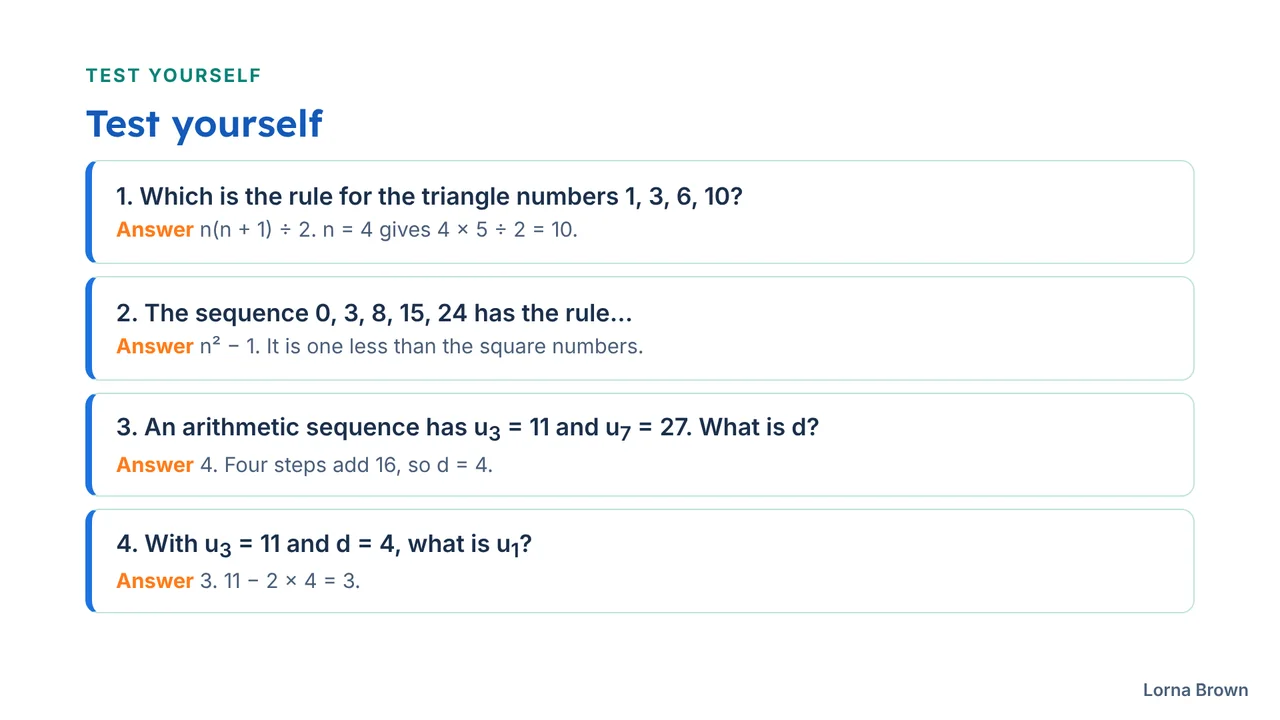
1. Which is the rule for the triangle numbers 1, 3, 6, 10?

Answer: n(n + 1) ÷ 2. n = 4 gives 4 × 5 ÷ 2 = 10.

2. The sequence 0, 3, 8, 15, 24 has the rule...

Answer: n² − 1. It is one less than the square numbers.

3. An arithmetic sequence has u3 = 11 and u7 = 27. What is d?

Answer: 4. Four steps add 16, so d = 4.

4. With u3 = 11 and d = 4, what is u1?

Answer: 3. 11 − 2 × 4 = 3.