7.1 Positive Integers
Revision slides, flash cards, quizzes, revision notes, the practice booklet and a text version of the slides for this unit. Open to everyone, no password needed.
Flash cards
Quizzes
Pick an answer to see if you are right. Your score shows at the end of each quiz.
Revision notes
Download and print the revision notes (PDF, A4)
The big idea. Connections and relationships between positive whole numbers: divisibility, multiples, factors, powers, primes, prime factors, HCF and LCM.
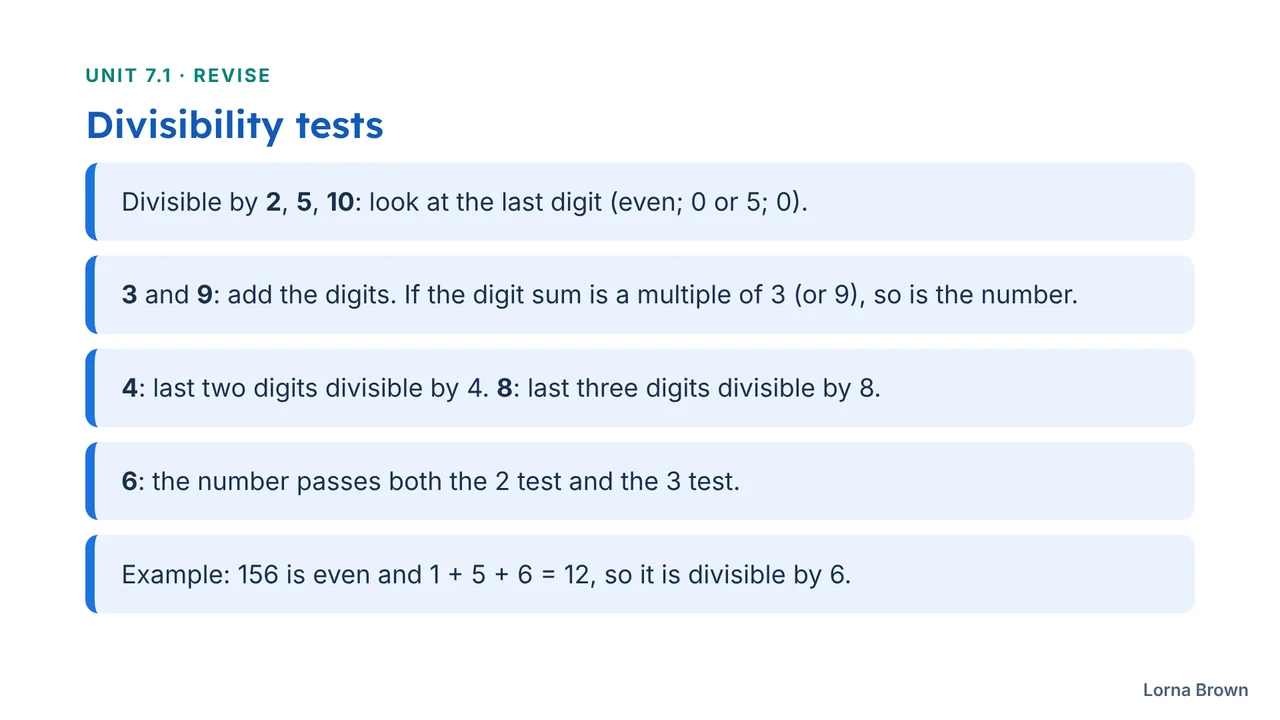
Divisibility tests
- Divisible by 2, 5, 10: look at the last digit (even; 0 or 5; 0).
- 3 and 9: add the digits. If the digit sum is a multiple of 3 (or 9), so is the number.
- 4: last two digits divisible by 4. 8: last three digits divisible by 8.
- 6: the number passes both the 2 test and the 3 test.
- Example: 156 is even and 1 + 5 + 6 = 12, so it is divisible by 6.
Multiples and factors
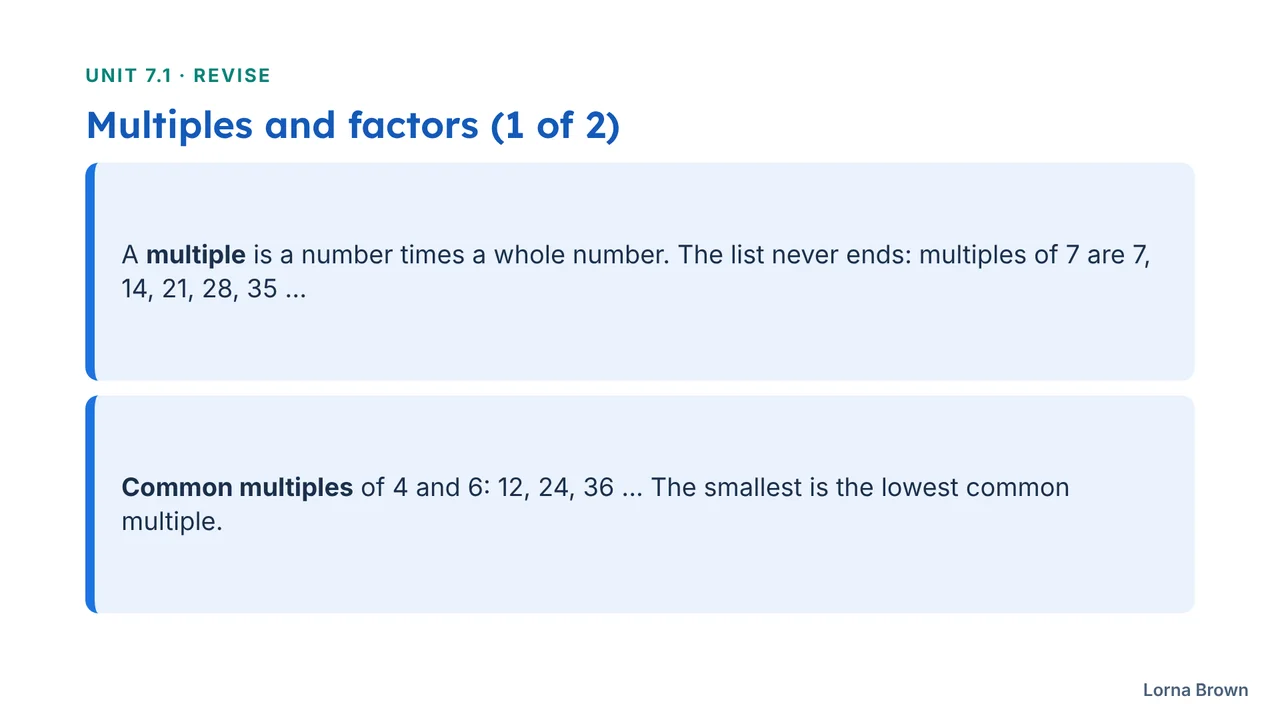
- A multiple is a number times a whole number. The list never ends: multiples of 7 are 7, 14, 21, 28, 35 ...
- Common multiples of 4 and 6: 12, 24, 36 ... The smallest is the lowest common multiple.
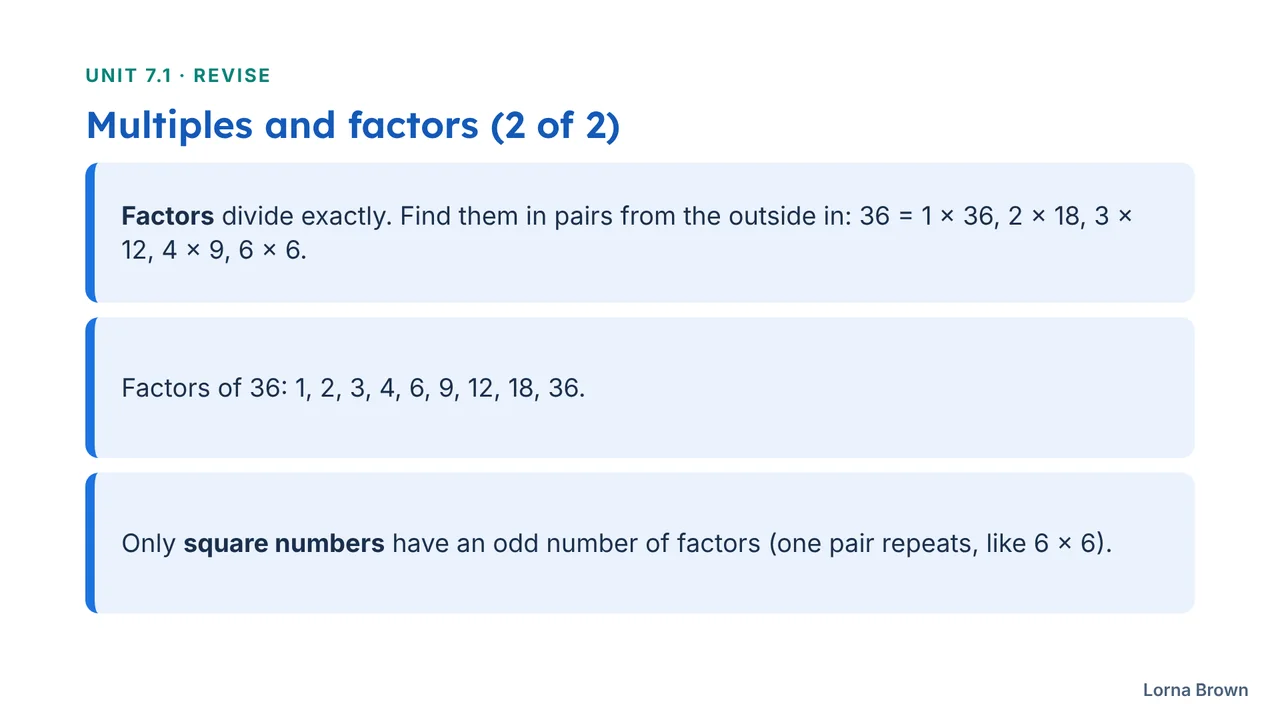
- Factors divide exactly. Find them in pairs from the outside in: 36 = 1 × 36, 2 × 18, 3 × 12, 4 × 9, 6 × 6.
- Factors of 36: 1, 2, 3, 4, 6, 9, 12, 18, 36.
- Only square numbers have an odd number of factors (one pair repeats, like 6 × 6).
Powers and roots
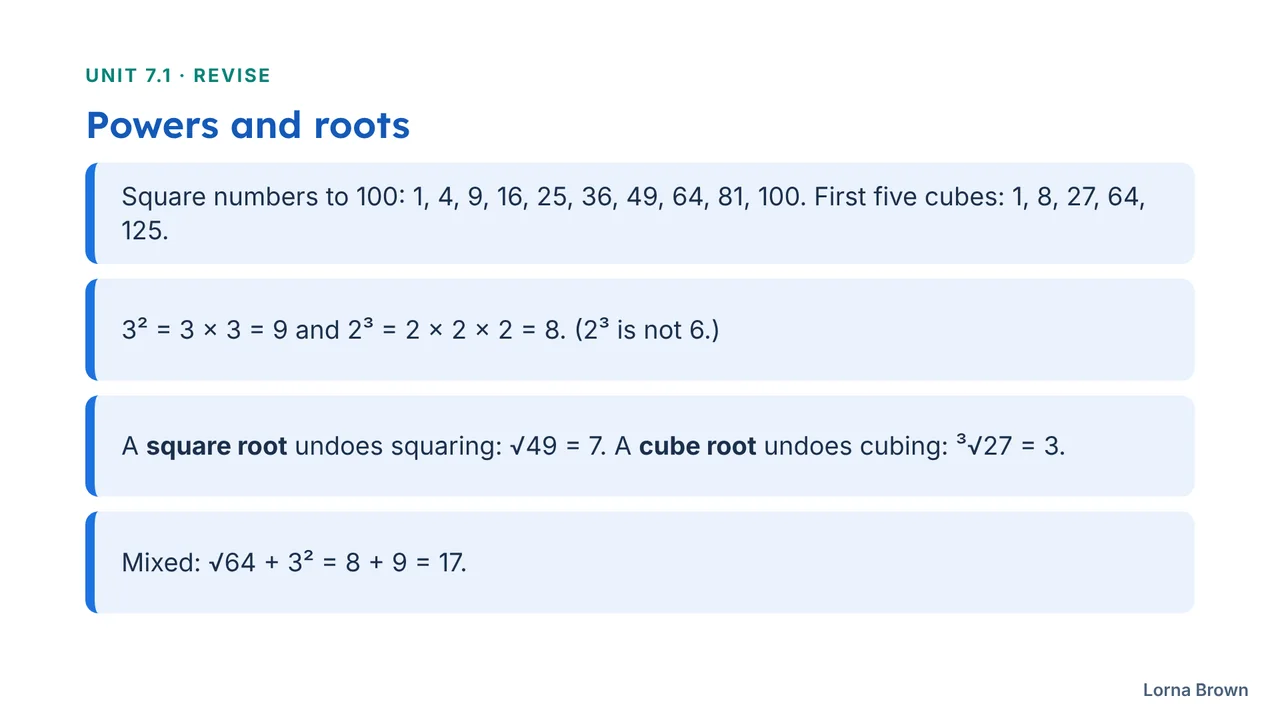
- Square numbers to 100: 1, 4, 9, 16, 25, 36, 49, 64, 81, 100. First five cubes: 1, 8, 27, 64, 125.
- 3² = 3 × 3 = 9 and 2³ = 2 × 2 × 2 = 8. (2³ is not 6.)
- A square root undoes squaring: √49 = 7. A cube root undoes cubing: ³√27 = 3.
- Mixed: √64 + 3² = 8 + 9 = 17.
Sequences
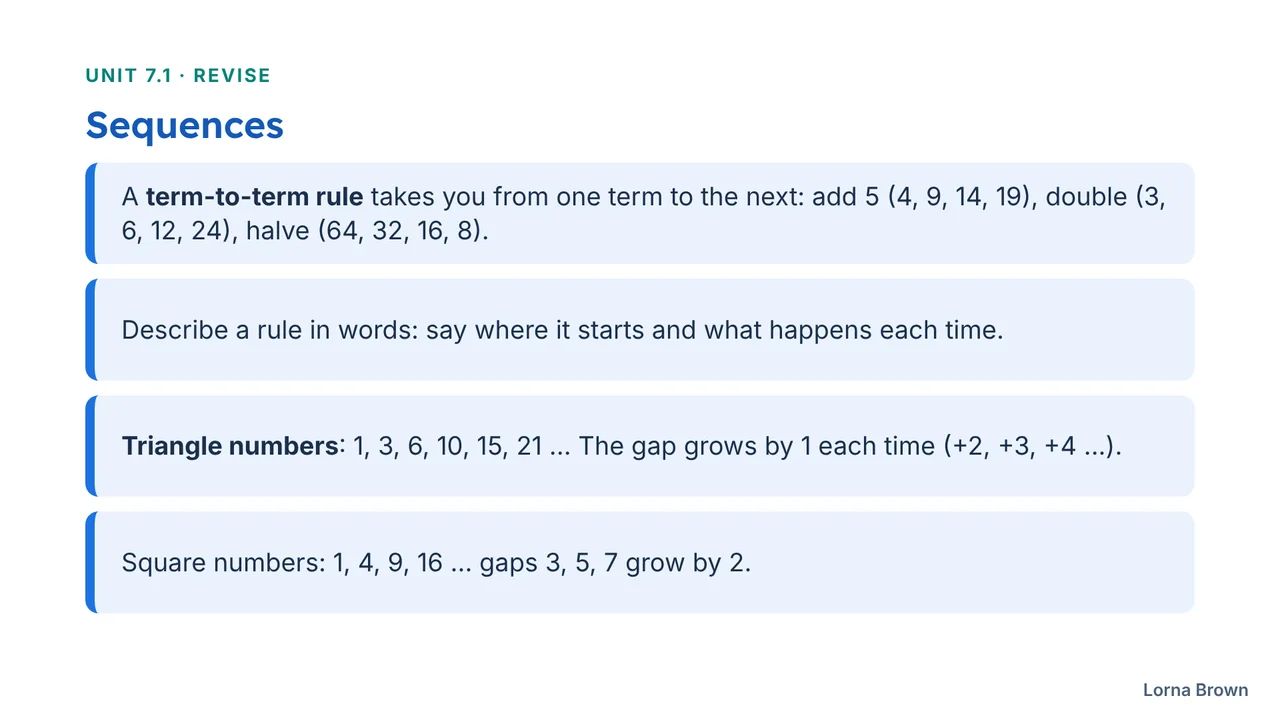
- A term-to-term rule takes you from one term to the next: add 5 (4, 9, 14, 19), double (3, 6, 12, 24), halve (64, 32, 16, 8).
- Describe a rule in words: say where it starts and what happens each time.
- Triangle numbers: 1, 3, 6, 10, 15, 21 ... The gap grows by 1 each time (+2, +3, +4 ...).
- Square numbers: 1, 4, 9, 16 ... gaps 3, 5, 7 grow by 2.
Prime numbers
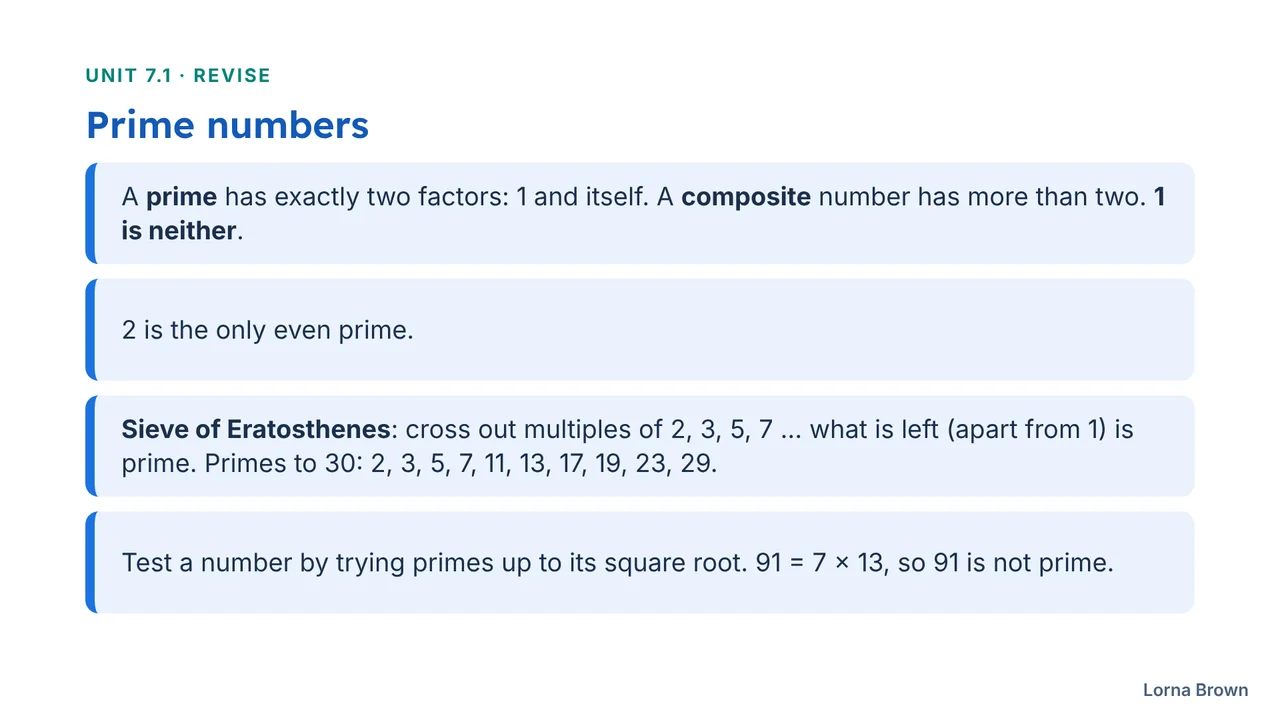
- A prime has exactly two factors: 1 and itself. A composite number has more than two. 1 is neither.
- 2 is the only even prime.
- Sieve of Eratosthenes: cross out multiples of 2, 3, 5, 7 ... what is left (apart from 1) is prime. Primes to 30: 2, 3, 5, 7, 11, 13, 17, 19, 23, 29.
- Test a number by trying primes up to its square root. 91 = 7 × 13, so 91 is not prime.
Prime factors
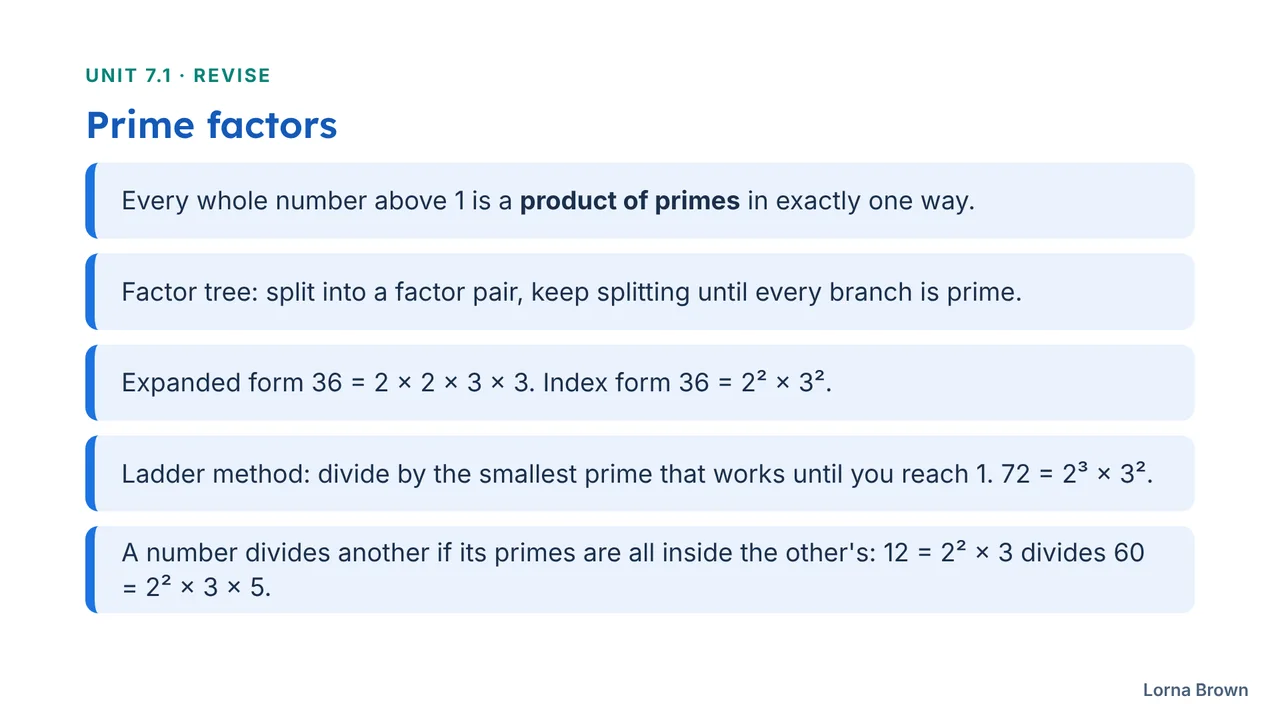
- Every whole number above 1 is a product of primes in exactly one way.
- Factor tree: split into a factor pair, keep splitting until every branch is prime.
- Expanded form 36 = 2 × 2 × 3 × 3. Index form 36 = 2² × 3².
- Ladder method: divide by the smallest prime that works until you reach 1. 72 = 2³ × 3².
- A number divides another if its primes are all inside the other's: 12 = 2² × 3 divides 60 = 2² × 3 × 5.
HCF and LCM
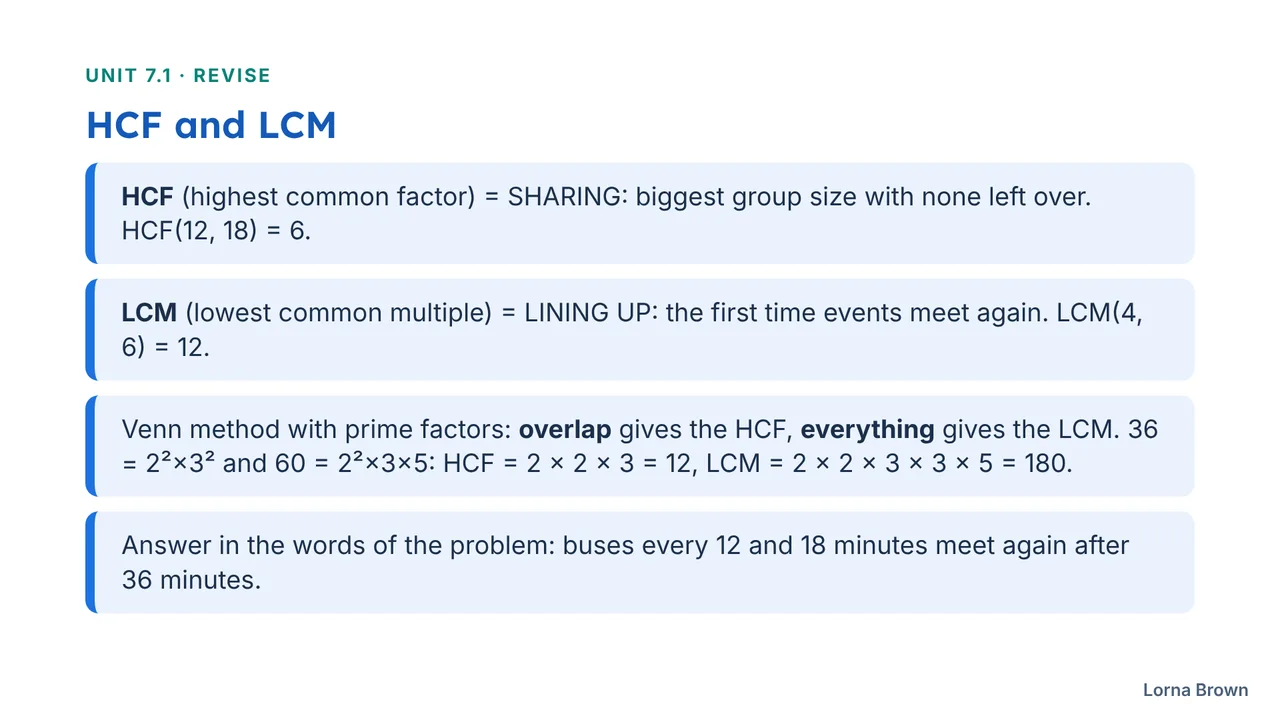
- HCF (highest common factor) = SHARING: biggest group size with none left over. HCF(12, 18) = 6.
- LCM (lowest common multiple) = LINING UP: the first time events meet again. LCM(4, 6) = 12.
- Venn method with prime factors: overlap gives the HCF, everything gives the LCM. 36 = 2²×3² and 60 = 2²×3×5: HCF = 2 × 2 × 3 = 12, LCM = 2 × 2 × 3 × 3 × 5 = 180.
- Answer in the words of the problem: buses every 12 and 18 minutes meet again after 36 minutes.
Common mistakes
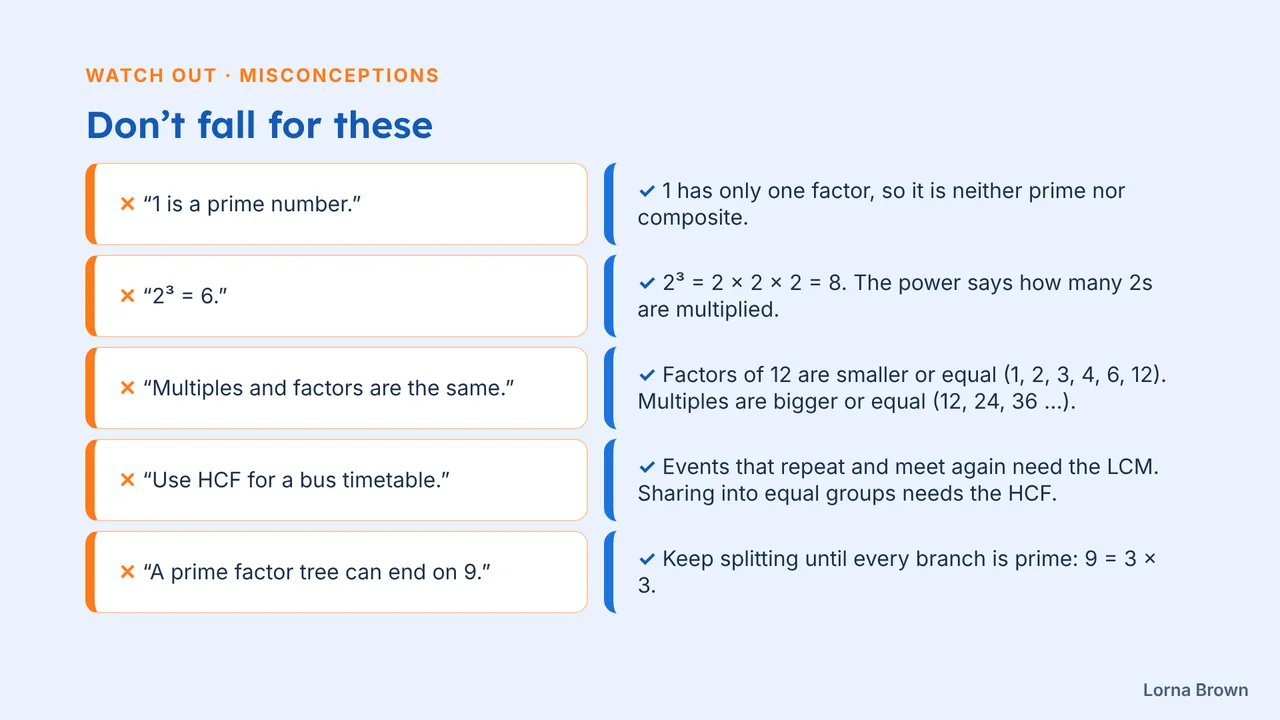
- ✕ “1 is a prime number.” ✓ 1 has only one factor, so it is neither prime nor composite.
- ✕ “2³ = 6.” ✓ 2³ = 2 × 2 × 2 = 8. The power says how many 2s are multiplied.
- ✕ “Multiples and factors are the same.” ✓ Factors of 12 are smaller or equal (1, 2, 3, 4, 6, 12). Multiples are bigger or equal (12, 24, 36 ...).
- ✕ “Use HCF for a bus timetable.” ✓ Events that repeat and meet again need the LCM. Sharing into equal groups needs the HCF.
- ✕ “A prime factor tree can end on 9.” ✓ Keep splitting until every branch is prime: 9 = 3 × 3.
Practice booklet
Practice questions at four levels (Learning, Practising, Challenging, Mastery), with answers at the end. Download the printable PDF.
Questions are numbered 1, 2, 3… all the way through, so your teacher can say exactly which ones to do. Check every answer with a green pen and do an error analysis. Choose a level: Learning (standard case, with your notes), Practising (the method alone), Challenging (harder, several steps) or Mastery (explain why, find errors, apply it).
7.1.1 Divisibility · 7.1.2 Multiples
Key vocabulary
| Word | Meaning | Example |
|---|---|---|
| divisible | divides exactly, with no remainder | 24 is divisible by 8 |
| multiple | a number in the times table of another number | 12 is a multiple of 4 |
| common multiple | a multiple of two or more numbers | 12 is a common multiple of 3 and 4 |
| digit sum | the total you get by adding all the digits | 2 340 → 2 + 3 + 4 + 0 = 9 |
Learning
- Which of these are divisible by 2? How can you tell from the last digit alone? 14, 27, 40, 55
- Which of these are divisible by 5? 30, 44, 65, 81
- Find the digit sum of 51. Is 51 divisible by 3? Explain how you know.
- Write the first five multiples of 3 and of 8. Does either list ever end?
Practising
- Test 2 340 for divisibility by 3, 4, 5 and 9. Give a reason for each.
- Write the first eight multiples of 7, then ring those that are also multiples of 3.
- Find all the common multiples of 4 and 6 below 50. Which is the lowest common multiple?
- Which single-digit numbers divide 918 exactly? Give the test you used for each.
Challenging
- A number is divisible by 4 and by 3. What else must divide it? Explain.
- Find the smallest number above 100 that is divisible by both 8 and 9.
- Find the missing digit so that 4 ★ 2 is divisible by 6. Is there more than one answer?
- Find and describe the mistake. Sam says 2 340 is divisible by 8 because it is divisible by both 4 and 2.
Mastery
- Explain why every number divisible by 9 is also divisible by 3.
- Invent a test for divisibility by 12. Check it on three numbers of your own.
- Mystery number: I have 3 digits and my first digit is 4. I am divisible by 2 and by 5. My digits add up to 9. What number am I? Show how each clue helps.
7.1.3 Powers and roots · 7.1.4 Sequences
Key vocabulary
| Word | Meaning | Example |
|---|---|---|
| square number | a number multiplied by itself | 5² = 25 |
| cube number | a number multiplied by itself twice | 2³ = 8 |
| power (index) | the small number that says how many times to multiply the base | in 2⁵, the base is 2 and the index is 5 |
| square root | the number that squares to give it, written √ | √36 = 6 |
| sequence | a list of numbers that follow a rule | 2, 5, 8, 11, … |
| term-to-term rule | how to get from one term to the next | add 3 each time |
Learning
- Work out a) 3² b) 5² c) 2³
- Write down the first six square numbers and draw the dot array for one of them.
- Work out √25, √36 and ∛8. What is the root undoing each time?
- Continue the sequence 4, 7, 10, 13, ___, ___ and write the term-to-term rule in words.
Practising
- Work out a) √64 + 3² b) ∛27 × 5²
- Which of these are square numbers, and how did you decide? 36, 48, 64, 90
- Continue 2, 6, 18, 54, ___ and state the term-to-term rule.
- These are triangle numbers: 1, 3, 6, 10, ___. Describe the rule in words, then find the next two terms.
Challenging
- Work out √(3² + 4²). Show which step comes first.
- Which is larger, 2⁵ or 5²? Show your working.
- A sequence starts at 5. The rule is "double, then subtract 3". Write the first five terms.
- Find and describe the mistake. Mia writes √16 = 8 and 2³ = 6.
Mastery
- Add consecutive triangle numbers: 1 + 3, then 3 + 6, then 6 + 10. Describe what you notice, then check it on the next pair.
- A sequence has the rule "add 4". Its third term is 15. Find the first term and the seventh term.
- Which number bigger than 1 is both a square number and a cube number? Find the smallest one and show it is both.
7.1.5 Factors · 7.1.6 Prime numbers
Key vocabulary
| Word | Meaning | Example |
|---|---|---|
| factor | a number that divides exactly into another number | 3 is a factor of 12 |
| factor pair | two factors that multiply to give the number | 3 × 4 = 12 |
| prime number | a number with exactly two factors: 1 and itself | 2, 3, 5, 7, 11 |
| composite number | a number with more than two factors | 4, 6, 8, 9, 10 |
| sieve of Eratosthenes | a method that crosses out multiples to leave the primes |
Learning
- List all the factors of a) 10 b) 18 c) 25, working in pairs. How do the pairs help you know none are missing?
- Complete the factor pairs of 20: 1 × ___, 2 × ___, 4 × ___
- Which of these are prime? Give a reason for each one you reject. 9, 11, 15, 23, 27
- Write down all the prime numbers below 20
Practising
- List all the factors of 36, working in pairs from the outside in.
- Is 91 prime? Show how you decided.
- Write the factor pairs of 48 and say how many factors it has.
- Find all the prime numbers between 40 and 60. Which numbers could you rule out at a glance, and how?
Challenging
- Find every number below 50 with exactly three factors. What do they have in common?
- 12 has six factors but 16 has five. Explain the difference.
- List every number below 30 with exactly four factors.
- Find and describe the mistake. a) A student lists the factors of 18 as 1, 2, 3, 6, 9. b) Another student says 51 is prime because it is odd.
Mastery
- Any number with an odd number of factors is a square number. Test the claim on three numbers, then explain why it happens.
- Explain why 2 is the only even prime number and why 1 is not prime.
- In the sieve of Eratosthenes for the numbers 1 to 50, you cross out multiples of 2, 3, 5 and 7 only. Why can you stop at 7?
7.1.7 Product of prime factors
Key vocabulary
| Word | Meaning | Example |
|---|---|---|
| prime factor | a factor that is a prime number | 2, 3, 5, 7 |
| factor tree | split a number into factors until every end is prime | 60 → 4 × 15 → 2, 2, 3, 5 |
| index form | write repeated primes as powers | 60 = 2² × 3 × 5 |
Learning
- Draw a factor tree for 18 and ring the primes.
- Write 20 as a product of primes, then multiply back to check.
- Write 2 × 2 × 3 in index form.
- Which number is 2² × 3²?
Practising
- Write as a product of primes in index form a) 40 b) 54 c) 100
- Draw a factor tree for 84 and write the answer in index form.
- Write 2 × 2 × 2 × 3 × 3 in index form, then work out the number.
- Write 120 as a product of primes in index form. How did you know when to stop splitting?
Challenging
- A number is 2³ × 5. Write down four of its factors without working out the number.
- n = 2² × 3 × 7. Is n divisible by a) 14 b) 18? Justify each answer from the prime factors.
- Build a factor tree for 96 starting with 4 × 24, then another starting with 8 × 12. Compare the two answers.
- Find and describe the mistake. Jo writes 60 = 2 × 3 × 10 as a product of prime factors.
Mastery
- A number is square exactly when every index in its prime factorisation is even. Test this on 144 and on 200, then explain it.
- What is the smallest whole number you can multiply 90 by to make a square number? Show your reasoning.
- How many factors does 2³ × 3² have? Explain how you can find the answer without listing them.
7.1.8 LCM and HCF
Key vocabulary
| Word | Meaning | Example |
|---|---|---|
| HCF | highest common factor: the biggest number that divides both | HCF(12, 18) = 6 |
| LCM | lowest common multiple: the smallest number both divide into | LCM(4, 6) = 12 |
| Venn diagram | two overlapping circles: the overlap holds what is shared | prime factors of 20 and 30 |
Learning
- List the factors of 12 and of 16, then write the HCF. Why is it a factor of both?
- List the first six multiples of 3 and of 4, then write the LCM. Why do we want the lowest shared multiple?
- Find a) HCF(8, 12) b) LCM(8, 12)
- Two bells ring every 4 minutes and every 6 minutes, together now. After how many minutes do they next ring together?
Practising
- Find a) the HCF and b) the LCM of 18 and 30 by listing.
- Find HCF(24, 36) and LCM(24, 36), and check that their product is 24 × 36.
- 20 = 2² × 5 and 30 = 2 × 3 × 5. Draw the Venn diagram of their prime factors, then read off the HCF and the LCM.
- A teacher has 24 pencils and 36 erasers and makes identical packs using everything. What is the largest number of packs, and what is in each one?
Challenging
- 84 = 2² × 3 × 7 and 126 = 2 × 3² × 7. Find the HCF and the LCM.
- Two numbers have an HCF of 6 and an LCM of 36. Find two possible pairs.
- Buses leave every 15 minutes and every 25 minutes, both at 08:00. When do they next leave together?
- Find and describe the mistake. Lena says the HCF of 12 and 18 is 36 and the LCM is 6.
Mastery
- Two numbers have a product of 480 and an HCF of 4. Find their LCM, then find every possible pair.
- Three lights flash every 8, 12 and 18 seconds, together at midnight. When do all three next flash together? Explain your method in words a Year 6 student would follow.
- For each problem say whether you need the HCF or the LCM, and why, then solve it. a) Cut ribbons of 24 cm and 36 cm into equal pieces, with none left over, as long as possible. b) Two lights flash every 8 seconds and every 12 seconds. When do they flash together again?
Answers
Check and correct in green pen.
7.1.1 Divisibility · 7.1.2 Multiples
Learning
- 14 and 40. A number is divisible by 2 when its last digit is 0, 2, 4, 6 or 8.
- 30 and 65, because a number is divisible by 5 when its last digit is 0 or 5.
- Digit sum 5 + 1 = 6. 6 is divisible by 3, so 51 is divisible by 3 (51 = 3 × 17).
- 3, 6, 9, 12, 15 and 8, 16, 24, 32, 40. Neither list ends, because you can always add another 3 (or 8).
Practising
- Digit sum 2 + 3 + 4 + 0 = 9, so it is divisible by 3 and by 9. The last two digits are 40 and 40 ÷ 4 = 10, so it is divisible by 4. It ends in 0, so it is divisible by 5. It passes all four tests.
- 7, 14, 21, 28, 35, 42, 49, 56. Ring 21 and 42, because they are also multiples of 3.
- Multiples of 4: 4, 8, 12, 16, 20, 24, 28, 32, 36, 40, 44, 48. Multiples of 6: 6, 12, 18, 24, 30, 36, 42, 48. Common multiples: 12, 24, 36, 48. The lowest is 12.
- 1, 2, 3, 6 and 9. It ends in 8, so 2 works. The digit sum is 9 + 1 + 8 = 18, so 3 and 9 work. It is even and divisible by 3, so 6 works. 4 fails (18 ÷ 4 = 4.5), 5 fails (it does not end in 0 or 5), 7 fails (918 ÷ 7 = 131.14…) and 8 fails (918 ÷ 8 = 114.75).
Challenging
- 12, and also 2 and 6. 12 = 4 × 3 and 4 and 3 share no factor, so the number is divisible by 12. Anything that divides 12 (2, 6) divides it too.
- The lowest common multiple of 8 and 9 is 72. Multiples of 72: 72, 144. So 144 is the smallest above 100 (144 ÷ 8 = 18, 144 ÷ 9 = 16).
- Divisible by 6 means even and digit sum divisible by 3. It is even already. 4 + ★ + 2 = 6 + ★ must be a multiple of 3, so ★ = 0, 3, 6 or 9. The numbers are 402, 432, 462 and 492.
- Being divisible by 4 (and so by 2) does not make a number divisible by 8. For 8, test the last three digits: 340 ÷ 8 = 42.5, so 2 340 is not divisible by 8.
Mastery
- 9 = 3 × 3, so a number that is divisible by 9 is made of whole groups of 9, and each group of 9 is 3 groups of 3. Using digit sums: if the digit sum is a multiple of 9, it is also a multiple of 3.
- A number is divisible by 12 if it passes the test for 3 and the test for 4 (3 and 4 share no factor). For example 132: digit sum 6, last two digits 32 ÷ 4 = 8, so 132 ÷ 12 = 11. 144 and 156 also pass. 18 passes the test for 3 but not 4, so it is not divisible by 12.
- Divisible by 2 and 5 means it ends in 0, so it is 4 _ 0. The digits add to 9, so 4 + _ + 0 = 9 and the middle digit is 5. The number is 450.
7.1.3 Powers and roots · 7.1.4 Sequences
Learning
- a) 3 × 3 = 9 b) 5 × 5 = 25 c) 2 × 2 × 2 = 8
- 1, 4, 9, 16, 25, 36. For example 4² = 16 is a square of dots with 4 rows of 4.
- 5, 6 and 2. The square root undoes squaring (5² = 25) and the cube root undoes cubing (2³ = 8).
- 16, 19. The rule is add 3 each time.
Practising
- a) Powers and roots first: 8 + 9 = 17 b) 3 × 25 = 75
- 36 (6 × 6) and 64 (8 × 8). 48 is between 36 and 49, and 90 is between 81 and 100, so neither is a square number.
- 162. The rule is multiply by 3 each time (54 × 3 = 162).
- The gap grows by one each time: add 2, add 3, add 4. Next terms: 10 + 5 = 15, then 15 + 6 = 21.
Challenging
- The power inside comes first: 3² + 4² = 9 + 16 = 25. Then the root: √25 = 5.
- 2⁵ = 2 × 2 × 2 × 2 × 2 = 32 and 5² = 5 × 5 = 25. So 2⁵ is larger.
- 5, then 2 × 5 − 3 = 7, then 2 × 7 − 3 = 11, then 2 × 11 − 3 = 19, then 2 × 19 − 3 = 35. The terms are 5, 7, 11, 19, 35.
- √16 = 4, because 4 × 4 = 16; she halved 16 instead of finding the square root. 2³ = 2 × 2 × 2 = 8; she worked out 2 × 3 instead of using 2 three times.
Mastery
- The sums are 4, 9 and 16, which are square numbers. Next pair: 10 + 15 = 25 = 5², so it still works.
- Work backwards: the second term is 11 and the first term is 7. Going forwards from the third term: 19, 23, 27, 31. The seventh term is 31.
- 64, because 64 = 8² and 64 = 4³. (1 is both too, but it is not bigger than 1.)
7.1.5 Factors · 7.1.6 Prime numbers
Learning
- a) 1 × 10, 2 × 5: factors 1, 2, 5, 10 b) 1 × 18, 2 × 9, 3 × 6: factors 1, 2, 3, 6, 9, 18 c) 1 × 25, 5 × 5: factors 1, 5, 25. Working in pairs and stopping when the numbers meet means every factor has been found.
- 1 × 20, 2 × 10, 4 × 5
- 11 and 23 are prime. 9 = 3 × 3, 15 = 3 × 5 and 27 = 3 × 9 each have a factor other than 1 and themselves.
- 2, 3, 5, 7, 11, 13, 17, 19
Practising
- 1 × 36, 2 × 18, 3 × 12, 4 × 9, 6 × 6. The factors are 1, 2, 3, 4, 6, 9, 12, 18, 36.
- Not prime. It is not even, the digit sum is 10 (not a multiple of 3) and it does not end in 0 or 5, but 7 × 13 = 91, so 7 is a factor.
- 1 × 48, 2 × 24, 3 × 16, 4 × 12, 6 × 8. That is 10 factors. Ten is even because 48 is not a square number.
- 41, 43, 47, 53 and 59. Even numbers and numbers ending in 5 are ruled out at once. 51 and 57 have a digit sum divisible by 3. 49 = 7 × 7.
Challenging
- 4, 9, 25 and 49 (factors 1, p and p², for example 1, 2, 4). Each is a prime number multiplied by itself.
- 12 = 1 × 12, 2 × 6, 3 × 4 gives six factors. 16 = 1 × 16, 2 × 8, 4 × 4 repeats the 4, so only five. Square numbers have an odd number of factors.
- 6, 8, 10, 14, 15, 21, 22, 26, 27. For example 27 has factors 1, 3, 9, 27.
- a) 18 is missing: every number is a factor of itself. The factors are 1, 2, 3, 6, 9, 18. b) Being odd does not make a number prime. 51 = 3 × 17 (digit sum 6), so it is not prime.
Mastery
- For example 9 has 3 factors, 16 has 5 and 25 has 3, and all are squares. Factors come in pairs, so the count is even unless a factor pairs with itself, which only happens when the number is a square.
- Every even number above 2 has 2 as a factor as well as 1 and itself, so it has at least three factors. 1 has only one factor, but a prime needs exactly two.
- The next prime is 11 and 11 × 11 = 121 is bigger than 50. Any composite number up to 50 has a prime factor of at most 7 (because 7 × 7 = 49), so it has already been crossed out.
7.1.7 Product of prime factors
Learning
- 18 = 2 × 9 and 9 = 3 × 3, so 18 = 2 × 3 × 3. Ring 2, 3 and 3.
- 20 = 2 × 2 × 5. Check: 2 × 2 = 4, 4 × 5 = 20.
- 2 × 2 is 2², so 2 × 2 × 3 = 2² × 3.
- 2² = 4 and 3² = 9, so 4 × 9 = 36.
Practising
- a) 40 = 2 × 2 × 2 × 5 = 2³ × 5 b) 54 = 2 × 3 × 3 × 3 = 2 × 3³ c) 100 = 2 × 2 × 5 × 5 = 2² × 5²
- 84 = 2 × 42, 42 = 2 × 21, 21 = 3 × 7. So 84 = 2 × 2 × 3 × 7 = 2² × 3 × 7.
- 2³ × 3² = 8 × 9 = 72
- 120 = 2 × 2 × 2 × 3 × 5 = 2³ × 3 × 5. You stop when every branch ends in a prime number, because a prime cannot be split any further.
Challenging
- Any four of 1, 2, 4, 5, 8, 10, 20, 40 (each is made from some of the primes 2, 2, 2 and 5).
- a) Yes: 14 = 2 × 7 and both primes are in n. b) No: 18 = 2 × 3 × 3 needs two 3s but n has only one 3. (n = 84 and 84 ÷ 18 = 4.67…)
- Both trees give 96 = 2 × 2 × 2 × 2 × 2 × 3 = 2⁵ × 3. The prime factors are always the same, however you build the tree.
- 10 is not prime (10 = 2 × 5), so the factorisation is not finished. 60 = 2 × 2 × 3 × 5 = 2² × 3 × 5.
Mastery
- 144 = 2⁴ × 3², all even, and 144 = 12². 200 = 2³ × 5² has an odd index and is not square. A square splits into two identical halves, so each prime appears an even number of times.
- 90 = 2 × 3² × 5. The 2 and the 5 have odd indices, so multiply by 2 × 5 = 10. 90 × 10 = 900 = 30².
- Twelve. A factor uses 0, 1, 2 or 3 twos (4 choices) and 0, 1 or 2 threes (3 choices), so (3 + 1) × (2 + 1) = 12. Check: 2³ × 3² = 72 has factors 1, 2, 3, 4, 6, 8, 9, 12, 18, 24, 36, 72.
7.1.8 LCM and HCF
Learning
- 12: 1, 2, 3, 4, 6, 12. 16: 1, 2, 4, 8, 16. The common factors are 1, 2 and 4, so HCF = 4. It divides both numbers exactly, so it is a factor of each.
- 3, 6, 9, 12, 15, 18 and 4, 8, 12, 16, 20, 24. The first shared multiple is 12, so LCM = 12. There is no highest common multiple, because multiples never end.
- Factors of 8: 1, 2, 4, 8. Factors of 12: 1, 2, 3, 4, 6, 12. a) HCF = 4. Multiples of 8: 8, 16, 24. Multiples of 12: 12, 24. b) LCM = 24.
- This needs the lowest common multiple: LCM(4, 6) = 12. They next ring together after 12 minutes.
Practising
- Factors of 18: 1, 2, 3, 6, 9, 18. Factors of 30: 1, 2, 3, 5, 6, 10, 15, 30. a) HCF = 6. Multiples of 18: 18, 36, 54, 72, 90. Multiples of 30: 30, 60, 90. b) LCM = 90.
- HCF = 12 and LCM = 72. Check: 12 × 72 = 864 and 24 × 36 = 864, so the product matches.
- Overlap: 2 and 5, so HCF = 2 × 5 = 10. Only in 20: 2. Only in 30: 3. Everything together: 2 × 2 × 3 × 5, so LCM = 60.
- Sharing into identical packs needs the HCF: HCF(24, 36) = 12. There are 12 packs, each with 24 ÷ 12 = 2 pencils and 36 ÷ 12 = 3 erasers.
Challenging
- HCF: take the shared primes, lowest powers: 2 × 3 × 7 = 42. LCM: take every prime, highest powers: 2² × 3² × 7 = 252.
- 6 and 36, or 12 and 18. Check 12 and 18: HCF = 6, LCM = 36.
- LCM(15, 25) = 75 minutes, which is 1 hour 15 minutes, so 09:15.
- She swapped them. The HCF is the largest number that divides both, which is 6. The LCM is the smallest number both divide into, which is 36.
Mastery
- HCF × LCM = the product, so LCM = 480 ÷ 4 = 120. Pairs: 4 and 120, 8 and 60, 12 and 40, 20 and 24.
- 72 seconds. 8 = 2³, 12 = 2² × 3, 18 = 2 × 3², so take the highest power of each prime: 2³ × 3² = 72.
- a) HCF, because we are sharing into the biggest equal pieces: 12 cm. b) LCM, because we are waiting for both to line up: 24 seconds.
Error analysis
The questions I need to rework:
What went wrong, and what I will do differently:
Revision slides as text (easy to translate)
This is a plain-text version of the revision slides. Your browser can translate it into any language.
Slide 1: Positive Integers
Revision slides: everything you need for the test, one idea per slide.
Slide 2: Divisibility tests
Divisible by 2, 5, 10: look at the last digit (even; 0 or 5; 0).
3 and 9: add the digits. If the digit sum is a multiple of 3 (or 9), so is the number.
4: last two digits divisible by 4. 8: last three digits divisible by 8.
6: the number passes both the 2 test and the 3 test.
Example: 156 is even and 1 + 5 + 6 = 12, so it is divisible by 6.
Slide 3: Multiples and factors (1 of 2)
A multiple is a number times a whole number. The list never ends: multiples of 7 are 7, 14, 21, 28, 35 ...
Common multiples of 4 and 6: 12, 24, 36 ... The smallest is the lowest common multiple.
Slide 4: Multiples and factors (2 of 2)
Factors divide exactly. Find them in pairs from the outside in: 36 = 1 × 36, 2 × 18, 3 × 12, 4 × 9, 6 × 6.
Factors of 36: 1, 2, 3, 4, 6, 9, 12, 18, 36.
Only square numbers have an odd number of factors (one pair repeats, like 6 × 6).
Slide 5: Powers and roots
Square numbers to 100: 1, 4, 9, 16, 25, 36, 49, 64, 81, 100. First five cubes: 1, 8, 27, 64, 125.
3² = 3 × 3 = 9 and 2³ = 2 × 2 × 2 = 8. (2³ is not 6.)
A square root undoes squaring: √49 = 7. A cube root undoes cubing: ³√27 = 3.
Mixed: √64 + 3² = 8 + 9 = 17.
Slide 6: Sequences
A term-to-term rule takes you from one term to the next: add 5 (4, 9, 14, 19), double (3, 6, 12, 24), halve (64, 32, 16, 8).
Describe a rule in words: say where it starts and what happens each time.
Triangle numbers: 1, 3, 6, 10, 15, 21 ... The gap grows by 1 each time (+2, +3, +4 ...).
Square numbers: 1, 4, 9, 16 ... gaps 3, 5, 7 grow by 2.
Slide 7: Prime numbers
A prime has exactly two factors: 1 and itself. A composite number has more than two. 1 is neither.
2 is the only even prime.
Sieve of Eratosthenes: cross out multiples of 2, 3, 5, 7 ... what is left (apart from 1) is prime. Primes to 30: 2, 3, 5, 7, 11, 13, 17, 19, 23, 29.
Test a number by trying primes up to its square root. 91 = 7 × 13, so 91 is not prime.
Slide 8: Prime factors
Every whole number above 1 is a product of primes in exactly one way.
Factor tree: split into a factor pair, keep splitting until every branch is prime.
Expanded form 36 = 2 × 2 × 3 × 3. Index form 36 = 2² × 3².
Ladder method: divide by the smallest prime that works until you reach 1. 72 = 2³ × 3².
A number divides another if its primes are all inside the other's: 12 = 2² × 3 divides 60 = 2² × 3 × 5.
Slide 9: HCF and LCM
HCF (highest common factor) = SHARING: biggest group size with none left over. HCF(12, 18) = 6.
LCM (lowest common multiple) = LINING UP: the first time events meet again. LCM(4, 6) = 12.
Venn method with prime factors: overlap gives the HCF, everything gives the LCM. 36 = 2²×3² and 60 = 2²×3×5: HCF = 2 × 2 × 3 = 12, LCM = 2 × 2 × 3 × 3 × 5 = 180.
Answer in the words of the problem: buses every 12 and 18 minutes meet again after 36 minutes.
Slide 10: Don’t fall for these
✕ Wrong: 1 is a prime number.
✓ Correct: 1 has only one factor, so it is neither prime nor composite.
✕ Wrong: 2³ = 6.
✓ Correct: 2³ = 2 × 2 × 2 = 8. The power says how many 2s are multiplied.
✕ Wrong: Multiples and factors are the same.
✓ Correct: Factors of 12 are smaller or equal (1, 2, 3, 4, 6, 12). Multiples are bigger or equal (12, 24, 36 ...).
✕ Wrong: Use HCF for a bus timetable.
✓ Correct: Events that repeat and meet again need the LCM. Sharing into equal groups needs the HCF.
✕ Wrong: A prime factor tree can end on 9.
✓ Correct: Keep splitting until every branch is prime: 9 = 3 × 3.
Slide 11: Test yourself
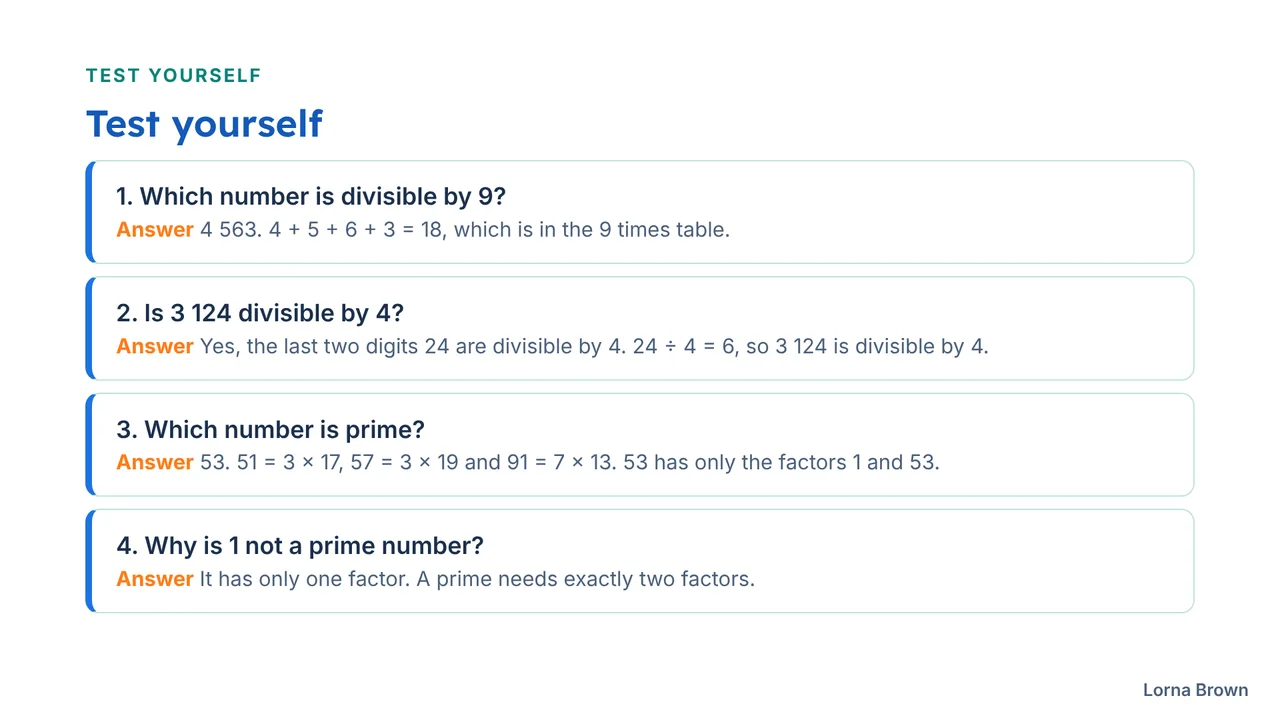
1. Which number is divisible by 9?
Answer: 4 563. 4 + 5 + 6 + 3 = 18, which is in the 9 times table.
2. Is 3 124 divisible by 4?
Answer: Yes, the last two digits 24 are divisible by 4. 24 ÷ 4 = 6, so 3 124 is divisible by 4.
3. Which number is prime?
Answer: 53. 51 = 3 × 17, 57 = 3 × 19 and 91 = 7 × 13. 53 has only the factors 1 and 53.
4. Why is 1 not a prime number?
Answer: It has only one factor. A prime needs exactly two factors.