Year 8 · Unit 8.2

8.2 Ratio and Proportion

Revision slides, flash cards, quizzes, revision notes and a text version of the slides for this unit. Open to everyone, no password needed.
8.2 slide 1 of 11
8.2 slide 2 of 11
8.2 slide 3 of 11
8.2 slide 4 of 11
8.2 slide 5 of 11
8.2 slide 6 of 11
8.2 slide 7 of 11
8.2 slide 8 of 11
8.2 slide 9 of 11
8.2 slide 10 of 11
8.2 slide 11 of 11
Slide 1 of 11

8.2 revision slides as a PDF

Flash cards

Quizzes

Pick an answer to see if you are right. Your score shows at the end of each quiz.

Revision notes

Download and print the revision notes (PDF, A4)

The big idea. Relationships and equivalence between quantities: similarity and scale factor, ratio, direct proportion, conversion graphs, scale diagrams and map scales.

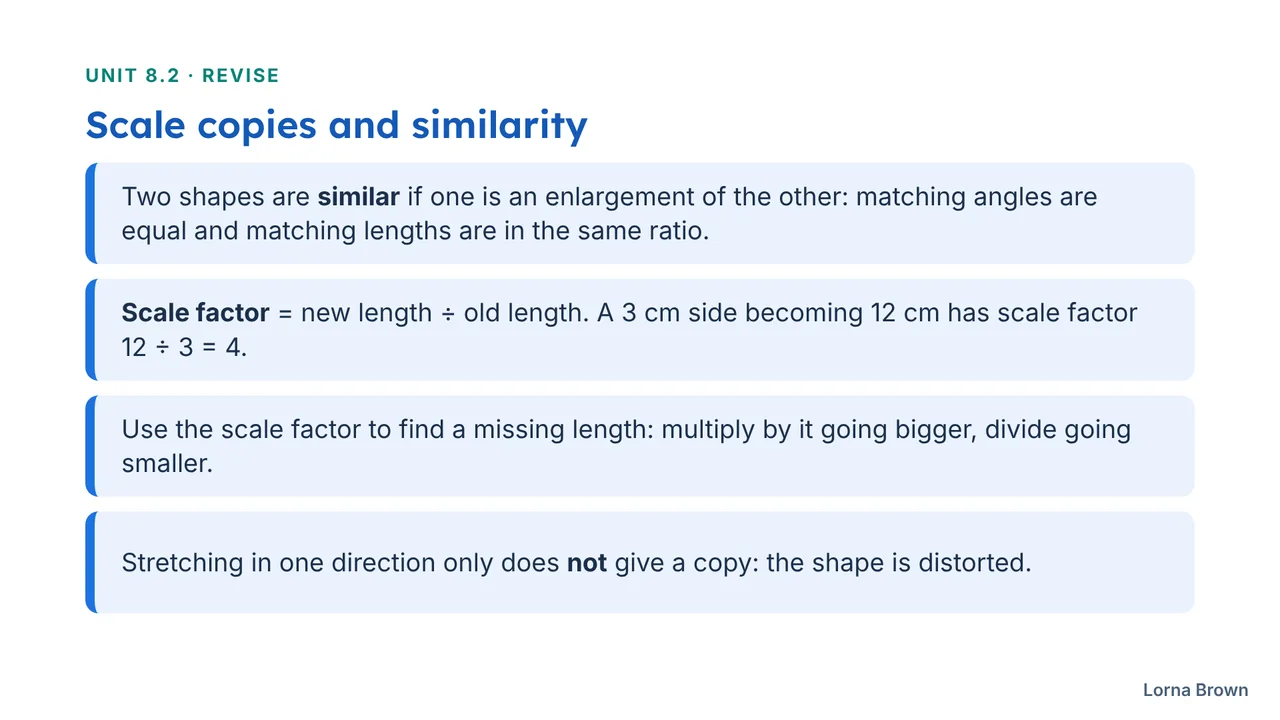
Scale copies and similarity
  • Two shapes are similar if one is an enlargement of the other: matching angles are equal and matching lengths are in the same ratio.
  • Scale factor = new length ÷ old length. A 3 cm side becoming 12 cm has scale factor 12 ÷ 3 = 4.
  • Use the scale factor to find a missing length: multiply by it going bigger, divide going smaller.
  • Stretching in one direction only does not give a copy: the shape is distorted.
Ratio
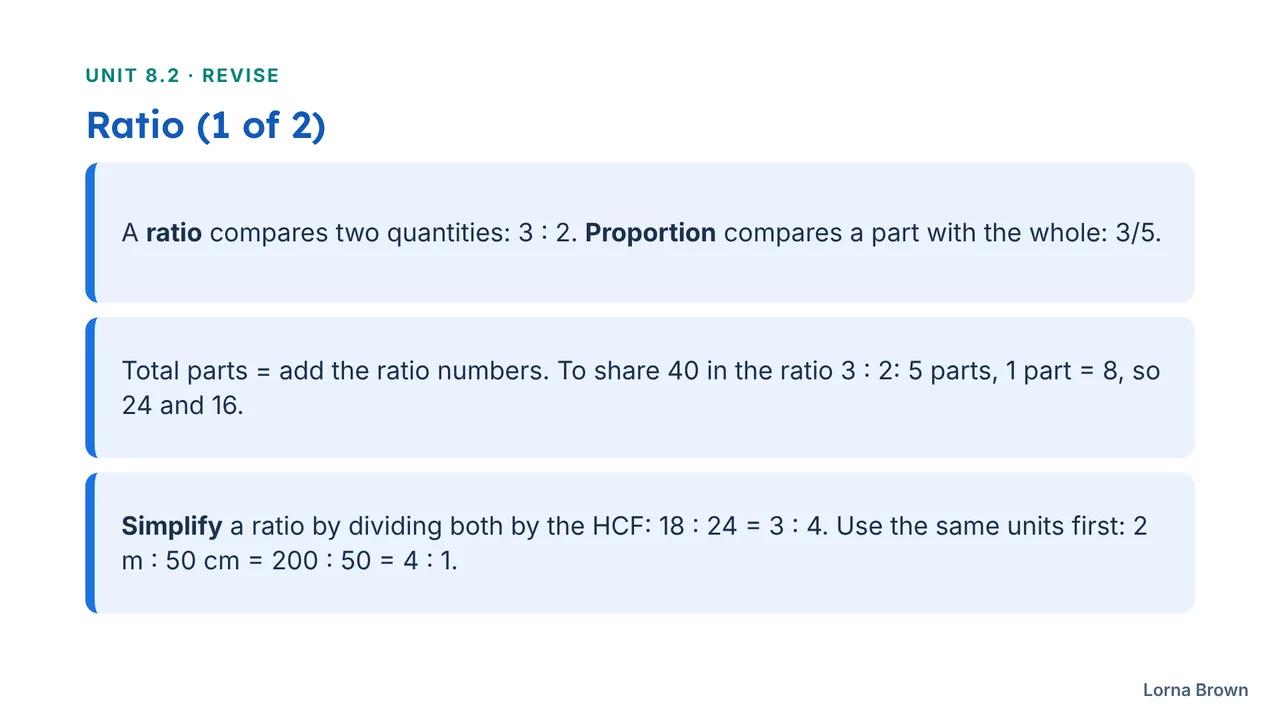
  • A ratio compares two quantities: 3 : 2. Proportion compares a part with the whole: 3/5.
  • Total parts = add the ratio numbers. To share 40 in the ratio 3 : 2: 5 parts, 1 part = 8, so 24 and 16.
  • Simplify a ratio by dividing both by the HCF: 18 : 24 = 3 : 4. Use the same units first: 2 m : 50 cm = 200 : 50 = 4 : 1.
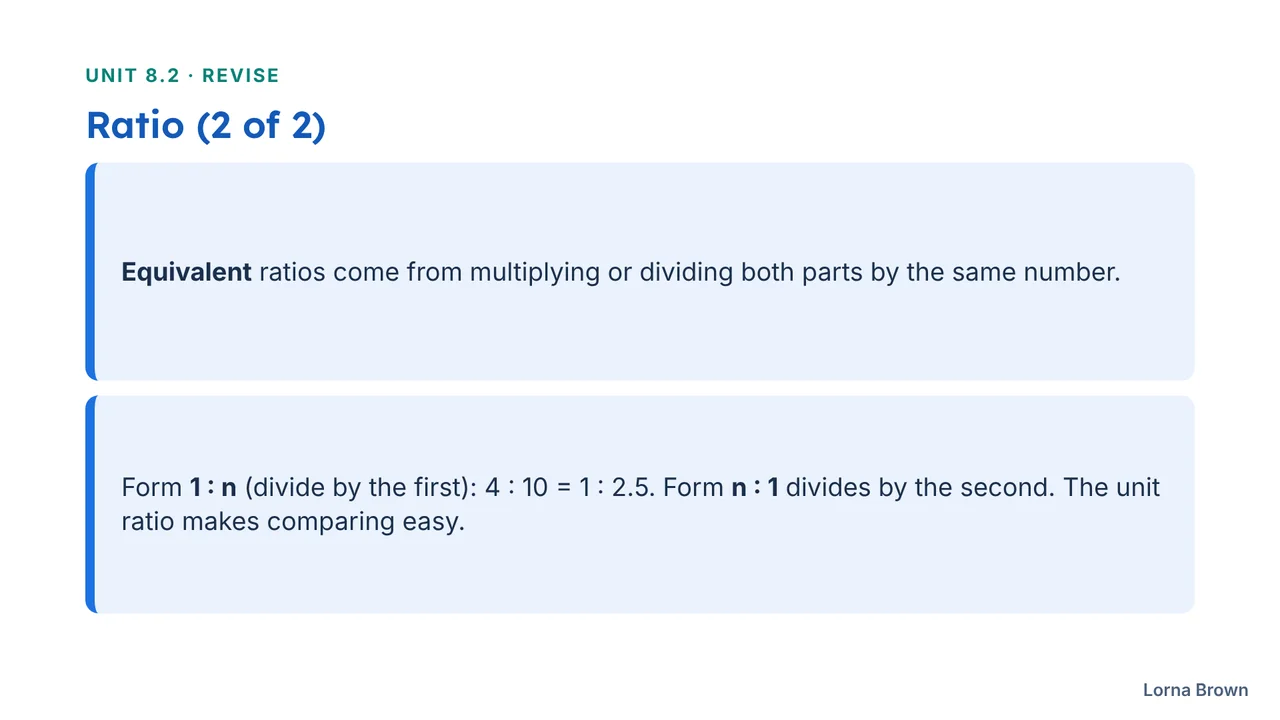
  • Equivalent ratios come from multiplying or dividing both parts by the same number.
  • Form 1 : n (divide by the first): 4 : 10 = 1 : 2.5. Form n : 1 divides by the second. The unit ratio makes comparing easy.
Ratio and fractions
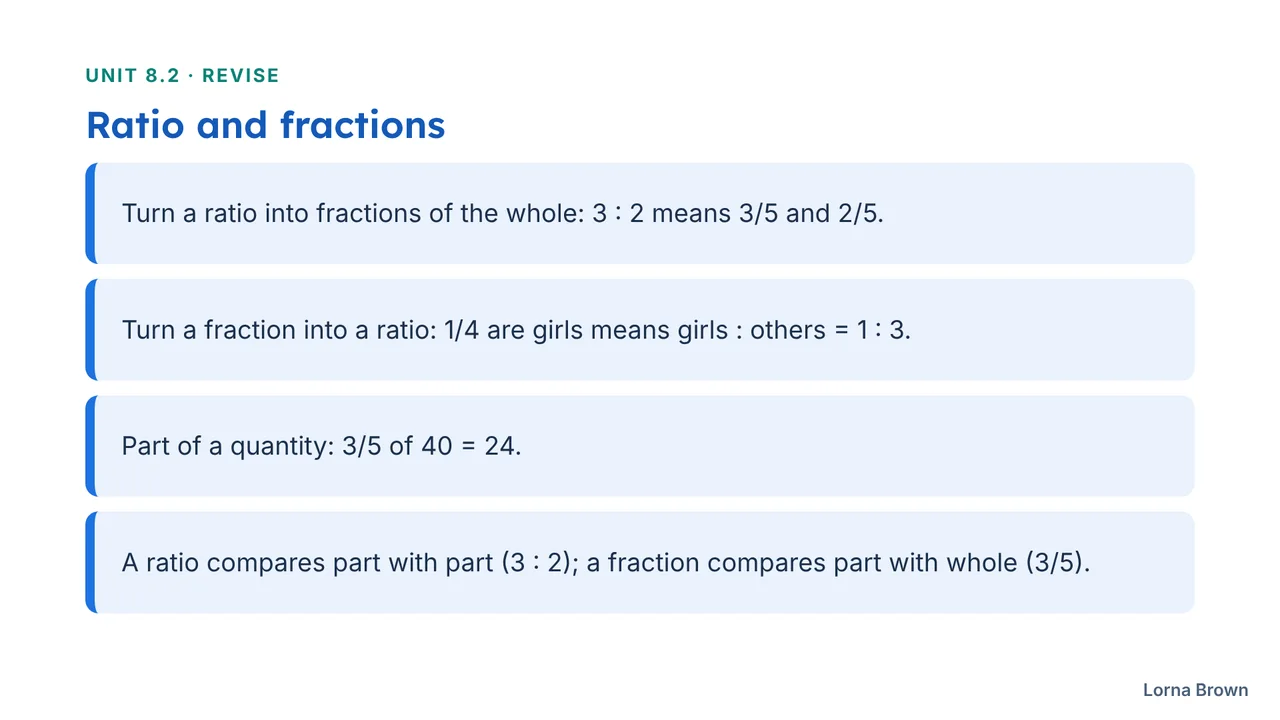
  • Turn a ratio into fractions of the whole: 3 : 2 means 3/5 and 2/5.
  • Turn a fraction into a ratio: 1/4 are girls means girls : others = 1 : 3.
  • Part of a quantity: 3/5 of 40 = 24.
  • A ratio compares part with part (3 : 2); a fraction compares part with whole (3/5).
Direct proportion
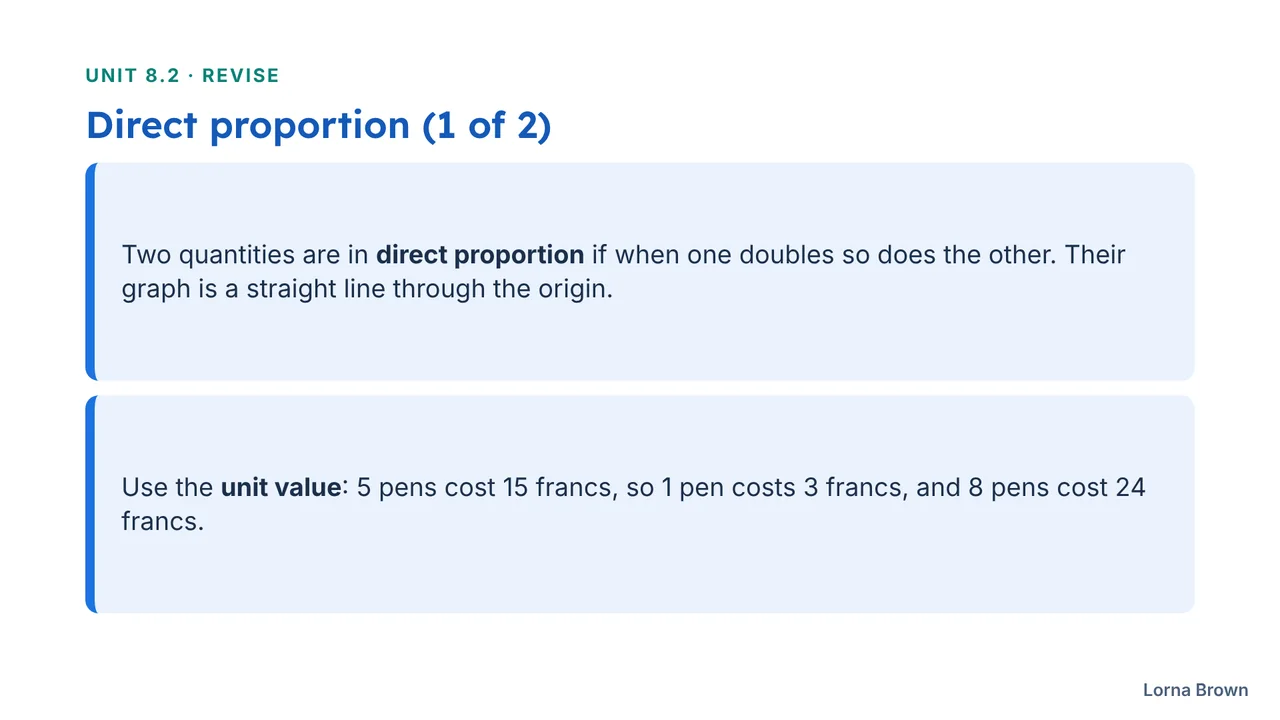
  • Two quantities are in direct proportion if when one doubles so does the other. Their graph is a straight line through the origin.
  • Use the unit value: 5 pens cost 15 francs, so 1 pen costs 3 francs, and 8 pens cost 24 francs.
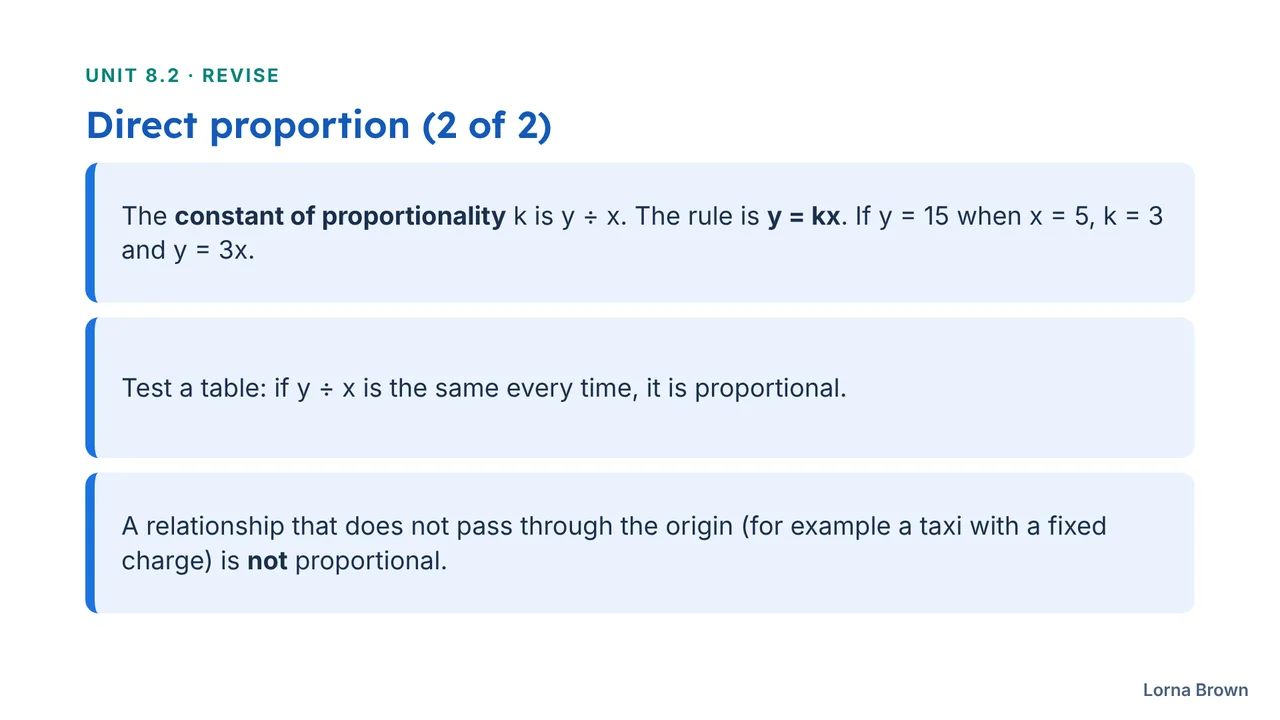
  • The constant of proportionality k is y ÷ x. The rule is y = kx. If y = 15 when x = 5, k = 3 and y = 3x.
  • Test a table: if y ÷ x is the same every time, it is proportional.
  • A relationship that does not pass through the origin (for example a taxi with a fixed charge) is not proportional.
Conversion graphs
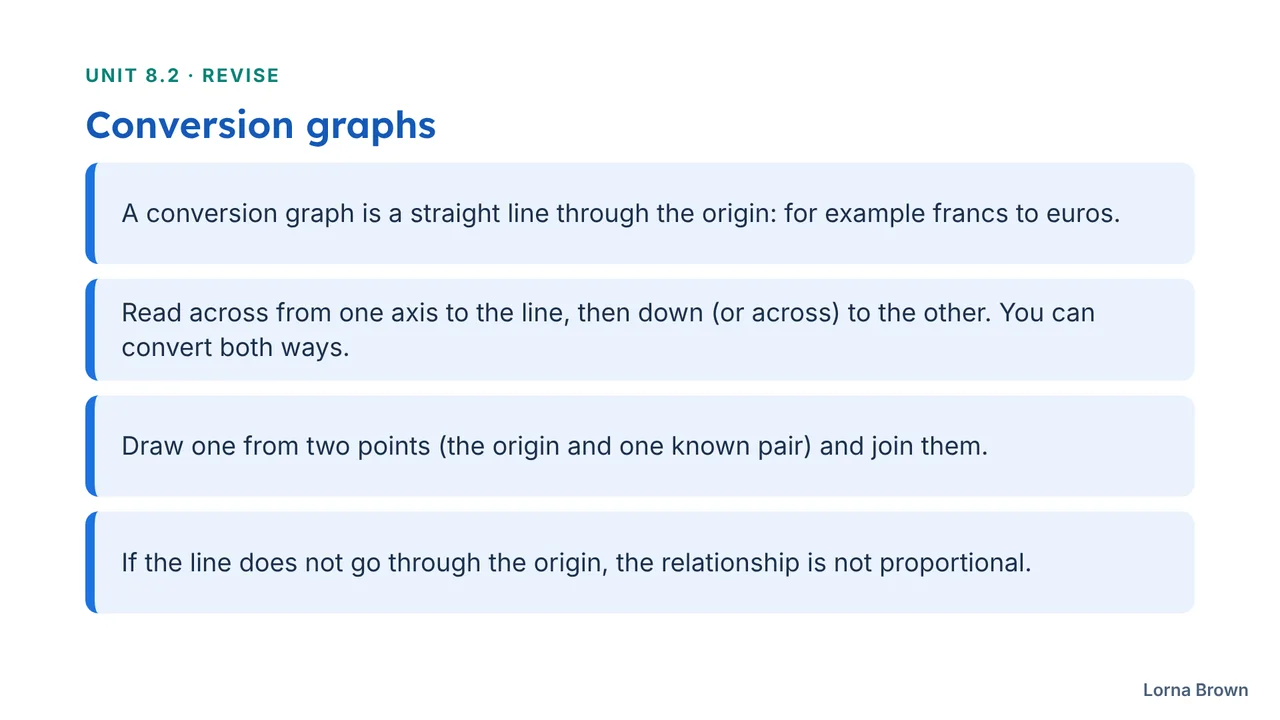
  • A conversion graph is a straight line through the origin: for example francs to euros.
  • Read across from one axis to the line, then down (or across) to the other. You can convert both ways.
  • Draw one from two points (the origin and one known pair) and join them.
  • If the line does not go through the origin, the relationship is not proportional.
Scale diagrams and map scales
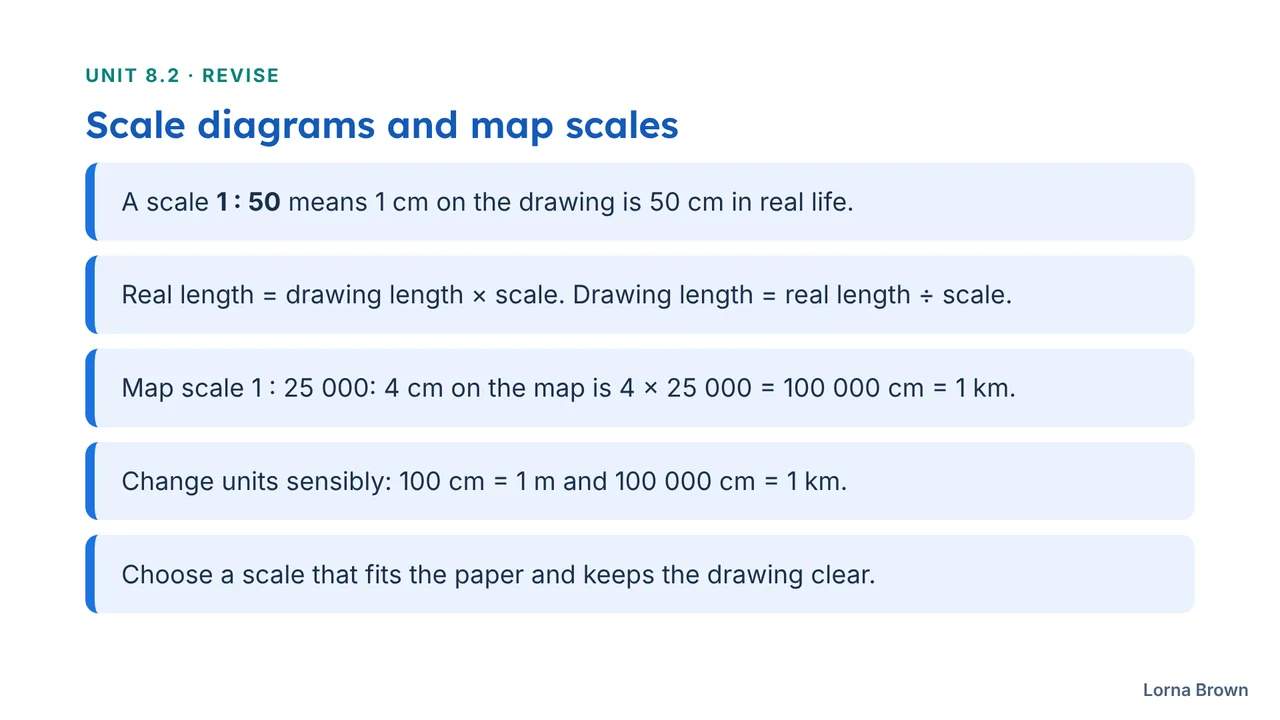
  • A scale 1 : 50 means 1 cm on the drawing is 50 cm in real life.
  • Real length = drawing length × scale. Drawing length = real length ÷ scale.
  • Map scale 1 : 25 000: 4 cm on the map is 4 × 25 000 = 100 000 cm = 1 km.
  • Change units sensibly: 100 cm = 1 m and 100 000 cm = 1 km.
  • Choose a scale that fits the paper and keeps the drawing clear.
Common mistakes
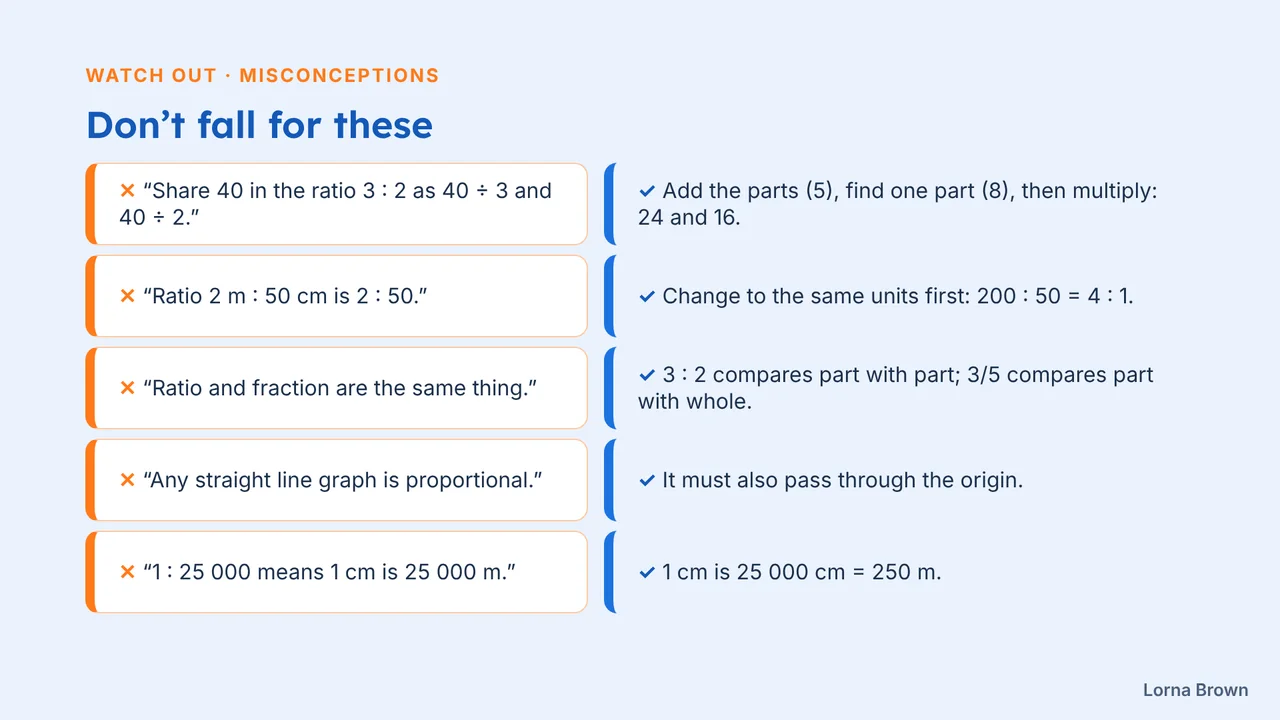
  • ✕ “Share 40 in the ratio 3 : 2 as 40 ÷ 3 and 40 ÷ 2.” ✓ Add the parts (5), find one part (8), then multiply: 24 and 16.
  • ✕ “Ratio 2 m : 50 cm is 2 : 50.” ✓ Change to the same units first: 200 : 50 = 4 : 1.
  • ✕ “Ratio and fraction are the same thing.” ✓ 3 : 2 compares part with part; 3/5 compares part with whole.
  • ✕ “Any straight line graph is proportional.” ✓ It must also pass through the origin.
  • ✕ “1 : 25 000 means 1 cm is 25 000 m.” ✓ 1 cm is 25 000 cm = 250 m.

Practice booklet

Unit 8.2 Practice Booklet
mathscafe.net
Lorna Brown © 2026
Ms B’s mathscafe

Practice Booklet

MYP 2 · Year 8 Mathematics
Unit 8.2 · Ratio and Proportion
Name:
8.2.1
Scale copies and similarity · Questions 1–17
8.2.2 · 8.2.3
Understanding ratio · Simplifying ratio · Questions 18–35
8.2.4 · 8.2.5
The form 1 : n · Ratio and fractions · Questions 36–53
8.2.6 · 8.2.6b
Direct proportion · Conversion graphs · Questions 54–71
8.2.7
Constant of proportionality · Questions 72–89
8.2.8 · 8.2.9
Scale diagrams · Map scales · Questions 90–107
Homework
Homework page and checking record
Answers
For checking and correcting in green pen
MYP 2 · Year 8 · Unit 8.2 Ratio and Proportion · Practice BookletMs B’s mathscafe · page 1

How to use this booklet and your homework

Read this first

Choosing your level

Every part of the unit has four levels. Start where you feel comfortable and move between them freely. Most questions ask you to explain as well as answer, because being able to say why is what makes a method stick.

Learning

Small numbers, with counters or a diagram beside you.

Practising

The standard question, with your reasoning written out.

Challenging

Working backwards, and finding what is wrong with someone else's thinking.

Mastery

Explaining why a rule must be true, and testing it on new cases.

Working on your homework

Pens and setting out

  • Answers in blue or black non-erasable pen, or in pencil.
  • Colour and highlighters are for annotating your work and showing the steps of a method.
  • Never erase a mistake. Rework it underneath so you can see what changed.
Green pen is for checking. When you finish, use the answers at the back to check your work.
  • Got it wrong? Circle the question number, then make your correction and write your error analysis in green pen.
  • Still can’t work out how to solve it? Put a star ★ next to the question number, so we know to go over it in class.

Each sheet

  • Your name goes on every sheet, because they are handed in one at a time.
  • Each question is worth up to 3 marks. If a question has parts (a, b, c…), each part is marked out of 3. At the end of each level, write your score out of the total for that level.
  • Questions are numbered 1, 2, 3… all the way through the booklet, so we can say exactly which ones to do.
  • If you are stuck after trying, ask for help. Showing me what you tried is a good start.
MYP 2 · Year 8 · Unit 8.2 Ratio and Proportion · Practice Bookletmathscafe.net
Lorna Brown © 2026
page 2

8.2.1 Scale copies and similarity

Learning
Name:

Key vocabulary

WordMeaningExample
similarthe same shape, but not always the same size2 by 3 and 6 by 9
scale factorthe number every length is multiplied by (new length ÷ old length)10 ÷ 4 = 2.5
enlargementa copy that is bigger than the originalscale factor above 1
reductiona copy that is smaller than the originalscale factor below 1
correspondingmatching sides or angles in the two shapesthe two longest sides

Learning

1
A rectangle is 3 cm by 2 cm. A scale copy has scale factor 2. Write the sides of the copy. Draw both on squared paper if it helps
2
Complete the calculations.
a) 4 × 3 = ___
b) 5 × 2 = ___
c) 6 × ___ = 12
3
A 2 by 3 rectangle becomes a 4 by 6 rectangle. Find the scale factor by dividing each new length by the old length
4
Choose the right word: a copy that is bigger than the original is an ________ and a copy that is smaller is a ________
5
A 2 by 3 rectangle is stretched to 4 by 3. Is it a scale copy? Say what happened to each length
Learning score / 21
Parent / guardian signature:
MYP 2 · Year 8 · Unit 8.2 Ratio and Proportion · Practice Bookletmathscafe.net
Lorna Brown © 2026
page 3

8.2.1 Scale copies and similarity

Practising
Name:

Practising

6
Find the scale factor from the small shape to the large shape.
a) 4 cm to 10 cm
b) 6 cm to 18 cm
c) 12 cm to 3 cm
7
A rectangle is 5 cm by 4 cm. Find the sides of its copy with scale factor 3
8
The two rectangles are similar. The small one is 5 cm by 4 cm and the large one is 15 cm by x cm. Find x
5 cm4 cm15 cmx cm
9
A 15 cm side is enlarged with scale factor 13. Write the new length
10
Are a 3 by 4 rectangle and a 6 by 9 rectangle similar? Show your working
Practising score / 21
Parent / guardian signature:
MYP 2 · Year 8 · Unit 8.2 Ratio and Proportion · Practice Bookletmathscafe.net
Lorna Brown © 2026
page 4

8.2.1 Scale copies and similarity

Challenging · Mastery
Name:

Challenging

11
Find and describe the mistake. Ben makes a copy of a 3 cm by 5 cm rectangle with scale factor 4 by adding 4 to each side. He gets 7 cm by 9 cm
12
A photo 10 cm wide and 15 cm tall is printed 25 cm wide, keeping its shape. How tall is the print?
13
A triangle has sides 3 cm, 4 cm and 5 cm. A similar triangle has a shortest side of 9 cm. Find the other two sides
14
A 12 cm line is reduced to 9 cm. Write the scale factor as a fraction in simplest form and as a decimal
Challenging score / 12

Mastery

15
Explain why doubling only the width of a 2 by 3 rectangle does not make a scale copy
16
A 2 cm by 3 cm rectangle has a copy made with scale factor 2.
a) Find both areas.
b) How many times bigger is the area of the copy? Why is it not 2?
17
A square of side 4 cm is enlarged with scale factor 5. Find the new area and say how it is linked to the scale factor
Mastery score / 12
Parent / guardian signature:
MYP 2 · Year 8 · Unit 8.2 Ratio and Proportion · Practice Bookletmathscafe.net
Lorna Brown © 2026
page 5

8.2.2 Understanding ratio · 8.2.3 Simplifying ratio

Learning
Name:

Key vocabulary

WordMeaningExample
ratiocompares two quantities, part with part2 red : 3 blue
proportioncompares a part with the whole25 of the counters are red
total partsall the parts of the ratio added together2 + 3 = 5
equivalent ratiosame value, made by multiplying or dividing both parts by the same number2 : 3 = 4 : 6
simplest formthe only common factor of the parts is 112 : 18 = 2 : 3

Learning

18
There are 5 red counters and 3 blue counters. Write the ratio red : blue
19
Write the ratio blue : red for the same counters. Is it the same as your answer to question 1? Why?
20
A bag has 2 red counters and 3 blue counters. Write the total number of parts
21
Fill the gaps: 2 : 3 = 4 : ___ = ___ : 9
22
Share 10 sweets between two people in the ratio 1 : 4. Use the bar model.
a) How many equal parts are there in total?
b) How many sweets are in one part?
c) How many does each person get?
Learning score / 21
Parent / guardian signature:
MYP 2 · Year 8 · Unit 8.2 Ratio and Proportion · Practice Bookletmathscafe.net
Lorna Brown © 2026
page 6

8.2.2 Understanding ratio · 8.2.3 Simplifying ratio

Practising
Name:

Practising

23
A class has 12 cats and 8 dogs in a story. Write the ratio cats : dogs
24
A bag has 2 red and 3 blue counters.
a) Write the ratio red : blue.
b) Write the fraction of the counters that are red
25
Share 40 francs between Ana and Ben in the ratio 3 : 2. Draw a bar model
26
Share 36 in the ratio 5 : 1
27
Simplify the ratios.
a) 18 : 24
b) 40 : 100
c) 14 : 35
28
Simplify 75 cm : 3 m. Change to the same units first
Practising score / 27
Parent / guardian signature:
MYP 2 · Year 8 · Unit 8.2 Ratio and Proportion · Practice Bookletmathscafe.net
Lorna Brown © 2026
page 7

8.2.2 Understanding ratio · 8.2.3 Simplifying ratio

Challenging · Mastery
Name:

Challenging

29
Find and describe the mistake. Sam shares 30 sweets in the ratio 2 : 3 by dividing 30 by 2 to get 15 and 15
30
Is 6 : 8 equivalent to 9 : 12? Show how you know
31
Fill the gap: 2 : 7 = 8 : ___
32
Red : blue = 2 : 3 and there are 12 red counters. How many blue counters are there?
Challenging score / 12

Mastery

33
Explain, with a drawing, the difference between the ratio 2 : 3 and the fraction 25 for a bag of red and blue counters
34
Share 60 in the ratio 2 : 3 : 5. Show each step
35
The ratios 4 : 6 and 10 : 15 look different. Explain why they describe the same mix and write both in simplest form
Mastery score / 9
Parent / guardian signature:
MYP 2 · Year 8 · Unit 8.2 Ratio and Proportion · Practice Bookletmathscafe.net
Lorna Brown © 2026
page 8

8.2.4 The form 1 : n · 8.2.5 Ratio and fractions

Learning
Name:

Key vocabulary

WordMeaningExample
1 : na ratio with first part 1, found by dividing both parts by the first part2 : 5 = 1 : 2.5
n : 1a ratio with second part 1, found by dividing both parts by the second part5 : 2 = 2.5 : 1
numeratorthe number above the line in a fraction2 in 25
denominatorthe number below the line: the total number of equal parts5 in 25

Learning

36
Complete: 2 : 6 = 1 : ___ (divide both parts by 2)
37
Write each ratio as 1 : n.
a) 2 : 8
b) 5 : 20
c) 3 : 9
38
Work out.
a) 5 ÷ 2
b) 3 ÷ 4
c) 7 ÷ 2
39
The ratio red : blue is 1 : 3. What fraction of the counters are red? Use the bar model
40
25 of a bag is red and the rest is blue. Write the ratio red : blue
Learning score / 27
Parent / guardian signature:
MYP 2 · Year 8 · Unit 8.2 Ratio and Proportion · Practice Bookletmathscafe.net
Lorna Brown © 2026
page 9

8.2.4 The form 1 : n · 8.2.5 Ratio and fractions

Practising
Name:

Practising

41
Write each ratio as 1 : n.
a) 4 : 10
b) 5 : 2
c) 8 : 20
42
Write each ratio as n : 1.
a) 12 : 3
b) 9 : 2
c) 10 : 4
43
Write 2 : 5 and 1 : 3 as 1 : n. Which mix has more of the second thing for every 1 of the first?
44
37 of a class are boys. Write the ratio boys : girls
45
Share 30 in the ratio 2 : 3. Draw a bar model
46
Write 4 : 5 as a fraction for each part
Practising score / 30
Parent / guardian signature:
MYP 2 · Year 8 · Unit 8.2 Ratio and Proportion · Practice Bookletmathscafe.net
Lorna Brown © 2026
page 10

8.2.4 The form 1 : n · 8.2.5 Ratio and fractions

Challenging · Mastery
Name:

Challenging

47
Find and describe the mistake. Mia writes 3 : 5 as the fraction 35 for the first part
48
Write 0.5 : 2 as a ratio 1 : n
49
A paint mix is yellow : blue = 2 : 5. Write it as 1 : n, then find how many ml of blue go with 30 ml of yellow
50
29 of a class of 36 students are left-handed. Write the ratio left-handed : right-handed and find how many are left-handed
Challenging score / 12

Mastery

51
Explain why dividing both parts by the first number always gives a ratio of the form 1 : n. Use 6 : 15 as an example
52
Juice A is orange : water = 2 : 5 and juice B is orange : water = 3 : 7. Write both as 1 : n and decide which tastes stronger
53
Red : blue = 3 : 5 and there are 40 counters in total. Write the fraction that are red, then find how many red and blue counters there are. Draw a bar model
Mastery score / 9
Parent / guardian signature:
MYP 2 · Year 8 · Unit 8.2 Ratio and Proportion · Practice Bookletmathscafe.net
Lorna Brown © 2026
page 11

8.2.6 Direct proportion · 8.2.6b Conversion graphs

Learning
Name:

Key vocabulary

WordMeaningExample
direct proportiony is always the same number of times xy = 5x
unit valuethe amount for 1 item1 pen costs 3 CHF
originthe point (0, 0) where the axes crossa proportion graph starts here
conversion grapha graph that changes one unit into anothermiles to km

Learning

54
1 pen costs 3 CHF. Complete the table. Pens: 1, 2, 3, 4 Cost in CHF: 3, ___, ___, ___
55
2 pens cost 6 CHF. What do 5 pens cost? Find the cost of 1 pen first
56
Use the conversion graph.
a) 10 miles = ___ km
b) 40 km = ___ miles
0510152025010203040mileskm
57
Use 1 mile ≈ 1.6 km. How many km are 20 miles? How many km are 0 miles?
58
x is 1, 2, 3 and y is 4, 7, 10. Work out y ÷ x each time. Is it proportional?
Learning score / 18
Parent / guardian signature:
MYP 2 · Year 8 · Unit 8.2 Ratio and Proportion · Practice Bookletmathscafe.net
Lorna Brown © 2026
page 12

8.2.6 Direct proportion · 8.2.6b Conversion graphs

Practising
Name:

Practising

59
6 pencils cost 9 CHF. What do 4 pencils cost?
60
3 books cost 24 CHF. What do 5 books cost?
61
A car uses 6 litres of petrol for every 100 km. How much petrol does it use for 250 km?
62
Use 1 mile ≈ 1.6 km.
a) 30 miles = ___ km
b) 80 km = ___ miles
63
y is 2, 4, 6 when x is 1, 2, 3. What is y when x = 10?
64
Plot the points (0, 0) and (10, 16) on the grid and join them with a straight line. What does the line show about 5 miles?
01234567891002468101214161820mileskm
Practising score / 21
Parent / guardian signature:
MYP 2 · Year 8 · Unit 8.2 Ratio and Proportion · Practice Bookletmathscafe.net
Lorna Brown © 2026
page 13

8.2.6 Direct proportion · 8.2.6b Conversion graphs

Challenging · Mastery
Name:

Challenging

65
Find and describe the mistake. Kai says x: 1, 2, 3 and y: 3, 5, 7 is proportional because y goes up by 2 each time
66
The Celsius to Fahrenheit graph passes through (0, 32). Is it a direct proportion graph? Explain
67
Use 1 mile ≈ 1.6 km. How many miles is 48 km?
68
5 kg of apples cost 12.50 CHF.
a) What do 8 kg cost?
b) What do 3 kg cost?
Challenging score / 15

Mastery

69
Explain how you can tell from a graph that two quantities are in direct proportion
70
Is y = x + 2 a direct proportion? Explain by using x = 0 and a table
71
The side of a square is 1, 2, 3. Compare the perimeters and the areas. Is either of them proportional to the side?
Mastery score / 9
Parent / guardian signature:
MYP 2 · Year 8 · Unit 8.2 Ratio and Proportion · Practice Bookletmathscafe.net
Lorna Brown © 2026
page 14

8.2.7 Constant of proportionality

Learning
Name:

Key vocabulary

WordMeaningExample
constant of proportionalitythe number k that links y and x: k = y ÷ xy = 3x, so k = 3
rulethe equation y = kxy = 4x
unit ratethe amount for 1 unit, equal to k60 km per hour
gradienthow much the line goes up for every 1 across, equal to kk = 2.5

Learning

72
x = 5 and y = 20. Find k by working out y ÷ x
73
x is 1, 2, 3 and y is 3, 6, 9. Work out y ÷ x each time, then write the rule y = kx
74
The rule is y = 4x. Find y when x = 7
75
4 pens cost 6 CHF. Find the cost of 1 pen. This number is k
76
The rule is y = 2x.
a) Find y when x = 5.
b) Find x when y = 12
Learning score / 18
Parent / guardian signature:
MYP 2 · Year 8 · Unit 8.2 Ratio and Proportion · Practice Bookletmathscafe.net
Lorna Brown © 2026
page 15

8.2.7 Constant of proportionality

Practising
Name:

Practising

77
x = 6 and y = 15. Find k and write the rule
78
The rule is y = 0.5x. Find y when x = 12
79
The rule is y = 2.5x. Find x when y = 20
80
Is this proportional? x is 2, 4 and y is 6, 11
81
A bus travels 90 km in 1.5 hours at a steady speed. Find k in km per hour and write the rule for the distance d after t hours
82
x is 2, 4, 6 and y is 5, 10, 15. Find k, then find y when x = 20
Practising score / 18
Parent / guardian signature:
MYP 2 · Year 8 · Unit 8.2 Ratio and Proportion · Practice Bookletmathscafe.net
Lorna Brown © 2026
page 16

8.2.7 Constant of proportionality

Challenging · Mastery
Name:

Challenging

83
Find and describe the mistake. Lena finds k from x = 4 and y = 10 by working out 4 ÷ 10 = 0.4 and writes y = 0.4x
84
Shop A sells 3 kg of grapes for 7.50 CHF and shop B sells 5 kg for 11 CHF. Find k for each shop and say which is cheaper per kilogram
85
Is y = 2x + 1 a direct proportion? Test it with x = 0
86
y is directly proportional to x. When x = 8, y = 20. Find y when x = 14
Challenging score / 12

Mastery

87
Explain why the graph of y = kx always goes through the origin (0, 0)
88
For y = 0.25x, k is less than 1. Explain what this means for y compared with x and give an example
89
Explain how the constant k is linked to the unit value and to the gradient of the line
Mastery score / 9
Parent / guardian signature:
MYP 2 · Year 8 · Unit 8.2 Ratio and Proportion · Practice Bookletmathscafe.net
Lorna Brown © 2026
page 17

8.2.8 Scale diagrams · 8.2.9 Map scales

Learning
Name:

Key vocabulary

WordMeaningExample
scalecompares a distance on the drawing or map with the real distance1 : 50
drawing lengththe length on the drawing, plan or map6 cm on the plan
real lengththe actual length, found by multiplying by the scale6 × 50 = 300 cm
cm, m, km100 cm = 1 m and 1000 m = 1 km, so 100 000 cm = 1 km300 cm = 3 m

Learning

90
A scale is 1 : 10. A drawing is 5 cm long. Find the real length in cm
91
How many cm are in 1 m? Change 300 cm to m
92
The scale is 1 : 20 and a drawing is 5 cm long. Find the real length in cm
93
A map has the scale 1 : 50 000. How many cm in real life is 1 cm on the map? Write the answer in m
94
Change.
a) 40 000 cm to m
b) 6000 m to km
Learning score / 18
Parent / guardian signature:
MYP 2 · Year 8 · Unit 8.2 Ratio and Proportion · Practice Bookletmathscafe.net
Lorna Brown © 2026
page 18

8.2.8 Scale diagrams · 8.2.9 Map scales

Practising
Name:

Practising

95
The scale is 1 : 100 and a drawing is 3 cm long. Find the real length in m
96
The scale is 1 : 50 and a drawing is 8 cm long. Find the real length in m
97
The scale is 1 : 20 and a real length is 3 m. Find the drawing length in cm
98
A model car has the scale 1 : 24 and the real car is 4.8 m long. Find the length of the model in cm
99
A map has the scale 1 : 25 000. A path is 12 cm long on the map. Find the real distance in km
100
A map has the scale 1 : 50 000. A real distance is 9 km. Find the map length in cm
Practising score / 18
Parent / guardian signature:
MYP 2 · Year 8 · Unit 8.2 Ratio and Proportion · Practice Bookletmathscafe.net
Lorna Brown © 2026
page 19

8.2.8 Scale diagrams · 8.2.9 Map scales

Challenging · Mastery
Name:

Challenging

101
Find and describe the mistake. Tom has a map with the scale 1 : 25 000 and a path 8 cm long on the map. He says the path is 200 000 m long
102
A model plane has the scale 1 : 72 and the real wingspan is 36 m. Find the wingspan of the model in cm
103
A map has the scale 1 : 100 000. A road is 3 cm long on the map. Find the real distance in km
104
A hike is 12 km long. How many cm long is it on a map with the scale 1 : 25 000?
Challenging score / 12

Mastery

105
Explain, with an example, why you multiply to go from the drawing to real life but divide to go from real life to the drawing
106
A room is 6 m by 4.5 m. Draw it on a plan with the scale 1 : 200. Find the lengths of the sides on the plan in cm and explain why you changed to cm first
107
A 5 km path is drawn on a map with scale 1 : 25 000 and on a map with scale 1 : 50 000. Find both map lengths and say which map shows more detail
Mastery score / 9
Parent / guardian signature:
MYP 2 · Year 8 · Unit 8.2 Ratio and Proportion · Practice Bookletmathscafe.net
Lorna Brown © 2026
page 20

Homework and checking record

Hand this page in with your sheets
Name:

Your teacher will tell you which sheet and questions to do. Choose your level, set out your work in pen or pencil, then check it with the answers at the back using a green pen: circle wrong question numbers, and star ★ any you still cannot solve.

SheetQuestionsWhich ones I didChecked in green ✓Teacher
8.2.1 Scale copies and similarityQ1–17
8.2.2 Understanding ratio · 8.2.3 Simplifying ratioQ18–35
8.2.4 The form 1 : n · 8.2.5 Ratio and fractionsQ36–53
8.2.6 Direct proportion · 8.2.6b Conversion graphsQ54–71
8.2.7 Constant of proportionalityQ72–89
8.2.8 Scale diagrams · 8.2.9 Map scalesQ90–107

Error analysis

Circle the number of any question you got wrong. Star ★ it if you still cannot solve it after correcting. Then write the questions you need to rework, and what you will do differently:

One thing I understand better now

Score: Parent / guardian signature:
MYP 2 · Year 8 · Unit 8.2 Ratio and Proportion · Practice Bookletmathscafe.net
Lorna Brown © 2026
page 21

Answers

Check in green pen

8.2.1 Scale copies and similarity

Learning
16 cm by 4 cm, because 3 × 2 = 6 and 2 × 2 = 4. Every length is multiplied by 2.2a) 12 b) 10 c) 234 ÷ 2 = 2 and 6 ÷ 3 = 2, so the scale factor is 2.4Enlargement; reduction. (An enlargement has scale factor above 1 and a reduction has scale factor below 1.)5No. The width was multiplied by 2 but the height was multiplied by 1. The lengths use different numbers, so the shape is stretched.
Practising
6a) 10 ÷ 4 = 2.5 b) 18 ÷ 6 = 3 c) 3 ÷ 12 = 14 (or 0.25), a reduction715 cm by 12 cm (5 × 3 = 15 and 4 × 3 = 12)8The scale factor is 15 ÷ 5 = 3, so x = 4 × 3 = 12 cm. Check: 15 over 5 = 3 and 12 over 4 = 3.915 × 13 = 15 ÷ 3 = 5 cm10No. 6 ÷ 3 = 2 but 9 ÷ 4 = 2.25. The lengths are not multiplied by the same number.
Challenging
11Scale factor means multiply, not add. 3 × 4 = 12 and 5 × 4 = 20, so the copy is 12 cm by 20 cm.12Scale factor 25 ÷ 10 = 2.5, so the height is 15 × 2.5 = 37.5 cm.13Scale factor 9 ÷ 3 = 3. The other sides are 4 × 3 = 12 cm and 5 × 3 = 15 cm.149 ÷ 12 = 912 = 34 = 0.75. The fraction and the decimal are the same number written two ways.
Mastery
15It becomes 4 by 3. The width was multiplied by 2 but the height by 1, so the lengths do not use the same scale factor. The angles stay right angles but the shape is stretched.16a) The original is 6 cm², the copy is 4 × 6 = 24 cm². b) 24 ÷ 6 = 4 times bigger. Both the length and the width double, so the area is multiplied by 2 × 2 = 4.17The new side is 20 cm, so the area is 400 cm². The old area is 16 cm² and 400 ÷ 16 = 25 = 5². The area is multiplied by the scale factor squared.

8.2.2 Understanding ratio · 8.2.3 Simplifying ratio

Learning
185 : 3193 : 5. It is not the same, because the order matters: the first number goes with the first thing named.202 + 3 = 5 parts in total212 : 3 = 4 : 6 = 6 : 9. Both parts are multiplied by 2, then by 3.22a) 5 parts b) 10 ÷ 5 = 2 sweets c) 1 × 2 = 2 sweets and 4 × 2 = 8 sweets
Practising
2312 : 824a) 2 : 3 b) 25. A ratio compares part with part and a fraction compares a part with the whole.255 parts in total. One part is 40 ÷ 5 = 8 francs. Ana gets 3 × 8 = 24 francs and Ben gets 2 × 8 = 16 francs. Check: 24 + 16 = 40.266 parts in total. One part is 36 ÷ 6 = 6. The shares are 30 and 6.27a) 3 : 4 (divide by 6)
b) 2 : 5 (divide by 20)
c) 2 : 5 (divide by 7)
283 m = 300 cm, so 75 : 300. Divide both by 75: 1 : 4.
Challenging
29He divided by 2, one of the ratio numbers. He must divide by the total number of parts: 2 + 3 = 5. One part is 30 ÷ 5 = 6, so the shares are 12 and 18.30Yes. 6 : 8 = 3 : 4 (divide by 2) and 9 : 12 = 3 : 4 (divide by 3). They have the same simplest form.312 × 4 = 8, so 7 × 4 = 28. The answer is 28.3212 red is 2 parts, so one part is 6. Blue is 3 × 6 = 18 counters.
Mastery
33The ratio 2 : 3 compares red with blue (part with part). The fraction 25 compares red with all the counters (part with whole), where 2 + 3 = 5 is the total number of parts.342 + 3 + 5 = 10 parts. One part is 60 ÷ 10 = 6. The shares are 12, 18 and 30. Check: 12 + 18 + 30 = 60.354 : 6 = 2 : 3 and 10 : 15 = 2 : 3. The value of the ratio does not change, only how it is written.

8.2.4 The form 1 : n · 8.2.5 Ratio and fractions

Learning
362 ÷ 2 = 1 and 6 ÷ 2 = 3, so 2 : 6 = 1 : 337a) 1 : 4 b) 1 : 4 c) 1 : 338a) 2.5 b) 0.75 c) 3.539There are 1 + 3 = 4 equal parts, and 1 of them is red. The fraction is 14.402 parts red and 5 − 2 = 3 parts blue, so red : blue = 2 : 3
Practising
41a) 1 : 2.5 (divide by 4) b) 1 : 0.4 (divide by 5) c) 1 : 2.5 (divide by 8)42a) 4 : 1 b) 4.5 : 1 c) 2.5 : 1432 : 5 = 1 : 2.5 and 1 : 3 stays 1 : 3. The mix 1 : 3 has more (3 against 2.5).443 parts boys and 7 − 3 = 4 parts girls, so boys : girls = 3 : 4455 parts in total. One part is 30 ÷ 5 = 6. The shares are 2 × 6 = 12 and 3 × 6 = 18.46There are 4 + 5 = 9 parts in total. The first part is 49 and the second part is 59.
Challenging
47The denominator must be the total number of parts: 3 + 5 = 8. The first part is 38 (and the second part is 58).48Divide both parts by 0.5: 0.5 ÷ 0.5 = 1 and 2 ÷ 0.5 = 4, so 1 : 4492 : 5 = 1 : 2.5. 30 ml of yellow is 30 × 2.5 = 75 ml of blue.5029 means 2 parts of 9, so the ratio is 2 : 7. One part is 36 ÷ 9 = 4, so 2 × 4 = 8 students are left-handed.
Mastery
51The first part divided by itself is 1, and the same division on the second part keeps the ratio equivalent. 6 ÷ 6 = 1 and 15 ÷ 6 = 2.5, so 6 : 15 = 1 : 2.5.52A = 1 : 2.5 and B = 1 : 2.33… (7 ÷ 3). B has less water for each part of orange, so B tastes stronger.53There are 8 parts, so 38 are red. One part is 40 ÷ 8 = 5. Red is 3 × 5 = 15 and blue is 5 × 5 = 25.

8.2.6 Direct proportion · 8.2.6b Conversion graphs

Learning
546, 9, 12. Each extra pen adds 3 CHF.551 pen costs 6 ÷ 2 = 3 CHF, so 5 pens cost 5 × 3 = 15 CHF.56a) 16 km b) 25 miles. Read across from the miles or up from the km, then along to the line.5720 × 1.6 = 32 km. 0 miles is 0 km, which is why the line starts at the origin.584 ÷ 1 = 4, 7 ÷ 2 = 3.5, 10 ÷ 3 = 3.33… The answers are different, so it is not proportional.
Practising
591 pencil costs 9 ÷ 6 = 1.50 CHF, so 4 pencils cost 4 × 1.50 = 6 CHF.601 book costs 24 ÷ 3 = 8 CHF, so 5 books cost 5 × 8 = 40 CHF.61250 km is 2.5 lots of 100 km, so 6 × 2.5 = 15 litres.62a) 30 × 1.6 = 48 km b) 80 ÷ 1.6 = 50 miles63y is always 2 times x, so y = 20.64A straight line through the origin. At 5 miles the line is at 8 km, because 5 × 1.6 = 8.
Challenging
65Going up by the same amount is not enough. For direct proportion y ÷ x must be the same each time: 3, 2.5, 2.33… So it is not proportional. When x = 0 the pattern gives y = 1, so the graph would not go through the origin.66No. A direct proportion graph goes through the origin (0, 0), and this one does not: 0 °C is 32 °F, not 0.6748 ÷ 1.6 = 30 miles681 kg costs 12.50 ÷ 5 = 2.50 CHF. a) 8 × 2.50 = 20 CHF b) 3 × 2.50 = 7.50 CHF
Mastery
69The graph is a straight line that goes through the origin (0, 0).70No. When x = 0, y = 2, not 0, so the graph does not go through the origin. y ÷ x also changes: 3, 2, 1.67… for x = 1, 2, 3.71Perimeters 4, 8, 12: each is 4 times the side, so proportional. Areas 1, 4, 9: area ÷ side is 1, 2, 3, which changes, so area is not proportional to the side.

8.2.7 Constant of proportionality

Learning
72k = 20 ÷ 5 = 4733, 3, 3, so k = 3 and the rule is y = 3x74y = 4 × 7 = 28756 ÷ 4 = 1.50 CHF, so k = 1.576a) y = 2 × 5 = 10 b) 2 × 6 = 12, so x = 6
Practising
77k = 15 ÷ 6 = 2.5, so y = 2.5x78y = 0.5 × 12 = 679x = 20 ÷ 2.5 = 8806 ÷ 2 = 3 but 11 ÷ 4 = 2.75. The values are different, so it is not proportional.81k = 90 ÷ 1.5 = 60 km per hour, so d = 60t82k = 5 ÷ 2 = 2.5 (the same each time). y = 2.5 × 20 = 50
Challenging
83k = y ÷ x, not x ÷ y. k = 10 ÷ 4 = 2.5, so the rule is y = 2.5x. Check: 2.5 × 4 = 10.84A: k = 7.50 ÷ 3 = 2.5. B: k = 11 ÷ 5 = 2.2. Shop B has the lower k, so it is cheaper per kilogram (8 kg costs 20 CHF at A and 17.60 CHF at B).85No. When x = 0, y = 1, not 0. A direct proportion has the rule y = kx, which always gives y = 0 when x = 0.86k = 20 ÷ 8 = 2.5, so y = 2.5 × 14 = 35
Mastery
87When x = 0, y = k × 0 = 0 for every value of k, so the point (0, 0) is always on the line.88y is always smaller than x: it is a quarter of x. For example when x = 8, y = 2.89k is the value of y when x = 1 (the unit value, such as the price of 1 item). On the graph the line goes up k for every 1 across, so k is the gradient.

8.2.8 Scale diagrams · 8.2.9 Map scales

Learning
905 × 10 = 50 cm91100 cm. 300 cm = 3 m925 × 20 = 100 cm9350 000 cm in real life. 50 000 ÷ 100 = 500 m.94a) 400 m b) 6 km
Practising
953 × 100 = 300 cm = 3 m968 × 50 = 400 cm = 4 m973 m = 300 cm and 300 ÷ 20 = 15 cm984.8 m = 480 cm and 480 ÷ 24 = 20 cm9912 × 25 000 = 300 000 cm = 3000 m = 3 km1009 km = 900 000 cm and 900 000 ÷ 50 000 = 18 cm
Challenging
1018 × 25 000 = 200 000 is in cm, not in m. 200 000 cm = 2000 m = 2 km.10236 m = 3600 cm and 3600 ÷ 72 = 50 cm1033 × 100 000 = 300 000 cm = 3 km10412 km = 1 200 000 cm and 1 200 000 ÷ 25 000 = 48 cm
Mastery
105Real life is bigger, and the scale 1 : 50 says 1 cm on the drawing is 50 cm in real life. So 6 cm on the drawing is 6 × 50 = 300 cm, and going back, 300 ÷ 50 = 6 cm.1066 m = 600 cm and 600 ÷ 200 = 3 cm. 4.5 m = 450 cm and 450 ÷ 200 = 2.25 cm. The scale compares lengths in the same unit, so change to cm first.1075 km = 500 000 cm. On 1 : 25 000 it is 20 cm and on 1 : 50 000 it is 10 cm. The 1 : 25 000 map is larger, so it shows more detail.

Revision slides as text (easy to translate)

This is a plain-text version of the revision slides. Your browser can translate it into any language.

Slide 1: Ratio and Proportion

Revision slides: everything you need for the test, one idea per slide.

Slide 2: Scale copies and similarity

Two shapes are similar if one is an enlargement of the other: matching angles are equal and matching lengths are in the same ratio.

Scale factor = new length ÷ old length. A 3 cm side becoming 12 cm has scale factor 12 ÷ 3 = 4.

Use the scale factor to find a missing length: multiply by it going bigger, divide going smaller.

Stretching in one direction only does not give a copy: the shape is distorted.

Slide 3: Ratio (1 of 2)

A ratio compares two quantities: 3 : 2. Proportion compares a part with the whole: 35.

Total parts = add the ratio numbers. To share 40 in the ratio 3 : 2: 5 parts, 1 part = 8, so 24 and 16.

Simplify a ratio by dividing both by the HCF: 18 : 24 = 3 : 4. Use the same units first: 2 m : 50 cm = 200 : 50 = 4 : 1.

Slide 4: Ratio (2 of 2)

Equivalent ratios come from multiplying or dividing both parts by the same number.

Form 1 : n (divide by the first): 4 : 10 = 1 : 2.5. Form n : 1 divides by the second. The unit ratio makes comparing easy.

Slide 5: Ratio and fractions

Turn a ratio into fractions of the whole: 3 : 2 means 35 and 25.

Turn a fraction into a ratio: 14 are girls means girls : others = 1 : 3.

Part of a quantity: 35 of 40 = 24.

A ratio compares part with part (3 : 2); a fraction compares part with whole (35).

Slide 6: Direct proportion (1 of 2)

Two quantities are in direct proportion if when one doubles so does the other. Their graph is a straight line through the origin.

Use the unit value: 5 pens cost 15 francs, so 1 pen costs 3 francs, and 8 pens cost 24 francs.

Slide 7: Direct proportion (2 of 2)

The constant of proportionality k is y ÷ x. The rule is y = kx. If y = 15 when x = 5, k = 3 and y = 3x.

Test a table: if y ÷ x is the same every time, it is proportional.

A relationship that does not pass through the origin (for example a taxi with a fixed charge) is not proportional.

Slide 8: Conversion graphs

A conversion graph is a straight line through the origin: for example francs to euros.

Read across from one axis to the line, then down (or across) to the other. You can convert both ways.

Draw one from two points (the origin and one known pair) and join them.

If the line does not go through the origin, the relationship is not proportional.

Slide 9: Scale diagrams and map scales

A scale 1 : 50 means 1 cm on the drawing is 50 cm in real life.

Real length = drawing length × scale. Drawing length = real length ÷ scale.

Map scale 1 : 25 000: 4 cm on the map is 4 × 25 000 = 100 000 cm = 1 km.

Change units sensibly: 100 cm = 1 m and 100 000 cm = 1 km.

Choose a scale that fits the paper and keeps the drawing clear.

Slide 10: Don’t fall for these

✕ Wrong: Share 40 in the ratio 3 : 2 as 40 ÷ 3 and 40 ÷ 2.

✓ Correct: Add the parts (5), find one part (8), then multiply: 24 and 16.

✕ Wrong: Ratio 2 m : 50 cm is 2 : 50.

✓ Correct: Change to the same units first: 200 : 50 = 4 : 1.

✕ Wrong: Ratio and fraction are the same thing.

✓ Correct: 3 : 2 compares part with part; 35 compares part with whole.

✕ Wrong: Any straight line graph is proportional.

✓ Correct: It must also pass through the origin.

✕ Wrong: 1 : 25 000 means 1 cm is 25 000 m.

✓ Correct: 1 cm is 25 000 cm = 250 m.

Slide 11: Test yourself

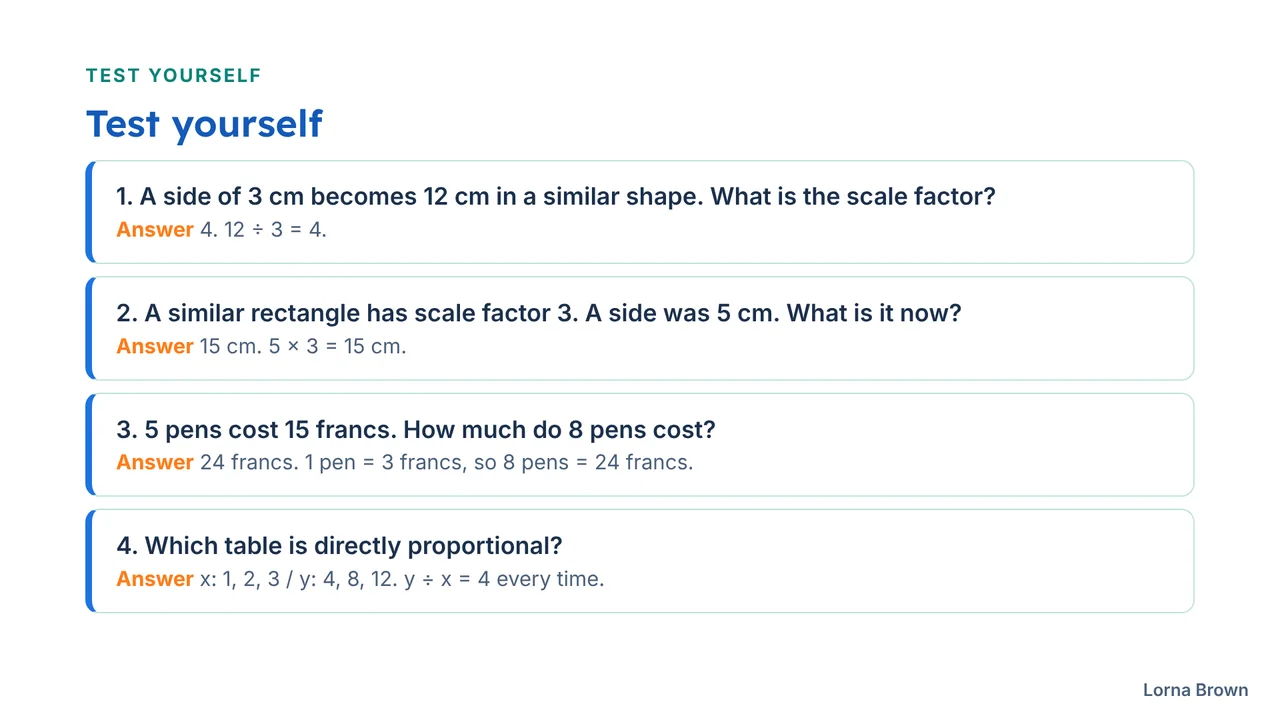
1. A side of 3 cm becomes 12 cm in a similar shape. What is the scale factor?

Answer: 4. 12 ÷ 3 = 4.

2. A similar rectangle has scale factor 3. A side was 5 cm. What is it now?

Answer: 15 cm. 5 × 3 = 15 cm.

3. 5 pens cost 15 francs. How much do 8 pens cost?

Answer: 24 francs. 1 pen = 3 francs, so 8 pens = 24 francs.

4. Which table is directly proportional?

Answer: x: 1, 2, 3y: 4, 8, 12. y ÷ x = 4 every time.