8.1 Fractions, Decimals and Percentages
Revision slides, flash cards, quizzes, revision notes and a text version of the slides for this unit. Open to everyone, no password needed.
Flash cards
Click a card to flip it. Say the answer first, then check.
Print the cards (PDF): word on the front, answer on the back, double-sided, flip on the long edge
Quizzes
Pick an answer to see if you are right. Your score shows at the end of each quiz.
Revision notes
Download and print the revision notes (PDF, A4)
The big idea. Equivalence and relationships between fractions, decimals and percentages: write quantities in different forms, convert between them, and calculate percentage increase and decrease.
Key vocabulary
| Word | Meaning |
|---|---|
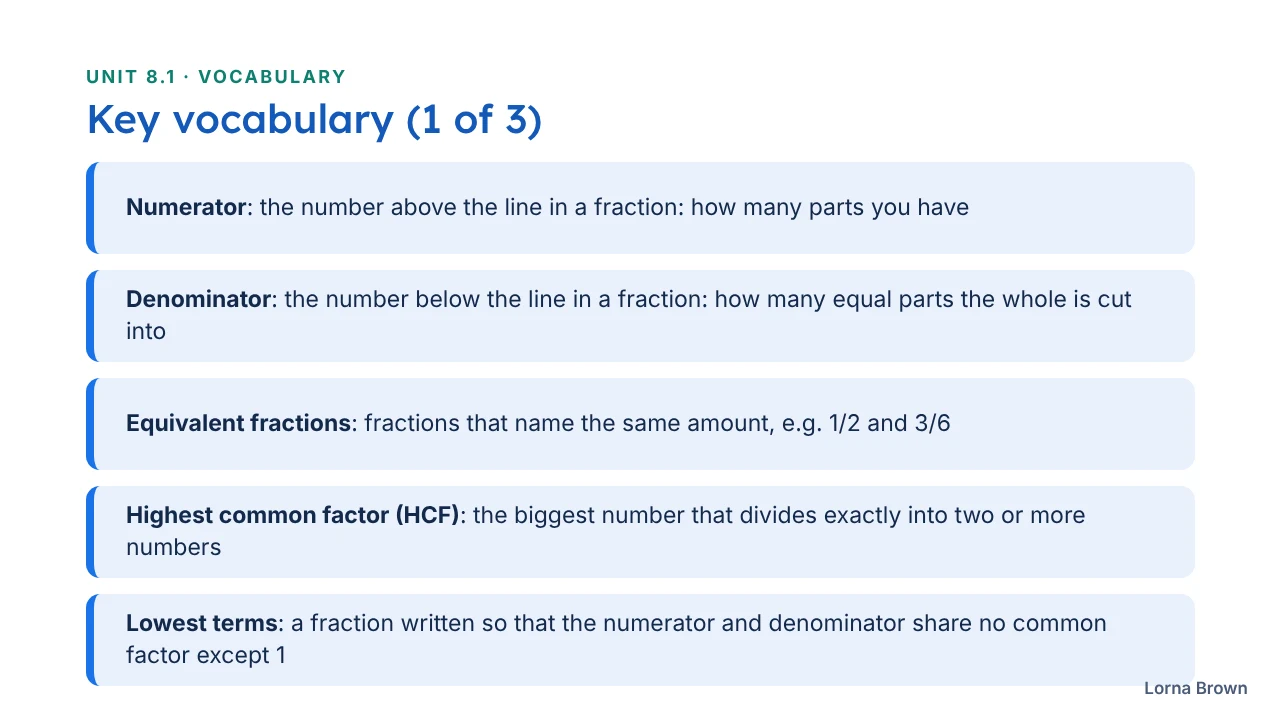
| Numerator | the number above the line in a fraction: how many parts you have |
| Denominator | the number below the line in a fraction: how many equal parts the whole is cut into |
| Equivalent fractions | fractions that name the same amount, e.g. 1/2 and 3/6 |
| Highest common factor (HCF) | the biggest number that divides exactly into two or more numbers |
| Lowest terms | a fraction written so that the numerator and denominator share no common factor except 1 |
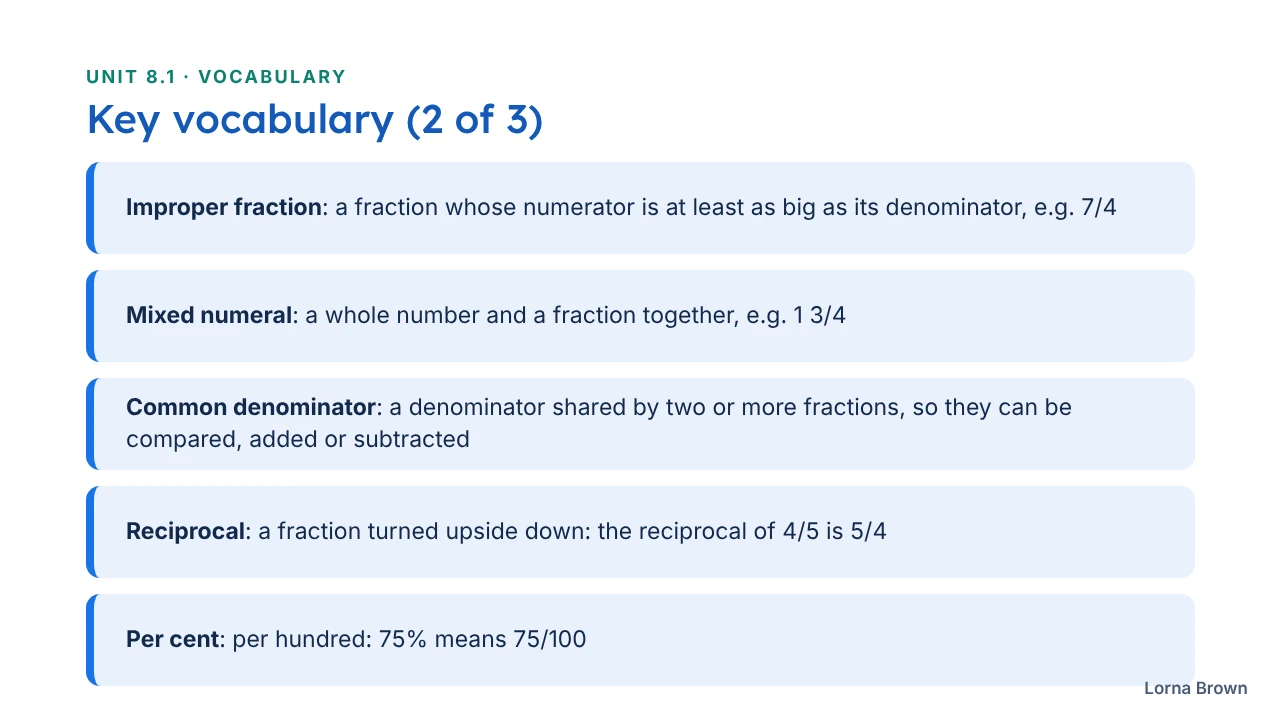
| Improper fraction | a fraction whose numerator is at least as big as its denominator, e.g. 7/4 |
| Mixed numeral | a whole number and a fraction together, e.g. 1 3/4 |
| Common denominator | a denominator shared by two or more fractions, so they can be compared, added or subtracted |
| Reciprocal | a fraction turned upside down: the reciprocal of 4/5 is 5/4 |
| Per cent | per hundred: 75% means 75/100 |
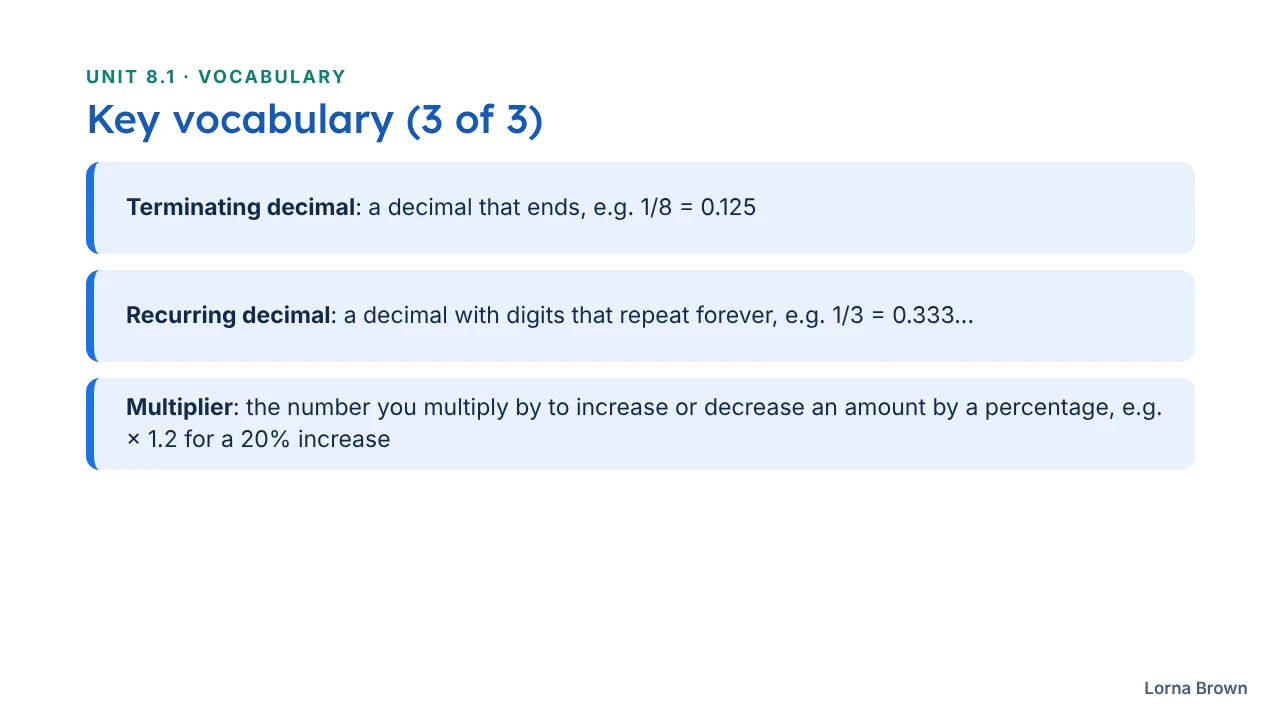
| Terminating decimal | a decimal that ends, e.g. 1/8 = 0.125 |
| Recurring decimal | a decimal with digits that repeat forever, e.g. 1/3 = 0.333... |
| Multiplier | the number you multiply by to increase or decrease an amount by a percentage, e.g. × 1.2 for a 20% increase |
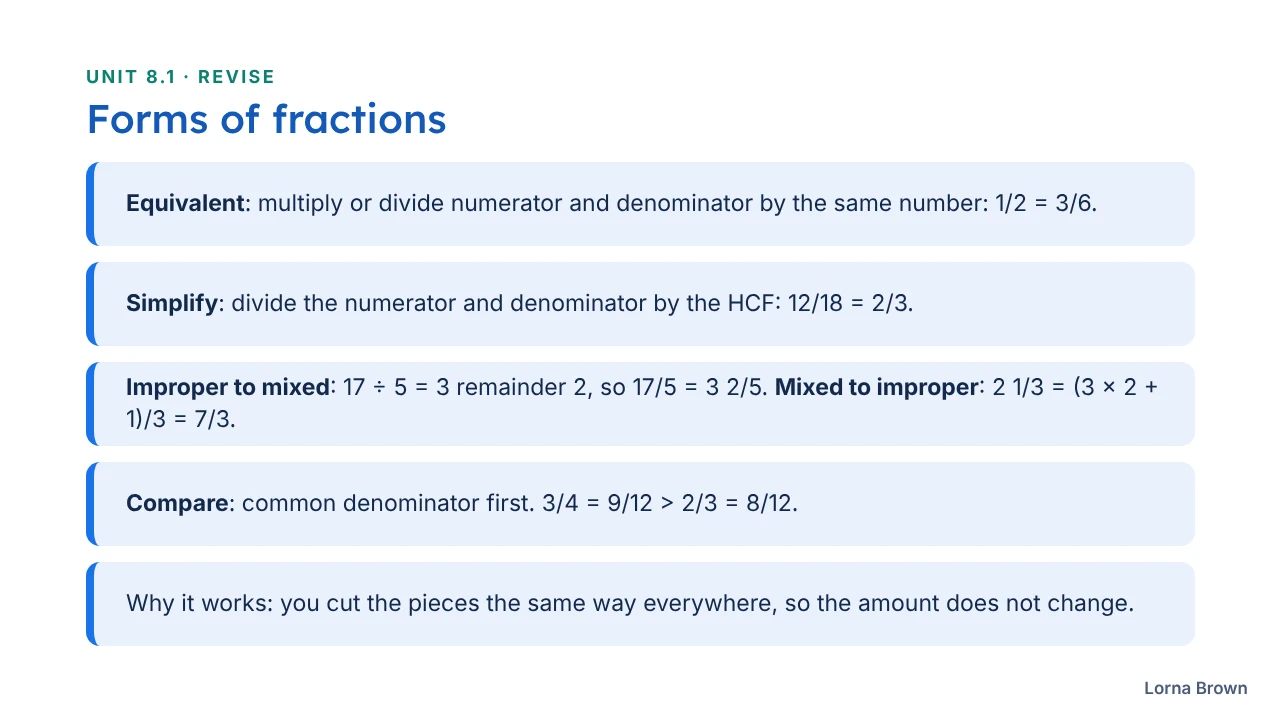
Forms of fractions
- Equivalent: multiply or divide numerator and denominator by the same number: 1/2 = 3/6.
- Simplify: divide the numerator and denominator by the HCF: 12/18 = 2/3.
- Improper to mixed: 17 ÷ 5 = 3 remainder 2, so 17/5 = 3 2/5. Mixed to improper: 2 1/3 = (3 × 2 + 1)/3 = 7/3.
- Compare: common denominator first. 3/4 = 9/12 > 2/3 = 8/12.
- Why it works: you cut the pieces the same way everywhere, so the amount does not change.
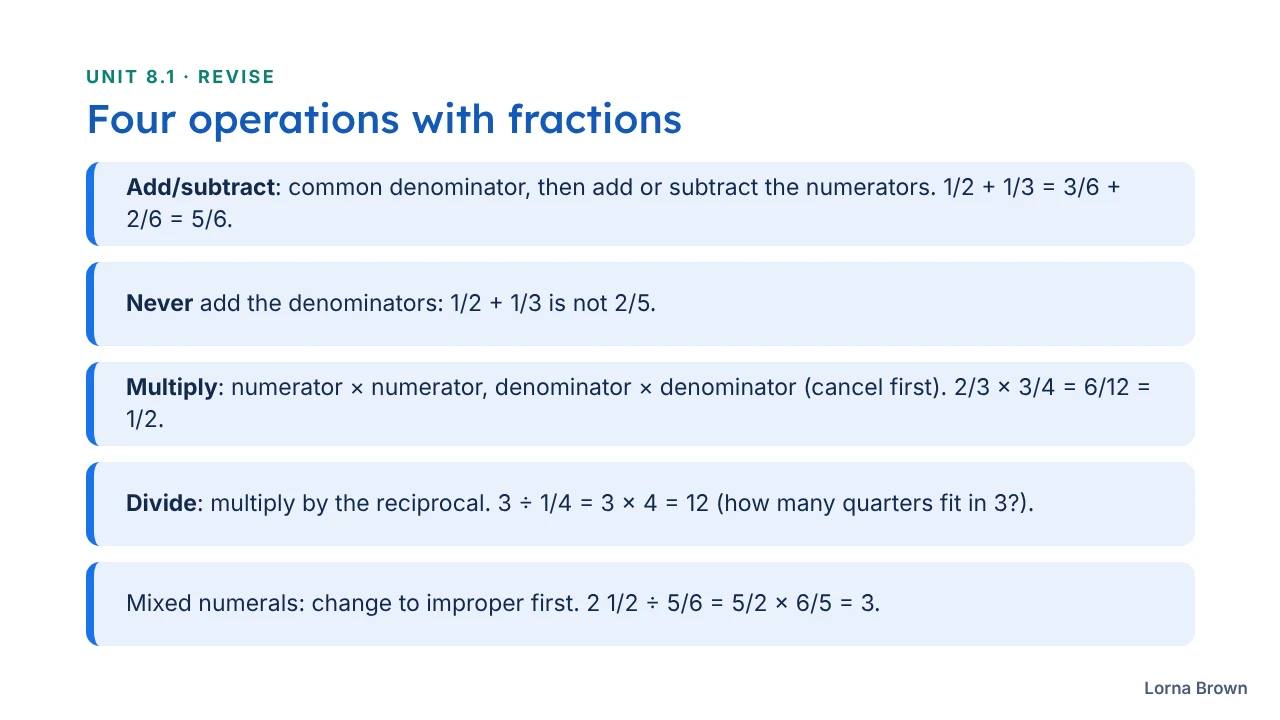
Four operations with fractions
- Add/subtract: common denominator, then add or subtract the numerators. 1/2 + 1/3 = 3/6 + 2/6 = 5/6.
- Never add the denominators: 1/2 + 1/3 is not 2/5.
- Multiply: numerator × numerator, denominator × denominator (cancel first). 2/3 × 3/4 = 6/12 = 1/2.
- Divide: multiply by the reciprocal. 3 ÷ 1/4 = 3 × 4 = 12 (how many quarters fit in 3?).
- Mixed numerals: change to improper first. 2 1/2 ÷ 5/6 = 5/2 × 6/5 = 3.
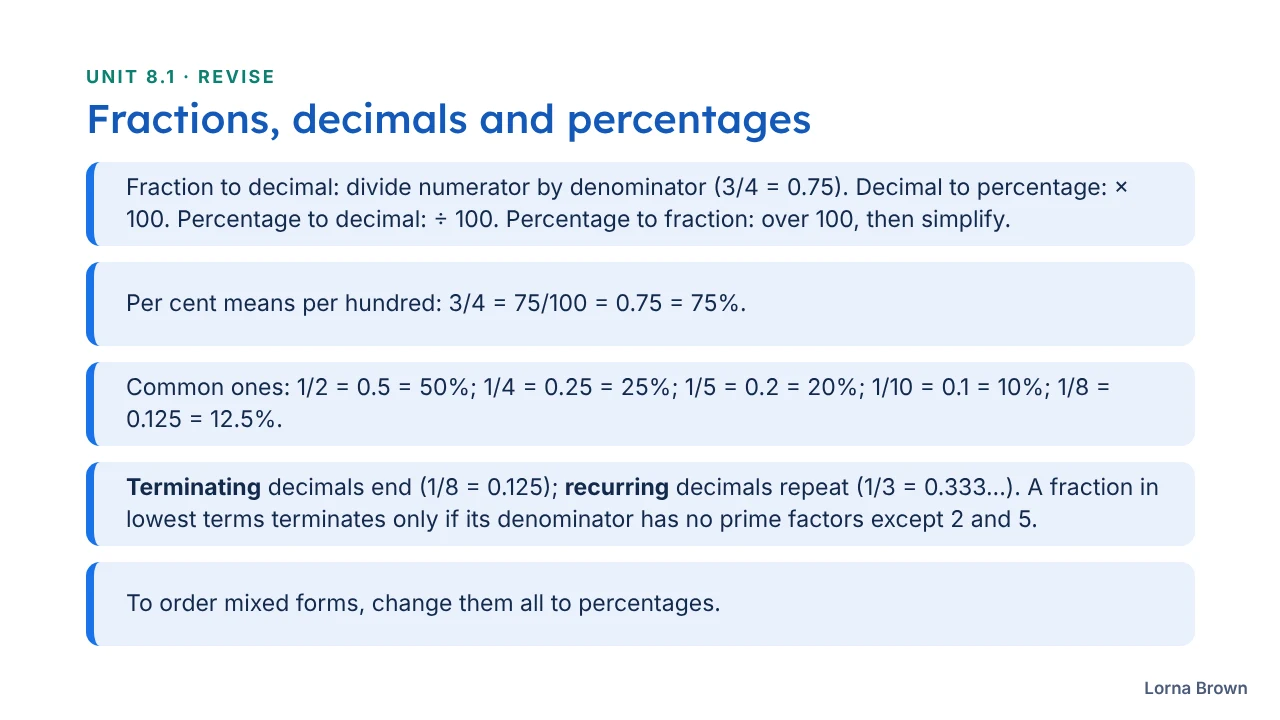
Fractions, decimals and percentages
- Fraction to decimal: divide numerator by denominator (3/4 = 0.75). Decimal to percentage: × 100. Percentage to decimal: ÷ 100. Percentage to fraction: over 100, then simplify.
- Per cent means per hundred: 3/4 = 75/100 = 0.75 = 75%.
- Common ones: 1/2 = 0.5 = 50%; 1/4 = 0.25 = 25%; 1/5 = 0.2 = 20%; 1/10 = 0.1 = 10%; 1/8 = 0.125 = 12.5%.
- Terminating decimals end (1/8 = 0.125); recurring decimals repeat (1/3 = 0.333...). A fraction in lowest terms terminates only if its denominator has no prime factors except 2 and 5.
- To order mixed forms, change them all to percentages.
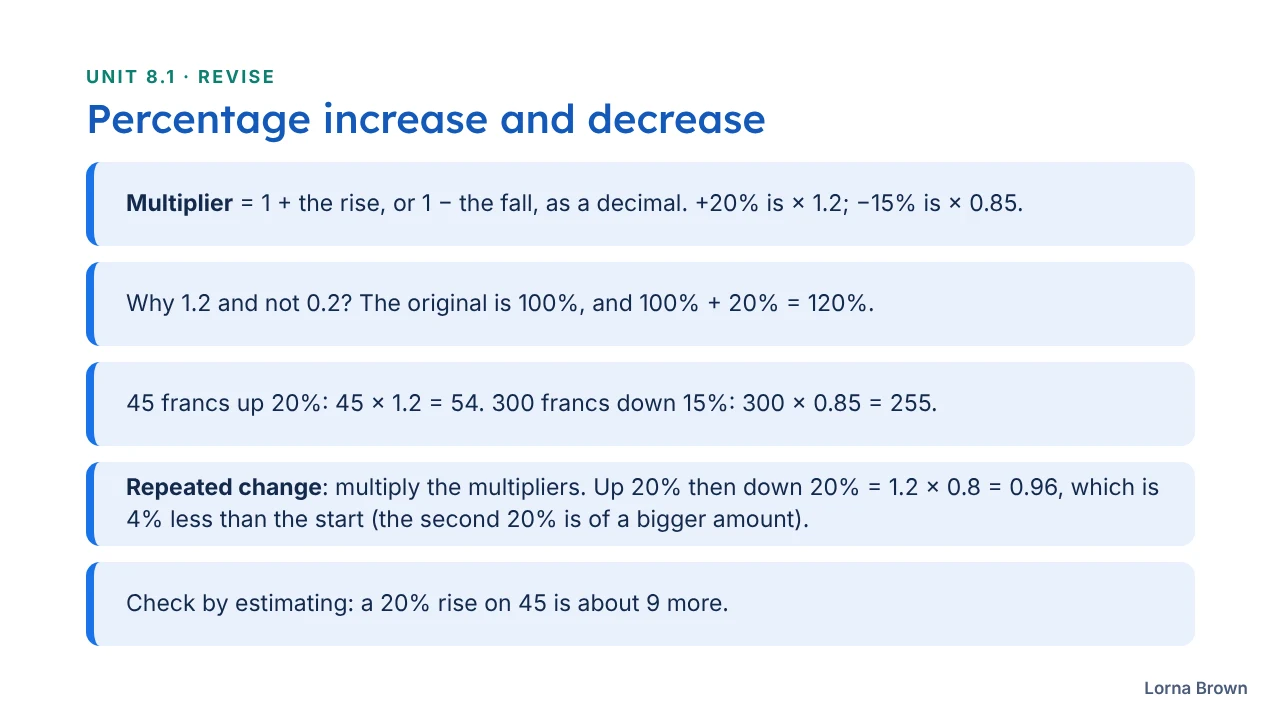
Percentage increase and decrease
- Multiplier = 1 + the rise, or 1 − the fall, as a decimal. +20% is × 1.2; −15% is × 0.85.
- Why 1.2 and not 0.2? The original is 100%, and 100% + 20% = 120%.
- 45 francs up 20%: 45 × 1.2 = 54. 300 francs down 15%: 300 × 0.85 = 255.
- Repeated change: multiply the multipliers. Up 20% then down 20% = 1.2 × 0.8 = 0.96, which is 4% less than the start (the second 20% is of a bigger amount).
- Check by estimating: a 20% rise on 45 is about 9 more.
Common mistakes
- ✕ “1/2 + 1/3 = 2/5.” ✓ Find a common denominator first: 3/6 + 2/6 = 5/6.
- ✕ “3 ÷ 1/4 = 3/4.” ✓ Dividing by 1/4 multiplies by 4: 3 × 4 = 12.
- ✕ “A 20% rise is × 0.2.” ✓ It is × 1.2, because the original stays (100% + 20%).
- ✕ “Up 20% then down 20% gets you back to the start.” ✓ It gives 96% of the start: 1.2 × 0.8 = 0.96.
- ✕ “Leave 12/18 as it is.” ✓ Simplify to lowest terms: 2/3.
Practice booklet
 mathscafe.net
Lorna Brown © 2026
Practice Booklet
- 8.1.1
- Forms of fractions · Questions 1–17
- 8.1.2
- Four operations with fractions · Questions 18–34
- 8.1.3
- Fractions, decimals and percentages · Questions 35–52
- 8.1.4
- Percentage increase and decrease · Questions 53–69
- Homework
- Homework page and checking record
- Answers
- For checking and correcting in green pen
How to use this booklet and your homework
Read this firstChoosing your level
Every part of the unit has four levels. Start where you feel comfortable and move between them freely. Most questions ask you to explain as well as answer, because being able to say why is what makes a method stick.
Learning
Simple numbers, with a bar or a grid drawn beside you.
Practising
The standard question, with your reasoning written out.
Challenging
Working backwards, and finding what is wrong with someone else’s thinking.
Mastery
Explaining why a rule must be true, and testing it on new cases.
Working on your homework
Pens and setting out
- Answers in blue or black non-erasable pen, or in pencil.
- Colour and highlighters are for annotating your work and showing the steps of a method.
- Never erase a mistake. Rework it underneath so you can see what changed.
- Got it wrong? Circle the question number, then make your correction and write your error analysis in green pen.
- Still can’t work out how to solve it? Put a star ★ next to the question number, so we know to go over it in class.
Each sheet
- Your name goes on every sheet, because they are handed in one at a time.
- Each question is worth up to 3 marks. If a question has parts (a, b, c…), each part is marked out of 3. At the end of each level, write your score out of the total for that level.
- Questions are numbered 1, 2, 3… all the way through the booklet, so we can say exactly which ones to do.
- If you are stuck after trying, ask for help. Showing me what you tried is a good start.
mathscafe.netLorna Brown © 2026page 2
8.1.1 Forms of fractions
LearningKey vocabulary
| Word | Meaning | Example |
|---|---|---|
| numerator | the number above the line: how many parts you have | 3 in 34 |
| denominator | the number below the line: how many equal parts the whole is cut into | 4 in 34 |
| the whole | the complete amount, or 1 | 44 = 1 |
| equivalent fractions | fractions with the same value, written with different numbers | 12 = 24 = 48 |
| highest common factor (HCF) | the biggest number that divides exactly into two numbers | HCF of 12 and 18 is 6 |
| simplest form | no common factor except 1 | 1218 = 23 |
| improper fraction | numerator bigger than or equal to the denominator | 74 |
| mixed numeral | a whole number and a fraction together | 134 |
The value of a fraction does not change when you write it a different way, only how it is written changes. “The big one” is a fraction equal to 1, such as 22, that you multiply or divide by.
Learning
a) What fraction of the first bar is shaded?
b) What fraction of the second bar is shaded?
c) What do you notice about the two fractions?
a) 12 = 6 b) 23 = 8 c) 34 = 12
a) 68 b) 1015 c) 1218
mathscafe.netLorna Brown © 2026page 3
8.1.1 Forms of fractions
Learning · PractisingLearning (continued)
b) Write 213 as an improper fraction. Work out 2 × 3 + 1 first
Practising
b) Write 427 as an improper fraction.
c) Write 338 as an improper fraction
mathscafe.netLorna Brown © 2026page 4
8.1.1 Forms of fractions
Challenging · MasteryChallenging
Mastery
mathscafe.netLorna Brown © 2026page 5
8.1.2 Four operations with fractions
LearningKey vocabulary
| Word | Meaning | Example |
|---|---|---|
| common denominator | a denominator two fractions share, so the pieces are the same size | 12 = 36 and 13 = 26 |
| simplify | write a fraction in simplest form, dividing by the big one | 612 = 12 |
| reciprocal | a fraction turned upside down; a number times its reciprocal is 1 | the reciprocal of 45 is 54 |
| product | the answer to a multiplication | 23 × 34 has product 12 |
| quotient | the answer to a division | 3 ÷ 14 has quotient 12 |
| mixed numeral | a whole number and a fraction together | 212 = 52 |
Add and subtract with a common denominator. Multiply with an area model. Divide by asking how many fit.
Learning
a) 15 + 25 b) 56 − 16 c) 38 + 18
a) How many equal pieces are in the whole grid?
b) How many pieces are shaded in both colours?
c) Write 12 × 13 as one fraction
mathscafe.netLorna Brown © 2026page 6
8.1.2 Four operations with fractions
Learning · PractisingLearning (continued)
Practising
a) 34 × 25 b) 56 × 310 c) 23 × 916
a) 112 + 234
b) 212 × 25. For b), change the mixed numeral to an improper fraction first
a) 12 × 14 b) 3 ÷ 14 c) 8 × 32
mathscafe.netLorna Brown © 2026page 7
8.1.2 Four operations with fractions
Challenging · MasteryChallenging
a) How many pupils play sport?
b) How many play football?
c) What fraction of the class plays football?
Mastery
mathscafe.netLorna Brown © 2026page 8
8.1.3 Fractions, decimals and percentages
LearningKey vocabulary
| Word | Meaning | Example |
|---|---|---|
| fraction | parts of a whole: a numerator over a denominator | 34 |
| decimal | a number with a decimal point | 0.75 |
| per cent (%) | out of 100 | 75% = 75100 |
| terminating decimal | a decimal that ends | 18 = 0.125 |
| recurring decimal | a decimal whose digits repeat forever | 13 = 0.333… |
| equivalent forms | the same value written in different ways | 34 = 0.75 = 75% |
The fraction bar means divide: numerator ÷ denominator. The value does not change, only how it is written.
Learning
a) 12 b) 14 c) 34
mathscafe.netLorna Brown © 2026page 9
8.1.3 Fractions, decimals and percentages
PractisingPractising
a) 14 b) 13 c) 15
mathscafe.netLorna Brown © 2026page 10
8.1.3 Fractions, decimals and percentages
Challenging · MasteryChallenging
Mastery
mathscafe.netLorna Brown © 2026page 11
8.1.4 Percentage increase and decrease
LearningKey vocabulary
| Word | Meaning | Example |
|---|---|---|
| percentage | a number out of 100 | 20% = 20100 |
| increase | the amount gets bigger | 40 up to 50 |
| decrease | the amount gets smaller | 40 down to 30 |
| multiplier | the number you multiply by to make the change in one step | × 1.2 |
| original amount | the amount before the change | 45 in 45 × 1.2 |
| new amount | the amount after the change | 54 in 45 × 1.2 |
Increase: multiplier = 1 + the rise as a decimal. Decrease: multiplier = 1 − the fall as a decimal.
Learning
mathscafe.netLorna Brown © 2026page 12
8.1.4 Percentage increase and decrease
PractisingPractising
a) What is the increase?
b) What is the increase as a percentage of the original number?
mathscafe.netLorna Brown © 2026page 13
8.1.4 Percentage increase and decrease
Challenging · MasteryChallenging
Mastery
mathscafe.netLorna Brown © 2026page 14
Homework and checking record
Hand this page in with your sheetsYour teacher will tell you which sheet and questions to do. Choose your level, set out your work in pen or pencil, then check it with the answers at the back using a green pen: circle wrong question numbers, and star ★ any you still cannot solve.
| Sheet | Questions | Which ones I did | Checked in green ✓ | Teacher |
|---|---|---|---|---|
| 8.1.1 Forms of fractions | Q1–17 | |||
| 8.1.2 Four operations with fractions | Q18–34 | |||
| 8.1.3 Fractions, decimals and percentages | Q35–52 | |||
| 8.1.4 Percentage increase and decrease | Q53–69 |
Error analysis
Circle the number of any question you got wrong. Star ★ it if you still cannot solve it after correcting. Then write the questions you need to rework, and what you will do differently:
One thing I understand better now
mathscafe.netLorna Brown © 2026page 15
Answers
Check in green pen8.1.1 Forms of fractions
b) 24
c) They are equivalent: the shaded part is the same size, so the value does not change, only how it is written changes2a) 3, because 12 × 33 = 36 b) 12, because 23 × 44 = 812 c) 9, because 34 × 33 = 9123a) 34, dividing by 22 b) 23, dividing by 55 c) 23, dividing by 664a) 134: four quarters make 1 whole and 3 quarters are left over
b) 2 × 3 + 1 = 7, so 213 = 735In 35, 3 is the numerator and 5 is the denominator. Equivalent fractions have the same value but are written in different ways
8.1.2 Four operations with fractions
b) 46 = 23
c) 48 = 12. The pieces are already the same size, so only the number of pieces changes1912 = 24, so 24 + 14 = 3420a) 6
b) 1
c) 16. The whole grid has 3 × 2 = 6 pieces and 1 × 1 = 1 is shaded twice2112 quarters fit, because 3 × 4 = 12, so 3 ÷ 14 = 12
b) 212 = 52, and 52 × 25 = 1010 = 126a) smaller, because 14 is less than 1
b) bigger, because more quarters fit than wholes
c) bigger, because 32 is more than 12734 × 23 = 612 = 12 cup. “Of” means multiply
b) 12
c) 34 × 23 = 612 = 12, which matches 12 out of 24
8.1.3 Fractions, decimals and percentages
b) 45%
c) 7%. You multiply by 100 because a percentage counts hundredths38A percentage means out of 100. A decimal that ends is a terminating decimal. A decimal whose digits repeat forever is a recurring decimal
8.1.4 Percentage increase and decrease
b) 325 = 0.12 = 12%. You divide the increase by the original 25
Revision slides as text (easy to translate)
This is a plain-text version of the 8.1 revision slides. Your browser can translate it into any language.
Key vocabulary
- Numerator
- the number above the line in a fraction: how many parts you have
- Denominator
- the number below the line in a fraction: how many equal parts the whole is cut into
- Equivalent fractions
- fractions that name the same amount, for example 12 and 36
- Highest common factor (HCF)
- the biggest number that divides exactly into two or more numbers
- Lowest terms
- a fraction written so that the numerator and denominator share no common factor except 1
- Improper fraction
- a fraction whose numerator is at least as big as its denominator, for example 74
- Mixed numeral
- a whole number and a fraction together, for example 134
- Common denominator
- a denominator shared by two or more fractions, so they can be compared, added or subtracted
- Reciprocal
- a fraction turned upside down: the reciprocal of 45 is 54
- Per cent
- per hundred: 75% means 75100
- Terminating decimal
- a decimal that ends, for example 18 = 0.125
- Recurring decimal
- a decimal with digits that repeat forever, for example 13 = 0.333...
- Multiplier
- the number you multiply by to increase or decrease an amount by a percentage, for example × 1.2 for a 20% increase
Forms of fractions
Why it works
The value of a fraction does not change when you write it a different way.
You cut the pieces the same way everywhere, so the amount does not change.
Equivalent fractions
Multiply or divide the numerator and denominator by the same number.
12 = 36
Simplify
Divide the numerator and denominator by the HCF.
1218 = 23
Improper fraction to mixed numeral
Divide the numerator by the denominator.
17 ÷ 5 = 3 remainder 2
175 = 325
Mixed numeral to improper fraction
213 = (3 × 2 + 1)3 = 73
Compare fractions
Write them with a common denominator first.
34 = 912 and 23 = 812
so 34 > 23
Four operations with fractions
Add and subtract
Find a common denominator.
Then add or subtract the numerators.
12 + 13 = 36 + 26 = 56
Never add the denominators.
12 + 13 is not 25
Multiply
Multiply numerator by numerator and denominator by denominator.
Cancel first if you can.
23 × 34 = 612 = 12
Divide
Multiply by the reciprocal.
Think: how many quarters fit in 3?
3 ÷ 14 = 3 × 4 = 12
Mixed numerals
Change to improper fractions first.
212 ÷ 56 = 52 × 65 = 3
Fractions, decimals and percentages
Per cent means per hundred
34 = 75100 = 0.75 = 75%
Changing between forms
Fraction to decimal: divide the numerator by the denominator.
34 = 0.75
Decimal to percentage: multiply by 100.
Percentage to decimal: divide by 100.
Percentage to fraction: write it over 100, then simplify.
Common ones to know
12 = 0.5 = 50%
14 = 0.25 = 25%
15 = 0.2 = 20%
110 = 0.1 = 10%
18 = 0.125 = 12.5%
Terminating and recurring decimals
A terminating decimal ends: 18 = 0.125
A recurring decimal repeats: 13 = 0.333...
A fraction in lowest terms terminates only if its denominator has no prime factors except 2 and 5.
Ordering
To order mixed forms, change them all to percentages.
Percentage increase and decrease
Multiplier
For a rise, the multiplier is 1 + the rise, as a decimal.
For a fall, the multiplier is 1 − the fall, as a decimal.
A 20% increase is × 1.2
A 15% decrease is × 0.85
Why 1.2 and not 0.2?
The original is 100%, and 100% + 20% = 120%.
Worked examples
45 francs up 20%: 45 × 1.2 = 54
300 francs down 15%: 300 × 0.85 = 255
Repeated change
Multiply the multipliers.
Up 20% then down 20%: 1.2 × 0.8 = 0.96
This is 4% less than the start, because the second 20% is of a bigger amount.
Check by estimating
A 20% rise on 45 is about 9 more.
Common mistakes
✗ Wrong: 12 + 13 = 25
✓ Correct: Find a common denominator first: 36 + 26 = 56
✗ Wrong: 3 ÷ 14 = 34
✓ Correct: Dividing by 14 multiplies by 4: 3 × 4 = 12
✗ Wrong: A 20% rise is × 0.2
✓ Correct: It is × 1.2, because the original stays (100% + 20%)
✗ Wrong: Up 20% then down 20% gets you back to the start
✓ Correct: It gives 96% of the start: 1.2 × 0.8 = 0.96