7.2 Directed Number
Revision slides, flash cards, quizzes, revision notes, the practice booklet and a text version of the slides for this unit. Open to everyone, no password needed.
Flash cards
Quizzes
Pick an answer to see if you are right. Your score shows at the end of each quiz.
Revision notes
Download and print the revision notes (PDF, A4)
The big idea. Positive and negative numbers: the number line, ordering, adding, subtracting, multiplying, dividing and the order of operations.
The number line and ordering
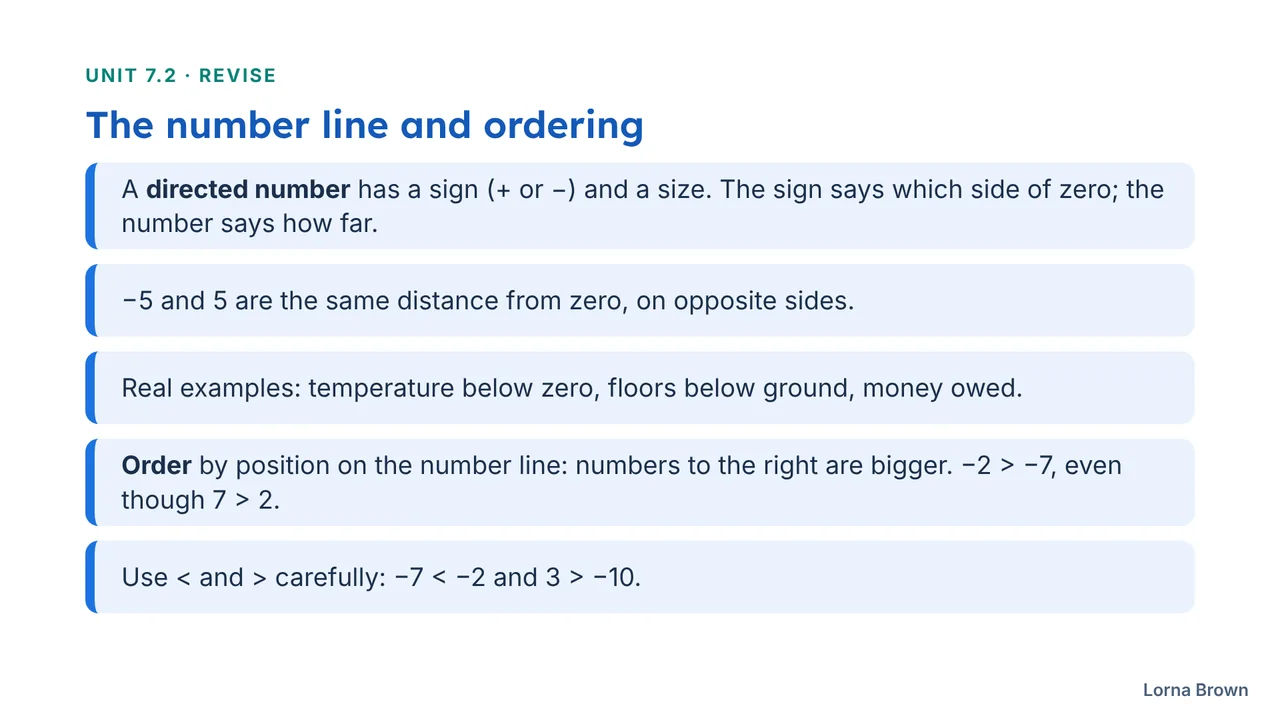
- A directed number has a sign (+ or −) and a size. The sign says which side of zero; the number says how far.
- −5 and 5 are the same distance from zero, on opposite sides.
- Real examples: temperature below zero, floors below ground, money owed.
- Order by position on the number line: numbers to the right are bigger. −2 > −7, even though 7 > 2.
- Use < and > carefully: −7 < −2 and 3 > −10.
Adding directed numbers
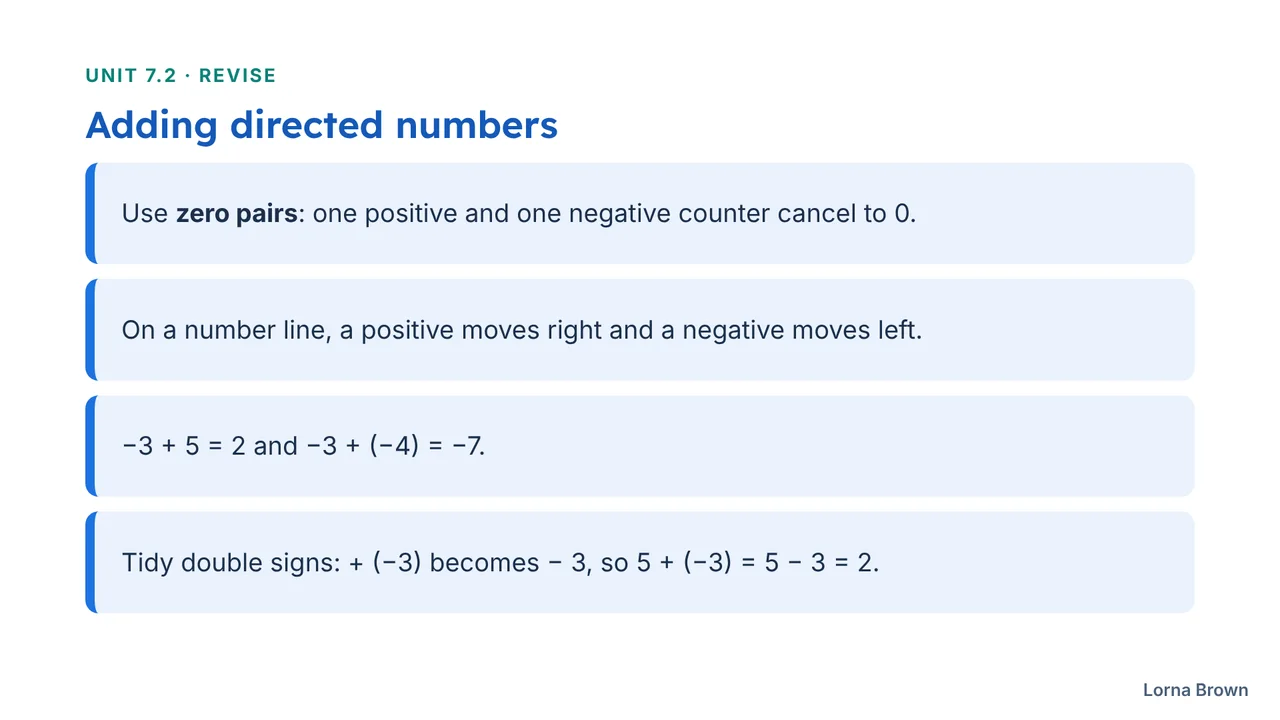
- Use zero pairs: one positive and one negative counter cancel to 0.
- On a number line, a positive moves right and a negative moves left.
- −3 + 5 = 2 and −3 + (−4) = −7.
- Tidy double signs: + (−3) becomes − 3, so 5 + (−3) = 5 − 3 = 2.
Subtracting directed numbers
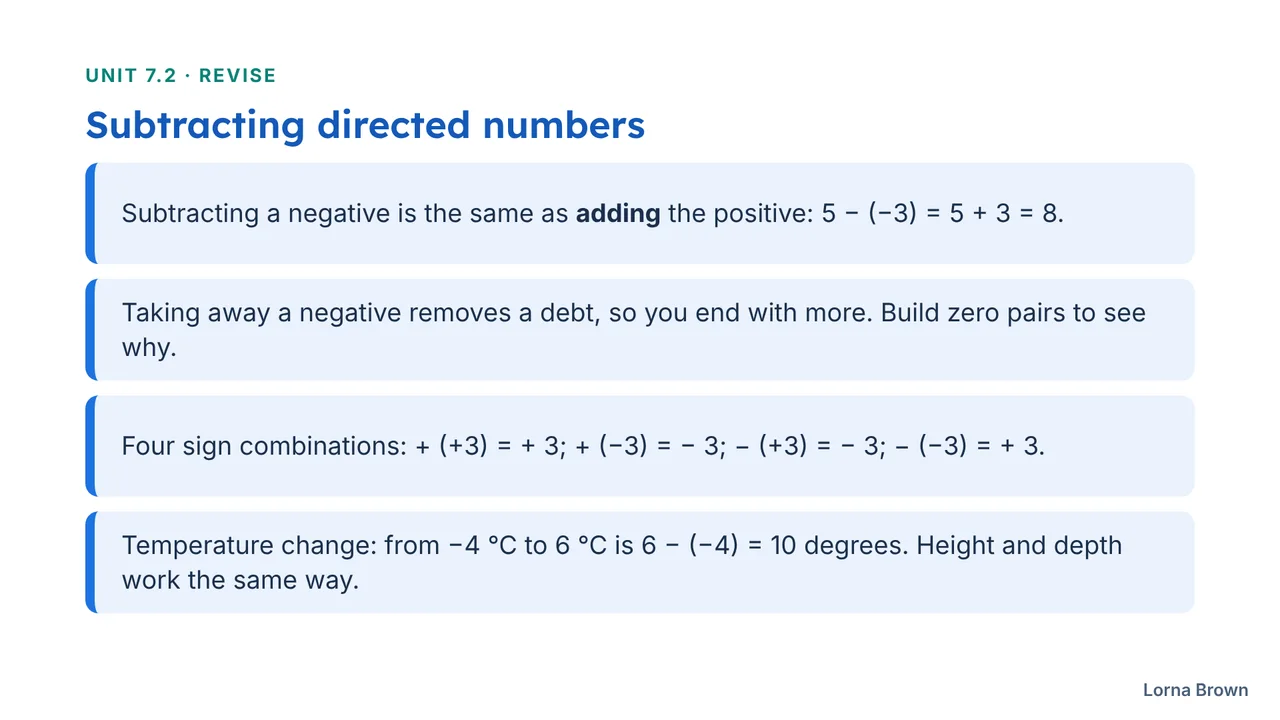
- Subtracting a negative is the same as adding the positive: 5 − (−3) = 5 + 3 = 8.
- Taking away a negative removes a debt, so you end with more. Build zero pairs to see why.
- Four sign combinations: + (+3) = + 3; + (−3) = − 3; − (+3) = − 3; − (−3) = + 3.
- Temperature change: from −4 °C to 6 °C is 6 − (−4) = 10 degrees. Height and depth work the same way.
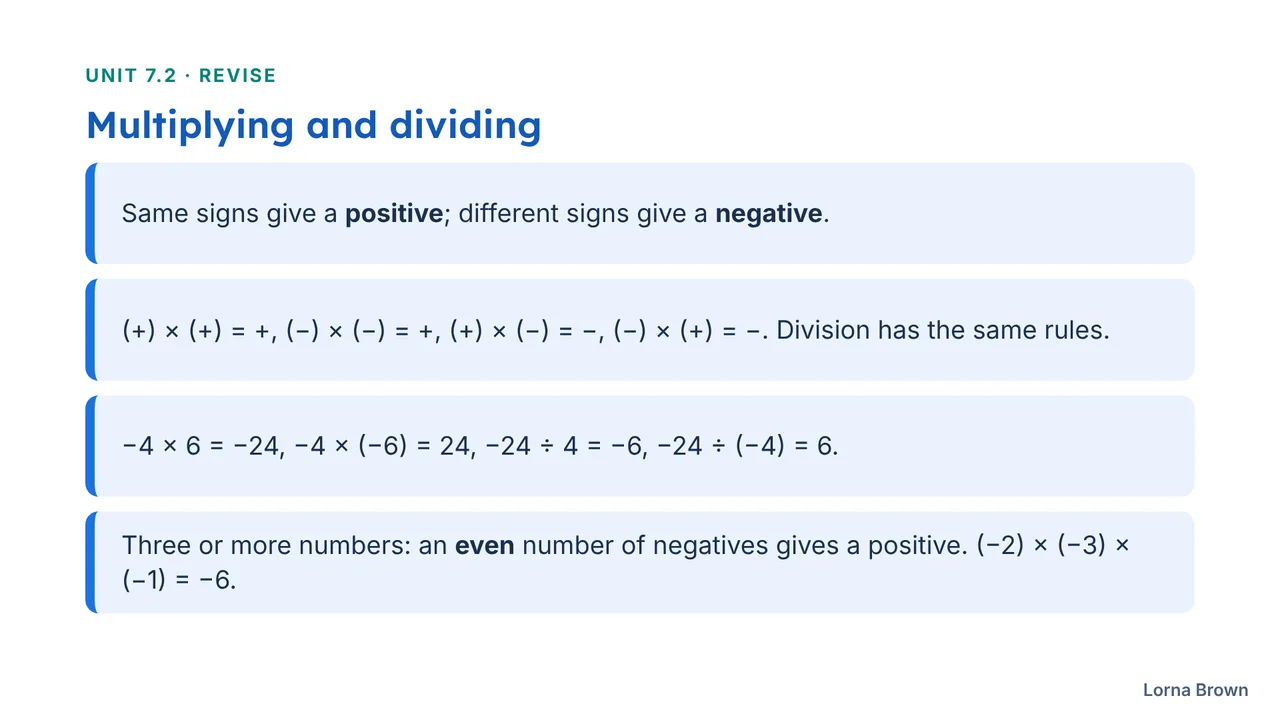
Multiplying and dividing
- Same signs give a positive; different signs give a negative.
- (+) × (+) = +, (−) × (−) = +, (+) × (−) = −, (−) × (+) = −. Division has the same rules.
- −4 × 6 = −24, −4 × (−6) = 24, −24 ÷ 4 = −6, −24 ÷ (−4) = 6.
- Three or more numbers: an even number of negatives gives a positive. (−2) × (−3) × (−1) = −6.
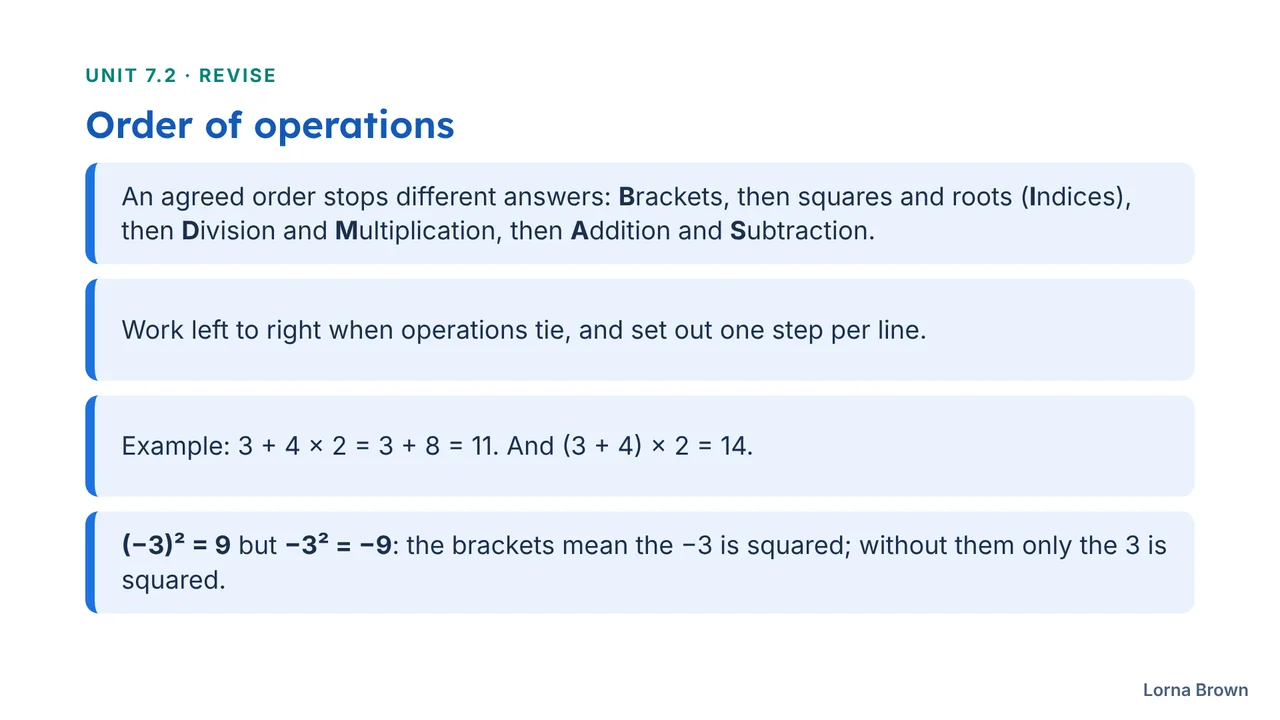
Order of operations
- An agreed order stops different answers: Brackets, then squares and roots (Indices), then Division and Multiplication, then Addition and Subtraction.
- Work left to right when operations tie, and set out one step per line.
- Example: 3 + 4 × 2 = 3 + 8 = 11. And (3 + 4) × 2 = 14.
- (−3)² = 9 but −3² = −9: the brackets mean the −3 is squared; without them only the 3 is squared.
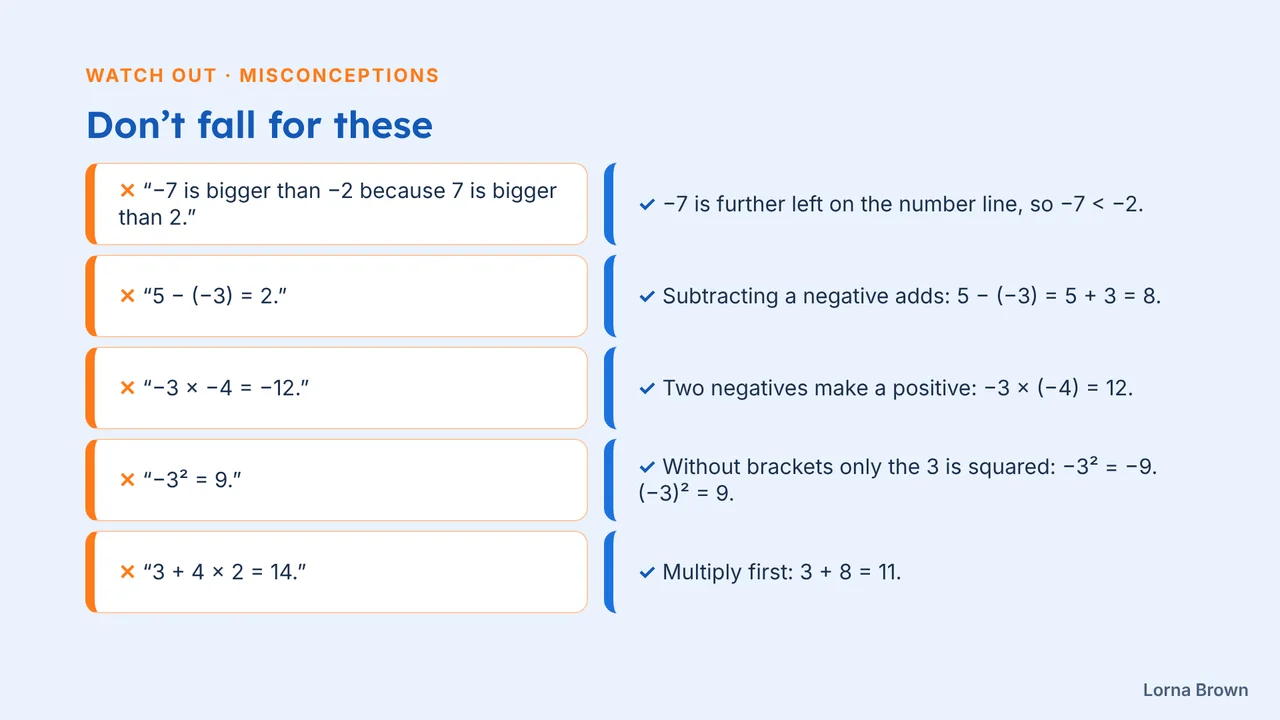
Common mistakes
- ✕ “−7 is bigger than −2 because 7 is bigger than 2.” ✓ −7 is further left on the number line, so −7 < −2.
- ✕ “5 − (−3) = 2.” ✓ Subtracting a negative adds: 5 − (−3) = 5 + 3 = 8.
- ✕ “−3 × −4 = −12.” ✓ Two negatives make a positive: −3 × (−4) = 12.
- ✕ “−3² = 9.” ✓ Without brackets only the 3 is squared: −3² = −9. (−3)² = 9.
- ✕ “3 + 4 × 2 = 14.” ✓ Multiply first: 3 + 8 = 11.
Practice booklet
Practice questions at four levels (Learning, Practising, Challenging, Mastery), with answers at the end. Download the printable PDF.
Questions are numbered 1, 2, 3… all the way through, so your teacher can say exactly which ones to do. Check every answer with a green pen and do an error analysis. Choose a level: Learning (standard case, with your notes), Practising (the method alone), Challenging (harder, several steps) or Mastery (explain why, find errors, apply it).
7.2.1 Distance from zero · 7.2.2 Ordering
Key vocabulary
| Word | Meaning | Example |
|---|---|---|
| directed number | a number with a sign that shows its direction from zero | +4, −4 |
| positive / negative | right of zero / left of zero | 5 and −5 |
| opposite | same distance from zero, on the other side | 3 and −3 |
| < and > | less than and greater than: the open end faces the greater number | −7 < −2 |
Learning
- Which is colder, −4 °C or −9 °C? How do you know?
- Write in ascending order (smallest first): 2, −5, 0, −1
- How far from zero is −6? And 6? What does that tell you?
- Write < or > in each gap: a) −3 ___ 2 b) −7 ___ −2 c) 0 ___ −4
- Is every negative number smaller than every positive number? Explain.
Practising
- Write in ascending order: −12, 7, −3, 0, −15, 4
- Which is further from zero, −8 or 5? Which is the larger number? Explain why those are different questions.
- Write the opposite of a) 9 b) −14 c) 0
- Zurich is −2 °C, Oslo −7 °C, Madrid 5 °C and Cairo 12 °C. List the cities from coldest to warmest.
- How many integers lie between −5 and 2? Explain how you counted them.
Challenging
- x lies between −4 and −1. List the integers x could be, and explain how the line helped.
- a is negative and b is positive. Which is larger? Must that always be true?
- Explain why −20 is smaller than −2, even though 20 is bigger than 2.
- Write a number between −3 and −2. Is there another one?
- Find and describe the mistake. Ravi puts −7, −2, 3 and −5 in order from smallest to largest as −2, −5, −7, 3.
Mastery
- Find two numbers that differ by 10 and are both below −5. Explain how you chose them.
- Describe where all the numbers with distance 7 from zero sit on the line, and what that says about the line’s symmetry.
- Which numbers are 4 steps away from −1? Explain how you found them.
7.2.3 Adding · 7.2.4 Subtracting
Learning
- Work out a) −3 + 5 b) 4 + (−7) c) −2 − 4
- Continue the pattern: 5 + 2 = 7, 5 + 1 = 6, 5 + 0 = 5, 5 + (−1) = ___, 5 + (−2) = ___. What does adding a negative number do?
- 6 − (−2). Draw or describe the counters, and say why the answer is bigger than 6.
- Use counters to work out 5 + (−3). Draw them, circle the zero pairs and say what is left.
- Complete: a zero pair is one ________ counter and one ________ counter, and together they are worth ____
Practising
- Work out a) −8 + (−5) b) −6 − (−10) c) 12 + (−15) − (−4)
- Use “which way do I face?” to work out 3 − (−5). Say which way you face, whether you turn round, and where you land.
- Adding −5 and subtracting 5 give the same answer. Explain why, using the number line.
- At 06:00 it is −7 °C; at noon it is 4 °C. How much warmer, and why is the answer positive?
- Draw counters and circle the zero pairs to work out (−6) + 4. Write how many zero pairs there are and what is left.
Challenging
- Fill the gaps and say how you worked backwards: a) −5 + ___ = 3 b) ___ − (−6) = 1
- Two numbers add to −2 and one of them is 7. Find the other.
- A student says "subtracting always makes a number smaller". Give a counterexample and explain what they have missed.
- Find and describe the mistake. Nia works out −3 − (−5) = −8.
- Write two different additions that give −2 and use zero pairs. Draw one of them with counters.
Mastery
- Use counters to explain why taking away a negative gives the same answer as adding a positive. Write it as a general statement.
- Write two different calculations that give −4, one of which subtracts a negative. Explain your choices.
- Explain why adding a zero pair to a total never changes it. Use counters and an example.
- Try a = 5 and b = −3. Work out a − b and b − a. What do you notice, and why?
7.2.5 Multiplying and dividing
Key vocabulary
| Word | Meaning | Example |
|---|---|---|
| product | the answer to a multiplication | (−3) × 4 = −12 |
| quotient | the answer to a division | −12 ÷ 4 = −3 |
| inverse | the operation that undoes another one | division undoes multiplication |
| sign | plus or minus | the − in −5 |
Learning
- Work out a) −3 × 4 b) −5 × (−2)
- Work out a) −20 ÷ 4 b) −18 ÷ (−3)
- −3 × 4 means "four lots of −3". Explain the answer using that sentence.
- Complete the pattern: 3 × 2 = 6, 3 × 1 = 3, 3 × 0 = 0, 3 × (−1) = ___, 3 × (−2) = ___. What does the answer go down by each time?
- Use the words product, quotient and inverse to complete: the answer to a multiplication is the ________. The answer to a division is the ________. Division is the ________ of multiplication.
Practising
- Work out a) −7 × 6 b) −8 × (−9) c) −56 ÷ 7
- Predict the sign of −2 × (−3) × (−4) before you calculate. Say how you knew, then work it out.
- Continue: −4 × 3 = −12, −4 × 2 = −8, −4 × 1 = ___, −4 × 0 = ___, −4 × (−1) = ___. What does the pattern show?
- 3 × (−4) = −12. Use this to write two division facts, and say what the word inverse means here.
Challenging
- Fill the gaps: a) ___ × (−4) = 20 b) −6 × ___ = −42. Explain your reasoning for the signs.
- Why is the product of three negative numbers negative, but of four negatives positive?
- Work out −4² and (−4)², then explain what the brackets changed.
- Find and describe the mistake. Tom says (−4) × (−3) = −12.
Mastery
- Use the pattern of products to explain why a negative times a negative must be positive. Write it so a Year 6 student would follow.
- a × b is positive and a is negative. What do you know about b, and why?
- Division undoes multiplication. Use that to explain why −24 ÷ (−6) = 4.
- What is (−1) to the power 100? And (−1) to the power 101? Explain how you know.
7.2.6 (a) Order of operations
Every number in this set is a positive whole number, and no step gives an answer below zero. Show one operation per line.
Square: 4² = 4 × 4 = 16. Square root: √16 = 4, because 4² = 16.
Learning
- 4 + 3 × 2
- (4 + 3) × 2
- 20 − 12 ÷ 4
- 18 ÷ 3 + 6
- 5 × 4 − 2 × 3
- √16 + 3 × 2
- 2 + 3²
- (2 + 3)²
- Look at questions 55 and 56. Why are the answers different?
Practising
- 7 + 24 ÷ (9 − 3)
- 4² − 3 × 5
- 3 × (2 + 4)²
- (15 − 3) ÷ 4 + 2²
- √81 ÷ 3 + 2 × 4
- 6² ÷ (5 − 1)
- 2 × 3² − 4 × 2
- (8 − 2 × 3)² + 5
- Work out 5 + 2 × (10 − 4)² ÷ 8, one operation per line, with the equals signs underneath each other.
Challenging
- Put brackets into 4 + 2 × 5 − 3 so that the answer is 27.
- Put brackets into 2 × 3 + 4² so that the answer is 100.
- Find the missing number: 4 + ☐ × 3 = 19
- Find and describe the mistake. Sam writes 10 − 4 + 2 = 4.
- Which is larger, 2 × 5² or (2 × 5)²? Show how you know.
Mastery
- Use 2, 3, 4 and 5 once each, with any operations and brackets, to make 24.
- A cinema ticket costs 9 francs and popcorn costs 4 francs. Three friends each buy one of each. Write one calculation with brackets for the total and work it out. Explain why 3 × 9 + 4 gives the wrong total.
- Is (3 + 4)² the same as 3² + 4²? Test it, then explain what you found.
- One student works out 8 − 2 × 3 + 1 and says the answer is 19. Another says 3. Who is right? Explain what the other student did.
7.2.6 (b) Order of operations
Learning
- 5 + 2 × 3
- (5 + 2) × 3. Compare with your answer to question 82: why are the answers different?
- −4 + 6 ÷ 2
- 3² − 5
Practising
- −2 + 4 × (−3)
- (−4 + 1) × (−5)
- 20 ÷ (−4) + 3
- Work out a) (−4)² b) −4² c) (−2)³
- Work out −4 + 3 × (−2)², one operation per line, with the equals signs underneath each other.
Challenging
- Put brackets into 3 + 5 × 2 − 1 so that the answer is 15.
- Explain why −3² is not 9, using the order of operations.
- Work out (−3)² − (−2)³, showing each stage.
- Find and describe the mistake. Ana works out 3 + 4 × 2 = 14.
Mastery
- One student says −2 × 3² = 36 and another says −18. Who is right, and what mistake did the other one make?
- Use the numbers −2, 3 and 3 with one pair of brackets and one other operation to make −15.
- Why does mathematics need one shared order of operations? What would happen without it?
Answers
Check and correct in green pen.
7.2.1 Distance from zero · 7.2.2 Ordering
Learning
- −9 °C, because it is further below zero
- −5, −1, 0, 2
- Both are 6 from zero, so they differ only in direction
- a) < b) < c) >
- Yes: every negative is left of zero and every positive is right of it.
Practising
- −15, −12, −3, 0, 4, 7
- −8 is further from zero, but 5 is the larger number: distance ignores direction, size does not
- a) −9 b) 14 c) 0 (zero is its own opposite)
- Oslo, Zurich, Madrid, Cairo (−7, −2, 5, 12)
- Six: −4, −3, −2, −1, 0, 1
Challenging
- −3 and −2
- b is larger, and this is always true because every positive lies right of every negative
- −20 is 20 to the left of zero, which is further left than −2, and further left always means smaller.
- For example −2.5. There are infinitely many, such as −2.1 and −2.99
- He ordered the negatives as if they were positive. The further a negative number is from zero, the smaller it is. The correct order is −7, −5, −2, 3.
Mastery
- Any pair such as −6 and −16
- 7 and −7, one either side of zero: the line is symmetric about zero, so every distance gives two numbers.
- 3 and −5: 4 steps right of −1 and 4 steps left of −1
7.2.3 Adding · 7.2.4 Subtracting
Learning
- a) 2 b) −3 c) −6
- 4, 3. The answer goes down by 1 each time, so adding a negative number makes the answer smaller.
- 8. Add 2 zero pairs so there are negative counters to take away. Taking away the 2 negatives leaves 8 positives, so the answer grows.
- 5 positive and 3 negative counters. 3 zero pairs make 0, so 2 positives are left: 5 + (−3) = 2.
- positive, negative, 0
Practising
- a) −13 b) 4 c) 1
- Subtracting means face the negative direction (left). The negative sign turns you round to face right. Walk 5 steps right and land on 8.
- Both move five steps to the left, so the journey and the answer are the same
- 4 − (−7) = 11, eleven degrees warmer; a difference is a distance, so it is positive.
- 6 negatives and 4 positives. There are 4 zero pairs, so 2 negatives are left: (−6) + 4 = −2.
Challenging
- a) 8 b) −5
- −9
- 5 − (−3) = 8 is larger than 5: subtracting a negative removes a debt, which increases the value.
- Subtracting a negative is the same as adding the positive, so −3 − (−5) = −3 + 5 = 2. She treated it as −3 − 5.
- For example 3 + (−5), 1 + (−3) or (−6) + 4. In each, the zero pairs cancel and 2 negatives are left.
Mastery
- Building in zero pairs does not change the value, but it provides the negative counters to remove; what is left is the original plus that many positives, so a − (−b) = a + b
- For example 1 + (−5) = −4 and −7 − (−3) = −4
- A zero pair is one positive and one negative counter, worth +1 and −1, which is 0. Adding 0 leaves the total the same. For example 4 is 4 positives; add a zero pair and there are 5 positives and 1 negative, and 5 + (−1) is still 4.
- 5 − (−3) = 8 and (−3) − 5 = −8. They are opposites: swapping the order of a subtraction changes the sign of the answer.
7.2.5 Multiplying and dividing
Learning
- a) −12 b) 10
- a) −5 b) 6
- Four lots of −3 is −3 − 3 − 3 − 3 = −12.
- −3, −6. It goes down by 3 each time.
- product, quotient, inverse
Practising
- a) −42 b) 72 c) −8
- Three negative signs, an odd number, so the answer is negative: −24
- −4, 0, 4. Each step adds 4, so the answers must cross zero and become positive.
- −12 ÷ 3 = −4 and −12 ÷ (−4) = 3. Division is the inverse of multiplication: it undoes it.
Challenging
- a) −5 b) 7
- Each negative sign flips the answer’s side of zero, so an odd number of flips lands on negative and an even number lands on positive
- −4² = −16 and (−4)² = 16: without brackets only the 4 is squared.
- Two negative numbers multiplied give a positive answer, so (−4) × (−3) = 12. He only used the multiplication fact and kept a negative sign.
Mastery
- Going down the list −4 × 3, −4 × 2, −4 × 1, −4 × 0 the answers rise by 4 each time; continuing past zero gives −4 × (−1) = 4
- b is negative, because only two negatives multiply to a positive
- 4 × (−6) = −24, and division undoes multiplication, so −24 ÷ (−6) = 4.
- 1 and −1. An even number of negative signs gives a positive; an odd number gives a negative.
7.2.6 (a) Order of operations
Learning
- 4 + 6 = 10
- 7 × 2 = 14
- 20 − 3 = 17
- 6 + 6 = 12
- 20 − 6 = 14
- 4 + 6 = 10
- 2 + 9 = 11
- (2 + 3)² = 5² = 25
- In the first, the multiplication is done first. In the second, the brackets make the addition happen first.
Practising
- 7 + 24 ÷ 6 = 7 + 4 = 11
- 16 − 15 = 1
- 3 × 6² = 3 × 36 = 108
- 12 ÷ 4 + 4 = 3 + 4 = 7
- 9 ÷ 3 + 8 = 3 + 8 = 11
- 36 ÷ 4 = 9
- 2 × 9 − 8 = 18 − 8 = 10
- (8 − 6)² + 5 = 2² + 5 = 4 + 5 = 9
- 5 + 2 × 6² ÷ 8 = 5 + 2 × 36 ÷ 8 = 5 + 72 ÷ 8 = 5 + 9 = 14
Challenging
- (4 + 2) × 5 − 3 = 30 − 3 = 27
- (2 × 3 + 4)² = 10² = 100
- 5, because 5 × 3 = 15 and 4 + 15 = 19
- Sam added first. Addition and subtraction go from left to right: 10 − 4 = 6, then 6 + 2 = 8.
- 2 × 25 = 50 and 10² = 100, so (2 × 5)² is larger.
Mastery
- For example (5 + 3 − 2) × 4 = 24, or 4 × (5 + 3 − 2) = 24
- 3 × (9 + 4) = 3 × 13 = 39 francs. 3 × 9 + 4 = 31 only adds one popcorn, because the multiplication is done first.
- No. (3 + 4)² = 7² = 49, but 3² + 4² = 9 + 16 = 25. Squaring a bracket is not the same as squaring each number.
- 3 is right: 2 × 3 = 6 first, then 8 − 6 + 1 = 3. The other student worked from left to right and ignored the order.
7.2.6 (b) Order of operations
Learning
- 11
- 21; the brackets are done first, so the addition happens before the multiplication
- −1
- 9 − 5 = 4
Practising
- −14
- 15
- −2
- a) 16 b) −16 c) −8
- −4 + 3 × 4 = −4 + 12 = 8
Challenging
- (3 + 5) × 2 − 1 = 15
- The power applies only to the 3, and the negative is applied afterwards, so −3² = −9
- 9 − (−8) = 9 + 8 = 17
- She added first. Multiplication comes before addition, so 4 × 2 = 8 and then 3 + 8 = 11.
Mastery
- −18 is right: 3² = 9 first, then −2 × 9. The other student multiplied before squaring
- (−2 − 3) × 3 = −5 × 3 = −15
- Without a shared order the same written calculation would have several answers, so no one could rely on anyone else's working.
Error analysis
The questions I need to rework:
What went wrong, and what I will do differently:
Revision slides as text (easy to translate)
This is a plain-text version of the revision slides. Your browser can translate it into any language.
Slide 1: Directed Number
Revision slides: everything you need for the test, one idea per slide.
Slide 2: The number line and ordering
A directed number has a sign (+ or −) and a size. The sign says which side of zero; the number says how far.
−5 and 5 are the same distance from zero, on opposite sides.
Real examples: temperature below zero, floors below ground, money owed.
Order by position on the number line: numbers to the right are bigger. −2 > −7, even though 7 > 2.
Use < and > carefully: −7 < −2 and 3 > −10.
Slide 3: Adding directed numbers
Use zero pairs: one positive and one negative counter cancel to 0.
On a number line, a positive moves right and a negative moves left.
−3 + 5 = 2 and −3 + (−4) = −7.
Tidy double signs: + (−3) becomes − 3, so 5 + (−3) = 5 − 3 = 2.
Slide 4: Subtracting directed numbers
Subtracting a negative is the same as adding the positive: 5 − (−3) = 5 + 3 = 8.
Taking away a negative removes a debt, so you end with more. Build zero pairs to see why.
Four sign combinations: + (+3) = + 3; + (−3) = − 3; − (+3) = − 3; − (−3) = + 3.
Temperature change: from −4 °C to 6 °C is 6 − (−4) = 10 degrees. Height and depth work the same way.
Slide 5: Multiplying and dividing
Same signs give a positive; different signs give a negative.
(+) × (+) = +, (−) × (−) = +, (+) × (−) = −, (−) × (+) = −. Division has the same rules.
−4 × 6 = −24, −4 × (−6) = 24, −24 ÷ 4 = −6, −24 ÷ (−4) = 6.
Three or more numbers: an even number of negatives gives a positive. (−2) × (−3) × (−1) = −6.
Slide 6: Order of operations
An agreed order stops different answers: Brackets, then squares and roots (Indices), then Division and Multiplication, then Addition and Subtraction.
Work left to right when operations tie, and set out one step per line.
Example: 3 + 4 × 2 = 3 + 8 = 11. And (3 + 4) × 2 = 14.
(−3)² = 9 but −3² = −9: the brackets mean the −3 is squared; without them only the 3 is squared.
Slide 7: Don’t fall for these
✕ Wrong: −7 is bigger than −2 because 7 is bigger than 2.
✓ Correct: −7 is further left on the number line, so −7 < −2.
✕ Wrong: 5 − (−3) = 2.
✓ Correct: Subtracting a negative adds: 5 − (−3) = 5 + 3 = 8.
✕ Wrong: −3 × −4 = −12.
✓ Correct: Two negatives make a positive: −3 × (−4) = 12.
✕ Wrong: −3² = 9.
✓ Correct: Without brackets only the 3 is squared: −3² = −9. (−3)² = 9.
✕ Wrong: 3 + 4 × 2 = 14.
✓ Correct: Multiply first: 3 + 8 = 11.
Slide 8: Test yourself
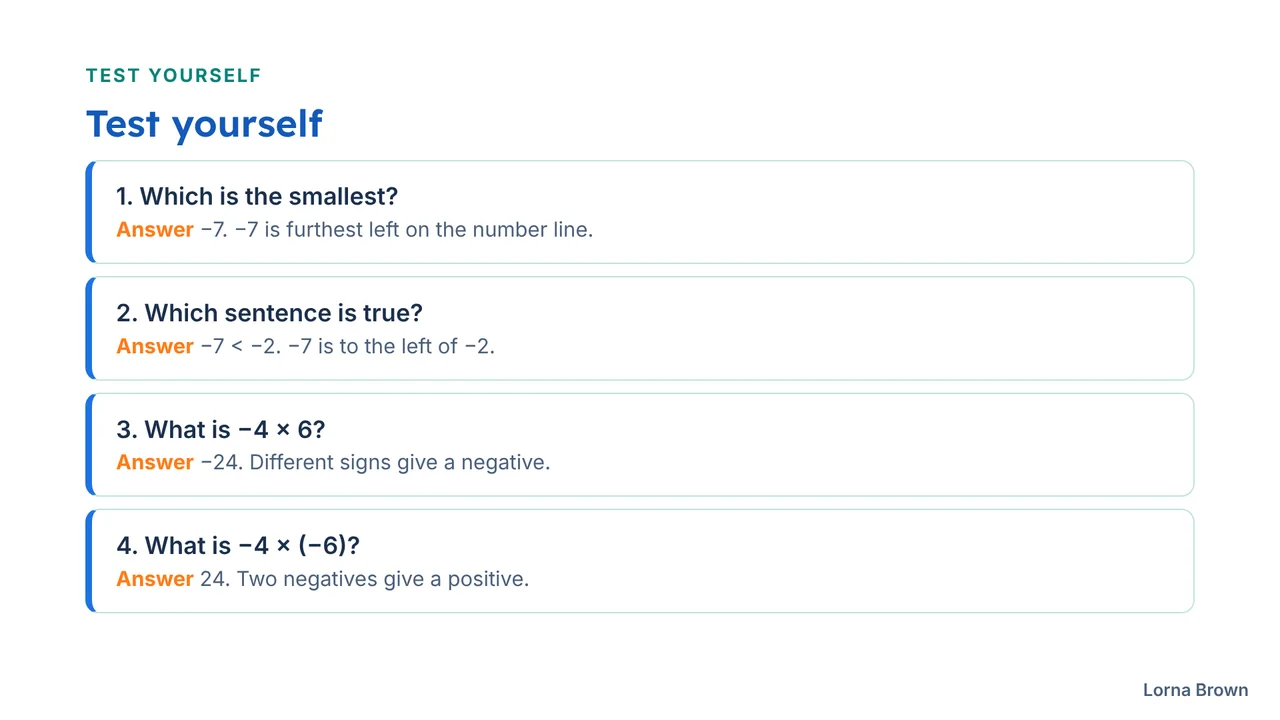
1. Which is the smallest?
Answer: −7. −7 is furthest left on the number line.
2. Which sentence is true?
Answer: −7 < −2. −7 is to the left of −2.
3. What is −4 × 6?
Answer: −24. Different signs give a negative.
4. What is −4 × (−6)?
Answer: 24. Two negatives give a positive.